Are you tired of high energy bills and constantly replacing old floodlights? This endless cycle of maintenance and cost can be frustrating, impacting both your budget and your time.
LED floodlights offer significant benefits, primarily through energy efficiency, long lifespan, and superior durability. They consume up to 80% less energy than traditional lights, can last over 50,000 hours, and are built to withstand harsh weather conditions, saving you money on electricity and maintenance.

You see the main benefits: they save energy and last a long time. But to really understand why they are a smart investment, you need to look closer. When I started in this business, I learned a crucial lesson on the factory floor. An LED floodlight isn’t just one piece. It’s a system of four critical parts: the LED chip, the power supply, the heat sink, and the optics. If a manufacturer cuts costs on any one of these, the entire light will fail sooner or later. Understanding this helps you see beyond the price tag and choose a product that truly delivers on its promises. Let’s break down the common questions I hear from purchasing managers like you.
Do LED flood lights use a lot of electricity?
Worried about your outdoor lighting sending your electricity bills through the roof? Traditional floodlights are known for being power-hungry, making you think twice before leaving them on.
No, LED floodlights are incredibly energy-efficient. They use significantly less electricity than older technologies like halogen or metal halide lamps to produce the same amount of light, leading to immediate and substantial cost savings on your energy bills.
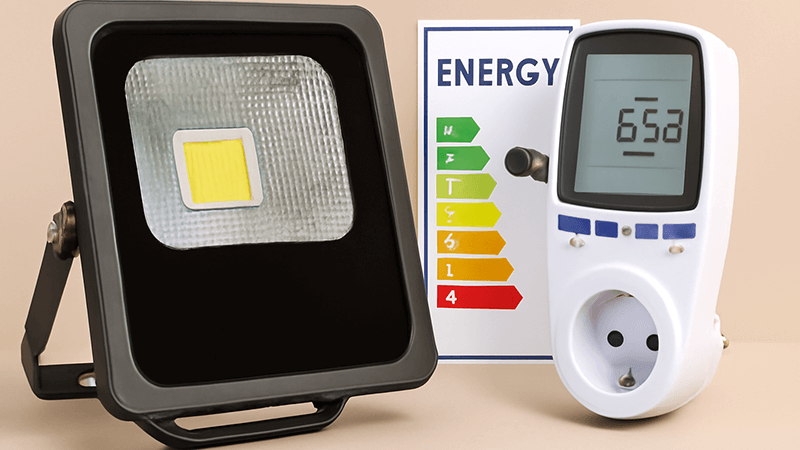
When we talk about efficiency in lighting, the key metric is lumens per watt (lm/W). This tells you how much light (lumens) a bulb produces for every watt of power it consumes. A higher number means better efficiency. I’ve seen countless spec sheets in my career, and the difference is always striking. A typical halogen floodlight might give you 15-20 lm/W. An LED floodlight, on the other hand, easily starts at 130 lm/W and can go much higher. This difference is huge.
It all comes down to the quality of the components.
- The LED Chip: A high-quality chip from a reputable brand like Cree or Lumileds is designed to be efficient. It converts more electricity into light and less into wasted heat. Low-quality chips are cheaper but far less efficient, meaning you pay more in electricity for less light.
- The Power Supply (Driver): The driver is just as important. It converts the AC power from your building into the DC power the LED chip needs. A cheap, poorly designed driver is inefficient. It might have a Power Factor (PF) of only 0.5, meaning half the power it draws is wasted. A quality driver has a PF of >0.95, ensuring almost all the electricity is used to power the light.
Think of it this way: buying a floodlight with a cheap chip and driver is like buying a car with a leaky fuel tank. It might be cheaper upfront, but you’ll pay for it every single day at the pump. For a purchasing manager, choosing an efficient system means delivering real, long-term operational savings to your company.
| Light Source |
Power Consumption (for ~15,000 lumens) |
Efficiency (lm/W) |
| Halogen |
1000W |
~15 lm/W |
| Metal Halide |
400W |
~37.5 lm/W |
| LED |
100W |
~150 lm/W |
Why do people prefer LED lights?
You know LEDs save energy, but is that the only reason for their popularity? If you’re sourcing for a large project, you need to know if they meet all the requirements beyond just cost.
People prefer LED lights for their superior light quality, instant-on capability, and design flexibility. They offer better color rendering, a range of color temperatures, and are more durable, making them adaptable for any application from sports fields to architectural lighting.
In my experience helping clients with large projects, the conversation quickly moves from energy savings to performance. A great LED floodlight does more than just save money; it creates a better, safer, and more usable environment. This comes from two of the four key parts: the chip and the optics.
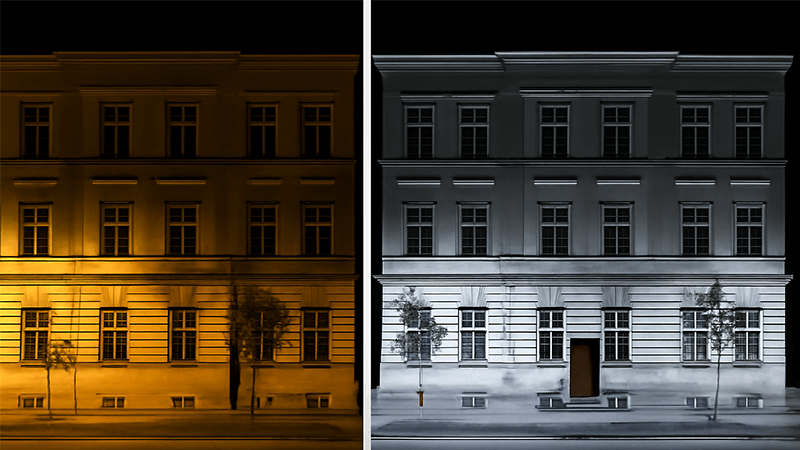
First, let’s talk about light quality. The LED chip determines the Color Rendering Index (CRI), which is how accurately the light shows the true colors of an object. Old sodium lamps have a terrible CRI, making everything look yellow and washed out. A quality LED has a CRI of 70, 80, or even 90+, making colors appear vibrant and natural. This is critical for security cameras where identifying colors accurately is important, or for sports lighting where player uniforms need to be clear.
Second, the optics are crucial. The optics are the lenses or reflectors that shape and direct the light beam. In the past, with old "brute force" lighting, you’d just point a powerful bulb and create a lot of glare and light pollution. Modern LED floodlights use precision optics. We can design them with specific beam angles—a narrow 30° beam to light up a flagpole or a wide 120° asymmetrical beam to evenly light a parking lot without spilling into neighboring properties. This level of control means you put light exactly where you need it, improving safety and efficiency while reducing light pollution. It’s the difference between using a fire hose and a precision sprinkler. Both use water, but one is controlled and effective, while the other is wasteful.
How long do LED floodlights last?
Are you constantly scheduling maintenance to replace burnt-out floodlights? The labor costs and equipment rentals for hard-to-reach fixtures add up quickly, becoming a major operational headache.
High-quality LED floodlights are rated to last for 50,000 hours or more. This incredibly long lifespan, over 10 times longer than traditional bulbs, is due to their solid-state design and effective thermal management, which drastically reduces maintenance and replacement costs.
The lifespan of an LED isn’t about when it suddenly burns out like an old bulb. Instead, we talk about lumen depreciation, measured by a standard called "L70." An L70 rating of 50,000 hours means that after 50,000 hours of use, the floodlight will still produce at least 70% of its original light output. For most applications, this is still plenty of usable light. Running a light for 12 hours a day, 50,000 hours is over 11 years. Compare that to a halogen bulb you might change every year.
So what makes an LED last so long? It’s not just the chip itself, but the entire system working together, especially the heat sink. Heat is the number one enemy of any electronic component, including LED chips and drivers. I remember visiting a new factory once that was trying to cut costs. They used a thin, undersized piece of aluminum for their heat sink. Their lights looked great for the first week, but then failures started rolling in. The chips were overheating, causing their light output to fade quickly and the drivers to fail completely.
A good floodlight is built with robust thermal management in mind. We use heavy-duty, die-cast aluminum housings with carefully designed fins. These fins increase the surface area, allowing heat to be pulled away from the sensitive chip and driver and dissipate safely into the air. When you pick up a well-made LED floodlight, it should feel heavy and substantial. That weight is often from the heat sink, and it’s a good sign. It tells you the manufacturer didn’t cut corners on the one thing that guarantees a long and reliable life for the product.
Do LED flood lights get hot?
You’ve heard that heat is bad for LEDs, so it’s natural to wonder if the fixtures themselves get hot. Will they be a fire hazard or burn someone who touches them?
Yes, LED floodlights produce heat, but they manage it very differently from old bulbs. The heat is drawn away from the LED chip to the back of the fixture, so the fixture itself will feel warm but the light beam is cool.
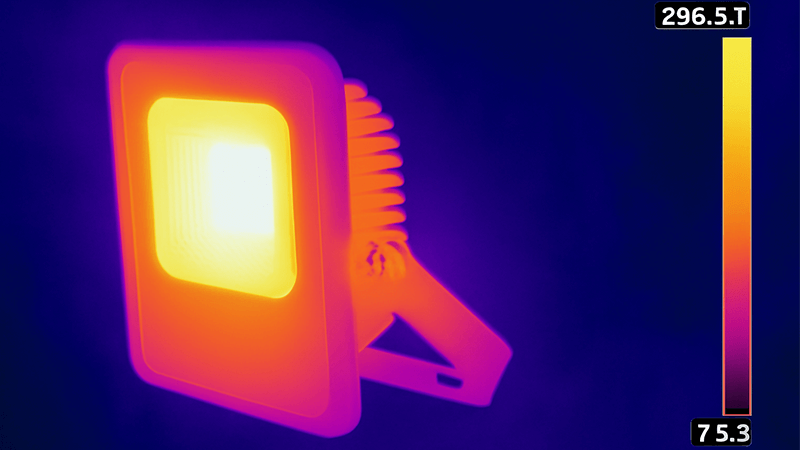
This is one of the biggest misunderstandings about LED technology. An old incandescent or halogen bulb is incredibly inefficient; over 90% of the energy it uses is converted into infrared radiation, which is heat. That heat is projected out with the light beam. That’s why you can feel the heat from an old stage light from meters away.
LEDs work completely differently. They are much more efficient, but they still produce some heat as a byproduct of the light-emitting process. However, this heat is generated at the back of the LED chip and is conductive, not radiative. This is where the heat sink becomes the most important part of the fixture’s design. The whole purpose of the robust metal body of an LED floodlight is to act as a massive heat sink.
The process works like this:
- The LED chip produces light and some heat.
- The chip is mounted on a metal-core printed circuit board (MCPCB) that quickly pulls the heat away.
- This MCPCB is attached directly to the large, finned aluminum housing of the floodlight.
- The heat spreads throughout the housing and dissipates into the surrounding air through convection.
Because of this system, the front of the light remains cool, and the light beam itself contains no infrared heat. The back of the fixture will get warm to the touch—that’s a sign it’s working correctly! A fixture that’s cool all over might mean the heat isn’t being drawn away from the chip effectively, which will lead to a very short life. So, when you choose a floodlight, pay close attention to the size and design of its housing. A heavy, well-designed heat sink shows that the manufacturer understands that controlling heat is the key to a reliable, long-lasting product.
Conclusion
Choosing the right LED floodlight is an investment in a complete system. By focusing on the quality of the chip, driver, optics, and heat sink, you ensure long-term reliability and savings.