Picking the wrong downlight can ruin your lighting project. With so many choices, it’s easy to get confused. Let’s make sure you select the perfect one every time.
LED downlights are categorized by function, like fixed, adjustable, and surface-mounted. They also differ in trim style, voltage (e.g., 12V vs. 240V), and IP ratings for wet or dry locations. Understanding these types is key to specifying the right product for any project.
Over my years in the lighting industry, from the factory floor to founding iPHD, I’ve seen many purchasing managers get confused by technical terms. You need clear answers to make confident decisions. This guide will break everything down simply. Let’s dive into the specifics.
Are there different types of downlights?
Thinking all downlights are the same is a common mistake. This assumption can lead to poor lighting effects and unhappy clients. Let’s look at the core types.
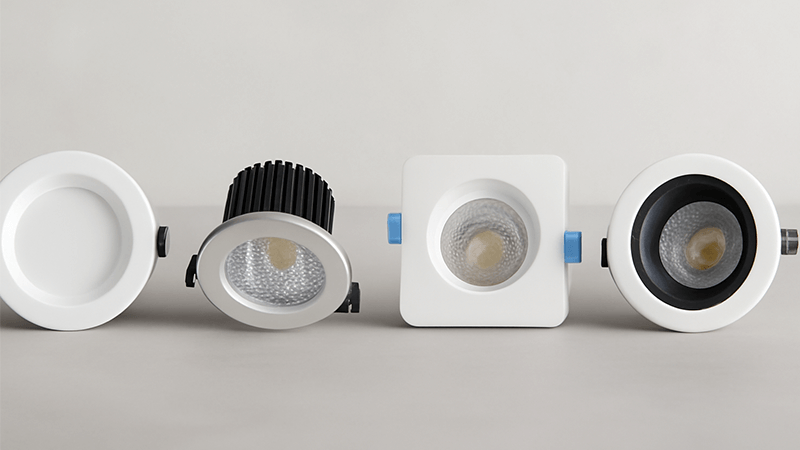
Yes, downlights come in several main types based on their function and installation. The most common are fixed for general lighting, adjustable (or gimbal) for accent lighting, and surface-mounted for solid ceilings. Each one serves a specific purpose in a lighting design.

When I first started helping clients with their lighting plans, I noticed they often just ordered "downlights." They didn’t specify the type. This could lead to a room with great general light but no way to highlight important features like artwork or architectural details. That’s why I always stress the importance of understanding the functional types. It’s the first step to a successful lighting scheme. You have to match the tool to the job.
Fixed vs. Adjustable vs. Surface-Mounted
The biggest difference between downlights is how they direct light. Let’s break down the three main functional categories.
-
Fixed Downlights: These are the most common type. As the name suggests, they are fixed in place and cast light straight down. They are perfect for general ambient lighting in a room. Think of hallways, open-plan offices, or kitchens where you need consistent, even illumination. They create a wide, uniform pool of light.
-
Adjustable (Gimbal) Downlights: These downlights have a tilting mechanism. This allows you to aim the light beam toward a specific area. They are ideal for accent lighting. You can use them to highlight a painting on the wall, a retail display, or an architectural feature. This flexibility is essential for creating depth and focus in a space.
-
Surface-Mounted Downlights: These are the solution for when you can’t cut a hole in the ceiling. This is common with concrete or very shallow ceilings. These downlights mount directly onto the surface and look like a stylish cylinder or square. They provide functional downlighting without needing a ceiling cavity.
Here is a simple table to help you decide.
| Downlight Type |
Best Use Case |
Installation |
Light Direction |
| Fixed |
General Ambient Lighting |
Recessed into Ceiling |
Straight Down |
| Adjustable |
Accent & Task Lighting |
Recessed into Ceiling |
Angled / Directional |
| Surface-Mounted |
Solid Ceilings |
Mounted on Ceiling Surface |
Straight Down |
Choosing the right combination of these types allows you to layer your lighting. This creates a more dynamic and functional space for your client.
What are the three types of LED lights?
You hear "LED" everywhere, but it causes confusion. People often mix up the LED chip, the bulb, and the fixture. Understanding the difference is key to sourcing correctly.
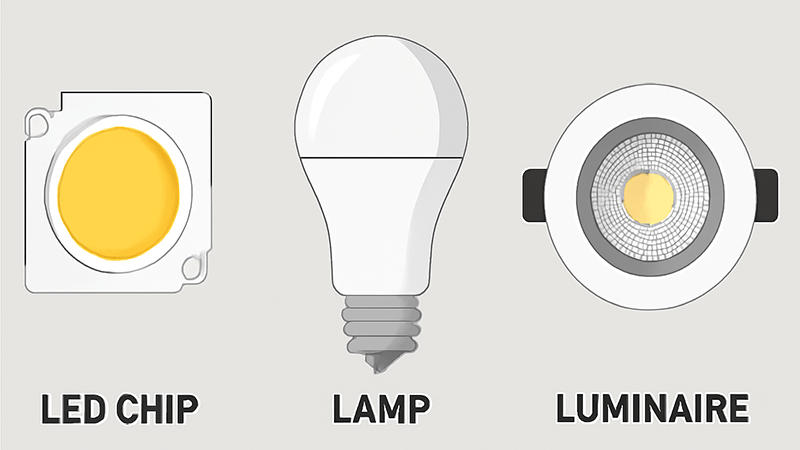
The three main types of LED lighting products are LED chips (the light source), LED lamps (bulbs), and LED luminaires (integrated fixtures). A downlight is a luminaire, where the chip and housing are a single unit. This integration improves performance and lifespan.
I remember a client, an experienced purchasing manager, who was frustrated with failing "LED downlights." When we looked into it, he was buying cheap LED bulbs and putting them into old downlight housings. The bulbs were overheating and failing quickly. The problem wasn’t the "LED" but the type of product. An integrated LED luminaire, like a proper downlight, is designed to manage heat and last much longer. This experience taught me to always clarify what "type" of LED light a client really needs.
From Chip to Luminaire
To avoid confusion, it’s important to know the building blocks of LED lighting. Every LED product starts with a chip but ends up in a very different form. Let’s look at each stage.
1. The LED Chip (The Light Source)
This is the heart of the technology. The LED chip, or Light Emitting Diode, is a tiny semiconductor that produces light when electricity passes through it. The two most common types used in downlights are:
- SMD (Surface Mounted Device): These are small, flat chips mounted on a circuit board. They produce a wide, diffused light. Many SMD chips are often grouped to create a bright, even light source, which is great for general illumination.
- COB (Chip on Board): This technology packs many small LED chips tightly together into a single module. This creates a powerful, single point of light that looks like one large chip. COB LEDs are great for producing a strong, focused beam, similar to a halogen lamp, making them perfect for accent and high-ceiling applications.
2. The LED Lamp (The Bulb)
This is what most people think of as a "light bulb." It’s an LED chip and driver packaged into a traditional bulb shape, like an A19, GU10, or MR16. These are designed to be retrofitted into old fixtures that used incandescent or halogen bulbs. While convenient, their performance is limited by the small space for heat dissipation.
3. The LED Luminaire (The Integrated Fixture)
This is a complete lighting unit where the LED light source and the fixture are designed as one integrated system. An LED downlight is a perfect example. The body of the downlight acts as a heat sink, drawing heat away from the LED chip. This superior thermal management leads to better performance, longer lifespan, and more stable color quality.
| Type |
Description |
Key Advantage |
Common Use |
| LED Chip |
The semiconductor light source itself. |
The core technology. |
Inside all LED products. |
| LED Lamp |
A self-contained bulb for retrofitting. |
Easy to replace. |
Old fixtures. |
| LED Luminaire |
A complete, integrated fixture. |
High performance and long life. |
New builds, quality projects. |
For any serious project, specifying an LED luminaire is almost always the best choice. It ensures reliability and delivers the quality your clients expect.
Which is better, 12V or 240V LED downlights?
Choosing the wrong voltage can cause installation headaches and safety risks. You’re stuck with incompatible systems and angry contractors. Let’s clarify which voltage is right for your project.
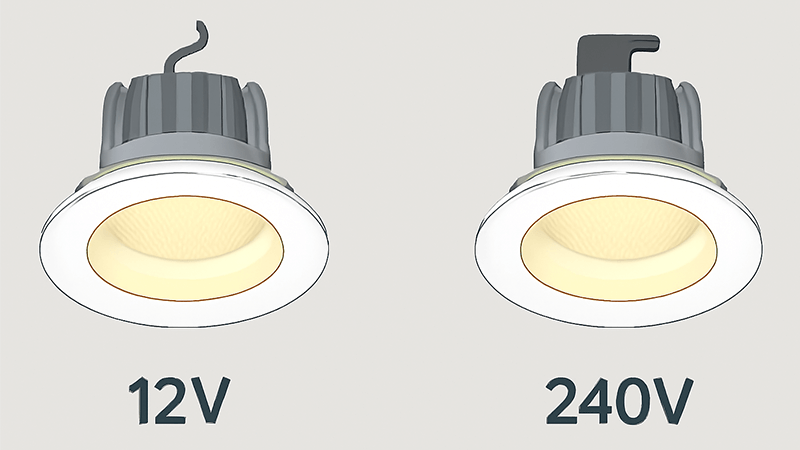
Neither is universally "better," they are for different applications. 240V (mains voltage) is simpler to install for general use. 12V (low voltage) is safer for wet areas like bathrooms and requires a separate driver. The choice depends on safety rules and location.
I often get questions from project contractors about this. One time, a team in the UAE was installing lights for a luxury hotel spa. They initially planned for 240V downlights everywhere to simplify wiring. But local regulations required low voltage (12V) lights near showers and pools for safety. We had to quickly revise the order to include 12V downlights and drivers for those specific zones. This highlights a critical point: always check local electrical codes first. It’s not about which is "better," but which is correct and safe for the specific application.
Mains Voltage vs. Low Voltage
The decision between 12V and 240V (or the local mains voltage) comes down to three things: safety, installation simplicity, and driver location. Let’s examine them.
240V (Mains Voltage) Downlights
These are also known as "driver-on-board" or "mains-powered" downlights. The driver, which converts AC power to the DC power the LED needs, is integrated into the downlight’s housing.
- Installation: It’s very simple. The electrician wires the downlight directly to the main electrical circuit. There are no external boxes to worry about. This saves time and labor costs.
- Application: Perfect for most general lighting applications in dry, indoor areas. Living rooms, bedrooms, kitchens, and hallways are all great places for 240V downlights.
- Limitation: In some regions, high voltage is not permitted in areas where it might come into contact with water due to the higher risk of electric shock.
12V (Low Voltage) Downlights
These downlights operate on a 12V DC current. They require an external LED driver (also called a transformer or power supply) to convert the 240V mains power down to 12V.
- Installation: This is more complex. The electrician must wire the mains power to the driver, and then run a separate low-voltage wire from the driver to the downlight. One driver can often power multiple 12V downlights, but you have to calculate the load correctly.
- Application: Their main advantage is safety. The low voltage makes them the required choice for "wet zones" in bathrooms (near showers and baths) and for outdoor or landscape lighting.
- Flexibility: Since the driver is separate, you can place it in an accessible location for easier maintenance. If a driver fails, you don’t have to remove the entire downlight from the ceiling to replace it.
| Feature |
240V (Mains Voltage) |
12V (Low Voltage) |
| Safety |
Standard for dry areas |
Higher safety, required for wet areas |
| Installation |
Simple, direct to mains |
More complex, requires external driver |
| Components |
All-in-one unit |
Downlight + external driver |
| Best For |
General residential, commercial |
Bathrooms, spas, outdoors, landscape |
| Maintenance |
Replace whole unit if driver fails |
Can replace driver separately |
For my clients, I always recommend a mix. Use cost-effective and simple 240V downlights for the bulk of a project, and specify 12V models only where safety regulations demand it.
What is the difference between IP20 and IP65 downlight?
Using an indoor-rated downlight outdoors is a recipe for disaster. Water will get in, causing short circuits and failures. Understanding IP ratings is not optional; it’s essential for safety.
The key difference is protection against solids and liquids. An IP20 downlight is for indoor use only, protected from fingers but not water. An IP65 downlight is dust-tight and protected against water jets, making it safe for bathrooms and outdoor soffits.
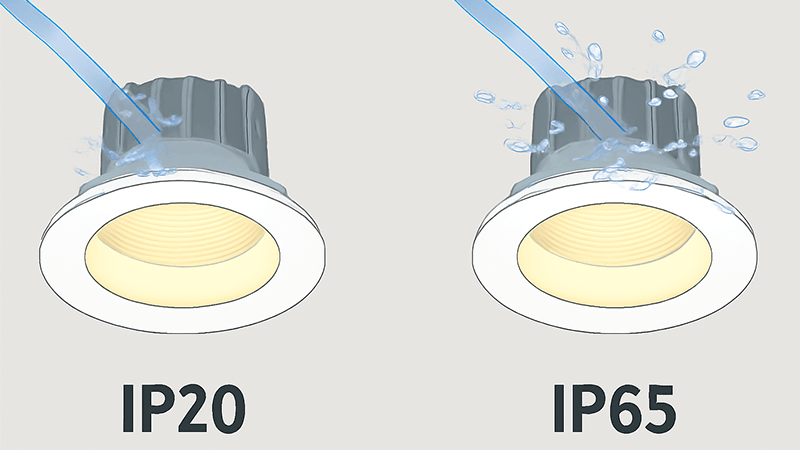
A few years ago, a distributor I work with had a major problem. A contractor installed dozens of our standard IP20 downlights in the covered outdoor walkways of a resort. They thought "covered" meant "dry." After the first big rainstorm with blowing wind, more than half the lights failed. The cost to replace them all with IP65-rated downlights was huge. This taught me a valuable lesson: always clarify the exact installation environment. Never assume. The IP rating system is a clear language we must use to prevent these costly mistakes.
Decoding the IP Rating
IP stands for "Ingress Protection." The rating is a two-digit number that tells you how well a fixture is sealed against foreign objects (like dust and fingers) and moisture (like drips and jets of water).
The First Digit: Solids
This number ranges from 0 to 6. It tells you the level of protection against solid objects.
- IP2x: Protected against solid objects larger than 12.5mm. Basically, it means you can’t poke your finger inside and touch a live part. This is the minimum standard for most indoor electrical products. An IP20 downlight fits this description. The "0" means it has zero protection against water.
- IP6x: Totally dust-tight. No dust can get inside the enclosure. This is the highest level of protection against solids.
The Second Digit: Liquids
This number ranges from 0 to 9. It tells you the level of protection against moisture. This is the most critical number for downlights.
- IPx0: No protection. This is why an IP20 downlight is strictly for dry, indoor locations.
- IPx4: Protected against splashing water from any direction. This is often the minimum requirement for bathroom zones where splashes are possible but direct jets are not.
- IPx5: Protected against low-pressure water jets from any direction. This makes a downlight suitable for bathrooms (including inside shower areas in some regions) and covered outdoor areas. An IP65 downlight is protected at this level.
- IPx7/IPx8: Protected against temporary or continuous immersion in water. These ratings are for underwater lights, not downlights.
| IP Rating |
First Digit (Solids) |
Second Digit (Liquids) |
Common Application |
| IP20 |
2: Finger-safe (>12.5mm) |
0: No protection |
Dry indoor rooms (living rooms, bedrooms) |
| IP44 |
4: Wire-safe (>1mm) |
4: Splashing water |
Bathrooms (outside of direct spray zones) |
| IP65 |
6: Dust-tight |
5: Water jets |
Bathrooms (in-shower), outdoor soffits, canopies |
When specifying downlights, you must match the IP rating to the environment. For general indoor spaces, IP20 is fine. For bathrooms, you’ll need a mix, typically IP44 for the main area and IP65 for inside the shower. For any outdoor application, even under a roof, IP65 is the safest choice to protect against wind-driven rain and humidity.
Conclusion
Choosing the right LED downlight is simple when you know the types. Consider function, voltage, and IP rating to ensure safety, performance, and a successful project every single time.