Confused by lighting terms for your project? Choosing the wrong light can ruin a room’s atmosphere and function. Let’s clarify the key differences to help you illuminate your space perfectly.
A ceiling light is a fixture mounted on the surface of the ceiling, providing broad, general (ambient) light. A downlight is recessed into the ceiling, casting a narrow, focused beam downwards. Their main differences are mounting style (surface vs. recessed) and light distribution (wide vs. concentrated).
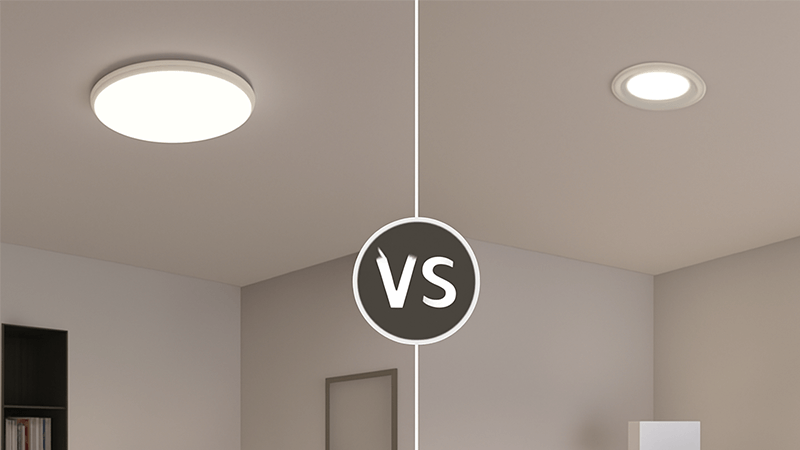
Now you know the basic distinction, but deciding which one is right for a specific project is the next challenge. The best choice depends on the room’s purpose, the ceiling height, and the specific mood you want to create. Sometimes, one is enough. Other times, a combination is best. Let’s dive deeper to ensure you can confidently select the right lighting for any client and any space.
What are the three types of ceiling lights?
Are you feeling overwhelmed by all the ceiling light options available? Picking the wrong one can lead to poor illumination or a style that clashes with the room. Let’s break down the main categories.
The three primary types of ceiling lights are flush mount, semi-flush mount, and suspended lights like chandeliers or pendants. Flush mounts sit directly on the ceiling, semi-flush hang slightly below, and suspended lights drop down significantly, often acting as decorative centerpieces.
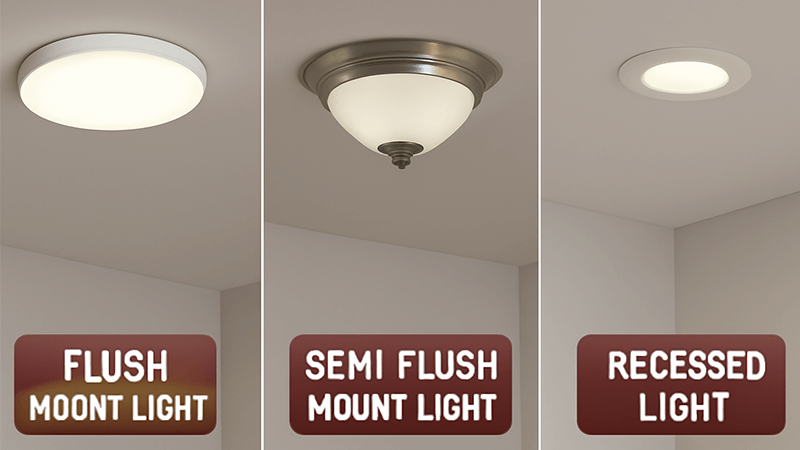
Choosing the right type of ceiling light is the first step in creating a good lighting plan. During my early days in the lighting business, I saw many projects where a beautiful, expensive chandelier was installed in a room with a low ceiling. It looked cramped and was a constant hazard for taller people. This taught me that function must always guide form. Each type of ceiling light has a specific role and is suited for different environments. Understanding these differences is crucial for a purchasing manager like Shaz, who needs to source the perfect fixture for a project.
Flush Mount Lights
These lights are installed directly against the ceiling surface. They are the go-to solution for rooms with low ceilings, typically under 8 feet (about 2.4 meters). Because they have a low profile, they maximize headroom and create a clean, unobtrusive look. They are excellent for providing general, ambient light across a whole room, like in hallways, closets, or small bedrooms.
Semi-Flush Mount Lights
As the name suggests, semi-flush mounts hang just below the ceiling, usually with a small gap of 4 to 8 inches (10-20 cm). This small space allows light to shine both downwards and upwards, reflecting off the ceiling to create a softer, more diffused glow. They are ideal for rooms with medium-height ceilings (8 to 10 feet) and add a bit more decorative flair than a standard flush mount.
Suspended Lights (Chandeliers & Pendants)
These are the most decorative type of ceiling light, hanging down from the ceiling on a chain or rod. Chandeliers and pendants are statement pieces, perfect for dining rooms, grand entryways, or living rooms with high ceilings (over 10 feet). They provide ambient light but can also be used for task lighting over a dining table or kitchen island.
To make it easier, here’s a simple comparison:
| Feature |
Flush Mount |
Semi-Flush Mount |
Suspended (Chandelier/Pendant) |
| Best Ceiling Height |
Low (< 8 ft / 2.4m) |
Medium (8-10 ft / 2.4-3m) |
High (> 10 ft / 3m) |
| Light Direction |
Downward |
Downward & Upward |
Multi-directional/Downward |
| Primary Use |
General Ambient Light |
General & Diffused Light |
Decorative & Task Lighting |
| Style |
Minimalist, Simple |
Versatile, Decorative |
Statement Piece, Elegant |
What is a ceiling downlight?
Are you unsure what exactly a "downlight" is and how it’s used? This confusion can prevent you from creating modern, layered lighting designs. Let’s define it clearly to expand your options.
A ceiling downlight, also known as a recessed light or can light, is a fixture installed into a hollow space in the ceiling. It shines a concentrated beam of light straight down, providing focused illumination for tasks, accenting features, or contributing to general light when used in groups.
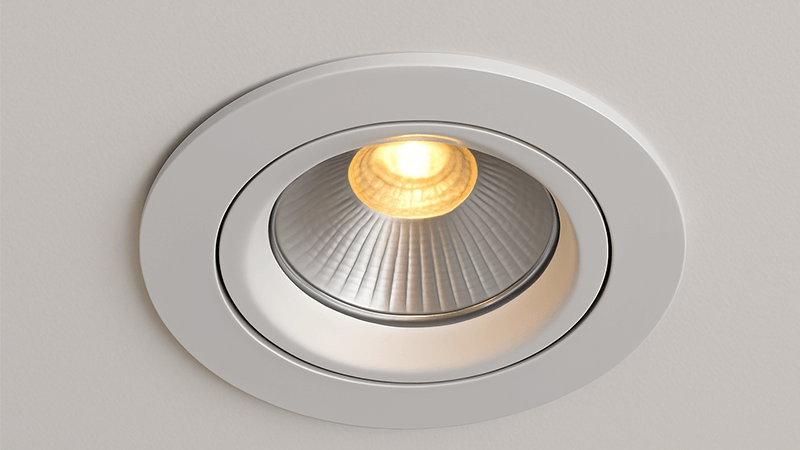
Downlights are the foundation of what we in the industry call "architectural lighting." They integrate seamlessly into the ceiling, creating a clean, modern aesthetic. Unlike a single ceiling light that floods a room from one central point, downlights allow you to paint with light. You can place light exactly where it is needed. I remember working with a client who wanted to highlight his art collection. We used adjustable downlights with a narrow beam to spotlight each painting. The effect was dramatic and transformed the room from a simple living space into a personal gallery. This level of control is the true power of the downlight.
The Anatomy of a Downlight
A downlight has two main parts:
- Housing: This is the main fixture that is installed inside the ceiling. It contains the lamp holder and all the electrical components. Housings come in different types, such as "New Construction" for ceilings that are not yet finished, or "Remodel" for existing ceilings.
- Trim: This is the visible part you see from below. The trim directs the light and gives the downlight its finished look. Trims come in many styles, including simple baffle trims that reduce glare, or gimbal trims that can be pivoted to direct the light.
Beam Angle and Its Impact
The beam angle of a downlight determines how wide the cone of light is. This is a critical factor for lighting designers.
- Narrow Beams (10-25 degrees): These are used for accent lighting. They create a dramatic, high-contrast spotlight effect, perfect for highlighting artwork, architectural details, or products in a retail display.
- Wide Beams (30-60 degrees or more): These are used for general or task lighting. When spaced correctly, multiple downlights with a wide beam can provide smooth, even illumination across an entire room, creating a "no-main-light" design.
To give you a practical idea, here are the main types of downlights and their uses:
| Downlight Type |
Beam Direction |
Primary Function |
Best Application |
| Fixed (Static) |
Straight Down |
General & Task Lighting |
Hallways, kitchens, whole-room illumination |
| Adjustable (Gimbal) |
Pivoting |
Accent & Wall Washing |
Highlighting art, sloped ceilings, retail |
| Wall Washer |
Angled to one side |
Vertical Illumination |
Making a room feel larger, lighting a feature wall |
Can I install downlights in my ceiling?
Thinking about a sleek, modern look with downlights? You might worry if your ceiling is suitable for them. Let’s see what’s required and if it’s possible for your project.
Yes, you can install downlights in most ceilings, provided there is enough empty space (a plenum) above the ceiling board to fit the fixture’s housing. For solid concrete ceilings, surface-mounted downlights are an excellent alternative that provides a similar aesthetic without requiring recessing.
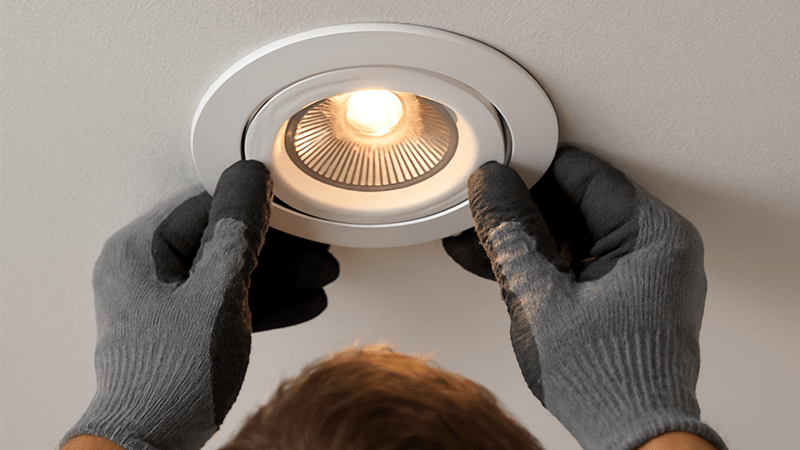
This is one of the most common questions I get from project contractors and designers. The answer almost always comes down to the ceiling construction. In my experience manufacturing lights for clients globally, especially for partners like Shaz in the UAE where concrete construction is common, this is a key consideration. You cannot simply cut a hole in solid concrete. However, almost every problem in lighting has a solution. The first step is to identify the type of ceiling you are working with.
Ceilings with a Cavity (Hollow Ceilings)
Most modern residential and commercial buildings use plasterboard (also known as drywall or gypsum board) attached to a frame. This creates a hollow space between the visible ceiling and the structural slab above. This space is perfect for installing standard recessed downlights.
- Check the Depth: Before sourcing downlights, you must measure the depth of this cavity. A standard downlight might need 4-6 inches (10-15 cm) of clearance. If space is limited, you can use "slim" or "pancake" LED downlights, which require as little as 1-2 inches of depth.
- Insulation: If the ceiling has insulation, you must use "IC-rated" (Insulation Contact) downlights. These are designed to be safely covered with insulation without overheating, which is a critical fire safety requirement.
Solid Ceilings (Concrete)
In many commercial buildings, apartment blocks, and industrial spaces, the ceiling is a solid concrete slab. You cannot cut into this to recess a light. But you can still achieve the downlight effect.
- Surface-Mounted Downlights: These are your best solution. They are cylindrical or square fixtures that mount directly onto the surface of the ceiling. They mimic the look of a recessed downlight and cast light in the same downward direction. We manufacture many surface-mounted models at iPHD precisely for these applications. They offer a clean, architectural look without any complex ceiling modifications.
- Create a Dropped Ceiling: For larger projects, another option is to build a secondary, "dropped" ceiling below the concrete slab. This creates the necessary cavity to install standard recessed downlights.
Here’s a quick guide for your decision-making:
| Ceiling Type |
Is Recessing Possible? |
Recommended Solution |
Key Consideration |
| Plasterboard/Drywall |
Yes |
Standard or Slim Recessed Downlights |
Check cavity depth and need for IC-rating. |
| Solid Concrete |
No |
Surface-Mounted Downlights |
Choose a style that matches the desired aesthetic. |
| Wood Beams |
Yes, between beams |
Standard or Slim Recessed Downlights |
Careful placement to avoid drilling into beams. |
Can I put LED bulbs in my downlights?
Have old halogen downlights that use too much energy and get hot? You’re likely wondering if you can just swap the bulbs for LEDs. Let’s clarify how to upgrade effectively.
Yes, you can often put LED bulbs in existing downlight fixtures. This is called retrofitting. You need to choose an LED bulb with the same base (like GU10 or MR16) as the old bulb. For the best performance and efficiency, replacing the entire fixture with an integrated LED downlight is superior.
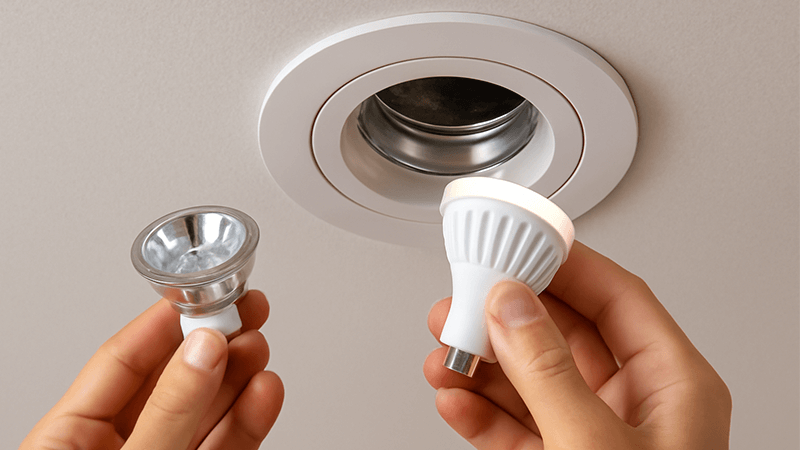
Upgrading to LED is one of the smartest decisions you can make. It cuts energy costs, reduces maintenance, and provides better quality light. As a manufacturer, I’ve seen the entire industry shift from halogen to LED for these reasons. The question for purchasing managers and contractors isn’t if they should upgrade, but how. You have two main paths: retrofitting bulbs or replacing the entire fixture. Each has its pros and cons depending on the project budget and long-term goals.
Path 1: Retrofitting with LED Bulbs
This is the quickest and cheapest way to upgrade. You simply remove the old halogen bulb and insert a compatible LED bulb.
- Check the Base: The most common bases for downlight bulbs are GU10 (a twist-and-lock base) and MR16 (a two-pin push-in base). You must buy an LED with the exact same base.
- Check the Transformer: MR16 bulbs operate on low voltage (12V) and require a transformer. Older halogen transformers may not be compatible with the low power draw of LEDs, which can cause flickering. For best results, it’s recommended to replace the old transformer with a new LED driver. GU10 bulbs run on mains voltage and do not need a transformer, making them easier to retrofit.
Path 2: Replacing with Integrated LED Downlights
This involves removing the entire old fixture (both housing and trim) and installing a new, all-in-one integrated LED downlight.
- Superior Performance: Integrated units are designed from the ground up as a single system. This means the LED chip, heat sink, and driver are all optimized to work together. This results in better efficiency, longer lifespan, and more reliable performance.
- Better Heat Management: Heat is the enemy of LEDs. Integrated fixtures have built-in heat sinks that draw heat away from the LED chip far more effectively than a simple retrofit bulb can. A cooler LED lasts longer and maintains its brightness.
- Modern Features: New integrated fixtures often come with features like selectable color temperature (CCT), high color rendering (CRI >90), and better dimming capabilities.
Here’s a comparison to help you decide:
| Factor |
Retrofit LED Bulb |
Integrated LED Downlight |
| Upfront Cost |
Low |
High |
| Installation |
Very Easy (Plug-and-play) |
More complex (Requires rewiring) |
| Performance |
Good |
Excellent |
| Lifespan |
Good (15,000-25,000 hrs) |
Excellent (40,000-50,000+ hrs) |
| Compatibility Issues |
Possible (with old transformers/dimmers) |
None (all components are matched) |
| Best For |
Quick, budget-friendly upgrades |
New construction, major renovations, best long-term value |
For my clients, I usually recommend integrated LED downlights for new projects. The long-term value and reliability are simply better. For upgrading existing installations on a tight budget, high-quality retrofit bulbs are a great option.
Conclusion
A single ceiling light is simple, but combining it with downlights or using only downlights creates a far more comfortable, modern, and functional lighting environment for any space.