Struggling to get that modern, focused lighting look with a solid ceiling? You want the clean style of downlights but can’t cut holes. Surface mounted downlights are your perfect solution.
A surface mounted downlight is a lighting fixture that attaches directly onto the surface of a ceiling. It provides the focused, modern light of a recessed downlight but without needing to cut holes or have a suspended ceiling, making it highly versatile for any room.
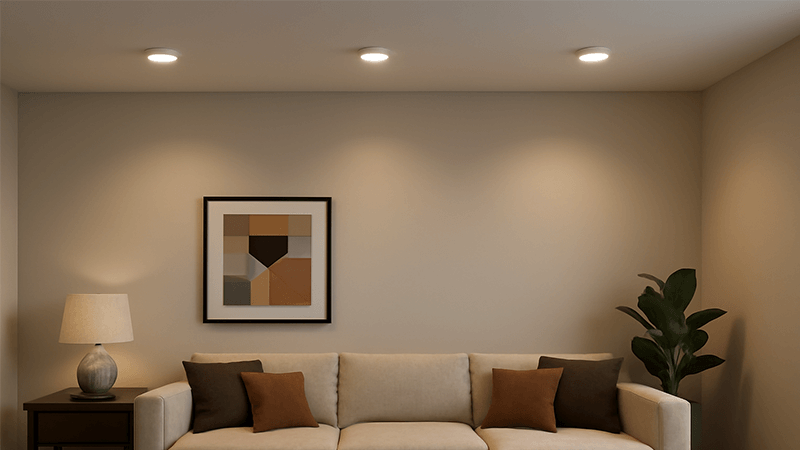
In my years of manufacturing LED lights, I’ve seen many project managers and designers, like my client Shaz in the UAE, face this exact challenge. They have a great lighting design in mind that calls for downlights, but the building’s structure, often a concrete ceiling, makes recessed installation impossible. This is where the conversation always turns to surface mounted options. They are a game-changer. They provide a beautiful and practical alternative without compromising on the desired lighting effect. Let’s explore this further so you can confidently choose the right lighting for your next project.
What is the difference between surface mounted and recessed mounted?
Confused by mounting types? Choosing the wrong one can lead to project delays and budget issues. Understanding the fundamental difference ensures you specify the correct fixture from the start.
The primary difference is installation. Surface mounted fixtures attach onto the ceiling. Recessed mounted fixtures install into the ceiling, sitting flush. This means recessed lights require a ceiling cavity, while surface mounted lights do not, making them suitable for solid ceilings.
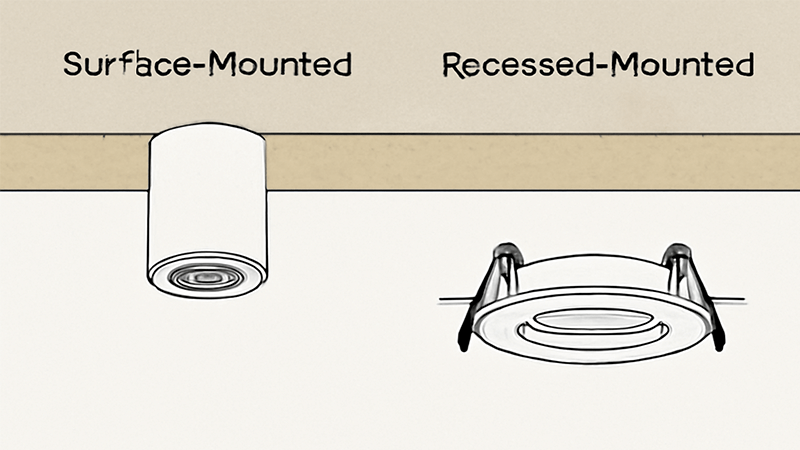
When I work with purchasing managers, this is the most critical distinction we discuss. The choice isn’t just about aesthetics; it’s about the fundamental structure of the building. I remember a project where a client had ordered thousands of recessed downlights for a new commercial building, only to discover that a large portion of the building had solid concrete ceilings. This created a huge logistical problem. We had to quickly help them source a surface mounted equivalent that matched the original lighting specification. This experience taught me to always confirm the ceiling type first. Understanding this difference is not just technical knowledge; it’s essential for project success. Let’s break it down further.
Installation Requirements
The biggest factor separating these two is how they are installed. This directly impacts labor costs, time, and the type of ceiling you need.
-
Surface Mounted: These are very straightforward. You typically screw a mounting bracket directly onto the ceiling surface. A junction box might be needed for wiring. The light fixture then attaches to the bracket. It’s a simple process that doesn’t require special tools beyond a drill and screwdriver. This is ideal for retrofitting or for buildings with concrete or solid ceilings where cutting is not an option.
-
Recessed Mounted: This method is more involved. You must cut a precise hole in the ceiling, usually plasterboard or a ceiling tile. The fixture is then inserted into the hole and held in place by spring-loaded clips that grip the ceiling from above. This requires a void or cavity above the ceiling to house the body of the light and allow for heat dissipation.
Aesthetic and Visual Impact
How the light looks in the room is another key point.
| Feature |
Surface Mounted |
Recessed Mounted |
| Visual Profile |
The fixture is visible and becomes a design element in the room. |
The fixture is hidden, with only the trim visible, creating a minimal, clean look. |
| Ceiling Appearance |
Creates a layered, modern look with visible hardware. |
Provides a seamless, uncluttered ceiling line. |
| Design Style |
Often used in industrial, modern, or minimalist designs. |
Popular in contemporary and traditional designs for an unobtrusive feel. |
Choosing between them depends entirely on your project’s architectural constraints and desired aesthetic. If you have a solid ceiling, the choice is made for you: surface mounted. If you have a false ceiling, you can choose based on the look you want to achieve.
What is the difference between surface-mount and recessed LED lights?
Your project requires modern LED efficiency, but which mounting style is best? Choosing the wrong type can affect not just looks, but also light performance and long-term maintenance.
The main difference lies in housing and heat management. Surface-mount LED lights have an external housing that helps dissipate heat. Recessed LED lights sit inside a ceiling cavity, so they need specific IC-ratings if they will be near insulation to manage heat safely.

As a manufacturer, the design of the fixture’s body is crucial for the performance and lifespan of the LED chips inside. LEDs are sensitive to heat. Poor heat dissipation will dramatically shorten their life and affect their color consistency. When we design a surface mounted fixture, we use the external body as a heat sink. The aluminum housing is engineered with fins or a large surface area to radiate heat out into the room. For recessed LEDs, the challenge is different. They are enclosed in a small, often insulated, space. This requires a different approach to thermal management. Let’s dive into the technical specifics that matter for performance and safety.
Thermal Management and Safety
Heat is the enemy of LEDs. How each type handles it is a major design and safety consideration.
-
Surface-Mount LEDs: The entire fixture body is exposed to the air. This allows for excellent passive cooling. We design the housing, usually from aluminum, to act as a large heat sink. It draws heat away from the LED chip and dissipates it into the surrounding environment. This generally leads to a very long and stable lifespan for the LED components.
-
Recessed LEDs: These are enclosed within the ceiling. Heat can get trapped. This is why safety ratings are so important. You will see terms like "IC-rated" (Insulation Contact) and "Non-IC-rated".
- IC-Rated: These fixtures are designed to be in direct contact with insulation safely. They have advanced thermal management systems to prevent overheating.
- Non-IC-Rated: These must have a certain amount of clearance (usually at least 3 inches) from any insulation to prevent a fire hazard.
Light Distribution and Application
The form of the fixture also influences how it shapes light.
| Aspect |
Surface-Mount LED |
Recessed LED |
| Beam Control |
The external body allows for more flexibility in lens and reflector design, enabling various beam angles. Some models offer adjustable, gimbal-like heads for directional light. |
Offers excellent, controlled downlighting. The light source is set back, which helps reduce glare and creates clean pools of light on the floor or a wall. |
| Typical Use |
General ambient lighting, task lighting over counters or desks, and accent lighting in spaces with solid ceilings. Great for garages, basements, and modern apartments. |
Used for creating ambient layers of light, wall washing effects, and precise task lighting in kitchens and offices with suspended ceilings. |
For a purchasing manager like Shaz, understanding these differences is key. Specifying an IC-rated recessed light is critical for safety and compliance in many projects. For a concrete ceiling, a surface-mount LED with good thermal design is the reliable choice.
What does surface mounted light mean?
You see "surface mounted" in catalogs, but what does it really mean for your installation? Misunderstanding this simple term can lead you to buy a product that won’t work.
Surface mounted simply means the light fixture is installed on top of a flat surface, like a ceiling or wall, rather than inside it. The fixture’s body remains fully visible after installation, attached directly to the surface with screws or a bracket.

I often explain this term using a simple analogy. Think of it like hanging a picture on a wall versus building a window into the wall. The picture frame is surface mounted; it sits on the surface. The window is recessed; it is built into the surface. This simple idea is fundamental in the lighting industry. When a client tells me they have a "solid ceiling," my first thought is, "Okay, we need to focus on surface mounted solutions." It immediately narrows down the product choices and ensures we are looking at fixtures that are practical for the space. It’s a foundational concept that dictates the entire installation process.
The Core Concept of Surface Mounting
Let’s break down the meaning into its key components. It’s about how the fixture physically connects to the building.
- Installation Location: It is always on the exterior of a surface. This could be a ceiling, wall, or even under a cabinet. The key is that no major hole is cut into the surface to hide the fixture’s main body.
- Visibility: The entire housing of the light fixture is visible. This is a deliberate choice. Designers use surface mounted lights as part of the room’s decor. The shape, color, and material of the fixture contribute to the overall aesthetic. This is different from recessed lights, which are designed to be as invisible as possible.
- Versatility: This is the biggest advantage. Because you don’t need a cavity, you can install these lights almost anywhere.
- Concrete ceilings
- Ceilings with pipes or ducts directly above
- Historic buildings where cutting into the ceiling is not allowed
- Walls for accent or pathway lighting
- Underneath shelves or cabinets for task lighting
Common Types of Surface Mounted Lights
The term "surface mounted" applies to more than just downlights. It’s a broad category of installation.
| Light Type |
Description |
Common Application |
| Surface Downlights |
Cylindrical or square fixtures that direct light downwards. |
General and task lighting, replacement for recessed lights. |
| Ceiling Lights (Oyster/Flush Mount) |
Dome or disc-shaped lights that provide broad, diffused light. |
Main light source for bedrooms, hallways, kitchens. |
| Track Lighting |
Lights attached to a surface-mounted track, allowing for flexible positioning. |
Accent lighting in galleries, retail, and modern homes. |
| Linear Batten Lights |
Long, rectangular fixtures. |
Garages, workshops, offices, and commercial spaces. |
So, when you see "surface mounted," it’s a simple, direct instruction: this fixture attaches onto the surface. It signals ease of installation and versatility, making it a reliable choice for a huge range of projects.
What is the difference between wall mounted and surface mounted light?
Are "wall mounted" and "surface mounted" the same thing? Using these terms incorrectly can cause confusion and lead to ordering the wrong type of light for your specific needs.
"Surface mounted" is a broad installation category meaning a fixture attaches to any flat surface. "Wall mounted" is a specific type of surface mounting. So, all wall mounted lights are surface mounted, but not all surface mounted lights are wall mounted (many are for ceilings).
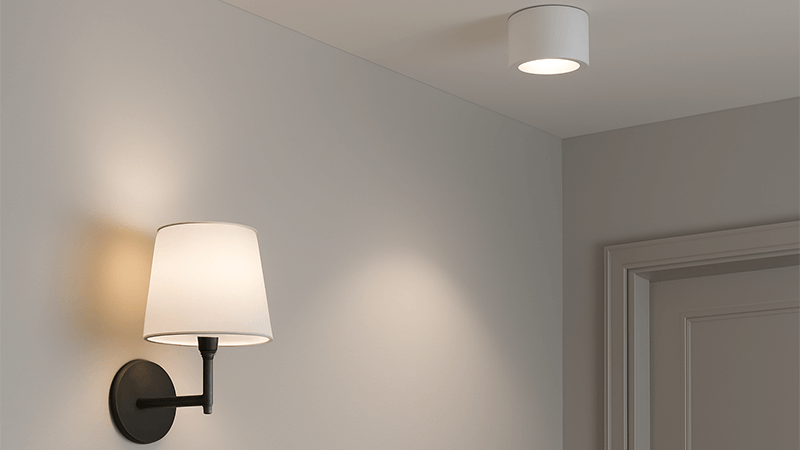
This is a point of clarification I often make. A client might ask for a "surface light," and my first question is always, "For the ceiling or the wall?" The answer changes everything. While the basic installation principle is the same—attaching to the surface—the design and function of the lights are completely different. Wall lights, or sconces, are designed for specific effects like ambient lighting or highlighting architectural features. Ceiling-mounted surface lights are typically designed for general or task illumination. Thinking about it as a parent-child relationship helps. "Surface Mount" is the parent category, and "Wall Mount" and "Ceiling Mount" are the children.
A Hierarchy of Terms
The best way to understand this is to see how the terms relate to each other. It’s a simple classification system based on location.
-
Grandparent Category: Lighting Fixtures
- This includes every type of light imaginable.
-
Parent Category: Installation Method
- Surface Mounted: Attaches to the surface.
- Recessed Mounted: Installs into the surface.
- Suspended Mounted: Hangs from the surface (like a pendant light).
-
Child Category: Specific Application/Location
- Within the Surface Mounted family, you have:
- Ceiling Mounted Lights: These are designed to be installed on a horizontal, overhead surface. Examples include surface downlights and flush mount dome lights. Their primary purpose is often to illuminate the area below.
- Wall Mounted Lights: Also known as sconces. These are designed specifically for vertical surfaces. Their design considers that they will be viewed at eye level and often directs light up, down, or out to create ambiance, provide accent lighting, or illuminate a pathway.
Design and Functional Distinctions
Because they are installed in different locations and serve different purposes, their designs are fundamentally different.
| Feature |
Wall Mounted Light (Sconce) |
Ceiling Surface Mounted Light |
| Primary Function |
Ambient, accent, or decorative lighting. Often indirect. |
General, task, or ambient lighting. Usually direct downlighting. |
| Light Direction |
Up, down, or multi-directional. Designed to wash walls with light or provide soft, non-glaring illumination. |
Primarily downwards. Designed to illuminate floors, work surfaces, and objects below. |
| Design Consideration |
High aesthetic value as it’s at eye level. Materials, shape, and style are very important. |
Functional design. While style matters, the focus is on efficient light delivery and thermal management. |
| Example |
A decorative sconce next to a bathroom mirror. An uplighter in a hallway. |
A cylindrical surface downlight in a kitchen. A flat panel light in an office. |
So, when you are specifying a light, be precise. If you need a light for a wall, ask for a "wall mounted light" or "sconce." If you need a light for a solid ceiling, ask for a "ceiling surface mounted light." This clarity ensures everyone—from the designer to the purchasing manager to the installer—is on the same page.
Conclusion
A surface mounted downlight is a versatile and stylish fixture. It provides excellent, focused light without needing a suspended ceiling, making it the perfect solution for modern lighting in any space.