Confused by downlight choices? The wrong fixture ruins a room’s look and feel. I’ll clarify the main differences so you can select the perfect light for your project.
Recessed downlights are installed into a ceiling cavity, creating a clean, integrated look. Flat, or surface-mounted, downlights are fixed onto the ceiling surface, making them ideal for solid ceilings where a cavity isn’t available. The choice depends on your ceiling structure and desired aesthetic.
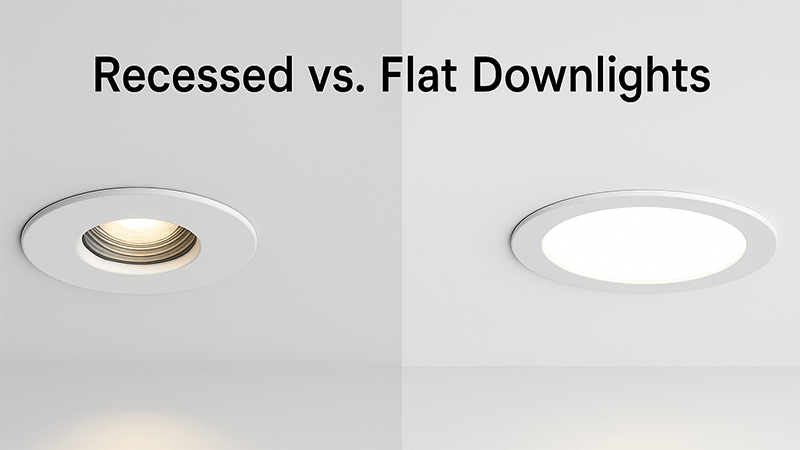
But the difference is more than just where they sit. It affects the entire atmosphere of a space, from glare control to visual comfort. I’ve spent my career in lighting manufacturing, and I see this question come up all the time with project managers like you. Making the right choice is critical for a successful installation. Let’s look deeper into the specifics so you can confidently select the best option for your clients.
Are downlights the same as recessed lights?
People often use "downlight" and "recessed light" to mean the same thing. This common confusion can lead to ordering mistakes. I’ll help you define them clearly to avoid costly errors.
Not exactly. "Downlight" describes any light that shines downwards. "Recessed light" is a type of downlight installed inside a ceiling. So, all recessed lights are downlights, but not all downlights are recessed lights, like flat panels or pendant lights.

In my early days in the factory, getting this terminology right was one of the first things I learned. A client would ask for "downlights," and we had to ask several follow-up questions to understand what they really needed. Was it for a suspended ceiling with plenty of space, or a solid concrete one? This distinction is crucial for you as a purchasing manager. You need to know exactly what your project requires to source the correct product. Let’s break down this lighting family tree.
The Downlight Family
Think of "downlight" as the family name. It’s a broad category for any fixture that casts light in a downward direction. Under this family name, there are several different types, each with a specific installation method and purpose. The most common types you’ll encounter are recessed lights and surface-mounted lights (which include flat panels).
Key Differences in Terminology
Using the right term ensures you get the right product. When you specify "recessed light" to a manufacturer like me, I know you need a fixture with housing that fits inside a ceiling void. If you ask for a "surface-mounted downlight," I know you need a self-contained unit that attaches to the face of the ceiling. It’s a simple difference, but it determines the entire installation process and the final look.
Here is a simple table to help you communicate your needs clearly:
| Term |
Category |
Description |
When to Use This Term |
| Downlight |
Function |
A general term for any fixture directing light downwards. |
When discussing the general lighting effect. |
| Recessed Light |
Installation |
A downlight installed into a ceiling cavity. |
For projects with false ceilings and a minimalist look. |
| Flat Downlight |
Installation |
A downlight mounted onto the ceiling surface. |
For solid ceilings or when installation speed is key. |
| Spotlight |
Beam |
Often a downlight with a narrow, focused beam. |
When you need to highlight a specific feature or object. |
What are recessed downlights?
Your project requires a clean, modern ceiling without visible fixtures. You know a recessed light is the answer, but what does that involve? I’ll explain the components and what to look for.
A recessed downlight is a lighting fixture installed into a hollow opening in a ceiling. It consists of a housing that holds the lamp and a trim that is visible on the ceiling. This creates a clean, unobtrusive look, with light shining from a hole.

Recessed lights are my go-to recommendation for clients who want a high-end, architectural feel. The magic of these lights is how they disappear. You see the light, not the source. This is perfect for creating focused, dramatic effects. But to get it right, you need to understand how they work. The quality of a recessed downlight isn’t just in the LED chip; it’s in the entire assembly. A good design considers heat dissipation, glare control, and ease of installation.
Anatomy of a Recessed Downlight
A recessed fixture has three main parts. Understanding them helps you specify the right product for your project’s needs.
- Housing: This is the main body of the fixture that is hidden within the ceiling. It contains all the electrical components, including the connection to the power source and often the driver. The quality of the housing, especially its heat sink, is critical for the LED’s lifespan. Better heat management means a longer-lasting, more reliable light.
- Light Source / Engine: This is the lamp itself. In modern fixtures, this is almost always an integrated LED module. When evaluating these, you look at lumens (brightness), CCT (color temperature), and CRI (color rendering index). For our OEM clients, we often customize the LED engine to match their exact project requirements.
- Trim: This is the only part of the fixture you see from below. It fits flush against the ceiling and shapes the light. Trims come in various styles and colors. A "baffle" trim has grooves to reduce glare, while a "reflector" trim maximizes light output. The trim choice directly impacts the visual comfort of the room. A deep-set trim, for example, hides the light source better and significantly reduces glare.
| Component |
Function |
What to Look For |
| Housing |
Protects components, dissipates heat. |
Quality aluminum, good heat sink design, IC rating if needed. |
| Light Engine |
Produces the light. |
High CRI (>90), consistent CCT, reliable LED brand. |
| Trim |
Finishes the look, controls the light beam. |
Low-glare design (e.g., deep baffle), aesthetic match, reflector quality. |
What are the disadvantages of recessed lighting?
Recessed lights look great, but they aren’t always the perfect solution. You might face installation challenges or performance issues. I’ll outline the potential downsides so you can anticipate and avoid them.
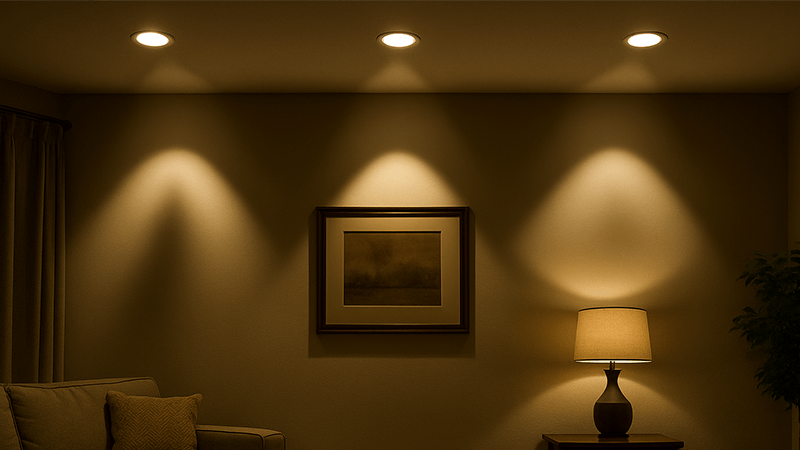
The main disadvantages are the complex installation, which requires cutting into the ceiling, and the potential for heat buildup. They can also create dark "scalloping" on walls if placed too close, and lower-quality fixtures can produce uncomfortable glare.
I always tell my partners that planning is everything with recessed lighting. While the clean look is a huge benefit, a poor installation can cause more problems than it solves. One of the biggest issues I’ve helped clients troubleshoot is air leakage. If the fixtures aren’t sealed properly, they can break the thermal insulation of a ceiling, leading to heat loss in the winter and heat gain in the summer. This impacts energy bills. That’s why choosing fixtures with the proper rating, like an IC (Insulation Contact) rating, is non-negotiable in many applications.
Key Drawbacks and How to Mitigate Them
Understanding the potential problems is the first step to preventing them. Here are the common challenges and my advice on how to handle them as a purchasing manager or project contractor.
-
Installation Complexity: You must cut precise holes in the ceiling. This requires skill and creates mess. For retrofits, you also need to check for joists, pipes, or wiring above the ceiling.
- Solution: Work with experienced installers. Use a high-quality hole saw for clean cuts. For our clients, we provide detailed installation guides and cutout templates to make this process smoother.
-
Heat Management: LEDs generate heat. If a recessed fixture isn’t designed with a proper heat sink or installed with enough clearance, it can overheat. This drastically shortens the LED’s lifespan and can even be a fire hazard.
- Solution: Only source fixtures from reputable manufacturers who provide thermal management data. Always check for certifications like UL or CE. If installing in an insulated ceiling, insist on IC-rated fixtures, which are designed to be safely covered with insulation.
-
Light Quality Issues: Poorly designed trims or incorrect placement can cause problems.
- Glare: If the light source is too exposed, it creates harsh glare that is uncomfortable on the eyes. Choose fixtures with deep-set LEDs or anti-glare baffle trims.
- Cave Effect: If you only use recessed lights, the ceiling can appear dark, making the room feel smaller. It’s often best to combine them with other light sources.
- Scalloping: When placed too close to a wall, the light beams create cone-shaped patterns on the wall, which can be distracting. Proper spacing is key, and lighting design software can help plan this perfectly.
Where not to use recessed lighting?
You love the clean look of recessed lights, but are there places they just don’t belong? Using them in the wrong spot can be a costly mistake. Let me share my experience.
Avoid using recessed lighting as the sole light source in rooms with very high or vaulted ceilings, as the light may not reach the floor effectively. Also, they are impractical for solid concrete ceilings where no cavity exists for installation.

In my experience, the biggest mistake is thinking recessed lights can do everything. They are a fantastic tool, but not the only tool. One client insisted on using only recessed downlights in a large conference room with a 5-meter ceiling. The result? The tabletops were well-lit, but the room felt dim and cavernous because the walls and ceiling were dark. We ended up adding pendant lights over the table and wall washers to balance the light. This is why a layered lighting approach is so important.
Scenarios to Reconsider Recessed Lighting
Before you specify recessed lights for a project, consider these situations where another solution might be better.
-
Solid Ceilings: The most obvious limitation is a solid concrete or wood ceiling. There is simply no space to install the housing.
- Alternative: This is the perfect scenario for high-quality flat panel or surface-mounted downlights. They provide excellent illumination without needing a ceiling cavity.
-
Very High or Sloped Ceilings: Standard recessed downlights can struggle in these spaces. The light becomes too diffused by the time it reaches the living area, leading to low light levels.
- Alternative: For high ceilings, consider powerful pendant lights or surface-mounted spotlights with a narrow beam angle. For sloped ceilings, look for specific "gimbal" or "adjustable" recessed fixtures that can be angled to direct light straight down.
-
As the Only Light Source: Relying solely on a grid of recessed downlights can create a flat, uninviting atmosphere, often called the "cave effect" because the ceiling plane is left in darkness.
- Alternative: This is where my key insight comes in. Use recessed lights strategically for accent and task lighting. Combine them with other types. For example, use flat panels for comfortable, widespread ambient light. Then, add recessed spotlights to highlight artwork or architectural features. This combination of flat and recessed fixtures creates a dynamic, functional, and aesthetically pleasing space. This is how modern lighting design achieves both beauty and function.
Conclusion
The main difference is installation: recessed fits into a ceiling, while flat mounts onto it. Use this knowledge to layer your lighting, combining both for a perfect blend of function and style.