Are you upgrading to LED downlights and feeling confused by the wiring? That old, heavy box might seem like a simple part to reuse, but it could be a mistake.
No, LED downlights do not need a traditional transformer like old halogen lights. Instead, they require a specialized power supply called an LED driver. This driver converts your mains AC voltage into the stable, low-voltage DC power with a constant current that LEDs need to function correctly.
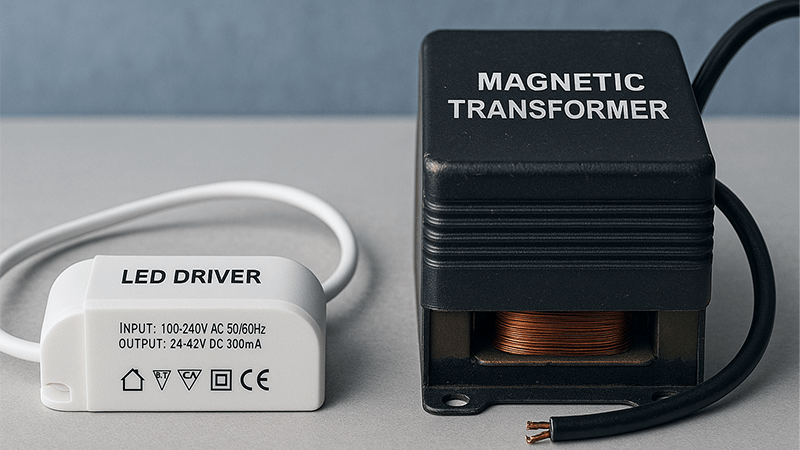
I’ve been in the lighting business for a long time, starting on the factory floor. I’ve seen how the term "transformer" causes a lot of problems for people. They often think it’s the same thing as the "LED driver" we use today. But they are completely different, and mixing them up can lead to flickering lights, or worse, dead ones. Understanding this difference is one of the most important things for anyone working with modern lighting. Let’s break it down so you can avoid these costly mistakes.
Do LED downlights need a transformer?
Upgrading your lighting from halogen to LED seems simple. But when you see that old transformer, you pause. Reusing it feels smart, but it could destroy your new investment.
LED downlights require an LED driver, not a traditional magnetic transformer. A driver is an electronic power supply that delivers the precise, low-voltage, constant-current DC power an LED needs. Using an old halogen transformer will provide the wrong type of power and quickly damage the LED chip.
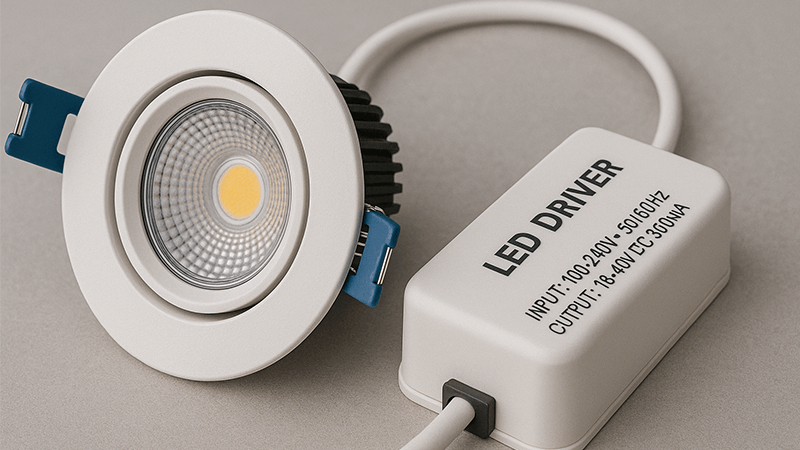
When I started my company, I wanted to help clients grow by providing reliable products. I learned early on that the driver is as important as the LED chip itself. People often call the power supply for an LED a "transformer," but this is a holdover from the halogen era. It’s a common mistake, but a critical one.
The Old-School Transformer
A traditional transformer, the kind used for low-voltage halogen lights like MR16 bulbs, is a simple device. It’s usually a heavy, iron-core box. Its only job is to take high-voltage alternating current (AC) from your wall, like 220V, and "step it down" to a lower voltage, like 12V AC. Notice it’s still AC power. It’s a brute-force approach to voltage reduction.
The Modern LED Driver
An LED driver is a much smarter piece of electronics. It’s more like a computer for your light. An LED is a semiconductor, and it needs direct current (DC) to work. The driver performs several essential jobs:
- Rectification: It converts AC power from the wall into DC power.
- Voltage Reduction: It steps down the voltage to a safe, low level.
- Current Regulation: This is the most important part. It provides a constant current to the LED, which protects it from damage and ensures a stable light output.
I always tell my partners, like Shaz, a purchasing manager in the UAE, that the driver is the LED’s life-support system. Here’s a simple table to show the difference.
| Feature |
Traditional Transformer |
LED Driver (Electronic) |
| Output |
Low-Voltage AC (e.g., 12V AC) |
Low-Voltage DC (e.g., 36V DC) |
| Main Function |
Voltage reduction |
Voltage reduction, AC to DC conversion, and constant current regulation |
| Technology |
Magnetic coil and iron core |
Complex electronic circuits |
| Compatibility |
Halogen lamps |
LED lamps |
| Key Role |
Simple power step-down |
Complete power management |
Using a halogen transformer on an LED is like putting diesel in a gasoline car. It just won’t work, and you will cause permanent damage.
What happens if you connect an LED directly to a 12V DC source?
You have a 12V LED and a 12V DC power source. It seems like a perfect match. But connecting them directly is a recipe for a quick, bright flash and then darkness.
Connecting an LED directly to a 12V DC power supply without a current-limiting driver will destroy it almost instantly. The LED will draw uncontrolled amounts of current, leading to rapid overheating and burnout. LEDs are current-driven devices, not voltage-driven ones. They need a regulated current to survive.
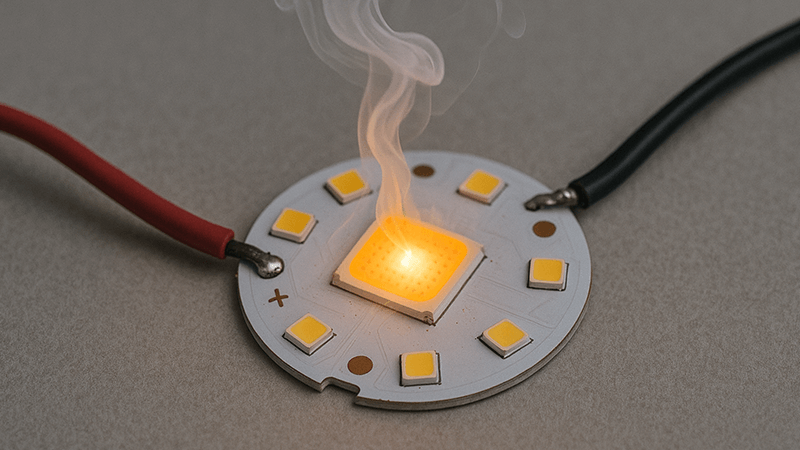
This is a lesson I learned the hard way in my early factory days. We were testing some new LED chips and a new technician hooked one straight to a lab power supply set to the "correct" voltage. The chip flashed brightly for a second and then went dark with a tiny puff of smoke. It was a perfect demonstration of a principle called thermal runaway. This is a vicious cycle that happens when an LED gets an unregulated voltage.
Why Voltage Isn’t Enough
An LED is a diode, a type of semiconductor. A key characteristic is that its internal resistance drops as its temperature rises. A standard DC power supply, like a 12V battery or wall adapter, provides a constant voltage. According to Ohm’s Law (Voltage = Current × Resistance), if the voltage is constant and the resistance drops, the current must increase to balance the equation.
The Vicious Cycle of Thermal Runaway
When you connect an LED directly to a voltage source, this is what happens:
- Power On: The LED receives the 12V, current flows, and it lights up, creating heat.
- Heat Builds Up: As the LED chip gets hotter, its internal resistance starts to decrease.
- Current Surges: Because the resistance is now lower, the LED draws more and more current from the 12V source.
- More Heat: This surge of current generates even more heat, much faster than the LED can dissipate it.
- Burnout: The cycle repeats rapidly. The resistance drops further, the current skyrockets, and the temperature spikes until the delicate semiconductor junction inside the LED is permanently destroyed.
This all happens in less than a second.
The Driver’s Protective Role
This is exactly why an LED driver is essential. A constant current driver does not provide a fixed voltage. Instead, it constantly monitors the current it’s sending to the LED and adjusts the voltage on the fly to keep the current at a safe, steady level (e.g., 350mA). No matter how the LED’s temperature and resistance change, the driver ensures the current never exceeds the safe limit. It breaks the thermal runaway cycle before it can start.
Do LED lights have built-in transformers?
You see many LED products, like A-shape bulbs or integrated downlights, that connect directly to mains voltage. This can be confusing. Does this mean they don’t need a driver?
Yes, these LED lights do have a power supply, but it is a compact, built-in LED driver, not a transformer. All LEDs need a driver to function. In these integrated products, the driver’s electronics are miniaturized and included inside the lamp’s housing for convenience.
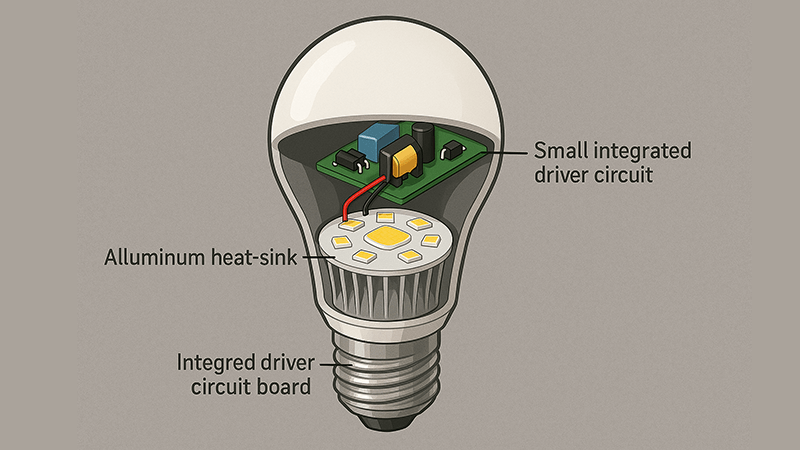
This is one of the biggest areas of innovation I’ve seen in my career. Making drivers smaller and more efficient without sacrificing reliability is a huge challenge. When we design a new "driver-on-board" or integrated downlight, the engineering is focused on fitting all the necessary components into a tiny space while managing the heat they generate.
Integrated vs. External Drivers
There are two main categories of LED products based on how they incorporate the driver. Understanding this helps sourcing professionals like Shaz choose the right product for their projects.
Which One is Better?
For my business, we offer both types, but I always guide clients based on their needs. For a home, an integrated LED bulb is convenient. But for a hotel, office, or any large commercial project, I strongly recommend fixtures with external drivers. The improved thermal management, longer lifespan, and easier maintenance are far more valuable in the long run. The initial simplicity of an integrated fixture can turn into a major headache down the road.
Do LED lights use a transformer?
We’ve covered a lot of ground, but let’s address this common question one last time. People ask me this constantly, and the simple answer can save them a lot of trouble.
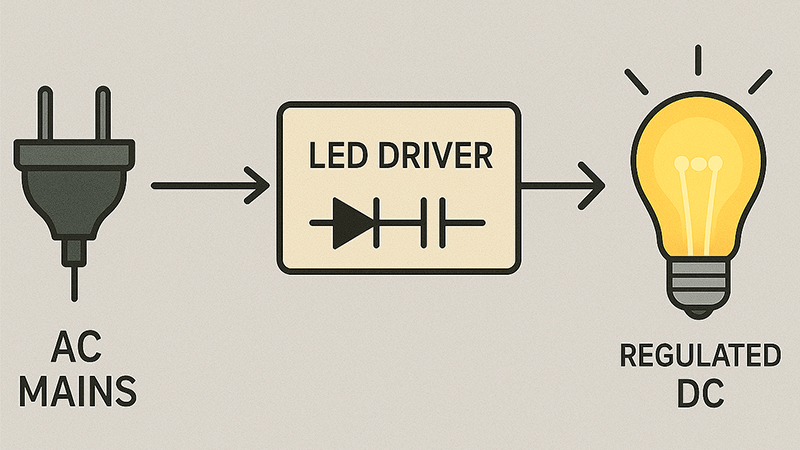
No, LED lights do not use a traditional transformer. They use a modern electronic device called an LED driver. While both change voltage, a transformer only steps down AC voltage. An LED driver performs a more complex job: converting AC to DC and regulating a constant current.
The heart of my business, iPHD, is a commitment to quality. And that quality rests on getting the fundamentals right. The driver is the most fundamental part of any LED system. Confusing it with an old-world transformer is the first step toward failure. Let’s make the distinction crystal clear.
The Problem with Terminology
The word "transformer" has been used in lighting for decades. It’s simple, and everyone knows what it means in the context of old halogen lights. The problem is, LEDs are not old technology. They are semiconductors that operate on entirely different principles. Using old terms for new technology creates confusion that leads to mistakes in specification and installation.
A purchasing manager like Shaz in the UAE knows that precision in language is critical when sourcing components. A purchase order for "12V transformers" versus "350mA constant current drivers" will result in two completely different products.
A Driver’s Three Core Tasks
Let’s summarize the LED driver’s critical functions to see why it’s not just a transformer:
- AC to DC Conversion: Mains power is AC (Alternating Current). LEDs are semiconductors that need DC (Direct Current). A driver contains a rectifier circuit to make this conversion. A traditional transformer does not; it outputs AC.
- Voltage Step-Down: The driver reduces the high mains voltage (e.g., 220V) to the low voltage an LED needs (e.g., 36V). This is the only function it shares with a transformer, but it does it electronically, not magnetically.
- Constant Current Regulation: This is the driver’s most vital and unique role. It ensures the LED receives a steady flow of current, protecting it from thermal runaway and guaranteeing a stable light output and long life. A transformer provides no current regulation at all.
I always tell my team: you can have the best LED chip in the world, but if you pair it with a cheap, poorly-made driver—or the wrong type of power supply altogether—the entire product will fail. The driver is the unsung hero of the LED world. Calling it a "transformer" does it a great disservice and ignores the sophisticated technology that makes modern lighting possible.
Conclusion
In short, LED downlights need an LED driver, not a transformer. This driver is the key to converting AC power to the constant DC current that ensures your lights are safe, stable, and long-lasting.