Are you sourcing downlights and finding the term "fixed" confusing? You might worry about maintenance, thinking you’re stuck if a light fails. This thinking can make you miss superior options.
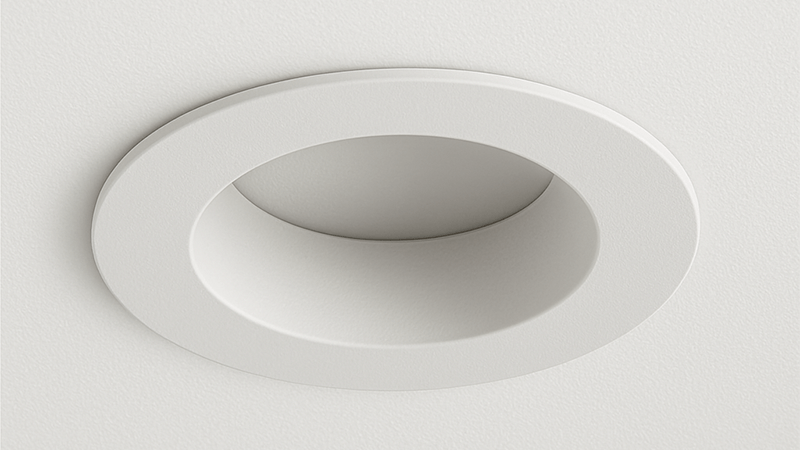
A fixed downlight is a luminaire where the light source, often an LED module, is built directly into the housing. Unlike traditional models, you don’t change a separate bulb. This integrated design allows for better performance, thermal management, and a more compact, sleeker profile.
The idea of a light you can’t change might seem strange at first. I remember when clients first started asking me about this. They were worried about being locked into a product that couldn’t be easily repaired. But this is where the conversation in the lighting industry has completely changed. When you look at the engineering, you begin to see the bigger picture.
It’s a shift from thinking about a "bulb" to thinking about a complete "luminaire system." Once you understand the reasons behind this shift, you’ll see why the high-end market has embraced this change. Let’s break down what these fixtures really are and why they matter for professionals like you.
What is a fixed downlight?
Trying to explain fixed downlights to your clients but getting stuck on the technical details? You need a simple, clear definition that highlights the benefits, not the perceived limitations.
A fixed downlight is a complete lighting unit where the light source and fixture are one piece. This is not about cutting costs. It is an engineering choice for optimal light output, color consistency, and a longer lifespan by perfectly matching the LED chip to its driver and heat sink.
In the past, a downlight was just a housing. The performance depended entirely on the separate bulb you installed. A fixed downlight, also known as an integrated downlight, changes this completely. It is a sealed, single unit designed from the ground up to perform one job perfectly. Think of it like the engine in a high-performance car. The manufacturer doesn’t just sell you a car body and let you pick your own engine from another company. They design the engine and the car together for perfect balance and performance. We do the same with fixed downlights in our factory.
The Integrated System Advantage
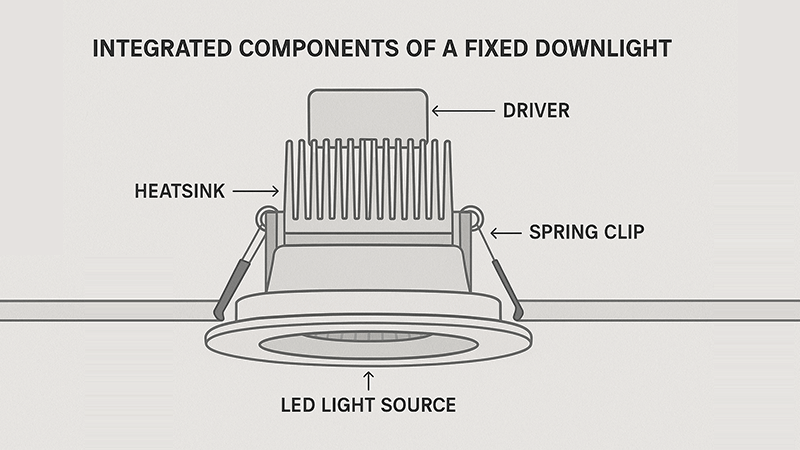
The key is that every component is selected and designed to work in harmony with the others. The LED chip, the driver (power supply), the optics (lens or reflector), and the heat sink are not separate parts. They are a single, cohesive system.
Here is a breakdown of how these parts work together in a fixed downlight:
| Component |
Role in the System |
Benefit of Integration |
| LED Chip |
The source of light. |
Specifically chosen for the desired brightness (lumens), color temperature (CCT), and color accuracy (CRI). |
| Heat Sink |
Manages and dissipates heat. |
Custom-designed for the specific LED chip’s heat output, ensuring a long life and stable performance. |
| Driver |
Supplies and regulates power. |
Calibrated to provide the precise voltage and current the LED chip needs for maximum efficiency and longevity. |
| Optics |
Shapes and directs the light. |
Engineered to work with the exact position of the LED chip to create the perfect beam angle and reduce glare. |
This holistic approach means we can guarantee performance in a way that’s impossible with replaceable bulbs. We can promise a lifespan of 50,000 hours not just for the LED, but for the entire fixture.
Can you change the bulb in a fixed downlight?
Worried that a "fixed" downlight means a dead fixture when the light goes out? This is a common fear, but it comes from an outdated way of thinking about lighting maintenance.
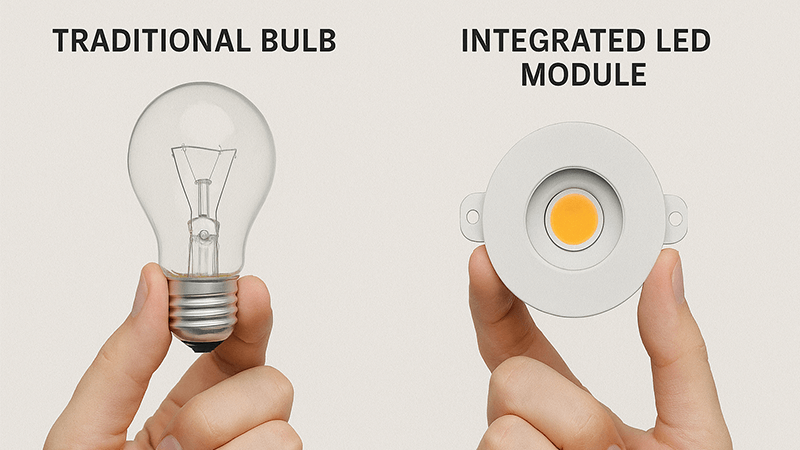
No, you cannot change the "bulb" in a fixed downlight because there is no separate bulb to change. The light source is an integrated LED module. But the real question is: why would you want to? The entire unit is designed to last for 50,000 hours or more, which is years of reliable operation.
When I talk to purchasing managers like Shaz, the conversation often starts with maintenance cycles. For years, the job involved planning for bulb replacements. With fixed LED downlights, we need to change our perspective. The focus shifts from "how often do I replace the bulb?" to "how long will the entire fixture last?" The answer is, a very long time. A typical integrated LED downlight rated for 50,000 hours, if used for 8 hours a day, will last for over 17 years. In a commercial setting running 12 hours a day, that’s still over 11 years of service.
Shifting from Replacement to Reliability
The design philosophy behind a fixed downlight is to eliminate the weakest link: the replaceable bulb. A standard LED bulb is a marvel of miniaturization, but it has compromises. It must fit its driver and heat sink into a tiny, standardized base like a GU10 or E27. This severely limits its thermal management and overall lifespan.
In contrast, a fixed downlight’s heat sink is the body of the fixture itself, giving it a huge surface area to dissipate heat. This keeps the LED chip cool and running efficiently.
Here’s why this matters for large-scale projects:
- Reduced Maintenance Costs: Think about the labor costs of replacing hundreds of bulbs in a hotel, office building, or retail space. With fixed downlights, you virtually eliminate this expense for a decade or more.
- Consistent Performance: When you replace bulbs one by one, you often end up with mismatched colors and brightness levels over time. A fixed LED installation ensures every light looks and performs identically for its entire lifespan.
- Greater Safety and Reliability: An integrated system with a dedicated driver is more stable. There are fewer points of failure compared to a system with separate bulbs, holders, and connections.
So, while you can’t change the bulb, you’re getting a fixture that’s designed to make bulb-changing an obsolete task. You’re investing in reliability, not planning for failure.
What are the different types of downlights?
Feeling overwhelmed by the variety of downlights on the market? It can be hard to know which type is right for your project. Let’s simplify it and focus on the key distinctions.
Fundamentally, downlights can be categorized by their light source (integrated vs. non-integrated), adjustability (fixed vs. adjustable), and features. Understanding these types helps you specify the exact product you need for a given application, ensuring both function and form are met.
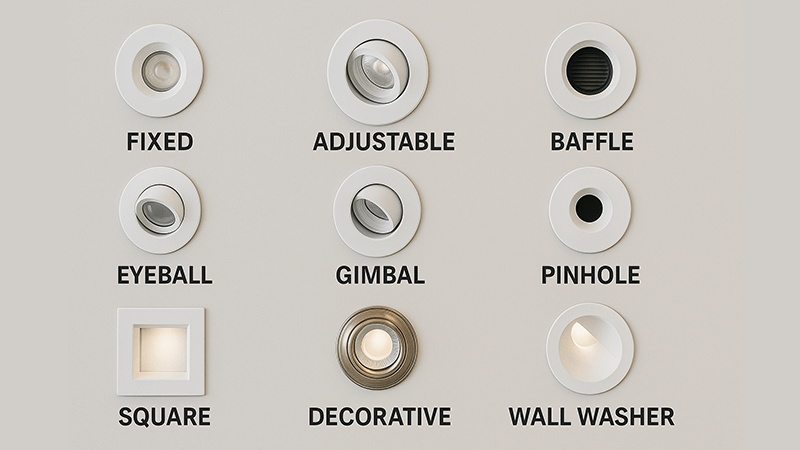
As a manufacturer, I see these categories as different tools for different jobs. There is no single "best" type of downlight; there is only the best type for a specific space and purpose. A purchasing manager who understands these differences can source products more effectively and provide more value to their clients. The main confusion today arises between the light source technology. Let’s focus on that first, as it’s the most important distinction in the modern market.
A Modern Classification of Downlights
The old way was to classify them by the type of bulb they took (halogen, CFL). Today, it’s more helpful to classify them by their core design and function.
Here’s a structured look at the main types you’ll encounter:
-
Based on Light Source:
- Non-Integrated (Bulb-Replaceable): These are traditional housings, most commonly for GU10 bulbs. They offer flexibility because the end-user can choose the bulb. However, performance, dimming, and lifespan are dependent on the third-party bulb used. They are becoming less common in high-specification projects.
- Integrated (Fixed LED): As we’ve discussed, these have a built-in LED module. They offer superior performance, longevity, and design possibilities. This is the standard for new commercial and high-end residential construction.
-
Based on Adjustability:
- Fixed: The light beam points straight down. This is the most common type and is perfect for general ambient lighting in a space. They provide a clean, uniform look on the ceiling.
- Adjustable (Gimbal): The central part of the downlight can be tilted and sometimes rotated. This is ideal for accent lighting, like highlighting artwork, architectural features, or retail displays. It allows you to direct light exactly where it’s needed.
-
Based on Special Features:
- Fire-Rated: Essential for certain building regulations, these downlights have an intumescent material that expands in a fire to seal the ceiling opening, maintaining the fire barrier.
- IP-Rated: These are rated for resistance to dust and water. An IP44 rating is common for general use, while IP65 is required for bathrooms (Zone 1) and outdoor areas.
- Trimless: These are plastered into the ceiling for a completely seamless, minimalist look where only the light source is visible.
For a professional buyer, matching these types to project requirements is key. For a hotel lobby, you might use fixed downlights for general lighting and adjustable ones to highlight reception desks or decor. For guest bathrooms, you would need IP65-rated fixed downlights.
What is a fixed LED?
Are you seeing the term "fixed LED" in spec sheets and wondering if it’s different from "integrated LED"? You’re right to question it, as terminology in our industry can be confusing.
A "fixed LED" simply refers to an LED light source that is permanently built into the luminaire and cannot be replaced. It is another term for an integrated LED. The word "fixed" emphasizes that the light source does not move and is not designed to be swapped out like a traditional bulb.
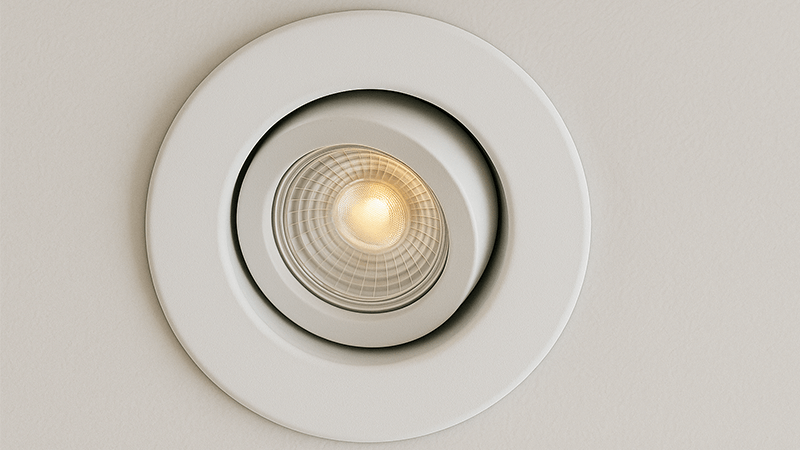
The term "fixed LED" helps distinguish these modern fixtures from older styles. In my experience, using this term helps manage expectations with clients who are used to the old paradigm of changing bulbs. It opens the door to a conversation about longevity and performance. While "integrated" speaks to the engineering (how it’s made), "fixed" speaks to the user experience (what you do with it). Both terms describe the same superior technology that is now leading the market. It is not a limitation; it is a feature.
Why "Fixed" is the Smartest "Flexible"
The most advanced thinking in lighting design is now centered around fixed LED technology. When we were limited by halogen bulbs, lighting design was a compromise. We had to design around a hot, inefficient, and short-lived light source. The flexibility of a replaceable bulb was necessary because the bulb was guaranteed to fail. Fixed LED technology frees us from this.
This is the insight I share with my most forward-thinking partners: a fixed design provides the ultimate flexibility where it truly matters—in performance.
- Flexibility in Design: Because we don’t need to accommodate a bulky, hot bulb, we can create incredibly small and sleek fixtures. We can design trimless downlights that disappear into the ceiling, or miniature adjustable spots that deliver powerful beams from a tiny aperture. This gives architects and designers true creative freedom.
- Flexibility in Performance: With a fixed LED, we can precisely control the light. We can offer a huge range of beam angles, from a very narrow 10-degree spot to a wide 60-degree flood. We can guarantee a high Color Rendering Index (CRI) of 95+ for perfect color accuracy. We can ensure flawless, deep dimming without flicker. This level of control is simply not possible when you leave the light source to chance with a replaceable bulb.
When you choose a fixed LED downlight, you are not choosing a restriction. You are choosing a precisely calculated, optimized lighting solution. In the world of light, sometimes "fixed" is the most intelligent and flexible choice you can make.
Conclusion
A fixed downlight is an engineered luminaire with a built-in LED source. It offers superior performance, longevity, and design by treating the fixture as a complete system, making it the professional’s choice.