Struggling with flickering lights or early failures? The hidden cause might be your downlight’s driver. This small component can make or break your entire lighting project’s long-term success.
Yes, almost all LED downlights need a driver. This device converts high-voltage AC power from your mains into the low-voltage DC power that LEDs require to operate safely and efficiently. Without a proper driver, the LEDs would burn out almost instantly.
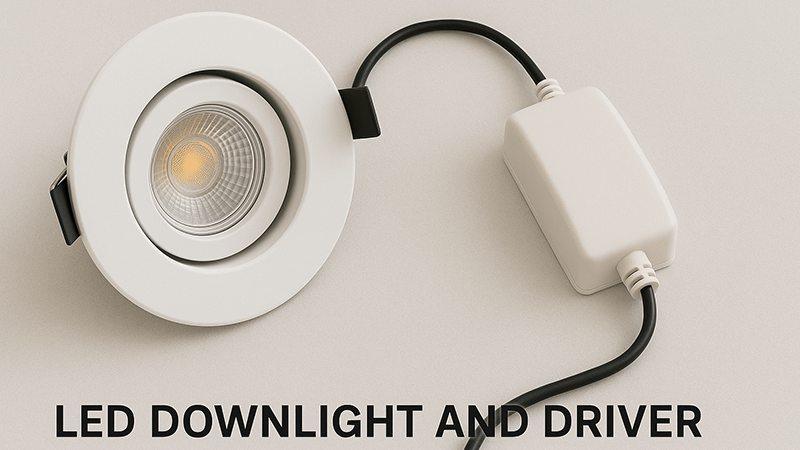
I’ve been in the LED lighting business for a long time, starting on the factory floor. I’ve seen firsthand how a seemingly small component like a driver can cause huge problems for a project down the line. It’s a lesson that many, like my client Shaz in the UAE, learn is critical for project success. But what exactly is this driver, and why is it so essential for your downlights? Let’s break it down further so you can make informed decisions for your next project.
Do I need an LED driver for downlights?
Confused about whether your specific downlights need a driver? Choosing the wrong setup can lead to compatibility issues, poor performance, and even safety hazards, costing you time and money.
Yes, you almost certainly need an LED driver for your downlights. Most downlights are designed to run on low-voltage DC. The driver is the essential link that safely converts your building’s standard high-voltage AC power, making the lights work correctly and last longer.
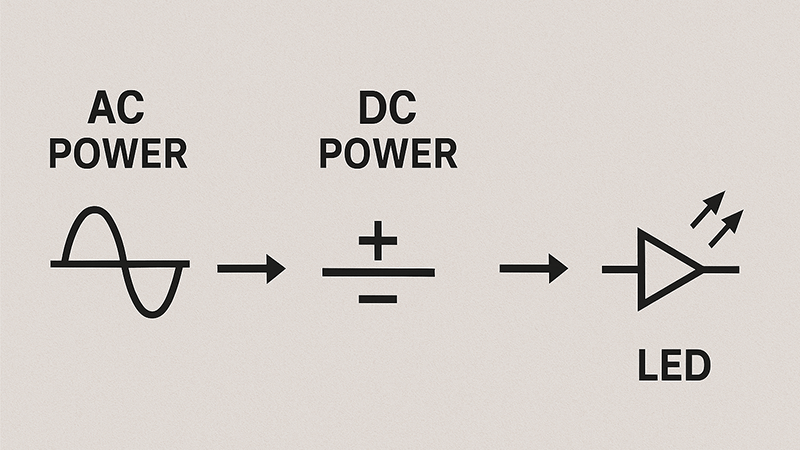
The need for a driver comes down to the basic physics of how an LED works. LEDs are not like old incandescent bulbs that could be connected directly to your wall socket. They are sensitive electronic components. Let me explain this in more detail.
Why AC Power Doesn’t Work for LEDs
The electricity in our buildings is Alternating Current (AC). This means the flow of electricity rapidly changes direction. LEDs, on the other hand, are "diodes," which means they only allow electricity to flow in one direction. They need a steady, one-way flow of Direct Current (DC) at a much lower voltage to light up. If you connect an LED directly to a high-voltage AC source, it will be destroyed in a fraction of a second. The driver acts as the bridge between these two incompatible electrical types. It takes the high-voltage AC from the wall and transforms it into the low-voltage DC that the LED chip needs to survive and thrive.
The Driver’s Dual Role: Conversion and Regulation
A driver does more than just convert power. Its second, equally important job is to regulate the current. LEDs are very sensitive to the amount of electrical current they receive. Too much current, even for a moment, can overheat and damage the LED chip, drastically shortening its life. Too little current, and the light will be dim and unstable. A good driver provides a Constant Current, ensuring the LED receives exactly the right amount of power at all times. This protects the LED from fluctuations in the main power supply, which are more common than you might think. This constant, stable power is what guarantees a consistent light output and the long lifespan that LEDs are famous for. A purchasing manager like Shaz knows that promising a 50,000-hour lifespan is meaningless if the driver can’t deliver that stable power for 50,000 hours.
Can LED lights work without a driver?
Thinking of simplifying your setup and skipping the driver? This common shortcut can lead to immediate burnout of your lights and create significant fire risks, completely wasting your investment.
No, standard low-voltage LED lights cannot work without a driver. The driver is essential for converting AC to DC and regulating current. Bypassing it will instantly destroy the LED and can be extremely dangerous.
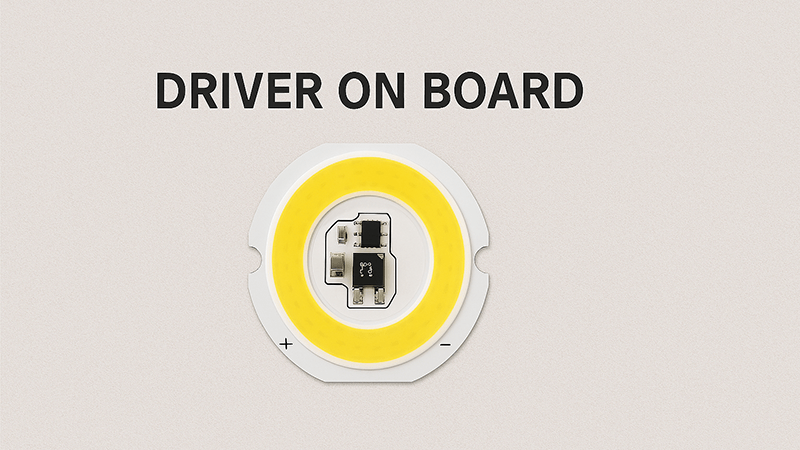
While the simple answer is no, the lighting market has developed some solutions that seem to work without a separate, external driver box. It’s important to understand what these are and what their trade-offs are. These are often called "driverless" or "Driver-on-Board" (DOB) solutions.
Understanding "Driverless" DOB Technology
"Driverless" is a bit of a misleading marketing term. These LED products still have driver components. The difference is that instead of being in a separate box, the components (like rectifiers and ICs) are mounted directly onto the same circuit board as the LED chips themselves. This creates a more compact, and often cheaper, single unit that can connect directly to AC power. For a purchasing manager focused on unit cost, this can seem very attractive. However, this design comes with significant compromises that I always advise my partners to consider carefully. It is not a technology we choose to use at iPHD for our premium products, and for good reason.
The Hidden Costs of DOB Solutions
The main problem with DOB technology is heat. All driver components generate heat, and so do LED chips. By placing them on the same small board, you concentrate all that heat in one place. LEDs are very sensitive to heat; high temperatures cause their light output to decrease and their lifespan to shorten dramatically. The small driver components on a DOB board are also more susceptible to damage from heat and power surges. There is simply no room for the robust protection circuits and high-quality components you find in a good external driver. I’ve seen projects that chose DOB downlights to save money initially, only to face widespread failures and expensive replacement costs within one or two years. The initial savings were completely wiped out by the lack of reliability.
Do LED downlights have built-in drivers?
Is the driver part of the downlight, or a separate piece? This is a key question for installation planning, as it affects wiring, spacing, and long-term maintenance access.
Many LED downlights come with an external driver that is included but separate from the light fixture. However, some models, called "integrated" downlights, have the driver built into the fixture’s housing. It is crucial to check the product specifications.
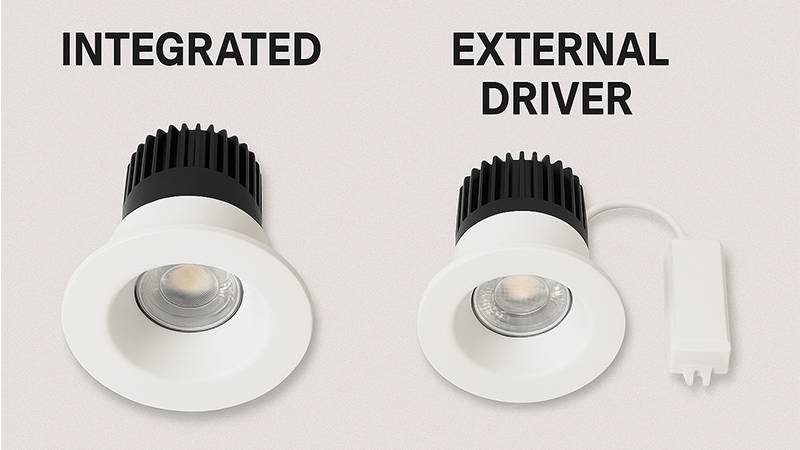
The location of the driver is a critical design choice that impacts performance, lifespan, and maintenance. As a manufacturer, we have to balance cost, ease of installation, and long-term reliability. Let’s look at the two main approaches and their pros and cons.
Approach 1: Integrated Drivers
In this design, the driver’s electronics are housed within the same casing as the LED and its heat sink. This creates a single, all-in-one unit that can be simpler to install. However, this presents a major thermal challenge. The heat generated by the driver is trapped in the same space as the heat generated by the LED chip. Both components get hotter than they would if they were separate. This combined heat is the enemy of longevity. It accelerates the aging of both the LED chips and the sensitive electronic components in the driver. While it might look sleek, an integrated design often means a shorter functional life for the entire fixture. If the driver fails, you often have to replace the whole downlight, which is more costly and wasteful.
Approach 2: External Drivers
This is the design we prefer at iPHD for our quality lighting solutions. The driver is a separate unit connected to the downlight by a short cable. This separation is key. It allows the heat from the LED to be managed by its own heat sink, and the heat from the driver to dissipate from its own casing. Both components run cooler, and a cooler electronic component is a more reliable, longer-lasting component. Another huge advantage is serviceability. If the driver fails after many years of use—and it’s usually the first part to fail—you can simply unplug the old driver and plug in a new one without replacing the entire downlight. For project contractors and facility managers, this means easier, cheaper, and faster maintenance.
Does an LED light need a driver?
It seems simple, but why is this component so vital? Ignoring the driver’s quality is like building a house on a weak foundation; everything can come crashing down unexpectedly.
Yes, an LED light needs a driver to convert power and regulate current for safety and longevity. The quality of that driver is just as important as the quality of the LED chip itself. A poor driver will ruin a good LED.
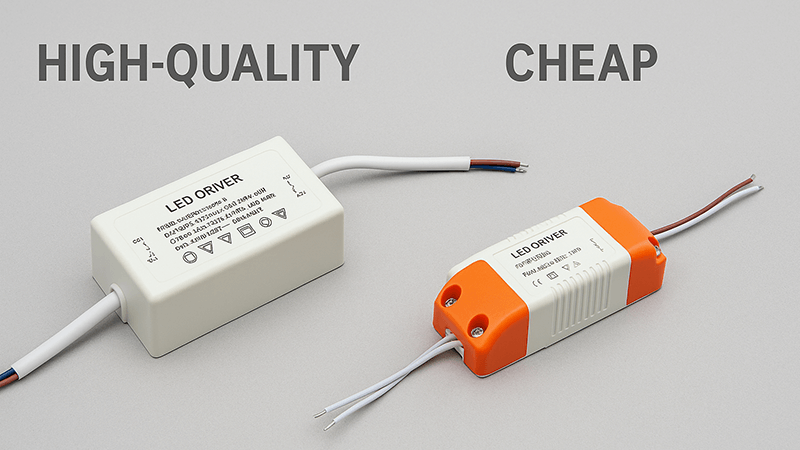
I want to share an insight from my years of manufacturing: the driver’s efficiency rating is not just a technical number. It directly translates into reliability and lifespan. A cheap driver might be advertised with good specs, but the real-world performance tells a different story.
Efficiency, Heat, and Lifespan
Let’s compare a high-quality driver with 95% efficiency to a cheaper one with 85% efficiency. The 10% difference seems small. However, the 85% efficient driver wastes 15% of its energy as heat, while the 95% efficient one only wastes 5%. This means the cheaper driver produces three times more waste heat. In a sealed downlight fixture where heat gets trapped, this extra heat is a killer. It constantly cooks the LED chips and the driver’s own components, causing them to fail much sooner. I once had a client in the UAE who was sourcing for a large hotel project. He was tempted by a low-cost downlight with an 85% efficient driver. I showed him the thermal data: the cheaper option ran 20°C hotter. He understood immediately that this would lead to failures in the hot UAE climate and chose our solution with a 95% efficient driver. He avoided a maintenance nightmare.
The Smart Driver Advantage
Modern, high-quality drivers have a feature called "thermal foldback." They have a sensor that monitors temperature. If the driver or the LED gets too hot, the driver automatically reduces the current flowing to the LED. This slightly dims the light but protects the LED chip from damage. It’s a smart self-protection mechanism. Cheaper drivers lack this. When they overheat, they just keep pushing the maximum current, "working hard" until they burn out the LED or themselves.
Here’s a table summarizing the real-world difference:
| Feature |
High-Quality Driver |
Low-Quality Driver |
| Efficiency |
Typically >90% |
Often <85% |
| Heat Waste |
Minimal |
Significant (2-3x more) |
| Overheating |
Reduces current to protect LED |
Continues max output, accelerating failure |
| Components |
Robust, high-temperature rated |
Cheaper, less durable components |
| Resulting Lifespan |
Meets or exceeds 50,000 hours |
Fails prematurely, often in 1-2 years |
For a purchasing expert like Shaz, understanding this distinction is key to sourcing products that deliver on their promises and protect his company’s reputation.
Conclusion
In summary, an LED downlight absolutely needs a driver. This component is essential for performance and safety, and choosing a high-quality, external driver is the best investment for long-term reliability.