Think smart downlights are just about color changes? You might be missing their true power, which goes far beyond simple app control and can completely transform your living environment.
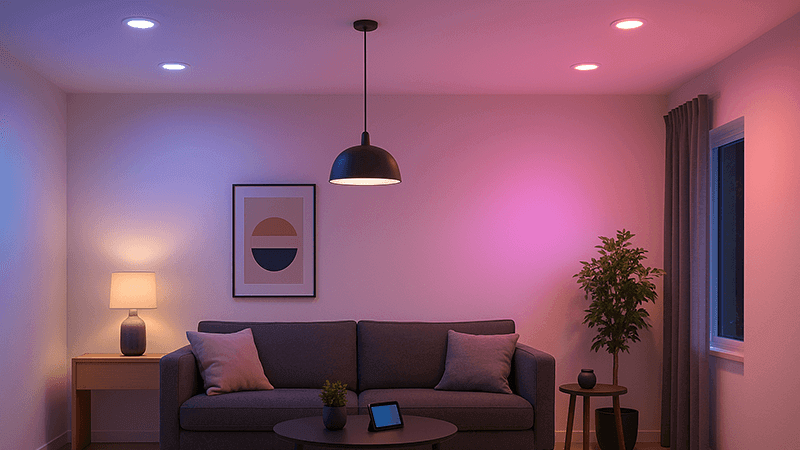
A smart downlight is more than a connected bulb. It’s a tool for "light environment reconfiguration." It automatically adjusts to natural light, reduces flicker fatigue, and learns your routines to provide optimal lighting, enhancing both comfort and the perception of your space.
Many people I talk to, like my client Shaz from the UAE, think smart lighting is just a fun gadget. They see the color-changing features and stop there. But I always tell them the real magic is happening behind the scenes. It’s about how these lights interact with you and your space. Let’s break down exactly how this technology works and what it means for your projects.
How do smart downlights work?
The inner workings of smart downlights can seem like a mystery. This uncertainty might make you hesitant to adopt them, fearing complex installations and unreliable performance for your clients.
Smart downlights connect wirelessly using protocols like Wi-Fi, Bluetooth, or Zigbee. This allows them to communicate with each other, a central hub, or your smartphone. Through an app, you can control brightness, color temperature, and automated schedules, creating a fully responsive lighting system.
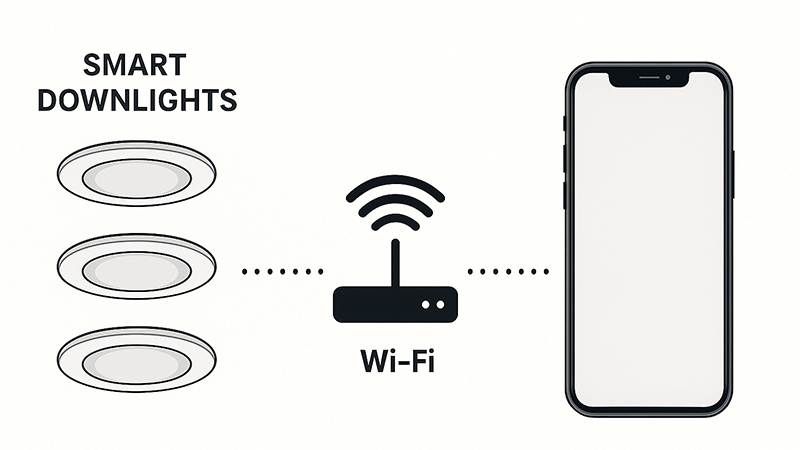
The real core of a smart downlight is not just the LED itself, but its ability to communicate and react. This system has a few key components that work together. I always explain this to my partners to demystify the technology.
Connectivity Protocols
The first step is connection. Smart lights use wireless signals to talk to a controller, which can be your phone, a smart speaker, or a dedicated hub. The most common protocols have different strengths.
| Protocol |
Best For |
Key Feature |
| Wi-Fi |
Simple setups |
Connects directly to your home router. No hub needed. |
| Bluetooth Mesh |
Small areas, single rooms |
Creates a local network between lights. Good range within its network. |
| Zigbee / Z-Wave |
Whole-home systems |
Requires a hub. Creates a powerful, dedicated mesh network that doesn’t slow your Wi-Fi. |
For most projects, I find Zigbee offers the most robust and scalable solution, especially in commercial settings where reliability is paramount. It ensures the lighting system operates independently of the Wi-Fi network traffic.
The Role of Sensors and Automation
This is where smart lighting truly shines. The best systems incorporate sensors to gather information about the environment. An ambient light sensor can detect how much daylight is entering the room. As the sun sets, the smart downlights can automatically increase their brightness to maintain a consistent light level. Motion sensors can turn lights on when you enter a room and off when you leave. Some advanced systems even learn your activity patterns. For example, they can provide a very dim, warm light for a midnight trip to the bathroom, just enough to see without being jarringly bright. This "light environment reconfiguration" is the real value, creating a space that responds to you.
What are the disadvantages of smart lighting?
You worry that investing in smart lighting will lead to technical headaches. The fear of complex setups, cybersecurity risks, or high costs can make you stick with traditional options.
The main disadvantages include a higher initial cost compared to standard bulbs, a reliance on a stable Wi–Fi or network connection, and potential security vulnerabilities if not set up correctly. Some users also find the initial setup and app configuration to be complex.
As an engineer and manufacturer, I believe in being transparent about a product’s limitations. Smart lighting is powerful, but it’s not without its challenges. It’s my job to help clients like Shaz understand and navigate these potential issues before they commit to a large project.
Cost and Complexity
The most obvious drawback is the upfront cost. A single smart downlight is more expensive than its non-smart counterpart. This is because it contains extra hardware: a wireless chip, a processor, and more advanced driver electronics. When you are outfitting an entire home or a large commercial space, this cost difference adds up. Also, the setup can be more involved. You don’t just flip a switch; you need to connect each light to a network, configure it in an app, and set up scenes or automations. For someone not comfortable with technology, this can be a frustrating experience. That is why choosing a system with a user-friendly app and clear instructions is so important.
Reliance on Network and Security
A smart light is only as reliable as the network it’s connected to. If your Wi-Fi goes down, you might lose control of your lights through the app. While most can still be operated by a physical switch, you lose all the "smart" functionality. This is a critical consideration in commercial projects where lighting is essential. Furthermore, any device connected to the internet is a potential security risk. It’s crucial to choose products from reputable manufacturers who provide regular security updates. I always advise my clients to use strong, unique passwords for their lighting system accounts and to secure their home network properly. These simple steps can prevent most security issues.
Is it worth installing downlights?
You’re designing a space and question if downlights are the right choice. You might think they create a harsh, clinical feel or worry about the ceiling looking cluttered and dated.
Yes, it is worth installing downlights, especially modern LED ones. They offer excellent, focused illumination for tasks and accent lighting. When planned correctly with proper spacing and beam angles, they create a clean, minimalist aesthetic and can make a room feel larger and more modern.
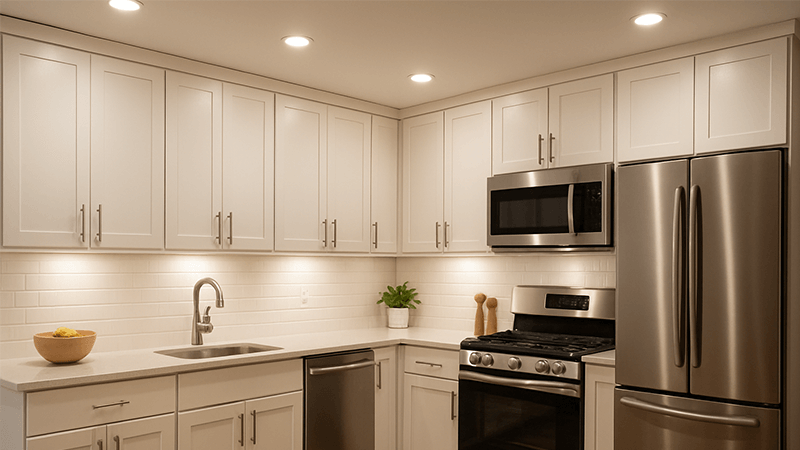
I’ve been in the lighting industry for my entire career, and I’ve seen trends come and go. But downlights have remained a staple for a good reason. They are incredibly versatile. The mistake many people make is thinking of them only as a tool for general, uniform brightness. The real art is in how you use them to shape a space.
General vs. Task vs. Accent Lighting
Downlights are not a one-size-fits-all solution. Their function depends entirely on placement and specifications.
- General Lighting (Ambient): This is when you space downlights in a grid to provide overall illumination. This is common, but it can be flat if it’s the only light source. Modern smart downlights help by allowing you to adjust the warmth and intensity to create a more inviting atmosphere.
- Task Lighting: This is where downlights excel. Placing them over kitchen counters, a reading nook, or a home office desk provides direct, focused light right where you need it. This is more efficient and effective than trying to light the entire room brightly.
- Accent Lighting: You can use "wall washer" downlights or ones with a narrow beam angle to highlight architectural features, artwork, or a textured wall. This adds depth and visual interest to a room, making it feel more dynamic and professionally designed.
The Power of Beam Angle
The key to unlocking a downlight’s potential is understanding beam angle. This is something I work on closely with our product designers. A narrow beam angle (e.g., 24 degrees) is perfect for accenting a small object. A wider angle (e.g., 60 degrees) is better for general illumination. But here is the secret: you can use the beam angle to manipulate the perception of space. In a room with a low ceiling, using downlights with a wider beam and washing the walls with light can make the space feel taller and more open. In a large, open-plan space, using narrower beams to create pools of light can define zones and make the area feel more focused and intimate.
Is it safe to leave smart lights on?
You might worry about the safety of leaving smart lights on all the time. Concerns about overheating, fire risk, or high energy consumption can make you hesitant to use them for extended periods.
Yes, it is completely safe to leave modern LED smart lights on. They are designed for continuous operation and produce very little heat compared to old incandescent bulbs, eliminating fire risk. They are also highly energy-efficient, so leaving them on uses minimal electricity.
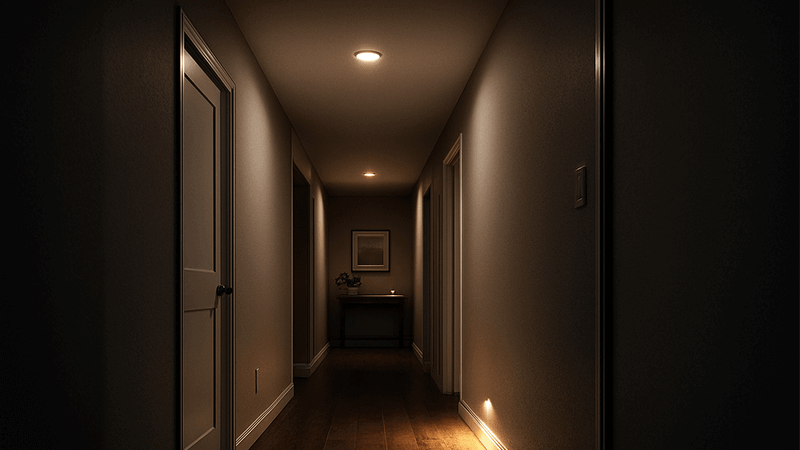
This is a question I get often, and it comes from our experience with old lighting technology. We all remember how hot a traditional 100-watt incandescent bulb could get. You wouldn’t dare leave one on near curtains or fabric. But LED technology, which is the foundation of all smart lights, is fundamentally different and much safer.
Heat and Fire Risk
The biggest difference is heat generation. Old incandescent bulbs were incredibly inefficient; about 90% of the energy they used was converted into heat, not light. This made them a genuine fire hazard. LED lights are the complete opposite. They are highly efficient at converting electricity into light. While they do produce some heat, it’s a very small amount, and it’s managed by a component called a heat sink, which is built into the downlight’s body. I oversee the design and testing of these heat sinks in my factory. We ensure they can effectively dissipate any heat, even when running 24/7. The surface of an LED downlight will feel warm at most, but never hot enough to pose a fire risk. This makes them perfectly safe to leave on for security lighting or as a night light.
Energy Consumption and Lifespan
Another concern is energy use. Leaving lights on all day sounds expensive. Again, with LEDs, this is not a major issue. A typical smart LED downlight might use between 5 and 9 watts of power. In comparison, an old halogen downlight used around 50 watts to produce similar brightness. You could run about 7 LED downlights for the same energy cost as one old halogen bulb. So, leaving a few smart lights on at a low brightness level for ambiance or security uses a very small amount of electricity. Furthermore, the lifespan of an LED is not significantly impacted by leaving it on. Unlike old bulbs that would burn out quickly, an LED’s lifespan is rated in tens of thousands of hours. Leaving it on continuously is well within its designed operating parameters.
Conclusion
Smart downlights are more than just a trend. They are a powerful tool to reconfigure a light environment, enhance safety, and improve how a space feels and functions.