Struggling to pick the truly efficient downlight? Choosing based on spec sheets alone wastes money. The best solution is not just about numbers; it’s about the right fit for your project.
The most efficient downlight is not always the one with the highest lumens per watt on paper. True efficiency comes from a perfect match to your space, usage patterns, and controls. A customized solution with smart controls often outperforms standard high-efficiency models in real-world energy savings.
I’ve spent years in the lighting industry, from the factory floor to founding my own company, iPHD. I’ve learned that efficiency is a complex topic. It goes far beyond the numbers you see on a box. To really understand efficiency, we need to break it down into smaller, more specific questions. Let’s explore what makes a downlight truly efficient for your needs and how to choose the right one for your projects.
What are the most energy-efficient downlights?
Searching for the most energy-efficient downlight type? The options can be overwhelming and confusing. The secret is knowing which performance metrics truly matter for saving energy and money.
The most energy-efficient downlights are integrated LED fixtures with high-quality drivers, excellent thermal management, and application-specific optics. These factors work together to maximize light output (lumens) while minimizing energy consumption (watts), resulting in the highest lumens per watt (lm/W) rating and longest lifespan.
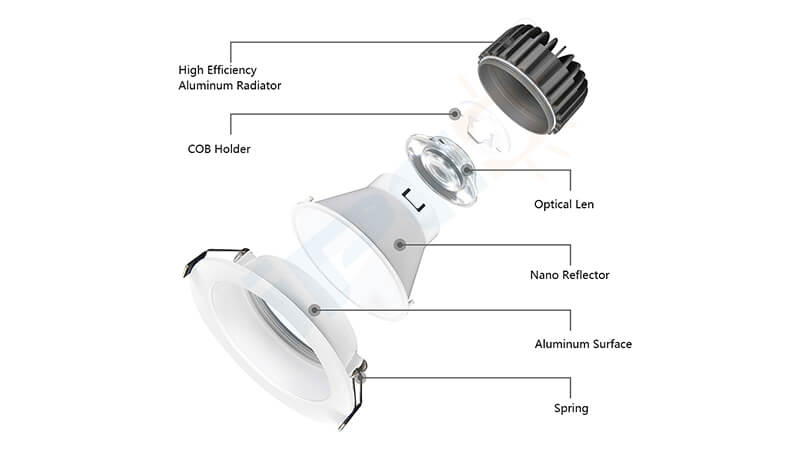
When my clients, like Shaz, a purchasing manager in the UAE, ask me this, I tell them to look past brand names and focus on the complete system. True efficiency is a combination of several key components working in harmony. The LED chip itself is just the starting point. A high-quality driver is essential because it converts AC power to DC power with minimal energy loss. Poor drivers can waste up to 20-30% of the energy before it even reaches the LED. Next is thermal management. LEDs generate heat, and if that heat isn’t drawn away effectively by a well-designed heat sink, the LED’s performance and lifespan will drop dramatically. Finally, the optics—the lens and reflector—are critical. They direct the light exactly where it’s needed. A downlight with a generic, wide beam in a high-ceilinged corridor wastes a huge amount of light and energy. The most efficient downlight isn’t just one component; it’s the sum of its well-engineered parts.
I remember working on a hotel project where the client wanted "the most efficient downlights" for their long corridors. Instead of just selling them the fixture with the highest lm/W on paper, we analyzed their specific needs. We designed a custom downlight with a precise 36° beam angle. This focused the light only on the walkway, not the walls. We also integrated a microwave motion sensor with a standby dimming function. The result? Even though the downlight had the same wattage as their previous standard model, the new system used 62% less energy in practice. This is because the lights were only at full brightness when someone was present. This experience taught me that real-world efficiency is about intelligent application, not just raw specifications.
Is OLED or LED more energy-efficient?
Do you feel pressured to choose between new lighting technologies like OLED and proven ones like LED? Making the wrong choice can impact your project’s budget and long-term performance.
Currently, LED technology is significantly more energy-efficient than OLED for general illumination purposes like downlights. LEDs offer much higher lumens per watt (often exceeding 150 lm/W), while commercial OLED panels are typically in the 40-90 lm/W range. LEDs also have a longer lifespan and lower cost.
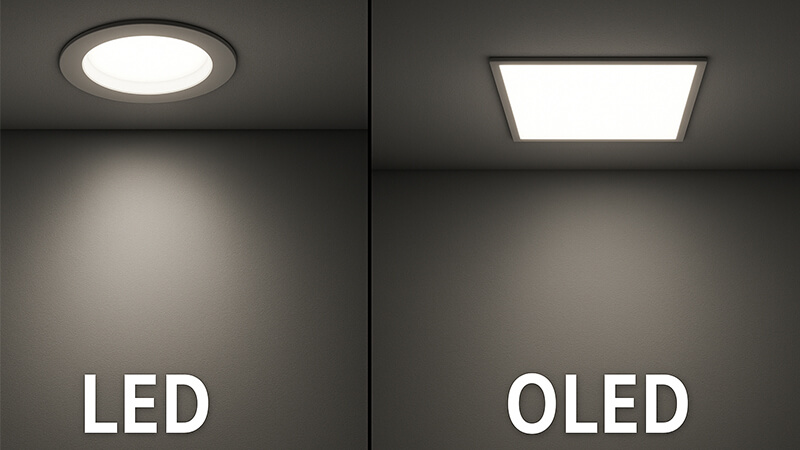
As a manufacturer, I constantly evaluate new technologies. OLED (Organic Light Emitting Diode) is fantastic technology. It produces a beautiful, soft, and diffuse light from a surface, which is great for reducing glare. It’s also incredibly thin and can be flexible, opening up amazing design possibilities. However, when we talk strictly about energy efficiency for functional lighting like downlights, LED is the clear winner today. The core job of a downlight is to push a high volume of light downward, and LEDs excel at this. They are point sources of light that can be easily controlled with optics to create focused beams. This makes them highly efficient for task, accent, and general lighting. OLEDs, being surface emitters, are less effective at creating directional light.
To make this clearer for purchasing managers like Shaz, I often use a simple table to compare the two technologies for downlight applications.
| Feature |
LED (Light Emitting Diode) |
OLED (Organic Light Emitting Diode) |
| Efficiency (lm/W) |
Very High (100-200+ lm/W) |
Moderate (40-90 lm/W) |
| Light Source Type |
Point Source (Directional) |
Surface Source (Diffuse) |
| Best Application |
General, Task, Accent Lighting |
Decorative, Low-Glare Ambient Lighting |
| Lifespan (L70) |
High (50,000+ hours) |
Moderate (20,000-40,000 hours) |
| Cost |
Low to Moderate |
High |
While my factory, iPHD, focuses on high-quality LED solutions, we keep a close eye on OLED. I believe its efficiency will improve over time. For now, if your primary goal is the highest energy efficiency and performance in a downlight or ceiling light, LED is the undisputed choice. OLED is a great option for specialty decorative fixtures where budget is less of a concern and the unique aesthetic is the main priority.
What is the most energy-efficient ceiling light?
Are you trying to find the most efficient ceiling light for a large project? With so many options, it’s easy to get lost and make a costly mistake.
The most energy-efficient ceiling light is typically an integrated LED panel or a smart downlight system. LED panels provide broad, uniform light with high efficiency, while smart downlights offer customized control, dimming, and scheduling to dramatically reduce energy use in real-world scenarios.
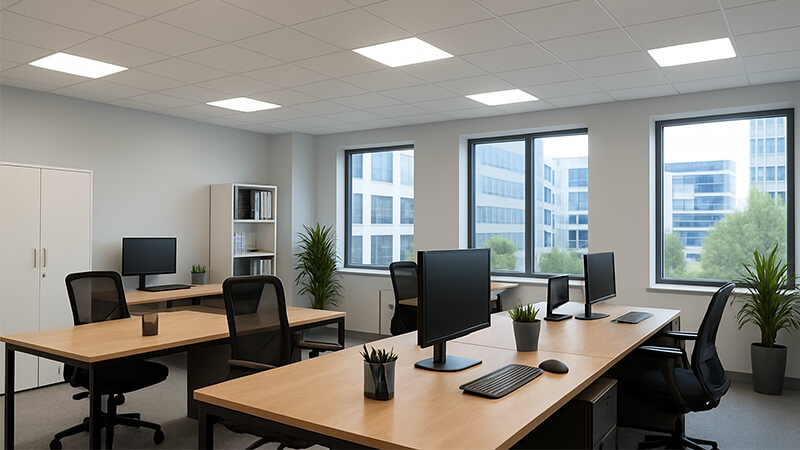
The term "ceiling light" is very broad, so the most efficient choice depends heavily on the space. For a large, open office, an integrated LED panel light is often the top contender. These fixtures are designed to replace traditional fluorescent troffers. They deliver smooth, even illumination across a wide area with excellent lm/W ratings. They eliminate dark spots and create a comfortable working environment, all while consuming minimal power. Their efficiency comes from spreading light widely and evenly from a large surface. At iPHD, we produce panels that achieve over 130 lm/W, which represents a huge energy saving compared to older technologies.
However, for spaces like corridors, meeting rooms, or retail environments, the answer changes. Here, a system of smart LED downlights is often far more efficient. This goes back to my hotel corridor example. While a single LED panel could light the corridor, it would light the entire space continuously. A system of smart downlights with motion sensors only lights the specific area being used, and only when it’s needed. This level of control is where the biggest energy savings are found. True efficiency isn’t just about the hardware; it’s about the intelligence of the system. I always advise clients to think about how the space is actually used. Is it occupied 24/7, or only intermittently? Does the required light level change during the day? Answering these questions leads to the truly most efficient solution, which is often a smart, controllable system rather than just a single type of fixture.
What is the best energy rating, A or G?
Confused by the new A-G energy labels? It’s hard to know if you’re choosing a truly efficient product or just getting lost in a new rating system.
On the new European energy labels, ‘A’ is the best and most energy-efficient rating, while ‘G’ is the worst and least efficient. This simplified A-G scale makes it much easier for buyers to quickly compare the energy consumption of different lighting products at a glance.
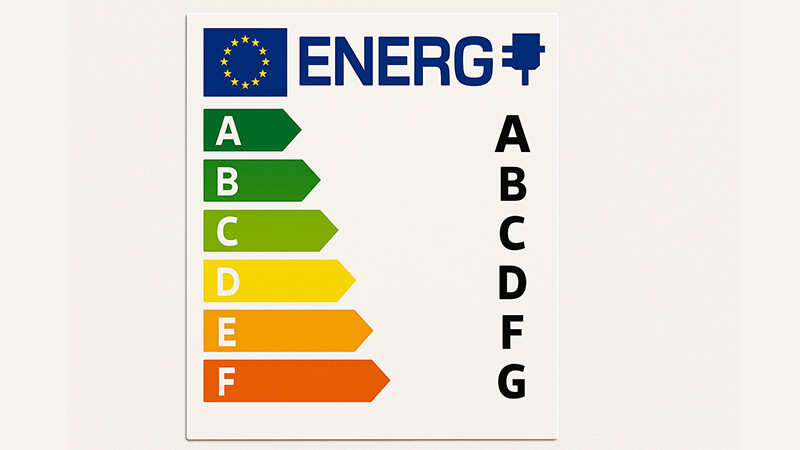
As a manufacturer exporting to many regions, staying on top of regulations is part of my job. The European Union updated its energy labeling system in 2021, and it has caused some confusion. The old system had ratings like A++, A+, and A. Over time, nearly every LED product was in one of these top categories, which made it difficult to tell the truly exceptional products from the merely good ones. The new system rescaled everything to a simple A to G range.
The key thing to understand is that the standards for each letter are now much higher. A product that was rated A++ on the old scale might now be a C or D on the new scale. This doesn’t mean the product got worse; it means the scale got stricter. The goal was to leave room at the top (A and B ratings) for future innovations in energy efficiency. When I explain this to purchasing managers, I emphasize that they should look for products rated as high as possible on the new scale.
Here is a simplified breakdown of the new A-G scale for lighting:
| New Rating |
General Efficiency Level |
Typical Technology |
| A |
Exceptionally High |
The most advanced, cutting-edge LEDs |
| B |
Very High |
High-performance, premium LED products |
| C |
High |
Good quality, standard LED products |
| D |
Good |
Standard LED products |
| E |
Average |
Basic LED lamps, older LED designs |
| F |
Low |
Inefficient LEDs or legacy tech |
| G |
Very Low |
Outdated technology (e.g., some halogens) |
For any large-scale project, specifying products with a rating of D or higher on the new scale is a good starting point. For clients who want the absolute best performance and long-term energy savings, aiming for B or C is the right strategy. Currently, very few products on the market can achieve the top ‘A’ rating, as it is reserved for the next generation of lighting technology.
Conclusion
The most efficient downlight is not a single product, but a solution. It is the one perfectly adapted to your space, usage patterns, and control needs for maximum real-world savings.