Struggling with downlight brightness? Worried about a space that’s too dim or glaringly bright? It’s a common and costly problem that can ruin a project’s atmosphere.
For general living areas, aim for 400-600 lumens per square meter. Kitchens and workspaces need more, around 700-800 lumens. But remember, the lumen number on the box isn’t the whole story. Factors like installation and quality can drastically reduce the effective light you actually see.

You’ve probably seen spec sheets with huge lumen numbers. It’s tempting to think more is always better. But my years in the factory have taught me that true quality lighting is about precision, not just raw power. The number on the box is just the starting point. Let me show you what those numbers really mean for your project and how to get the lighting you actually need.
How bright should downlights be?
Choosing downlight brightness can feel like a guessing game. Get it wrong, and the entire atmosphere of a room is ruined. You need a reliable way to calculate this.
The ideal brightness depends entirely on the room’s function. Use a simple formula: Room Area (m²) x Recommended Lux Level = Total Lumens Needed. For example, a 15m² living room needing 200 lux requires 3000 total lumens from all your downlights combined.
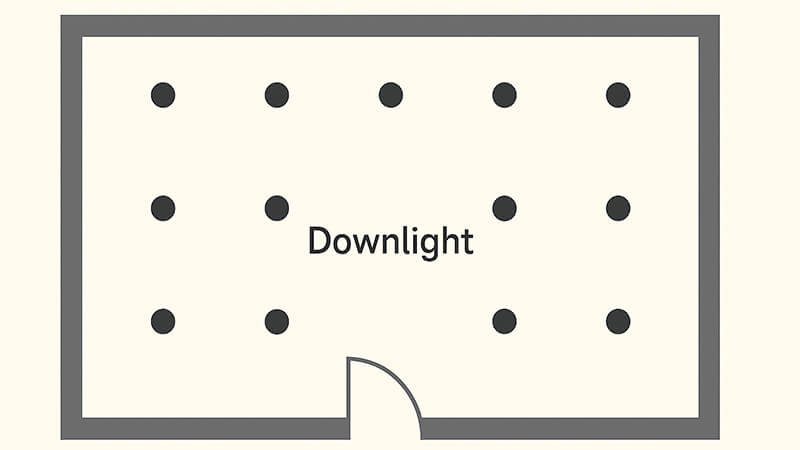
Let’s dive deeper into this calculation. The formula is your best friend when planning a lighting layout. It removes the guesswork and gives you a solid, data-driven starting point. However, the key is using the right "Recommended Lux Level" for each specific space. Every room has a different purpose, and its lighting should reflect that. A cozy bedroom needs a much softer light than a busy kitchen workshop.
I always advise my clients, including experienced purchasers like Shaz, to start with a table of recommended values. It’s a tool we use in-house to guide our OEM/ODM projects.
Recommended Lux Levels by Room Type
| Room Type |
Primary Function |
Recommended Lux Level |
Example Calculation (12m² Room) |
| Living Room |
Relaxation, Socializing |
150 – 200 lux |
12m² x 200 lux = 2400 lumens |
| Kitchen |
Task-heavy, Food Prep |
300 – 500 lux |
12m² x 400 lux = 4800 lumens |
| Bedroom |
Rest, Reading |
100 – 150 lux |
12m² x 150 lux = 1800 lumens |
| Bathroom |
Grooming, Tasks |
250 – 400 lux |
12m² x 300 lux = 3600 lumens |
| Home Office |
Focus, Computer Work |
300 – 500 lux |
12m² x 400 lux = 4800 lumens |
Remember, this total lumen value is what you need to achieve in the entire room. You will divide this number by the quantity of downlights you plan to install. So, for that 2400-lumen living room, you could use six 400-lumen downlights or four 600-lumen downlights. The choice depends on your desired layout and beam angle.
Is 3000 lumen too bright?
You see a 3000-lumen downlight and wonder if it’s pure power or just plain overkill. Installing a light that’s too bright can create a harsh, clinical environment, causing discomfort and eye strain.
Yes, a single 3000-lumen downlight is extremely bright for most standard residential rooms. It’s more suitable for commercial spaces with very high ceilings, like retail stores, warehouses, or large office atriums where light needs to travel a long distance.
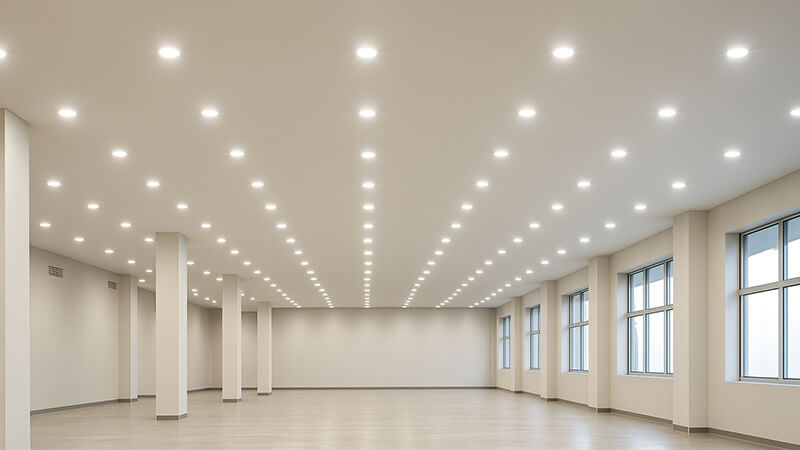
Let’s put 3000 lumens into perspective. A traditional 100-watt incandescent bulb produced about 1600 lumens. A 3000-lumen downlight is almost double that. Placing one in a standard 2.5-meter ceiling bedroom would feel like being under a spotlight. It’s not comfortable. However, that same downlight in a 6-meter high hotel lobby might be perfect. This is where context is everything.
I had a case with a distributor who wanted to win a contract for a new car showroom. They focused solely on hitting a high lumen number, thinking "brighter is better" to make the cars sparkle. They installed 3000-lumen downlights throughout. The result? The glare was so intense that it created harsh reflections on the cars, making them look cheap. We had to work with them to develop a layered solution. We used lower-lumen, wider-beam downlights for general ambiance and added high-CRI, narrow-beam spotlights to highlight specific vehicles. The total lumens in the space went down, but the quality of the light went way up.
When to Consider 3000 Lumens
- Ceiling Height: This is the most critical factor. For ceilings over 4 meters (about 13 feet), you need higher lumen output to ensure enough light reaches the floor.
- Task-Specific Areas: Think about a commercial kitchen or a detailed manufacturing workshop. Here, intense, clear light is a matter of safety and precision, making 3000 lumens a viable option directly over workstations.
- Large Open Spaces: In places like airport terminals or convention centers, powerful downlights are necessary to illuminate vast areas evenly from a great height.
For most applications, it’s far better to use multiple downlights with lower, more appropriate lumen outputs. This gives you more even light distribution and avoids uncomfortable "hot spots."
How many lumens is overkill?
You’re worried about wasting money and energy on light that nobody needs. Over-lighting is a real problem. It creates glare, washes out colors, and can even cause headaches for occupants.
Overkill is subjective and depends on the application. Generally, exceeding the recommended lux levels by more than 30% is overkill. For a living room that needs 200 lux, providing 300 lux is excessive and creates an unpleasant, sterile atmosphere.
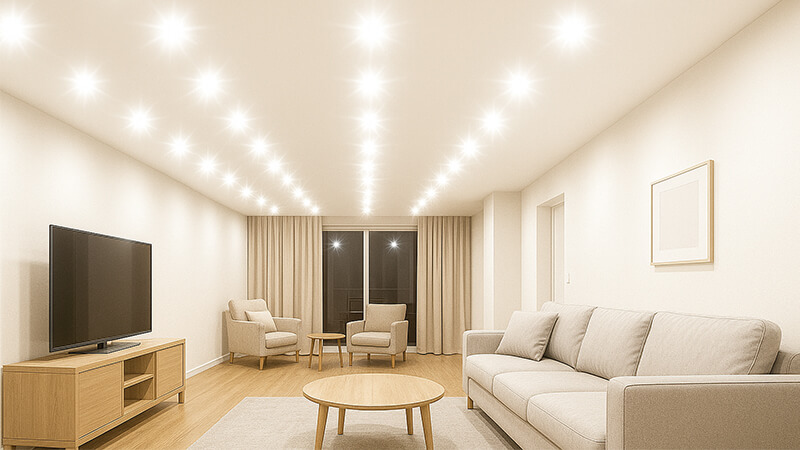
The biggest mistake I see is focusing only on the lumen rating on the box without considering the effective lumens. A cheap 1000-lumen downlight might only deliver 600 lumens into the room. A high-quality 800-lumen downlight might deliver 750 lumens. This is where the real engineering comes in.
As a manufacturer, I know exactly where those lumens get lost. Let me share some inside knowledge. A lumen rating is measured in a perfect lab environment. The real world is different.
Where Do the Lumens Go?
| Factor of Light Loss |
Description |
Potential Lumen Loss |
| Deep Recessed Design |
The deeper the light source is set into the housing, the more light gets trapped inside the fixture itself before it can even exit. |
15% – 30% |
| Low-Quality Reflector |
The cone that directs the light is critical. A poorly designed or coated reflector absorbs light instead of reflecting it. |
20% – 40% |
| Poor Heat Dissipation |
LEDs get hot. If the heat isn’t managed by a good heat sink, the LED’s performance drops fast. This is called thermal droop. |
10% – 15% (after 30 mins) |
| Lens/Diffuser Quality |
A cheap, cloudy plastic diffuser can block a surprising amount of light compared to a high-clarity glass or polycarbonate lens. |
5% – 15% |
I once had a client who was comparing my 850-lumen downlight to a competitor’s 1100-lumen model. The competitor’s price was lower. He said, "Michael, why should I pay more for fewer lumens?" I sent him samples of both. We set them up side-by-side. My downlight, with its superior reflector and heat sink, was visibly brighter in the room after just ten minutes. The competitor’s fixture got hot, and the light started to dim. My client learned a valuable lesson: the number on the box is marketing. The light in the room is reality. This is why you cannot just look at the lumen spec; you must look at the design and quality of the entire fixture.
How many lux is 3000 lumens?
You have a 3000-lumen downlight and need to know how bright the surface below it will be. This isn’t a simple conversion. Lumens measure total light output, while lux measures light intensity on a specific area.
You cannot directly convert lumens to lux without knowing the beam angle and the distance to the surface. A 3000-lumen downlight with a narrow 15° beam will create a very high lux level in a small spot, while the same downlight with a wide 90° beam will create a lower lux level over a larger area.
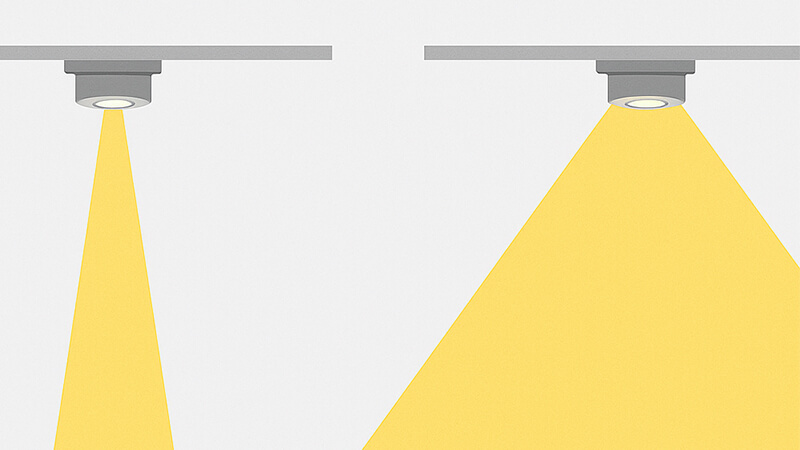
This is the concept that separates basic lighting from professional lighting design. It’s all about controlling where the light goes. Think of it like water from a hose. 3000 lumens is the total amount of water coming out. The beam angle is the nozzle. You can have a powerful, narrow jet (high lux, small area) or a gentle, wide spray (low lux, large area). The total amount of water (lumens) is the same, but its effect (lux) is completely different.
Let’s look at a practical example. Imagine a single 3000-lumen downlight mounted 3 meters above the floor.
Lux Levels from a 3000 Lumen Downlight (at 3 meters)
| Beam Angle |
Illuminated Area (Approx. on Floor) |
Lux Level at Center (Approx.) |
Best Use Case |
| 15° (Spot) |
0.5 m² |
~4244 lux |
Highlighting artwork, retail display |
| 36° (Flood) |
3.3 m² |
~718 lux |
General lighting from high ceiling |
| 60° (Wide Flood) |
9.6 m² |
~265 lux |
Broader lighting in large rooms |
| 90° (Very Wide) |
28.3 m² |
~90 lux |
Ambient fill light from low ceiling |
Note: These are simplified calculations. Real-world values are affected by reflector efficiency and environmental factors.
As you can see, the same 3000 lumens can produce anything from an intensely bright spot to a soft, wide pool of light. This is why, as a manufacturer, I stress the importance of a complete spec sheet. A purchasing manager like Shaz shouldn’t just ask "How many lumens?" He should ask, "What is the lumen output, what is the beam angle, and what is the light output ratio (LOR) of the fixture?" That complete picture allows him to source the right product for the job, ensuring the final installation delivers the precise lux level the designer intended. It turns a simple purchase into a calculated, professional decision.
Conclusion
Ultimately, lumens are just one piece of the puzzle. True quality lighting combines precise brightness, the right beam angle, excellent color rendering, and a smart, layered design.