Tired of installing new LED downlights only to have them flicker? You did the math and stayed under the dimmer’s limit, but the annoying flicker just won’t stop.
The number of LED downlights on one dimmer depends on compatibility, not just wattage. The correct number is the maximum that works without any flicker. Mismatched dimmers and LED drivers cause flicker, even with just one light, making compatibility testing the only way to be certain.
You’ve probably heard the standard advice. Add up the wattage of your LED lights and make sure it’s less than the dimmer’s maximum load. It sounds simple and logical. But in my years of manufacturing and troubleshooting, I’ve seen this simple math lead to countless frustrated calls and flickering lights. The real secret isn’t in the calculation. It’s in the connection between the dimmer and the light itself. Let’s explore why this compatibility is far more important than simple arithmetic and how you can get it right every time.
How many LED lights can I put on a dimmer switch?
You calculate the dimmer’s capacity and buy the right number of lights. But when you install them, they strobe like a disco ball. The problem isn’t your math.
The number of LED lights for a dimmer is limited by its wattage rating and the lights’ total wattage. For example, a 400W dimmer can theoretically support forty 10W LEDs. But you should only load it to 80% capacity, so thirty-two 10W LEDs is a safer maximum.
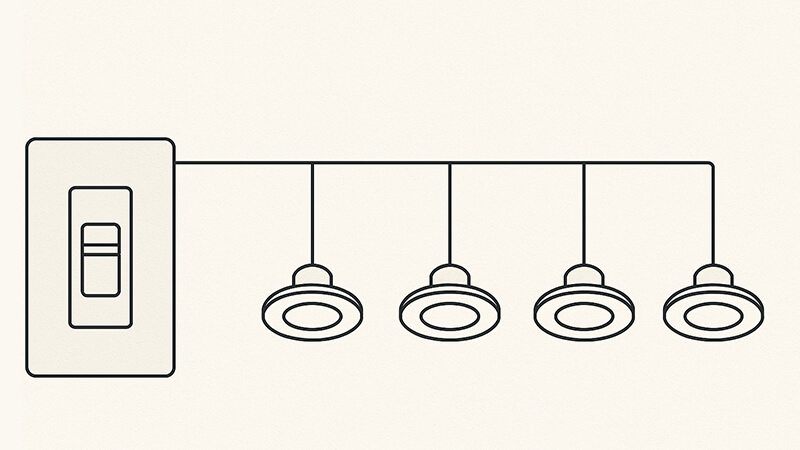
Let’s start with the classic method everyone uses. It’s a good starting point, but it’s not the whole story. The math seems straightforward. You look at the dimmer switch, and it has a maximum wattage rating, let’s say 400W. Then you look at your LED bulbs, and they are 10W each. Simple division tells you 400 divided by 10 equals 40 lights. So, you can connect 40 lights, right? Not quite.
The 80% Rule
First, there’s a safety and performance rule in the electrical world. You should never load a circuit to its absolute maximum. A good rule of thumb is to only use 80% of the rated capacity. This buffer accounts for small power surges, heat, and ensures the dimmer doesn’t get overworked, which can shorten its lifespan.
- Dimmer’s Max Rating: 400W
- 80% Safe Load: 400W * 0.80 = 320W
- LED Light Wattage: 10W
- Safe Number of Lights: 320W / 10W = 32 lights
So, the "math" answer is 32 lights. This calculation prevents you from overloading the dimmer, which is important for safety and longevity. But it does not guarantee a flicker-free performance. This is where most people stop, and it’s why they run into trouble. The real issue is much deeper.
The Hidden Problem: Inrush Current
When you first turn on an LED light, it draws a tiny, split-second burst of high current. This is called "inrush current." It’s much higher than the light’s normal operating current. If you have 30 lights turning on at once, that combined inrush current can be a huge shock to the dimmer’s internal components. Even if the total running wattage is well within the 80% safe zone, this initial jolt can trip the dimmer’s protective circuits or cause performance issues, including flicker or a complete failure to turn on. Cheaply made LED drivers are often the biggest offenders here. This is why sticking to the math alone is a recipe for potential failure.
How many LED downlights per dimmer?
Your project requires smooth dimming for multiple downlights. You follow the wattage rules, but the lights still buzz or flicker, especially at low levels. What’s going wrong with the setup?
The number of LED downlights per dimmer is dictated by the compatibility between the dimmer’s technology (like TRIAC) and the downlight’s driver. A dimmer might handle ten downlights from Brand A perfectly but fail with five from Brand B due to electronic conflicts, regardless of wattage.
Now we get to the heart of the matter. The reason a dimmer that should work on paper fails in practice is almost always a mismatch in technology. It’s not about how much power, but how that power is delivered and controlled. The two key components are the dimmer itself and the driver inside each LED downlight.
Leading-Edge vs. Trailing-Edge Dimmers
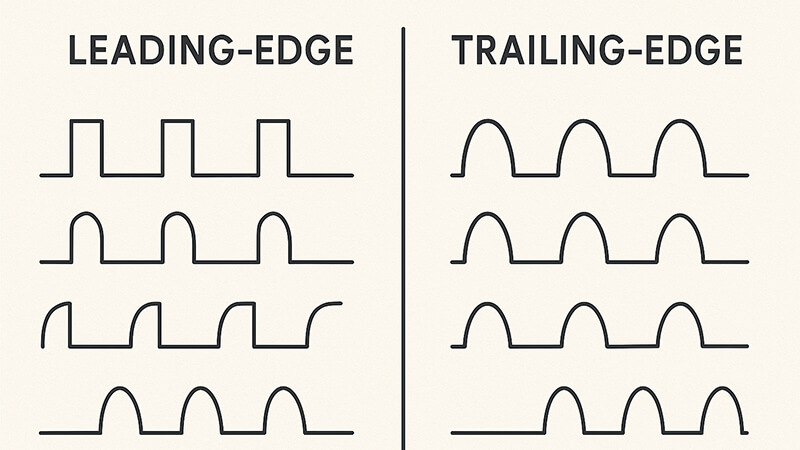
Most dimmers in older homes are "leading-edge" dimmers. They were designed for old-school incandescent bulbs. These dimmers work by cutting off the front part of the AC power waveform to reduce the voltage. They use a component called a TRIAC, which is simple and cheap.
LEDs, however, are complex electronics. They prefer a smoother power curve. "Trailing-edge" dimmers were designed specifically for them. These dimmers cut off the back part of the power waveform, which is much gentler on the LED’s driver circuitry. This results in smoother dimming, no buzzing, and a lower minimum dimming level.
Here’s a simple breakdown:
| Dimmer Type |
Technology |
Best For |
Common Issues with LEDs |
| Leading-Edge |
TRIAC-based, cuts front of waveform |
Incandescent bulbs, magnetic transformers |
Buzzing, flickering, limited dimming range, high minimum brightness |
| Trailing-Edge |
MOSFET or IGBT-based, cuts back of waveform |
LED bulbs, electronic transformers |
Smoother dimming, no buzz, wider dimming range, lower minimum brightness |
When you connect a modern LED downlight to an old leading-edge dimmer, the driver inside the LED tries to make sense of the choppy power signal. This conflict is what creates the flicker and buzz. The driver and the dimmer are speaking different languages. It’s why one brand of downlight might work okay while another flickers uncontrollably on the same exact dimmer.
How many LED downlights can I have on one switch?
You’re planning a new layout and want lots of downlights for bright, even coverage. The question is, can you put them all on one simple on/off switch without any issues?
You can connect many LED downlights to one standard switch, as long as their total wattage doesn’t exceed the switch’s rating (typically 1800W for a 15A circuit). Unlike dimmers, compatibility is not an issue. The switch simply completes the circuit, delivering full power to the lights.
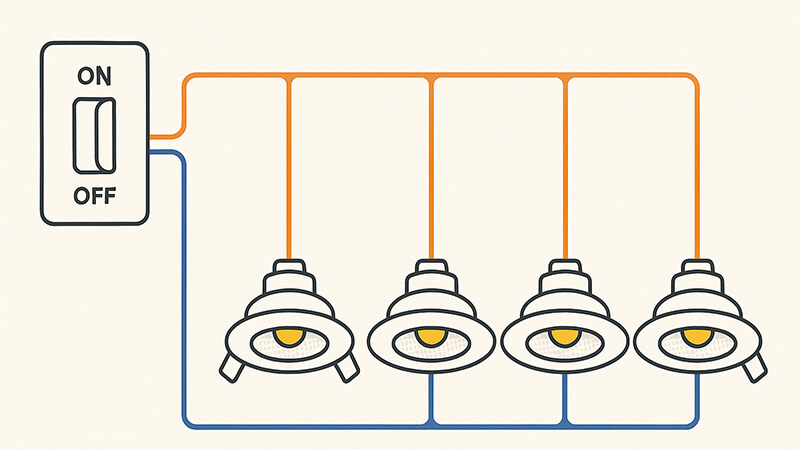
This question is much simpler to answer because we are removing the most complex part of the equation: the dimmer. A standard on/off switch is not a dimmer. Its job is purely mechanical. It either allows electricity to flow (ON) or it stops it (OFF). It doesn’t chop up the power waveform or try to communicate with the LED driver. It’s a simple gatekeeper for electricity.
Calculating for a Standard Switch
Because a standard switch doesn’t dim, the only limitation is the total electrical load it can handle. This is determined by the circuit breaker it’s connected to. In most residential settings, lighting circuits are 15 amps.
Here’s how to calculate the maximum load:
- Volts x Amps = Watts
- In the US, standard voltage is 120V. So, 120V x 15A = 1800W.
Using the same 80% safety rule we discussed earlier:
This 1440W is the total power you can safely put on that one circuit. Now, let’s see how many 10W LED downlights you can install:
- 1440W / 10W per downlight = 144 lights
That’s a huge number of lights! It’s very unlikely you would ever need to install 144 downlights on a single switch in a single room. For most projects, a standard switch can handle as many downlights as you would practically need. There are no compatibility issues, no waveforms to match, and no drivers to argue with the switch. The only concern is the total power draw, and with energy-efficient LEDs, that number is very high. This is why problems rarely occur with on/off switches but are very common with dimmers.
How many LED can lights can I put on one switch?
You’re using recessed "can" lights for a clean, modern look. How many can you wire together on the same circuit before you run into problems with a dimmer?
For dimmable LED can lights, the number you can put on one dimmer is determined by compatibility tests, not just math. Always test the specific can light model with the specific dimmer model. The only correct number is the one that guarantees zero flicker across the entire dimming range.
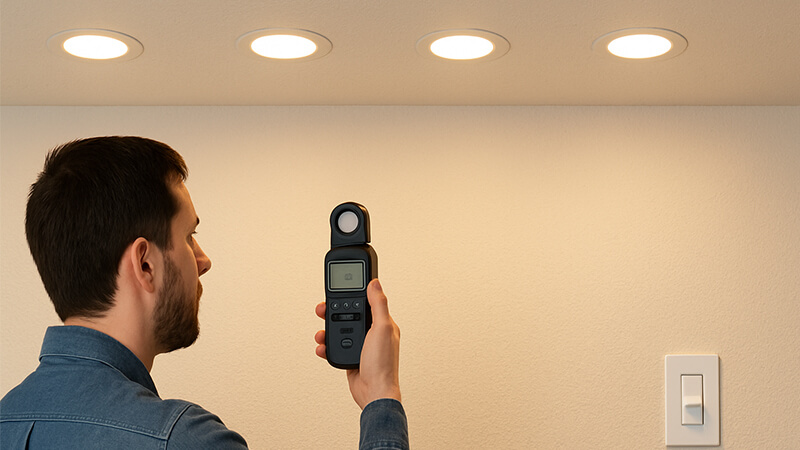
We’re back to the big issue: dimming. Whether you call them downlights, recessed lights, or can lights, the core challenge remains the same when a dimmer is involved. The term "can light" often refers to the housing that the light fits into, but the electronics behave the same. The real solution, the one we use in the industry to guarantee success, has nothing to do with calculations on paper. It’s all about real-world testing.
The Professional’s Method: Test, Don’t Guess
When a client asks me how many of our iPHD downlights they can put on a specific dimmer, I don’t give them a number based on wattage. I ask them for the exact model number of the dimmer they plan to use. Why? Because my engineers and I have already tested our lights with dozens of common dimmers on the market. We have compatibility lists.
This is the only way to be 100% sure. Here’s what that testing looks like:
- Bench Setup: We take one dimmer and connect a series of our downlights to it. We start with one light and go up to the dimmer’s maximum calculated load (e.g., 32 lights).
- Performance Test: At each stage, we run the lights through their full dimming range, from 100% down to 1%. We watch for any sign of flicker, strobing, or buzzing. We also check if the lights turn on instantly at low levels, which is a common failure point called "pop-on."
- Record Results: We record the maximum number of our lights that performed perfectly with that specific dimmer.
This compatibility data is gold. It tells us that our Model X downlight works perfectly with up to 15 units on a Lutron Model Y dimmer, but maybe only 10 units on a Leviton Model Z dimmer. The wattage calculations might have suggested 20 units would be fine, but the electronic reality proved otherwise. The "waveform" was the bottleneck, not the power. A dimmer that works perfectly with 10 of our lights might fail with just 5 lights from another brand.
So, the most important question you can ask your supplier is not "How many lights can I put on this dimmer?" but "Which dimmers have you tested with these lights, and what were the results?"
Conclusion
The right number of LEDs on a dimmer is the one that works flawlessly. Forget simple math. The secret is matching the dimmer and the LED driver to prevent flickering.