Struggling with static, lifeless lighting? Your space feels flat because fixed lights can’t adapt, leaving key features in the dark. Imagine having full control to direct light and transform your room’s atmosphere.
An adjustable downlight is a recessed light fixture with a movable head that can be tilted or swiveled. This lets you aim the light beam precisely onto artwork, architectural details, or work areas, offering dynamic, focused illumination instead of a generic, flat wash of light.
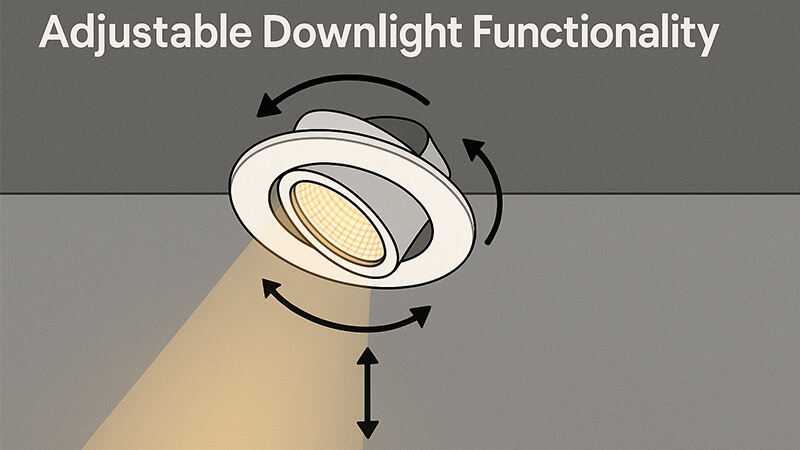
Most people see an adjustable downlight and just think about its tilting angle. They compare it to a fixed one and stop there. But after years of manufacturing these products, I can tell you that’s missing the entire point. This isn’t just another lighting product; it’s a dynamic space design tool. It answers the question of how to use light to shape, define, and bring a space to life. To really grasp this, we need to look closer at what makes it so different.
What Are Adjustable Downlights?
You’ve installed new downlights, but the room still lacks drama and focus. Important features are lost in the shadows, and the overall effect is underwhelming. This is the problem with fixed lighting. Adjustable downlights solve this by giving you precise control to aim the light exactly where it’s needed.
Adjustable downlights, often called gimbal or eyeball downlights, are fixtures that let you physically tilt and sometimes rotate the light source inside the housing. This core function enables you to direct light, making them ideal for accent lighting, task lighting, and highlighting specific features in a room.
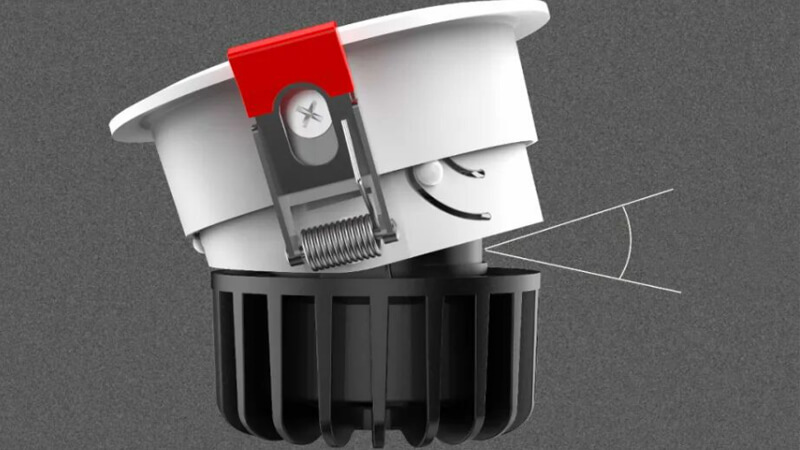
When my team and I work on a new design for an adjustable downlight, we’re not just thinking about a light source. We’re crafting a tool for designers. The real value isn’t in the light itself, but in its ability to be directed. This directional capability turns a simple light into an instrument for creating visual hierarchy and emotion in a space. You are no longer just lighting a room; you are painting with light. This is the fundamental shift in thinking that separates a basic lighting plan from a professional design. The ability to direct light is what allows a room to have different moods and functions. It empowers a designer to decide what the human eye sees first.
From Static to Dynamic: The Core Mechanisms
At its heart, the adjustability comes from its mechanical design. Understanding these simple mechanisms is key to understanding their application.
- Gimbal Downlights: These typically feature a frame that pivots on one or two axes. This allows the inner lamp to tilt. A single-gimbal tilts back and forth, while a double-gimbal offers more complex, multi-directional aiming.
- Eyeball Downlights: These have a more spherical, ball-like housing that swivels within the trim. They often offer a wide range of motion but can protrude more from the ceiling.
- Tilt and Rotation: The two primary specifications are the tilt angle (usually up to 30-45 degrees) and the rotation (often a full 360 degrees).
When a purchasing manager like Shaz specifies a downlight with a 30-degree tilt and 360-degree rotation, he’s not just listing numbers. He’s buying flexibility for a client who might want to move a painting from one wall to another or change the focus in a retail display next season. It’s about future-proofing the design of the space.
What Is a Recessed Adjustable Downlight?
You need a clean, minimalist ceiling, but you also want flexible, focused lighting. Traditional spotlights are too bulky, and fixed downlights are too rigid. This leaves you stuck between aesthetics and functionality. How do you get both?
A recessed adjustable downlight is a fixture installed flush within a ceiling, wall, or other surface, with its light source hidden from view. Its key feature is an internal mechanism that allows the light beam to be aimed, combining a clean, modern look with versatile, directional lighting.
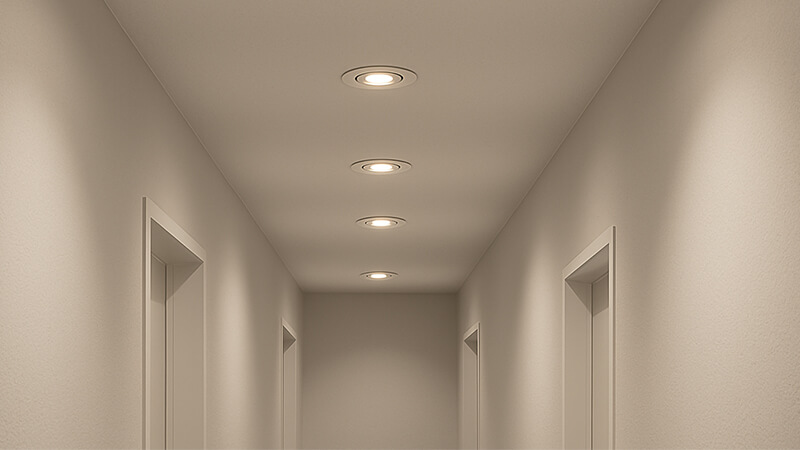
The word "recessed" is where the magic truly begins. By hiding the main housing of the fixture inside the ceiling, you remove the visual clutter. All you see is a clean trim and the light source itself. This minimalistic appearance is what architects and modern designers crave. But combining this clean aesthetic with adjustability creates the ultimate design tool. You get the sleek, unobtrusive look of a standard recessed downlight, but with the power to create focal points, wash walls with light, and adapt the lighting scheme without changing the physical fixture. It solves the core conflict between wanting a clean ceiling line and needing dynamic, functional light.
The Architect’s Choice: Blending In to Stand Out
When we manufacture recessed adjustable downlights, we obsess over the details of the trim, the reflector, and the smoothness of the tilting mechanism. Why? Because we know these fixtures are meant to disappear into the ceiling architecture. Their job is to perform without being seen.
Here is a breakdown of why this combination is so powerful for space design:
| Feature |
Fixed Recessed Downlight |
Recessed Adjustable Downlight |
Design Impact |
| Aesthetics |
Clean, minimalist, flush with ceiling. |
Clean, minimalist, flush with ceiling. |
Both maintain a modern, uncluttered ceiling line. |
| Functionality |
Provides general, downward ambient light. |
Provides directed, focused light. |
The adjustable version adds accent, task, or wall-washing capabilities. |
| Flexibility |
Static. The light goes where it’s installed. |
Dynamic. The light can be re-aimed as the room’s use changes. |
Future-proofs the space for new furniture layouts or artwork. |
| Atmosphere |
Creates a uniform, even layer of light. |
Creates contrast, drama, and visual interest. |
Allows for mood creation and guiding the eye to focal points. |
From a manufacturer’s perspective, the challenge is engineering a product that is both mechanically robust and visually discreet. The pivot must be smooth and hold its position over years of use, and the trim must integrate seamlessly. When we achieve this, we provide designers with a tool that enhances architecture rather than competes with it. The light from the fixture becomes the feature, not the fixture itself.
What Is the Difference Between Adjustable and Fixed Downlights?
Your project requires general room lighting, but also needs to highlight specific architectural details. Choosing the wrong downlight type could mean a flat, boring space or an inefficient, overly complex lighting plan. You need clarity.
The primary difference is control. A fixed downlight shines light straight down in a static beam, providing general illumination. An adjustable downlight has a tilting mechanism, allowing you to direct the light beam towards a specific object or surface for accent or task lighting.
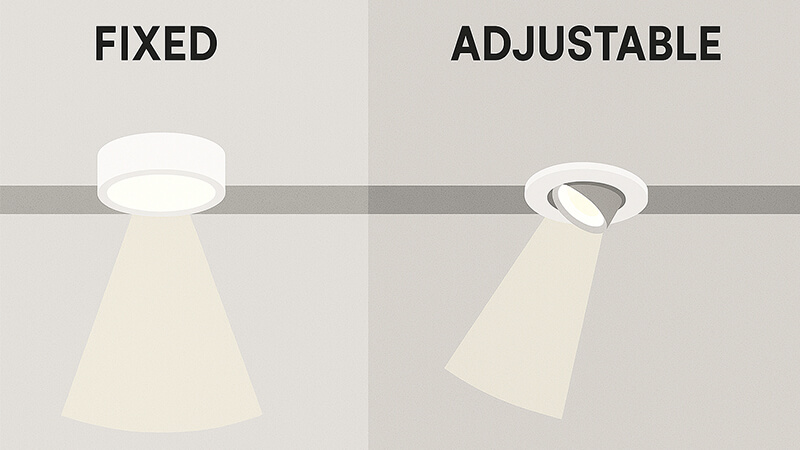
This seems like a simple mechanical difference, but its impact on a space is profound. I often explain this to clients by saying a fixed downlight is like a broadcast, while an adjustable downlight is like a conversation. A fixed downlight sends out one message: "Here is light." It’s great for general visibility in hallways, offices, or utility areas. It lays the foundation. But an adjustable downlight engages with the room. It says, "Look at this beautiful painting," "Notice the texture on this brick wall," or "This is where you should read." It creates points of interest and guides the experience of being in the space.
Choosing the Right Tool for the Job
As a manufacturer, we produce both types because they serve different, equally important purposes. A great lighting design often uses both. Thinking of them as tools in a toolbox helps clarify their roles.
Here’s how I advise clients like Shaz to approach their selection process, based on the intended function:
- Primary Goal: General Ambient Lighting
- Tool of Choice: Fixed Downlight.
- Why: For creating a base layer of uniform light efficiently. It’s the most cost-effective way to make a space functional and navigable. You use it in open office areas, corridors, and back-of-house spaces where even illumination is the only priority.
- Primary Goal: Creating Focus and Drama
- Tool of Choice: Adjustable Downlight.
- Why: For accent lighting. You need to create contrast—pools of light and areas of relative darkness. This is essential in retail to highlight merchandise, in galleries for artwork, and in homes to add warmth and character.
- Primary Goal: Functional, Directed Light
- Tool of Choice: Adjustable Downlight.
- Why: For task lighting. Aiming light directly onto a kitchen counter for food preparation or onto a desk in a home office is far more effective and comfortable than trying to work under general ambient light, which can create shadows.
The decision is not about which downlight is "better," but which one is right for a specific application. A common mistake I see is using only fixed downlights to save on initial cost, resulting in a perfectly bright but completely soulless room. Conversely, using only adjustable downlights can be inefficient and create a "spotty" effect if not planned correctly. The best designs use a thoughtful combination of both.
What Is the Difference Between a Downlight and a Ceiling Light?
You’re planning the lighting for a new project, but the terminology is confusing. You hear "ceiling light," "downlight," and "luminaire" used interchangeably. This confusion can lead to ordering the wrong product and compromising your design.
The key difference lies in installation and light direction. A ceiling light is surface-mounted and visibly protrudes from the ceiling, often casting light in multiple directions. A downlight is recessed into the ceiling, creating a clean look while casting light directly downwards.
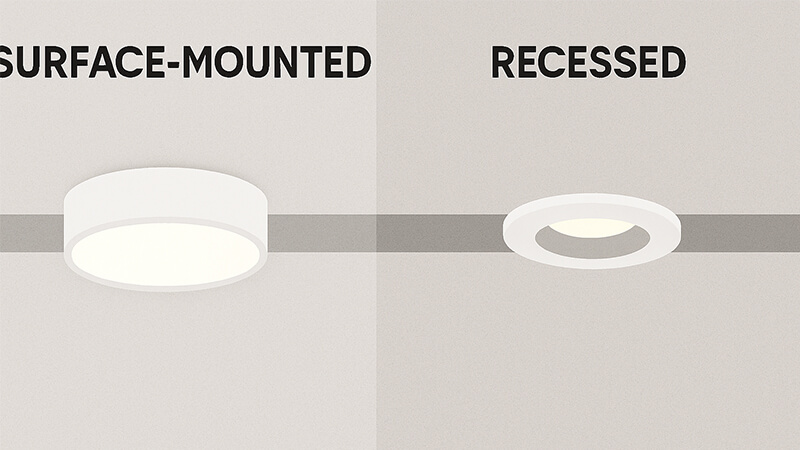
In my factory, we build both, and the design and engineering considerations are completely different. A surface-mounted ceiling light is a decorative element in itself. Its shape, material, and finish are all part of the room’s decor. It’s designed to be seen. A downlight, especially a recessed one, is designed to be invisible. Its purpose is to deliver light without drawing attention to itself. The focus is on the effect of the light, not the fixture. This distinction is crucial for any lighting plan. One is a piece of furniture that lights up; the other is a hidden tool that shapes the space.
Function Dictates Form
Thinking about it this way helps clarify which to use and where. It’s not just about aesthetics; it’s about the kind of light you need and the architectural statement you want to make.
Let’s break this down into a simple table to guide the decision:
| Feature |
Surface-Mounted Ceiling Light |
Recessed Downlight |
| Installation |
Mounted onto the surface of the ceiling. The body of the fixture is visible. |
Installed into a hole in the ceiling. Only the trim is visible. |
| Light Distribution |
Often diffuse and omni-directional (e.g., dome lights) or multi-directional. |
Directional, casting a cone of light downwards. |
| Visual Impact |
High. It is a decorative fixture and a focal point. |
Low. Designed to be discreet and integrate into the ceiling plane. |
| Best For… |
General ambient illumination in rooms with lower ceilings, or as a central decorative piece. |
Creating layers of light (ambient, task, accent) with a clean, modern look. |
When I consult with a client, the first question is always about the desired feeling of the space. Do you want the light source to be a bold, central statement, like a beautiful chandelier or a stylish flush mount in a dining room? Then you need a ceiling light. Or do you want the architecture and the objects within the room to be the heroes, with light appearing as if from nowhere to highlight them? Then you need a series of recessed downlights. The choice between them defines the entire character of the ceiling and, by extension, the room itself.
Conclusion
An adjustable downlight is more than a fixture; it’s a design tool. It empowers you to move beyond simple illumination and start shaping spaces with focused, dynamic, and intentional light.