Buying downlights seems simple, but the wrong choice creates poor lighting and high costs. It’s a frustrating mistake. Understanding a few key factors ensures you make the perfect choice.
The most important things to consider are light output (lumens), color temperature (Kelvin), beam angle, and IP rating. Balancing these ensures your lighting plan is functional, compliant, and perfectly suits the room’s atmosphere. Getting these right is the foundation of any good lighting design.

Getting the basics right is just the start. The real challenge for professionals like us often lies in the details that most guides completely overlook. Let’s break down the most common questions I get from partners like Shaz in the UAE. This will help you specify your next project with total confidence.
How Do I Calculate How Many Downlights I Need?
You followed the simple "area divided by spacing" formula, but the room still has dark spots. This standard advice fails you, wasting time and money on fixing a flawed layout.
A better way is to calculate total lumens needed (Room Area x Recommended Lux Level) and divide by the lumens of one downlight. Crucially, you must then adjust this number for room characteristics like wall color, ceiling height, and furnishings, which can absorb significant light.

Many people will tell you to use a simple spacing formula. This is a huge oversimplification. It ignores the secret of how light behaves in a space. After years in the lighting business, I can tell you that room surfaces can "steal" up to 30% of your light’s effectiveness. This is why a calculation that looks perfect on paper can fail in reality.
At my company, we don’t leave this to chance. We developed an internal "Reflectance Correction Factor" to ensure our lighting plans work perfectly the first time. It accounts for the light that gets absorbed by different surfaces. Think of it as a professional adjustment to the basic formula.
Here is a simplified version of what we use:
| Room Characteristic |
Condition |
Adjustment to Downlight Quantity |
Why? |
| Wall Color |
Light |
+0% |
High light reflection. |
|
Medium |
+20% |
Medium light absorption. |
|
Dark |
+40% |
High light absorption. |
| Ceiling Height |
Standard |
+0% |
Light travels a standard distance. |
|
High |
+15% |
Light spreads more and loses intensity. |
| Furnishings |
Minimal |
+0% |
Fewer objects to block or absorb light. |
|
Dense/Dark |
+20% |
Furniture absorbs light and casts shadows. |
So, if you are lighting a large living room with dark blue walls, you must increase your calculated downlight quantity by at least 40%. On the other hand, a room with many mirrored or glossy surfaces presents a different challenge. You might need to reduce the number of downlights or change their position. This is because these surfaces create secondary reflections, which can cause uncomfortable glare. This is a detail many overlook, but it’s critical for creating a comfortable space. This system isn’t just theory; it’s built from data from thousands of our projects.
Is 3000K or 4000K Better for a House?
Choosing between 3000K and 4000K seems small, but the wrong one can make a home feel cold or a kitchen feel dim. This detail changes the entire mood of a space.
For homes, 3000K (Warm White) is generally the best choice for living areas and bedrooms, as it creates a cozy, relaxing atmosphere. Use 4000K (Cool White) for kitchens, bathrooms, and home offices where you need clear, energizing light for tasks.

The choice between 3000K and 4000K is one of the most common questions I get from purchasing managers and project contractors. There is no single "better" option; the right choice depends entirely on the function and desired feel of the space. As lighting professionals, we need to guide our clients beyond simple preference and toward a functional, human-centric lighting design.
Matching Color Temperature to Room Function
Think of light as a tool to define a room’s purpose. The color temperature directly influences our mood and perception. We want to match this to the activities performed in each area of a house. I often advise my clients to use a "zoning" strategy for color temperature.
| Room Type |
Recommended CCT |
Primary Function & Mood |
Why It Works |
| Living Room |
3000K |
Relaxation, Socializing |
Warm light is inviting and helps people feel comfortable. |
| Bedroom |
3000K |
Rest, Wind-down |
Mimics sunset, signaling to the body it’s time to rest. |
| Kitchen |
4000K |
Task, Cleaning, Prep |
Clear, bright light improves visibility for safe cooking. |
| Bathroom |
4000K |
Grooming, Task |
Provides accurate color rendering for tasks like makeup. |
| Home Office |
4000K |
Focus, Productivity |
Cooler light promotes alertness and concentration. |
| Hallways/Entries |
3000K |
Welcoming, Transition |
Creates a warm, inviting first impression. |
A Personal Story: The Architect’s Dilemma
I remember working with a residential architect a few years ago. He specified 4000K lighting throughout an entire luxury apartment, thinking it looked modern and clean. When the homeowner moved in, they complained that their beautiful home felt like an office or a hospital. It was stark and unwelcoming. We had to replace all the downlights in the living areas and bedrooms with 3000K fixtures. It was a costly lesson for the architect, but it highlights how critical this single specification is. The client was much happier with the warmer, cozier light. This experience taught me to always discuss the "feel," not just the "look," with my partners.
How Do I Tell If I Have 240V?
Connecting a downlight to the wrong voltage is a dangerous and costly mistake. It can destroy the fixture, cause a fire, and create serious project delays.
In most residential and commercial settings, check the circuit breaker panel. The labels should indicate the voltage for each circuit. For a specific lighting point, a qualified electrician must use a multimeter to measure the voltage between the live and neutral wires for a definitive reading.
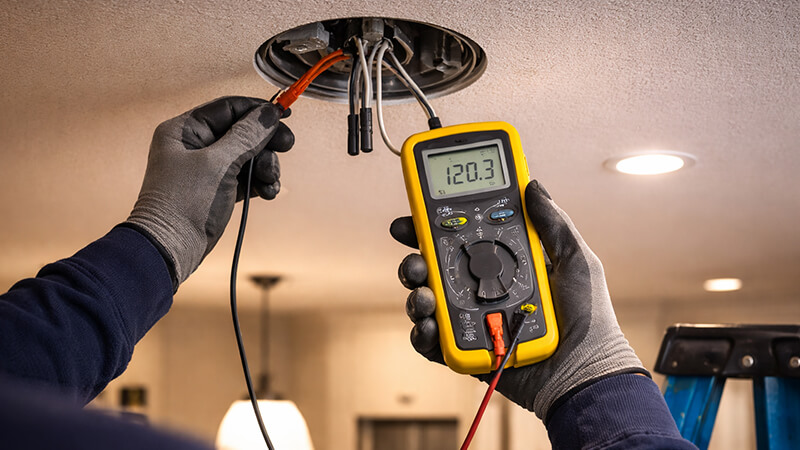
As a manufacturer, I’ve seen firsthand what happens when voltage is mismatched. A client once ordered a large batch of 120V downlights for a project in a country with a 240V standard. The mistake wasn’t caught until installation. The moment the lights were turned on, they blew out instantly. It was a complete loss. This is why verifying voltage is a non-negotiable first step.
Understanding Global Voltage Standards
Voltage isn’t the same everywhere. For purchasing managers like Shaz, who may source products for projects in different regions, understanding this is vital. The world is primarily split into two voltage camps.
- 100-127V Regions: This includes North America, Japan, and parts of South America.
- 220-240V Regions: This is common in Europe, Asia, Africa, Australia, and the UAE.
While many modern LED drivers are "universal voltage" (e.g., 100-277V), you can’t assume this. Always check the product specifications. When you are ordering customized or more basic products, they often come with fixed-voltage drivers to save costs. Specifying the wrong one will lead to 100% failure.
Practical Steps for Verification
You can’t just guess the voltage. Here are the reliable methods to confirm what you are working with:
- Check the Circuit Breaker: The main electrical panel is your first stop. In most modern installations, breakers are clearly labeled. A single-pole breaker typically supplies 120V, while a double-pole breaker supplies 240V. This is a good general guide.
- Look at Existing Fixtures: If you are replacing old lights, check their labels. The label on the old fixture or its driver will state the required input voltage. This is a strong clue, but always verify, as wiring could have been changed.
- Use a Multimeter (The Professional Method): This is the only way to be 100% certain. An electrician should set the multimeter to the AC voltage setting (V~). By touching the probes to the hot and neutral wires that will power the downlight, they will get an exact reading. A reading between 220V and 240V means you have a 240V supply. A reading between 110V and 127V means you have a 120V supply. Never attempt this yourself unless you are a qualified electrician.
Is IP20 Suitable for a Bathroom?
Using a downlight with the wrong IP rating in a wet area is a major safety risk. It can lead to short circuits, fixture failure, and even electric shock.
No, an IP20-rated downlight is not suitable for most areas of a bathroom. It offers no protection against moisture. Bathrooms require luminaires with higher IP ratings, such as IP44 or IP65, depending on their specific location relative to water sources like showers and sinks.
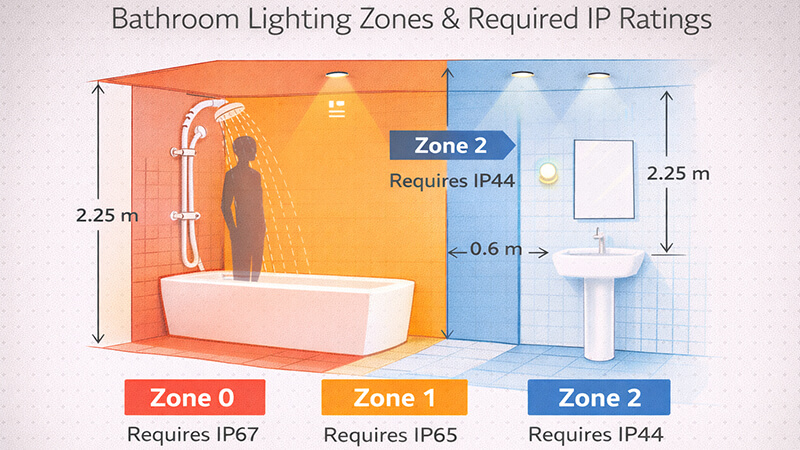
The IP (Ingress Protection) rating is a critical safety specification, not a suggestion. I always stress this to my partners. The rating tells us how well a fixture is protected against solids (like dust) and liquids (like water). It’s made of two numbers.
- First Digit (Solids): Ranges from 0 (no protection) to 6 (dust-tight).
- Second Digit (Liquids): Ranges from 0 (no protection) to 8 (can be submerged in water).
An IP20 rating means the fixture is protected from solid objects larger than 12.5mm (the ‘2’) and has zero protection against water (the ‘0’). This is fine for a living room or bedroom, but it is dangerous in a bathroom where steam and water splashes are common.
Understanding Bathroom Zones and IP Requirements
To ensure safety, bathrooms are divided into specific zones, each with a minimum required IP rating. These regulations are standard across the industry and are essential for any professional to know.
| Zone |
Location |
Minimum IP Rating |
Explanation |
| 0 |
Inside the bath or shower tray itself. |
IP67 |
The fitting can be temporarily submerged in water. |
| 1 |
The area directly above the bath or shower, up to 2.25m from the floor. |
IP65 |
The fitting is protected against jets of water from any direction. |
| 2 |
The area extending 0.6m outside the bath/shower and 2.25m high. Also around the sink. |
IP44 |
The fitting is protected against splashes of water from any direction. |
| Outside Zones |
Any area outside of zones 0, 1, and 2. |
IP20 |
No specific water protection is needed, but IP44 is often recommended. |
For a purchasing manager like Shaz, specifying the right IP rating is a matter of compliance and client safety. If a downlight is going directly over a shower, it must be at least IP65. If it’s for general lighting in the center of a large bathroom, away from the splash zones, IP44 is a safe and common specification. Using an IP20 downlight anywhere but in a very large, well-ventilated bathroom far from any water source is simply not a professional or safe choice. It’s a risk that is never worth taking.
Conclusion
Choosing the right downlight involves more than just price. By considering lumens, color temperature, voltage, and IP rating, you ensure every project is safe, functional, and meets your client’s expectations.