Are you specifying bathroom downlights and worried about safety? You see IP ratings, but choosing the wrong one could lead to failures. Let me show you what really matters.
For bathroom downlights, you typically need an IP44 rating for areas outside the splash zone and IP65 for inside the shower. However, the biggest danger isn’t always direct water, but internal condensation, which a high IP rating alone may not solve and can sometimes worsen.
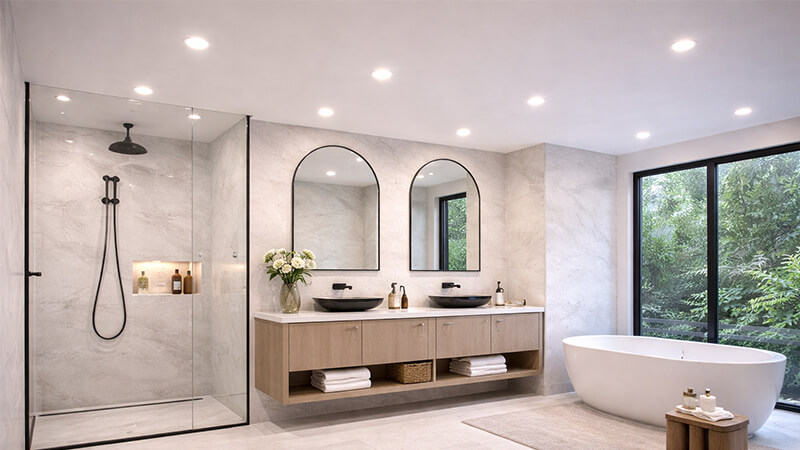
So, you think picking the right IP number is the end of the story? I’ve seen countless buyers make that mistake. They focus so much on the IP rating that they miss a hidden "assassin" that silently destroys lights from the inside. Before you finalize your next order, it’s crucial to understand what these ratings mean and, more importantly, what they don’t protect against. Let’s look deeper into what these IP numbers really tell us, and then I’ll reveal the real culprit behind most bathroom lighting failures.
What is the IP rating of a downlight?
You see IP numbers like IP20, IP44, and IP65, but do you know what they mean? Choosing based on a guess can lead to failed lights or overspending.
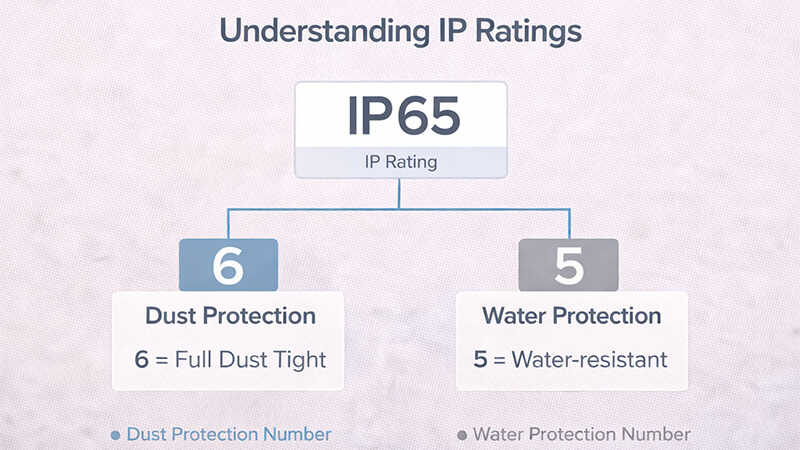
An IP (Ingress Protection) rating is a standard two-digit code. The first digit shows protection against solid objects like dust, while the second shows protection against liquids like water. A higher number means a higher level of protection for that specific category.
When I started in this industry, the IP code seemed like a technical secret. But once you break it down, it’s a simple and powerful tool. Think of it as a light fixture’s armor rating. The key is knowing how much armor you actually need for the situation.
The first digit rates protection against solids, from a person’s hand down to tiny dust particles. The second digit rates protection against water, from simple drips to powerful jets.
Let’s break it down in a table. As a purchasing manager, this is your quick reference guide.
Breaking Down the IP Code
| First Digit |
Protection Against Solids |
Second Digit |
Protection Against Liquids |
| 0 |
No protection |
0 |
No protection |
| 1 |
>50 mm (e.g., hand) |
1 |
Dripping water |
| 2 |
>12.5 mm (e.g., finger) |
2 |
Dripping water (15° tilt) |
| 3 |
>2.5 mm (e.g., tools) |
3 |
Spraying water |
| 4 |
>1 mm (e.g., wires) |
4 |
Splashing water |
| 5 |
Dust protected |
5 |
Water jets |
| 6 |
Dust tight |
6 |
Powerful water jets |
| 7 |
– |
7 |
Immersion up to 1m |
| 8 |
– |
8 |
Continuous immersion |
So, an IP20 downlight is fine for a bedroom; it’s protected from fingers but not water. An IP44 downlight can handle splashes, making it a common choice for bathroom ceilings. An IP65 downlight can withstand direct water jets, so you’d use it right inside a shower enclosure. Understanding this helps you avoid over-specifying. You don’t need an IP65 "tank" for a hallway where a simple IP20 light will perform perfectly for years. It’s about matching the spec to the real-world environment.
Are IP65 downlights waterproof?
You see "IP65" and think "waterproof," right? This assumption can lead to costly mistakes if the light fails unexpectedly in a steamy bathroom, causing project delays and unhappy clients.
Yes, an IP65-rated downlight is highly water-resistant, protecting against low-pressure water jets from any direction. However, it is not fully "waterproof" in the sense of being submersible. It is designed to resist splashes and sprays, like those in a shower.
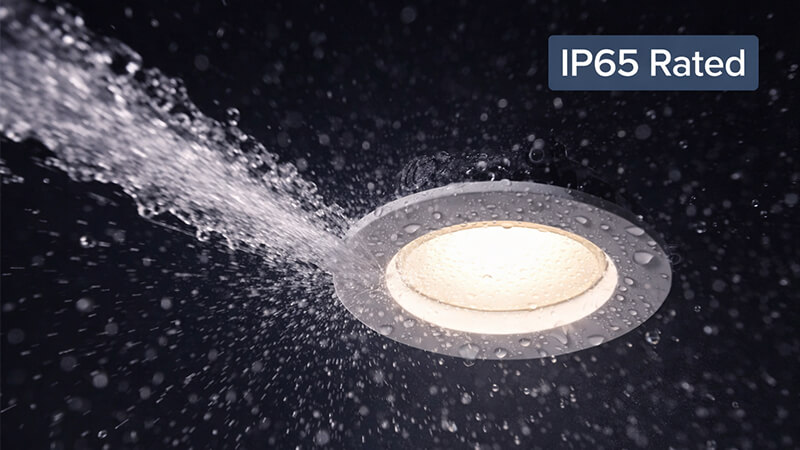
The term "waterproof" can be misleading. In the lighting industry, we prefer to talk about specific levels of water resistance, which is exactly what the IP rating system does. An IP65 rating means the enclosure is sealed tightly. We test this by spraying it with a water jet from a nozzle for several minutes from all angles. If no water gets inside, it passes.
This makes it perfect for Zone 1 in a bathroom—the area directly above the bath or within the shower cubicle. It’s built to handle the direct spray from a showerhead.
Where IP65 Excels and Where It’s Misunderstood
- Direct Water Exposure: This is the primary purpose of an IP65 rating. For downlights installed inside a shower or in a wet room ceiling, IP65 is non-negotiable. It provides the necessary protection against direct contact with water.
- Dust and Debris: The "6" in IP65 means it’s completely dust-tight. This is a great secondary benefit, especially in new construction environments or areas prone to dust. It keeps the internal components clean, which helps with performance and longevity.
However, many people stop there. They think IP65 is the ultimate solution for any wet environment. I remember a client who insisted on IP65 fixtures for an entire hotel bathroom project, including the vanity area far from the shower. He thought he was buying maximum safety. But the tight seal of an IP65 light can create a different, more subtle problem when it’s not truly needed. This brings us to the real issue in most bathroom ceilings.
Is IP65 ok for bathrooms?
You’re trying to choose the safest option, so picking the highest IP rating seems smart. But what if that "safer" choice actually introduces a hidden risk that leads to premature failure?
Yes, IP65 is more than okay for bathrooms; it’s the required standard for areas directly exposed to water, like inside a shower. However, for most of the bathroom ceiling, it can be "over-protection," and the tightly sealed design can trap condensation.
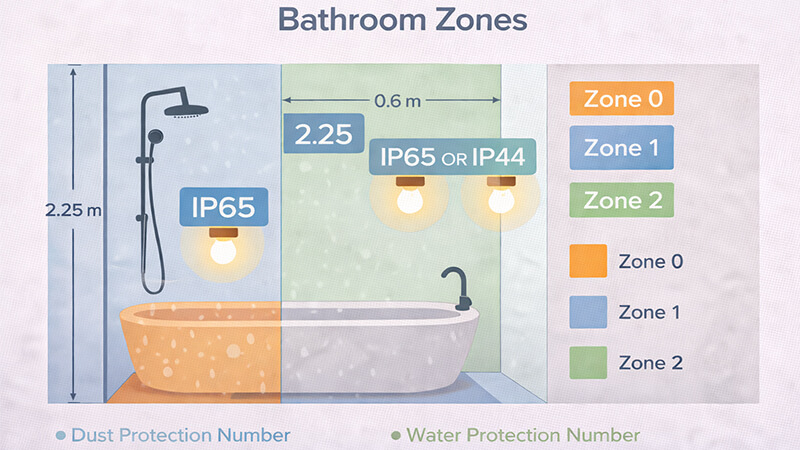
For years, the industry has pushed a simple message: higher IP is better. And if we’re only talking about direct water spray, that’s true. If you are installing a light right over a shower, you absolutely need IP65. Regulations demand it, and safety requires it. No question.
But most downlights in a bathroom are not installed inside the shower. They are installed in Zone 2 or the outside zone—the main ceiling area. Here, the biggest threat isn’t a jet of water. It’s steam.
Here’s the problem I’ve seen firsthand. A hot, steamy shower creates warm, moist air. This air gets inside the ceiling void. The downlight, when on, is hot. When you turn it off, it cools down. This temperature change causes the moisture in the air to turn into water droplets—condensation. This happens both outside and, crucially, inside the light fixture itself.
The Condensation Assassin
An IP65-rated light is sealed very tightly to keep water jets out. But that same seal also traps any moisture that forms inside. The thermal cycling (hot-cold-hot-cold) of daily use constantly creates tiny amounts of condensation within the fixture. Since the light is sealed, this moisture has nowhere to go. It can’t evaporate. Over months, these water droplets build up and will eventually cause the driver electronics to short-circuit or the LED chip to fail. I call this the "condensation assassin" because it kills the light slowly from the inside, and the IP65 rating provides no defense. In fact, it makes the problem worse by not letting the moisture escape.
Do bathroom ceiling lights need to be waterproof?
You know moisture is the enemy, so "waterproof" seems like the obvious answer. But focusing only on stopping water from getting in means you’re ignoring the water that forms inside.
No, not all bathroom ceiling lights need to be fully waterproof (like IP67 submersible). They need to be water-resistant to a degree that matches their location. The real secret to longevity is not just sealing water out, but also managing condensation that forms inside.
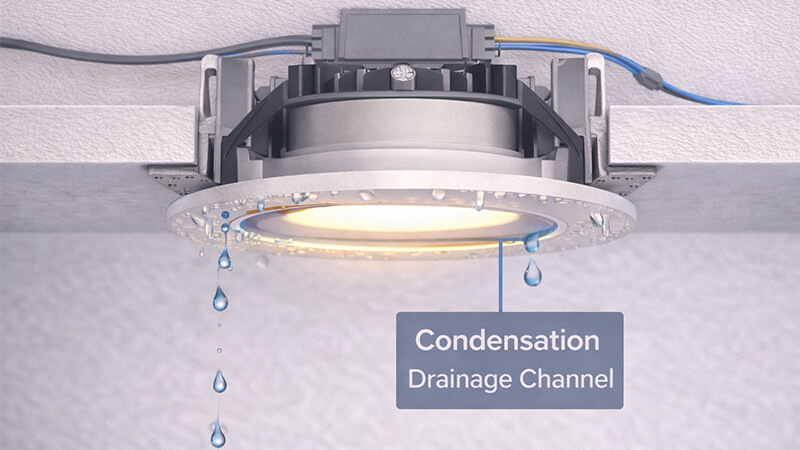
This is the most important insight I can share with you after decades of manufacturing LED lights. Chasing a high IP rating is a limited strategy. A truly professional solution thinks differently. Instead of trying to create a perfect, impenetrable seal—which is nearly impossible to maintain over years of thermal expansion and contraction—a better approach is to manage the moisture.
For downlights outside the direct spray zone (most of the bathroom ceiling), an IP44 rating is sufficient to protect against splashes. But the real innovation is in the product design. At my company, we’ve focused on this problem. Instead of a fully sealed body, our specialized bathroom downlights are designed to breathe.
Smart Design vs. Brute Force Sealing
For a purchasing manager like you, Shaz, this is a critical distinction. A supplier who only talks about high IP ratings is missing the point. A supplier who talks about condensation management and thermal design understands the real-world challenges of bathroom lighting. This smarter design is often more reliable and cost-effective in the long run than simply using an "over-protected" IP65 light where it isn’t needed.
Conclusion
For bathroom lighting, choose IP65 for direct water zones and IP44 elsewhere. But more importantly, look for smart designs that manage condensation, not just block water with a high IP rating.