Worried your lights are wasting energy in damp spaces? Moisture could be silently corroding your fixtures, driving up your electricity bill while dimming your lights’ performance day by day.
Yes, IP65 downlights are exceptionally energy-efficient, especially in the long run. Their sealed design protects the internal electronics from moisture and dust. This prevents corrosion, which increases electrical resistance and forces the light to draw more power just to maintain its brightness.
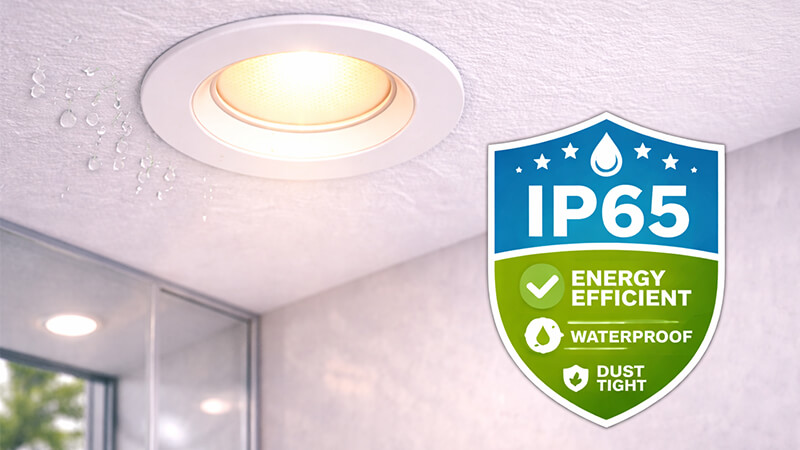
That’s the quick answer. But true efficiency isn’t just about the wattage printed on the box. It’s about maintaining that low energy use for the entire lifespan of the product, especially in challenging environments. As a manufacturer, I’ve seen how quickly unprotected lights can lose their efficiency.
Let’s dive deeper into why the IP rating is one of the most critical factors for long-term energy savings. We will look at how modern downlights consume power and how environmental factors can secretly turn an "efficient" light into an energy drain.
Do downlights use a lot of electricity?
Remember the heat from old halogen downlights? That heat was wasted energy, driving up bills. Modern LED technology has completely solved this, offering brilliant light for a fraction of the cost.
Modern LED downlights use very little electricity. For example, a standard 8-watt LED downlight produces the same amount of light as an old 50-watt halogen bulb. This represents a saving of over 80% on energy consumption for that single light point.
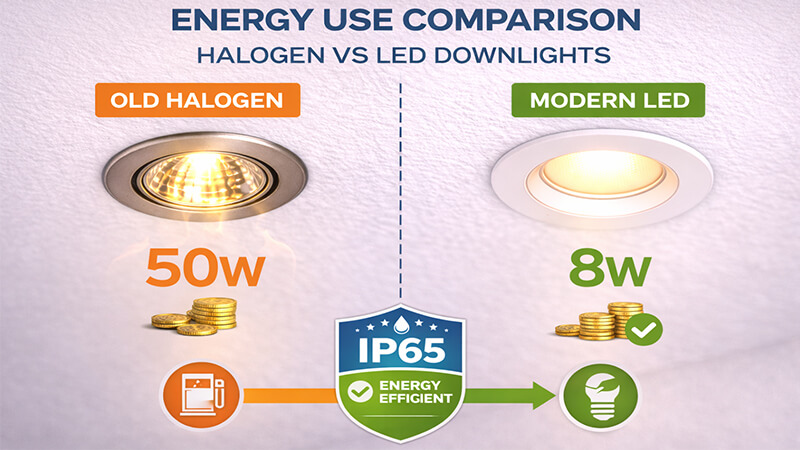
I started in this industry when halogen was king. I remember warehouses full of them, and every project budget had a huge line item for electricity consumption. The biggest complaint from clients back then was always about the high running costs and how often they had to replace the bulbs. The shift to LED technology was a complete revolution. It wasn’t just a small improvement; it was a fundamental change in how we produce light. Halogen bulbs worked by heating a tiny wire until it glowed. Most of the energy was lost as heat. LEDs, on the other hand, are semiconductors that release light when electricity passes through them. This process is incredibly efficient and produces very little heat.
To put it into perspective for a purchasing manager like Shaz, let’s look at a direct comparison.
Halogen vs. LED: A Clear Winner
| Feature |
Typical 50W Halogen Downlight |
Equivalent 8W LED Downlight |
| Power Usage |
50 Watts |
8 Watts |
| Average Lifespan |
2,000 hours |
30,000 – 50,000 hours |
| Heat Output |
Very High |
Very Low |
| Efficiency (lm/W) |
~15 lm/W |
~90 lm/W |
The real metric for efficiency is lumens per watt (lm/W), which tells you how much light you get for every watt of energy you use. As you can see, LEDs are vastly superior. This efficiency translates directly into lower electricity bills and less maintenance. But this is only true if the LED and its driver are protected from the environment, which we will explore next.
Do LED lights make your electric bill go up?
You switched to LEDs to save money, but your bill stayed the same or even rose. This is a common concern, but the problem is rarely the LED technology itself.
No, LED lights almost always lower your electric bill. If you see an increase, it is likely due to other factors. These include installing poor-quality products, adding more lights than you had before, or using non-rated lights in humid environments, which secretly degrades their efficiency.
I once had a client, a project contractor, who called me in frustration. He had replaced all the old lights in an apartment building with new LEDs, promising the owner significant savings. A few months later, the owner complained that the bills hadn’t dropped as much as expected. The contractor was baffled. We investigated and found the problem wasn’t the LEDs, but how they were being affected by their environment. This gets to the heart of my insight: an unprotected LED is an inefficient LED.
Let’s break down the hidden reasons your bill might not drop.
The Hidden Cost of Poor Quality
Not all LEDs are created equal. A cheap, low-quality LED downlight might use an inefficient driver. This driver wastes energy as heat instead of converting it into light, immediately undermining your savings. The LED chips may also suffer from rapid lumen depreciation, meaning they get dimmer faster.
The Environmental Sabotage
This is the most important and least understood factor. Let’s say you install a standard, non-rated LED downlight in a kitchen, a bathroom, or even a building in a humid climate like the UAE. Steam and moisture in the air will find their way inside the fixture. This moisture causes microscopic corrosion on the driver’s circuit board. This corrosion increases the electrical resistance. Now, the driver must work harder and draw more power to deliver the same voltage to the LED chip. At first, you won’t notice a change in brightness, but your light is secretly consuming more and more electricity. It’s fighting against itself. This is why an IP65-rated fixture is so critical. It seals the electronics, preventing this slow, costly decay and ensuring the light maintains its peak efficiency for its entire lifespan.
Is IP65 really waterproof?
You see "IP65" and think it’s completely waterproof, but it’s not that simple. Misunderstanding this can lead to product failure. The numbers actually have very specific meanings.
IP65 is not fully waterproof; it is highly water-resistant. The ‘6’ means it is completely sealed against dust. The ‘5’ means it is protected against low-pressure water jets from any direction. It can handle splashes and steam, but it cannot be submerged in water.
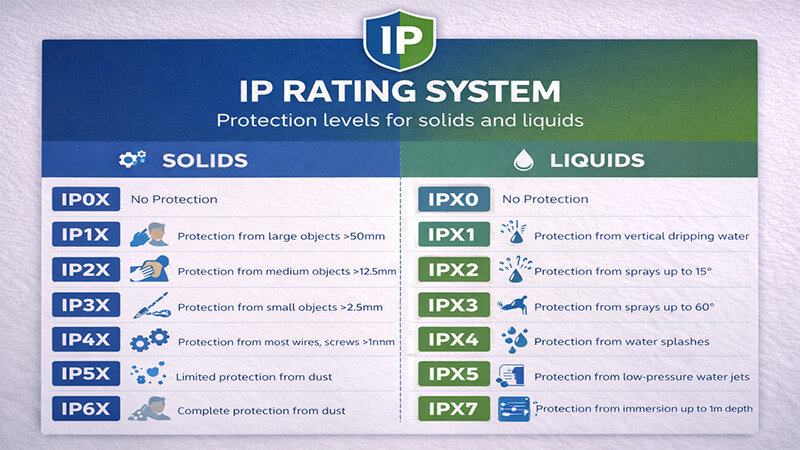
Understanding Ingress Protection (IP) ratings is fundamental for anyone sourcing lighting, like Shaz. It’s a standard that tells you exactly how well a device is sealed against foreign objects, both solid and liquid. The first digit refers to protection against solids (like dust), and the second digit refers to protection against liquids (water).
I learned this lesson the hard way early in my career. A client insisted on using IP44-rated downlights for a commercial kitchen project to save a little money. IP44 is rated for splashes, so they thought it would be fine. However, the kitchen staff used pressure hoses for daily wash-downs. Within six months, over half the lights had failed. The "splashes" were actually low-pressure jets, which required an IPX5 rating. The cost of replacing the lights and the operational downtime far exceeded the initial savings.
Here is a simple breakdown of the water protection levels to help you specify the right product every time.
Understanding Water Ingress Ratings
| IPX Rating |
Protection Against |
Typical Use Case |
| IPX4 |
Splashing water |
General bathroom areas (away from shower) |
| IPX5 |
Low-pressure water jets |
Bathrooms (near showers), kitchens, exteriors |
| IPX6 |
High-pressure water jets |
Wash-down areas, boat decks |
| IPX7 |
Immersion up to 1m |
Inside bathtubs, pools (temporary) |
| IPX8 |
Immersion beyond 1m |
Underwater lighting, ponds |
For most indoor applications where moisture is a concern—like kitchens, bathrooms, and covered outdoor patios—IP65 is the perfect balance. It ensures the fixture is completely dust-tight (the ‘6’) and protected from the water jets and heavy steam (the ‘5’) that are common in these areas. It provides robust protection that guarantees both safety and the long-term energy efficiency we’ve been discussing.
Can IP65 go in a bathroom?
Placing lights in a bathroom requires careful planning. You must follow safety regulations based on how close the light is to water. So, where exactly can you use an IP65 downlight?
Yes, IP65 downlights are ideal for bathrooms. Their rating makes them safe for installation in Zone 1 (the area directly above a shower or bath) and Zone 2 (the splash zone around the bath, shower, and sink), protecting them from steam and splashes.
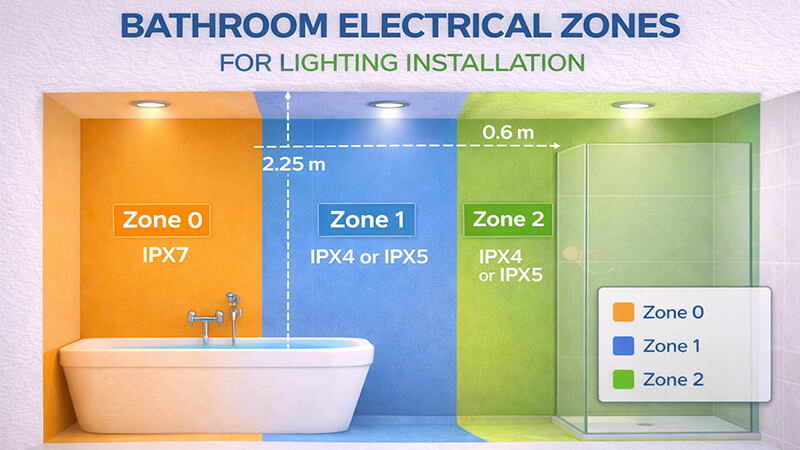
For a purchasing manager like Shaz, specifying the correct IP rating for a bathroom isn’t just about compliance—it’s about ensuring the client’s safety and the product’s longevity. Bathrooms are divided into electrical zones, and each zone has a minimum required IP rating. Using the wrong product can be dangerous and lead to liability issues.
I always advise my partners to use this simple guide. It helps ensure every installation is safe, compliant, and built to last. A quality installation reflects well on everyone involved, from the manufacturer to the contractor.
Bathroom Lighting Zones: A Guide for Safety and Compliance
| Zone |
Location Description |
Minimum IP Rating |
My Recommendation |
| Zone 0 |
Inside the bath or shower basin itself. |
IP67 |
IP67 (Low Voltage – 12V) |
| Zone 1 |
Area directly above the bath or shower, up to 2.25m from the floor. |
IP44 (but IP65 if water jets are likely) |
IP65 |
| Zone 2 |
Area 0.6m outside the bath/shower and 0.6m around the sink. |
IP44 |
IP65 |
As you can see, an IP65-rated downlight is perfectly suited for Zone 1 and Zone 2. While IP44 is the minimum for Zone 2, I always recommend using IP65 throughout. Why? Because of the constant steam and humidity. A light in Zone 2 might not get direct splashes, but it lives in a cloud of warm, moist air every time someone showers. As we discussed, this moisture will slowly degrade an IP44 fixture, compromising its energy efficiency and lifespan. By specifying IP65 for all lights in a bathroom, you are not just meeting a safety standard; you are providing a higher-quality, longer-lasting, and more energy-efficient solution that protects your client’s investment. It’s a hallmark of quality that distinguishes a professional specification from a basic one.
Conclusion
Ultimately, IP65 downlights are highly energy-efficient because they are built to last. Their sealed design stops moisture from causing corrosion, ensuring peak performance and preventing hidden energy waste over time.