Struggling to pick the right soffit light? You worry about weather damage and early failure. A wrong choice leads to frequent, costly replacements. Let’s find a more durable solution.
Yes, IP65 downlights are suitable for soffits as they are protected against water jets. However, they are not always the best choice. For most soffit applications, a lower IP rating like IP54 with better heat dissipation can actually offer a significantly longer lifespan and better performance.

Many people automatically reach for the highest IP rating they can find for any outdoor application, thinking "more protection is always better." I used to think that way too. But after years of manufacturing and testing, I’ve learned that for soffits, this isn’t the whole story. The real secret to longevity isn’t just about keeping water out; it’s about letting heat escape. Let’s break down why a seemingly "lesser" IP rating can be the superior choice.
What downlights are suitable for soffits?
Confused by the many types of soffit downlights? Picking the wrong one leads to bad lighting and quick failures. Let’s focus on the key features for a perfect installation.
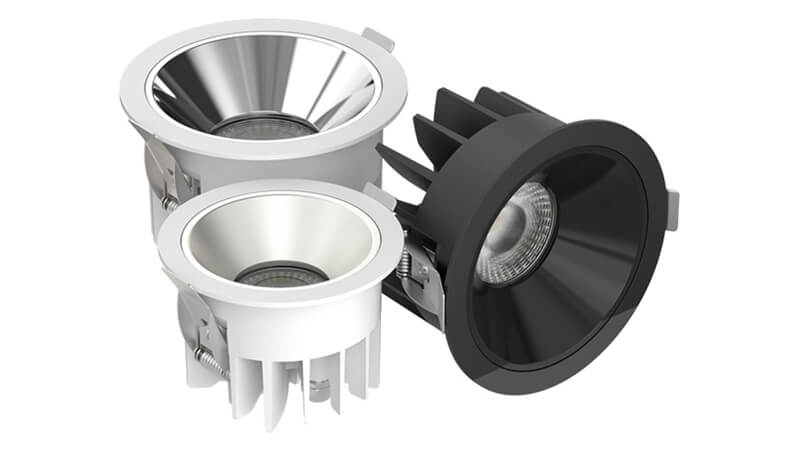
Downlights suitable for soffits should have at least an IP44 rating, be made of corrosion-resistant materials like aluminum, and possess excellent heat dissipation. Integrated LED downlights are often preferred over GU10 models for their sealed design and better thermal management, ensuring a longer operational life.
Dive Deeper
When selecting downlights for soffits, we need to look beyond just the light output. The environment under an eave is unique. It’s sheltered from direct rain but still exposed to humidity, temperature swings, and insects.
Material Matters
The body of the downlight is your first line of defense. I always recommend using fixtures made from die-cast aluminum with a high-quality powder coating. Plastic can become brittle and discolor from UV exposure over time, even in a shaded soffit. Steel, unless it’s marine-grade stainless steel which is expensive, will eventually rust. A client of mine in Dubai, a purchasing manager named Shaz, once showed me fixtures from a competitor that rusted within a year. We replaced them with our powder-coated aluminum models, and they still look new five years later.
Integrated vs. Replaceable Bulbs
For soffits, I strongly lean towards integrated LED downlights. With a replaceable bulb system like a GU10, you have more points of failure. Gaps between the bulb and the fitting can allow moisture and insects inside, which compromises the IP rating. An integrated unit is fully sealed by the manufacturer. This not only guarantees the IP rating but also allows for a design that manages heat far more effectively. The LED chip can be bonded directly to a large heat sink, which is crucial for longevity.
The Overlooked Factor: Heat
This is the most critical point. LEDs generate heat. If that heat isn’t removed, the LED chip degrades, and the light fails prematurely. In a soffit, which is an enclosed space, heat can get trapped. This is where the design of the heat sink becomes vital. A well-designed fixture will draw heat away from the LED and dissipate it into the surrounding air. This is why ventilation, even through subtle design features, is key to a long life.
Can IP65 downlights be used outside?
Unsure if your IP65 downlights are truly safe for outdoor use? A mistake here can cause product failure and even safety risks. Let’s clarify where IP65 fits best.
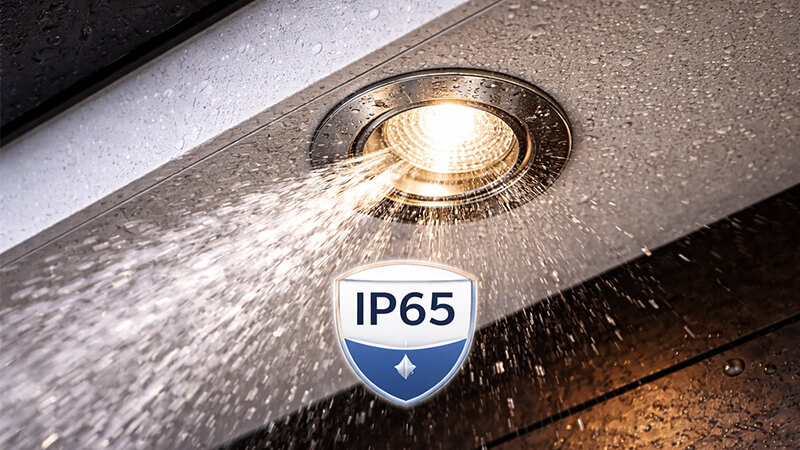
Yes, IP65 downlights can absolutely be used outside. This rating signifies the light is dust-tight and protected against low-pressure water jets from any direction. This makes them ideal for areas exposed to rain, such as wall-mounted lights, but not for submersion in water.
Dive Deeper
The "IP" in IP rating stands for Ingress Protection. It’s a universal standard that classifies how well an electrical enclosure protects against intrusion from solids and liquids. It’s a simple system, but many people misinterpret it, so it’s worth understanding correctly.
Decoding the IP Code
An IP rating has two digits.
- First Digit (Solids): This number, from 0 to 6, indicates protection against solid objects, from large body parts down to microscopic dust. A ‘6’ means it’s completely dust-tight.
- Second Digit (Liquids): This number, from 0 to 9, indicates protection against moisture, from simple drips to high-pressure jets and full submersion.
| Here’s a breakdown for IP65: |
Digit |
Meaning (Solids) |
Digit |
Meaning (Liquids) |
| 6 |
Dust Tight: No ingress of dust; complete protection. |
5 |
Water Jets: Protected against water jets from any direction. |
IP65: The Sweet Spot for Exposure
This rating makes a fixture very robust for most outdoor applications. Think about downlights installed on an open porch ceiling or wall lights that will be hit directly by sprinklers or wind-driven rain. For these locations, IP65 is an excellent choice. It provides peace of mind that the internal electronics are safe from the elements. A few years ago, we supplied IP65 fixtures for a coastal hotel project. They have been battered by sea spray and tropical storms but continue to function perfectly because the seals prevent any moisture or salt from getting inside.
When is IP65 Not Necessary?
However, for a light tucked up under a deep soffit or a covered veranda, it is often more protection than you need. These areas are shielded from direct water jets. This is where understanding the specific location is key to making a smarter, more cost-effective, and longer-lasting choice. Over-specifying the IP rating here can actually work against you.
What IP rating for soffit lights?
Unsure what IP rating your soffit lights actually need? Guessing wrong wastes money or leads to early failures. Let me give you my direct, experience-based recommendation for this specific application.
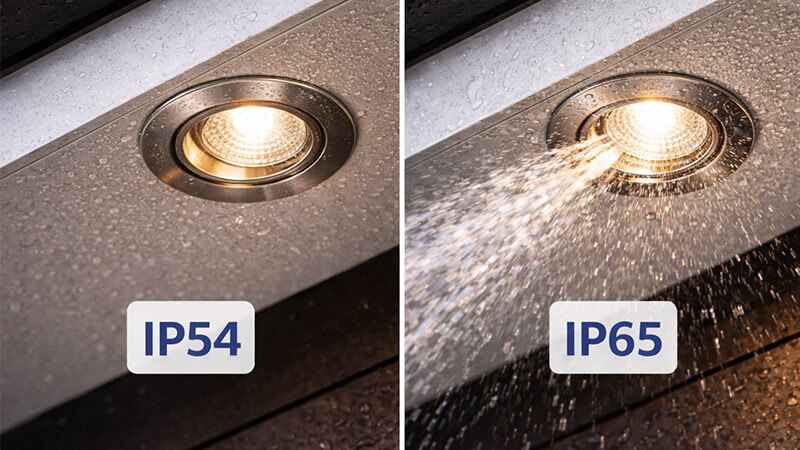
For most covered soffits, an IP44 or IP54 rating is sufficient and often better than IP65. These ratings protect against water splashes and allow for better heat dissipation designs, which can extend the downlight’s lifespan by up to 30% compared to a sealed IP65 unit.
Dive Deeper
This is where I often surprise my clients, especially experienced purchasing managers like Shaz. The common belief is that for anything outside, you must use IP65. But based on my factory’s testing and real-world results, this is not true for soffits.
The Heat vs. Water Trade-Off
An IP65 rating is achieved by using tight gaskets and seals to make the fixture airtight and watertight. This is great for keeping water out, but it’s terrible for letting heat escape. The heat generated by the LED driver and chip gets trapped inside the sealed housing. This elevated internal temperature is the number one killer of LEDs, causing their brightness to fade and the driver components to fail. Think of it like a person wearing a sealed raincoat on a warm day. You will not get wet from the rain, but you will overheat very quickly. A downlight is no different.
Why IP54 is the Soffit Sweet Spot
A soffit is naturally protected from direct jets of water. It might get some wind-driven spray or high humidity, but it will not be hosed down. An IP54 rating means the light is protected against most dust and splashes of water from any direction. This level of protection is more than enough for a soffit. More importantly, a lower IP rating allows designers to incorporate ventilation, like small, shielded vents or fins, into the heat sink. These features let hot air escape and cool air enter, dramatically lowering the operating temperature of the LED.
My Personal Test Results
We ran a long-term test in our lab. We took two identical downlights, one sealed to IP65 and one designed to IP54 with side heat dissipation channels. We ran them continuously in an environment simulating a warm, enclosed soffit. The results were clear: the IP54 downlight with better heat management lasted 30% longer before its light output degraded significantly. For a purchasing manager, this translates directly to a more reliable product, fewer warranty claims, and a happier end-user.
What kind of light is best for under a soffit?
Searching for the perfect light for under your soffits? Just chasing high lumens can create harsh glare and an unpleasant atmosphere. Let’s find a light that is both functional and beautiful.
The best light for under a soffit is an integrated LED downlight with an IP44 or IP54 rating. Choose one with a warm white color temperature (2700K-3000K), a CRI of 90+ for accurate color rendering, and a baffled or recessed design to reduce glare.

Dive Deeper
We have established that an IP54-rated, integrated LED downlight is the most durable choice. But durability is only half the story. The quality of the light itself is what turns a building into an attractive landmark or a house into a home. Here are the three lighting specifications I tell my clients to focus on for soffits.
Setting the Mood: Color Temperature (CCT)
Color temperature is measured in Kelvin (K) and describes how "warm" or "cool" the light appears. For residential and hospitality soffits, you want to create a welcoming, cozy atmosphere. I almost always recommend a warm white light, typically between 2700K and 3000K. This mimics the warm glow of traditional incandescent bulbs and makes home exteriors look inviting. A cooler white (4000K+) can look stark and clinical, which is more suitable for commercial security applications.
Seeing True Colors: Color Rendering Index (CRI)
CRI measures how accurately a light source reveals the true colors of objects. The scale goes up to 100, which is the quality of natural sunlight. For outdoor lighting, especially when illuminating architectural features like brick, stone, or wood, a high CRI is important. I insist on a CRI of 90 or higher for all our premium downlights. A low CRI light (around 80) can make beautiful natural materials look dull and washed out. High CRI lighting makes everything look more vibrant and real.
Controlling the Light: Beam Angle and Glare
The goal of soffit lighting is to wash the walls with light or illuminate pathways below, not to blind people looking at the house. This is all about glare control. Look for downlights with a baffled or recessed design. This means the light source is set back into the fixture, shielding it from direct view. This creates a soft pool of light on the ground or wall without a harsh bright spot on the ceiling. This small design detail makes a huge difference in the final look and feel of the project. It is a true sign of a quality fixture.
Conclusion
For soffits, choose an IP54 downlight over IP65 for a longer life. Prioritize heat dissipation, warm color temperature, and high CRI for the best performance and aesthetic appeal.