Worried about ceiling safety? A simple downlight installation could compromise your entire building’s fire defense. The choice you make is critical for protection and peace of mind.
The key difference is protection. A fire-rated downlight is built to seal the hole it’s fitted into during a fire, stopping flames and smoke from spreading. A non-fire-rated downlight offers no such barrier, leaving a dangerous gap in your ceiling’s fire defense.
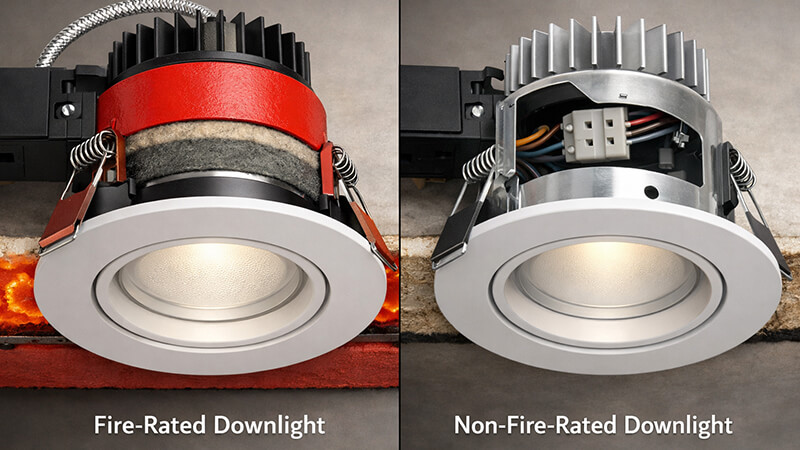
This might seem like a small detail, but in my years of manufacturing, I’ve seen how this choice impacts safety and liability. Understanding this difference is not just about compliance; it’s about protecting property and lives. Let’s break down what this means for you.
Can I fit non-fire rated downlights?
Trying to save costs but worried about safety? Fitting the wrong downlight can be a costly mistake, not just in money, but in compliance and potential danger.
Yes, you can install non-fire-rated downlights, but only where the ceiling is not a fire barrier. This includes concrete ceilings or the top floor of a house directly under the roof space. For any ceiling with a habitable room above, fire-rated is almost always required.
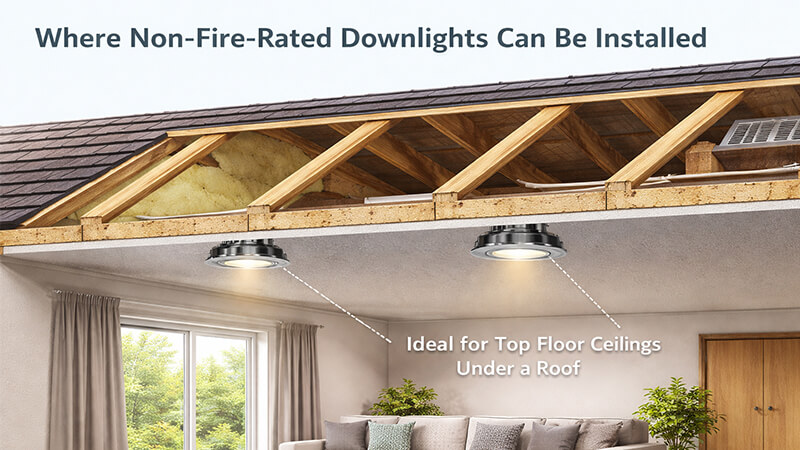
The question isn’t just "can I," but "should I?" The answer depends entirely on your ceiling’s job. In construction, some ceilings are just ceilings. Others are fire barriers. A fire barrier is designed to hold back fire and smoke for a specific period, usually 30, 60, or 90 minutes. This gives people time to escape and for emergency services to arrive. Most residential ceilings with a floor above them are considered fire barriers.
Understanding Your Ceiling’s Role
When you cut a hole in a fire-rated ceiling to install a downlight, you break that barrier. A non-fire-rated downlight simply fills the hole with a light fitting, doing nothing to restore the fire protection. It’s an open door for fire. You can only use them where the ceiling does not need to be a fire barrier. I remember a client, a project manager for a new apartment building, who wanted to use non-fire-rated lights throughout to save on the budget. I had to explain that while it was fine for the top-floor penthouses with no rooms above, using them on all the lower floors would violate building codes and put future residents at extreme risk. He hadn’t considered the ceiling as part of the building’s structural safety system. We switched the order to fire-rated units for the lower floors, a decision that protected his project and his reputation. Always check with your local building regulations, as they are the ultimate authority.
| Ceiling Type |
Can I Use Non-Fire-Rated Downlights? |
Reason |
| Ground floor ceiling with floor above |
No |
This is a fire barrier protecting the upper floor. |
| Top floor ceiling under a roof void |
Yes (usually) |
Not typically a fire barrier between habitable floors. |
| Solid concrete ceiling |
Yes (usually) |
The concrete itself provides the fire barrier. |
| In a suspended ceiling below concrete |
Yes (usually) |
The fire barrier is the concrete slab above. |
How do you know if a light is fire rated?
Can you spot the difference? An untested downlight looks similar to a tested one. But in a fire, that small difference has huge consequences for safety and compliance.
Check the product itself or the packaging for official markings. A fire-rated downlight will have a fire rating certification like "BS 476" and often an "F" mark. Physically, it feels heavier and has a sealed back, often with a special material called an intumescent strip.
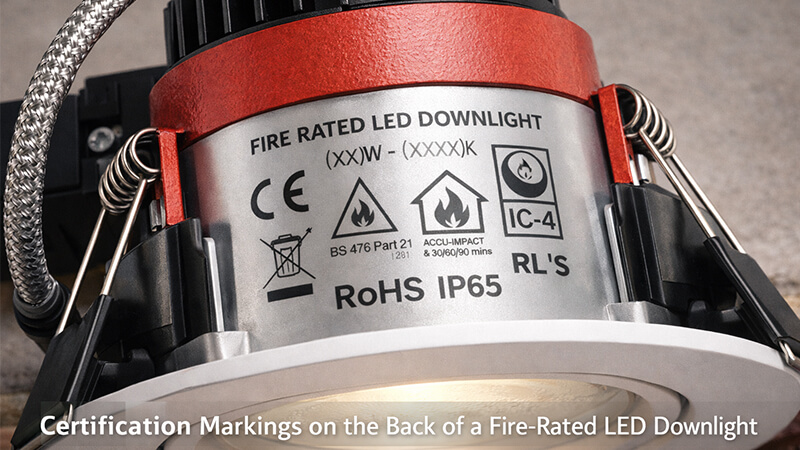
When you are a purchasing manager like Shaz, you need to be certain about what you’re buying. You can’t just trust a description; you need to see the proof. The best way to identify a fire-rated downlight is to look for the certifications marked directly on the product or its box. These are not just brand names; they are symbols of rigorous testing.
Decoding Product Markings and Construction
In Europe and many other regions, the key standard to look for is BS 476-21. This proves the fitting has been tested to maintain the integrity of a fire-rated ceiling for a specified duration (e.g., 60 minutes). You might also see an "F" mark, often inside a triangle, which indicates the fitting can be mounted on normally flammable surfaces. The most important physical feature is the intumescent material. This is a special substance that, when exposed to high heat, expands dramatically—up to 40 times its original size. This expansion completely seals the downlight and the hole in the ceiling, blocking any path for fire and smoke. I’ve held both types in my hands countless times in the workshop. A non-fire-rated downlight is often just a lightweight, open-backed metal can. A fire-rated one is a solid, sealed unit. It feels heavier, more robust. The quality is tangible. You can see the intumescent strips or pads, a clear sign of its purpose. It’s a promise of performance when it matters most.
| Feature |
Fire-Rated Downlight |
Non-Fire-Rated Downlight |
| Markings |
BS 476, F-Mark, specific minute rating (e.g., 60 min) |
Often just CE mark, no specific fire rating |
| Construction |
Sealed back, solid, heavier feel |
Open back, lightweight, flimsy feel |
| Key Component |
Contains intumescent material (pads/strips) |
No intumescent material present |
| Purpose |
To contain fire and restore ceiling integrity |
To provide light only |
What does "non-fire rated" mean?
You see the term "non-fire rated" everywhere. But what does it truly signify? It means you are intentionally leaving a weak point in your building’s most important safety system.
"Non-fire rated" means the product provides zero resistance to fire. When installed in a ceiling, it leaves an open pathway. In a fire, this allows flames, heat, and toxic smoke to travel directly to the floor above in seconds, drastically reducing escape time.
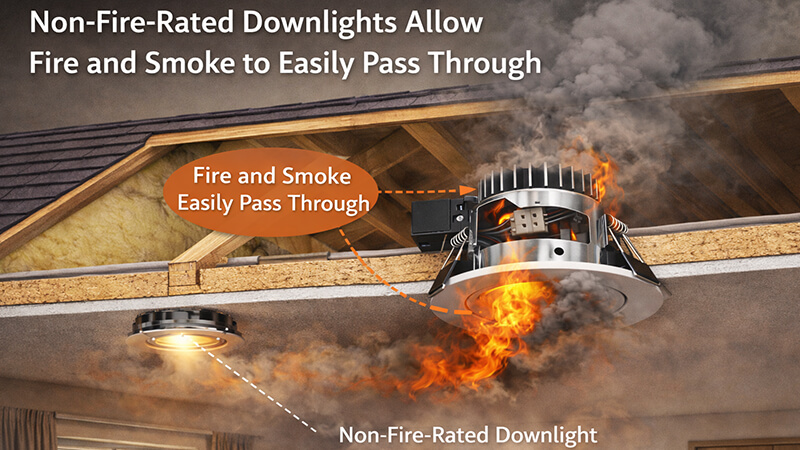
This brings me back to my core belief. A non-fire-rated downlight is an ‘active wall-breaker.’ Think about it. Your ceiling is a solid barrier, a wall between floors, meant to protect you. When you cut a hole for a light, you break that wall. Installing a non-fire-rated downlight means you are choosing to leave that hole open from a fire safety perspective. It offers no solution to the problem you just created. It is simply a light fixture sitting in a gap.
The Unseen Gap in Your Fire Defense
In contrast, a true fire-rated downlight is an ‘active wall-repairer.’ It is designed with one primary goal beyond illumination: to fix the hole you made. When a fire starts, the heat triggers the intumescent material, which swells up and reseals the ceiling. It rebuilds the barrier. It actively works to contain the danger. The difference isn’t just about technology; it’s about responsibility. As a manufacturer, I feel a responsibility to create products that solve problems, not ignore them. A non-fire-rated fitting only solves the lighting problem. A fire-rated fitting solves both the lighting and the safety problem created by its own installation. This is a critical distinction for anyone responsible for specifying or purchasing lighting for a building. Are you just buying a light, or are you maintaining a complete safety system?
| Action During a Fire |
Non-Fire-Rated Downlight |
Fire-Rated Downlight |
| Initial State |
Fills a hole in the ceiling. |
Fills a hole in the ceiling. |
| When Fire Starts |
The fitting melts or falls away quickly. |
The fitting remains intact for a rated period. |
| Ceiling Integrity |
A direct path for fire and smoke is created. |
Intumescent material expands, sealing the hole. |
| Outcome |
Fire spreads rapidly to the floor above. |
Fire and smoke are contained for 30, 60, or 90 mins. |
| Core Function |
Breaks the fire barrier. |
Repairs the fire barrier. |
Many believe cool-running LEDs don’t need a fire rating. This is a dangerous myth. The real danger isn’t the bulb’s heat; it’s the fire trying to get through.
Absolutely, yes. If the ceiling requires a fire rating, the downlight must also be fire-rated, regardless of whether it’s LED or halogen. The fire risk comes from a fire in the room below, not the heat of the lamp. The hole needs to be sealed.
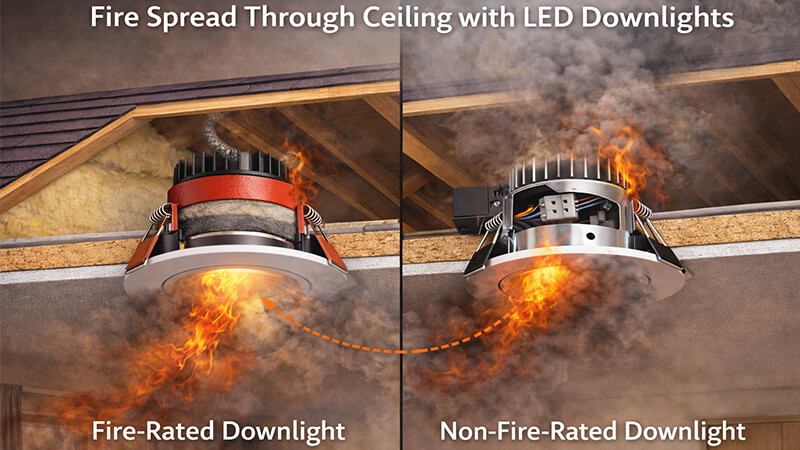
I hear this question often, especially since LEDs became the standard. People assume that because LEDs produce much less heat than old halogen bulbs, the fire risk is lower, so a fire rating is unnecessary. This is a complete misunderstanding of what a fire rating is for. The rating has almost nothing to do with the heat generated by the light itself. It has everything to do with a fire starting elsewhere in the room—a kitchen fire, an electrical fault in an appliance, a dropped candle.
It’s About the Hole, Not the Heat
When that fire starts, it will try to spread. The hole you cut for your cool-running LED downlight is a perfect chimney for it. The fire doesn’t care what kind of bulb is in there. It just sees an escape route to the floor above, a route filled with flammable materials like wood joists and floorboards. The entire purpose of fire rating is compartmentation—keeping the fire contained in the room where it started for as long as possible. This containment is measured in minutes, and those minutes are what people use to get out of the building safely. An LED downlight needs a fire rating for the exact same reason a halogen one did: to plug the hole. The technology of the light source has changed, but the physics of fire have not. Choosing an unrated LED downlight for a fire-rated ceiling is a critical error that compromises the entire safety strategy of the building.
| Time After Fire Starts |
With Non-Fire-Rated Downlights |
With 60-Minute Fire-Rated Downlights |
| 1-2 Minutes |
Smoke begins pouring through the light fitting. |
No smoke penetration. Ceiling is intact. |
| 3-5 Minutes |
Flames breach the ceiling through the hole. |
No flame penetration. Intumescent material has sealed the fitting. |
| 10 Minutes |
Fire is well-established on the floor above. |
Fire is still contained in the room of origin. |
| Up to 60 Minutes |
– |
Ceiling barrier remains intact, providing crucial escape time. |
Conclusion
Choosing between fire-rated and non-fire-rated downlights is simple. It is a choice between ignoring a risk and actively fixing it. It is a choice of responsibility.