Are you worried about installing downlights that might fail during a fire? You know that safety compliance is not optional, but navigating the complex regulations for fire-rated lighting can be confusing.
The key is to use downlights tested to maintain the fire resistance of the ceiling they are installed in. A fire-rated downlight contains intumescent material that expands when heated, sealing the hole and stopping fire from spreading through the ceiling for 30, 60, or 90 minutes.
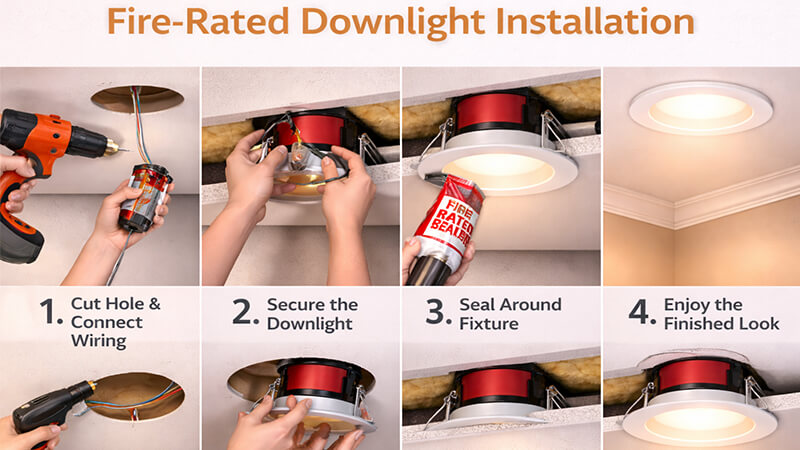
I’ve been in the lighting business for a long time. I started on the factory floor and now run my own manufacturing company, iPHD. I’ve seen it all. The most important lesson I’ve learned is that a fire-rated downlight is like a “light-emitting fire stop.” When you cut a hole in a ceiling for a downlight, you create a weak point. A proper fire-rated downlight seals that hole when a fire breaks out, acting as a safety sentinel. If you install the wrong one, that light becomes a dangerous vent, allowing fire and smoke to spread rapidly between floors. Understanding where and why these are required is the first step to ensuring the safety of any project. Let’s dive into what you need to know to make the right choice every time.
Where Are Fire-Rated Lights Required?
Concerned about where to install fire-rated lighting? You need to protect escape routes and prevent fire from spreading between floors, but identifying every specific location can be a challenge.
Fire-rated downlights are required in ceilings that have a habitable room above them. This includes most ceilings in ground-floor rooms of a two-story house, escape routes like hallways and landings, and ceilings below loft conversions. They are also needed in ceilings connected to an integrated garage.
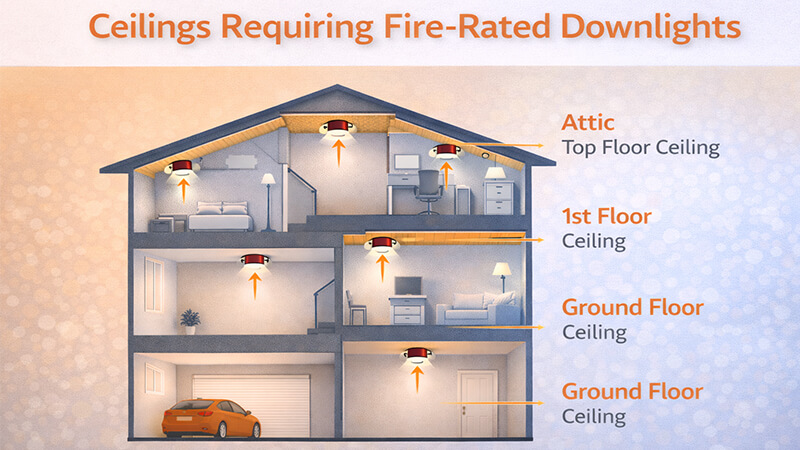
As a purchasing manager, you need to be precise. You’re not just buying a light; you’re buying a piece of safety equipment. The primary rule is simple: if the ceiling is a fire barrier, any light penetrating it must also be fire-rated. This restores the ceiling’s integrity. Think of a house with two or more stories. The ceiling of the ground floor is the floor of the first floor. Building regulations demand this structure resists fire for a specific period, usually 30, 60, or 90 minutes, to allow occupants to escape. When you cut a hole for a standard downlight, you completely destroy that fire rating.
Let’s break down the specific areas:
Key Areas for Installation
- Ceilings with Habitable Rooms Above: This is the most common scenario. Any room on the ground floor of a home with bedrooms or living spaces directly above requires fire-rated downlights.
- Escape Routes: Corridors, hallways, and landings are critical paths for escape. It is absolutely essential that the ceilings in these areas maintain their fire resistance to prevent a fire from blocking the exit route.
- Integrated Garages: The ceiling between an integrated garage and the living space above is a major fire risk area. Garages often contain flammable materials like fuel and solvents. Regulations here are very strict.
Here is a simple table to help you identify these locations.
| Location Type |
Requires Fire-Rated Downlights? |
Reason |
| Ground floor with room above |
Yes |
Maintains fire barrier between floors, protects occupants above. |
| Top floor below a roof void |
No |
The ceiling is not a fire barrier between habitable floors. |
| Hallways and Landings |
Yes |
Protects critical escape routes from fire and smoke. |
| Ceiling of an integrated garage |
Yes |
High-risk area; prevents fire spreading from garage to home. |
I remember a project contractor in the UK who nearly failed an inspection. He had used non-fire-rated downlights throughout the ground floor of a new housing development. He thought because the ceiling was made of fire-resistant plasterboard, it was enough. The inspector immediately flagged it as a major safety violation. He had to replace every single downlight, which cost him time and a lot of money. It taught him, and me, a valuable lesson: the component must match the rating of the structure it’s placed in.
Can You Put Downlights in a Fire-Rated Ceiling?
Do you want to install modern downlights without compromising the safety of a fire-rated ceiling? You might worry that cutting holes will permanently damage the ceiling’s fire barrier.
Yes, you can install downlights in a fire-rated ceiling, but only if you use specifically designed fire-rated downlights. These fixtures are built to automatically seal the opening in the event of a fire, maintaining the ceiling’s integrity and preventing the spread of flames and smoke.
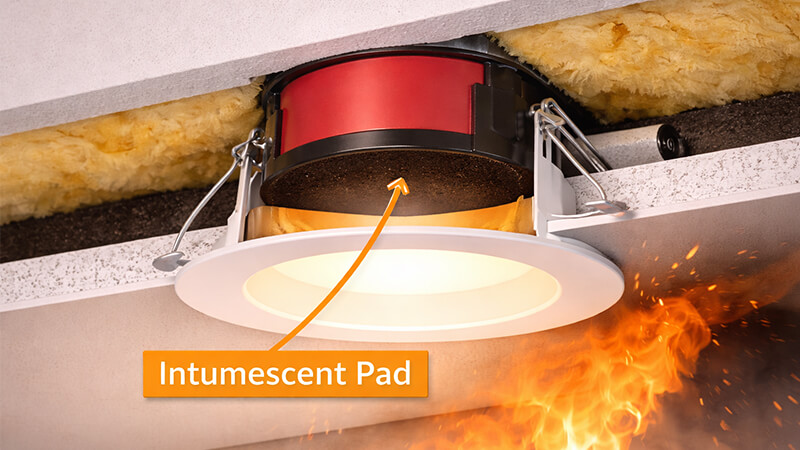
This is where the magic of material science comes into play. From my years on the factory floor, I can tell you that the difference between a standard downlight and a fire-rated one is a special material called an intumescent strip or pad. It’s the heart of the product’s safety function. This material is designed to be stable at normal temperatures. However, when exposed to the intense heat of a fire (usually around 150°C), it undergoes a rapid chemical reaction. It expands dramatically, sometimes up to 40 times its original size, turning into a dense, insulating char.
This char completely seals the hole that was cut for the downlight. It blocks the path for fire and hot gases, effectively restoring the ceiling’s fire barrier. This is why I call it a "light-emitting fire stop."
Understanding the Mechanism
- Penetration: You cut a hole in the fire-rated plasterboard ceiling. The fire barrier is now broken.
- Installation: You install a fire-rated downlight. Its metal can and intumescent material sit within the ceiling void.
- Fire Event: A fire starts in the room below. Heat rises and hits the downlight.
- Activation: The intumescent pad heats up and expands, filling the entire can and sealing any gaps around the fixture.
- Containment: The fire is prevented from entering the ceiling void and spreading to the floor above for the rated time (e.g., 60 minutes).
Installing a non-fire-rated downlight is like leaving a window open for the fire. The open metal can acts as a chimney, channeling intense heat directly to the wooden joists and floorboards above. This can cause the floor above to collapse in just a few minutes, trapping anyone upstairs. For a purchasing manager like you, Shaz, specifying a certified fire-rated downlight is one of the most critical decisions you can make for a building’s safety.
Are Non-Fire Rated Downlights a C2 or C3?
Are you evaluating the safety of an existing electrical installation? You may find non-fire rated downlights in a fire-rated ceiling and wonder how to classify this risk correctly.
A non-fire-rated downlight installed in a ceiling that requires a fire barrier is classified as a C2 defect. This means it is "Potentially Dangerous." It is not a C3 ("Improvement Recommended") because it actively compromises the building’s fire containment strategy, posing a serious risk to life.
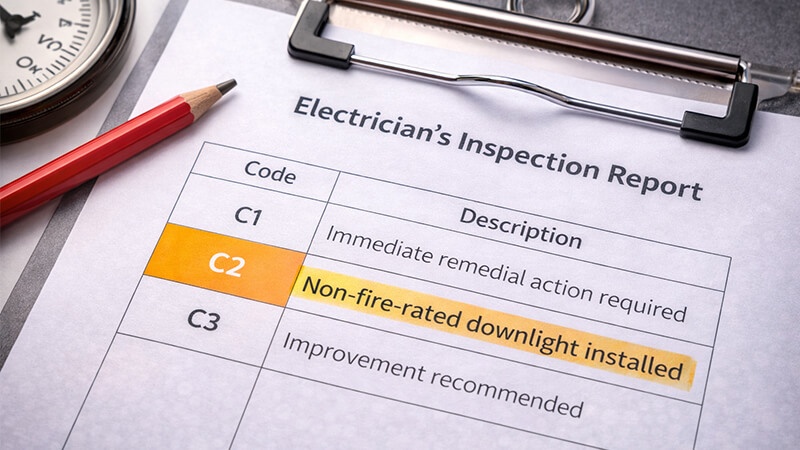
This classification comes from the Electrical Installation Condition Report (EICR) system, widely used in the UK and influential in many other regions. Understanding these codes is vital for anyone in the lighting supply chain. A C2 code isn’t just a suggestion; it signifies a real danger that requires urgent remedial action. The reason it’s not a C3 is all about the potential outcome. A C3 issue might be a non-compliance with the latest regulations that doesn’t pose an immediate or potential danger, like having socket outlets without USB ports. A C2 issue, however, could directly lead to injury, death, or property damage in a fault condition, and a fire is the ultimate fault condition.
Let’s look at why it’s a C2 in more detail.
The Logic Behind the C2 Classification
- Breach of Fire Compartmentation: Buildings are designed with fire compartments—walls, floors, and ceilings—to contain a fire in the area where it starts. This gives people time to escape and for firefighters to arrive. A non-fire-rated downlight creates a hole in a fire-rated ceiling, breaking the compartment.
- Accelerated Fire Spread: The open-backed metal can of a non-fire-rated downlight acts like a conduit. It funnels flames and extreme heat directly into the ceiling void, which is typically full of combustible materials like timber joists and electrical cables.
- Structural Failure: This concentrated heat attack can cause the timber joists supporting the floor above to fail much faster than they are designed to. A floor that should hold for 60 minutes might collapse in under 15.
Here is a breakdown of the EICR codes for context:
| Code |
Meaning |
Example related to Downlights |
Required Action |
| C1 |
Danger Present |
An exposed live wire on a downlight terminal. |
Immediate |
| C2 |
Potentially Dangerous |
A non-fire-rated downlight in a fire-rated ceiling. |
Urgent (remedial work) |
| C3 |
Improvement Recommended |
A halogen downlight that could be replaced with an energy-efficient LED. |
Recommended |
| FI |
Further Investigation |
A circuit of downlights trips intermittently. |
Required |
I once consulted for a property management company in Dubai that was assessing a portfolio of older apartment buildings. Their electricians found non-fire-rated downlights in all the escape corridors. The original contractor had cut corners years ago. Based on my advice and following best practices, they classified them all as C2 risks and launched an immediate replacement program. It was a significant investment, but the alternative—ignoring a known, potentially fatal fire hazard—was simply not an option.
How Do I Know if a Downlight Is Fire Rated?
As a buyer, how can you be certain the downlights you’re sourcing are genuinely fire-rated? With so many products on the market, you need a reliable method to verify their compliance.
You can verify a downlight is fire-rated by checking for specific markings on the product itself, its packaging, and the technical datasheet. Look for a fire rating in minutes (e.g., 30, 60, 90), compliance with standards like BS 476-21, and certification marks from recognized bodies.
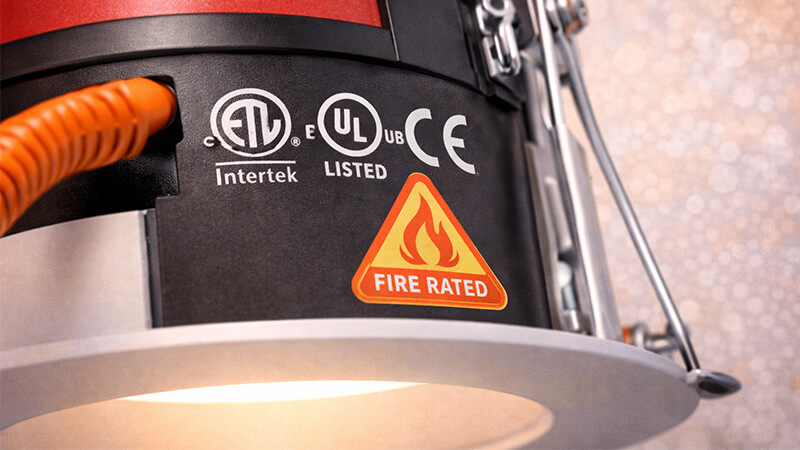
Trusting a supplier’s word is not enough. You need to be able to verify the claims yourself. In my manufacturing business, we ensure every fire-rated product has clear, undeniable proof of its testing and compliance. It’s about accountability and safety. A reputable manufacturer will make this information easy to find. A cheap, non-compliant product often has vague or missing information—that’s a major red flag.
Here’s a step-by-step checklist you can use as a purchasing manager to verify any fire-rated downlight.
Your Verification Checklist
-
Check the Product Itself:
- Fire Symbol: Many compliant products have a small triangle symbol with an ‘F’ inside, indicating suitability for mounting on flammable surfaces. While not a fire-rating guarantee on its own, its absence is a bad sign.
- Construction: A fire-rated downlight is typically fully enclosed with a steel can body. There are no large gaps for fire to pass through. It will feel more robust and heavier than a cheap, open-backed "canless" or "gimbal" fitting.
-
Examine the Packaging and Datasheet:
- Explicit Fire Rating: The box and technical documents must state the fire rating clearly. It should say "Fire Rated for 30/60/90 minutes." If it just says "fire resistant," be skeptical and ask for the test standard.
- Test Standards: Look for specific building regulation standards. The most common one for fire resistance is BS 476-21:1987 or its European equivalent EN 1365-2. The documents must state that the product has been tested to this standard.
- Acoustic and Air Leakage Ratings: Often, fire-rated downlights are also tested for resistance to sound transmission (Part E) and air leakage (Part L). The presence of these ratings is a good indicator of a high-quality, thoroughly tested product.
-
Look for Third-Party Certification:
- CE/UKCA Marking: This is mandatory but only shows the manufacturer claims compliance. It’s a starting point, not the final proof.
- Reputable Test Labs: Look for the mark of an independent testing laboratory like Intertek, TÜV SÜD, BRE, or UL. This proves the product was actually tested and passed. A manufacturer should always be able to provide the full test certificate from one of these bodies upon request.
I always tell my clients, "If the price seems too good to be true, it’s because they cut corners on safety testing." Sourcing a reliable product isn’t just about the spec sheet; it’s about the proof behind it. Always ask for the full test report. If a supplier hesitates or cannot provide it, walk away. Your reputation and the safety of end-users depend on it.
Conclusion
In short, using certified fire-rated downlights in required locations is not just a regulatory detail. It is a critical safety measure that protects property and, most importantly, saves lives.