Struggling to choose the right downlight? A bad choice leads to poor lighting, high costs, and endless complaints. The key is knowing what truly makes an LED downlight great.
Yes, LED downlights are excellent, but their quality depends less on the LED chip and more on the "hidden" components. For superior performance, you must investigate the optical design materials and the driver’s electronic topology. These elements determine the light quality and lifespan of the fixture.
It’s easy to get lost in technical specs like lumens and watts when you’re sourcing lighting. I’ve spent my entire career in LED factories, and I can tell you a secret: the spec sheet doesn’t tell the whole story. The real difference between a good downlight and a bad one is hidden from view. Let’s uncover what really matters, so you can source with confidence.
What are the disadvantages of LED ceiling lights?
You hear about all the benefits, but what are the downsides? Ignoring them can lead to costly mistakes and unhappy clients. Understanding potential issues helps you choose wisely and avoid problems.
The main disadvantages of LED ceiling lights are a higher initial cost, the potential for poor color rendering (low CRI), and flickering caused by cheap drivers. Inconsistent quality between batches is also a major risk if you don’t vet your supplier’s manufacturing process carefully.
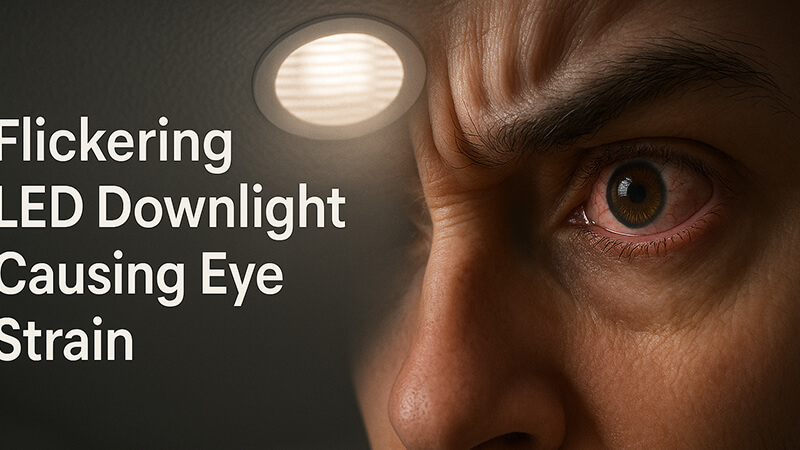
When a client like Shaz, a purchasing manager from the UAE, calls me about a problem with LED downlights they sourced elsewhere, the issue is almost never the LED chip itself. The chip is just the engine. The real performance comes from the parts that control and shape the light. The most common complaints—flickering, harsh glare, and colors looking "off"—all point back to two components that are often overlooked to save a few cents: the driver and the optics. These are the "hidden" parts where quality truly counts.
The Hidden Culprits: Drivers and Optics
The driver is the power supply for the LED. A cheap one provides unstable power, which causes the light to flicker, even if it’s invisible to the naked eye. This can cause headaches and eye strain. A good driver uses a stable electronic topology to deliver clean, constant power. The optics—the lens and reflector—shape the beam of light. Low-quality plastic optics can create harsh glare, uneven light spots, and can yellow over time. High-quality aluminum reflectors or PMMA lenses, on the other hand, provide smooth, comfortable, and consistent light. I always tell my clients, don’t ask about the brand of the LED chip. Instead, ask, "What is your optical solution made of?" and "What is the topology of your driver?" This tells you everything you need to know about the product’s quality.
| Component |
Poor Quality Signs |
High-Quality Standard (What I demand) |
| Driver |
Non-isolated, simple circuit |
Isolated, flicker-free topology for safety and stability |
| Optics |
Basic plastic reflector, prone to yellowing |
Precision-engineered aluminum reflector or PMMA lens |
| Color Rendering |
CRI <80, colors look dull |
CRI >90, colors appear vibrant and true |
| Heat Sink |
Thin, stamped sheet metal |
Robust, die-cast aluminum for superior heat dissipation |
Is it worth changing from halogen to LED?
Your facility is full of old halogen lights. They are constantly burning out, driving up maintenance and electricity bills. Switching to LED is a clear solution with long-term benefits.
Absolutely. The switch from halogen to LED is worth it for massive energy savings of up to 80%, a much longer lifespan, and greatly reduced maintenance. The initial investment is quickly recovered through lower electricity bills and fewer replacements, making it a smart financial decision.
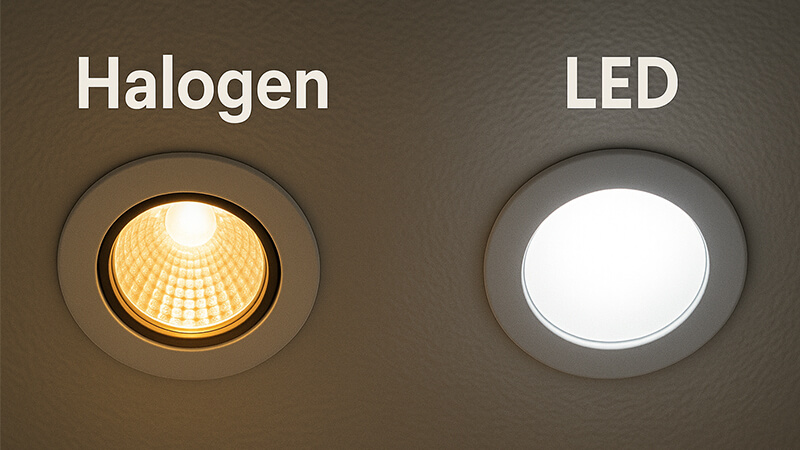
I remember working with a project contractor who was hesitant to switch a hotel’s lighting from halogen to LED because of the upfront cost. He was spending a fortune on electricity and had two full-time maintenance workers just replacing burnt-out halogen bulbs. I walked him through the numbers, showing him how the energy and labor savings would pay for the entire LED upgrade in under 18 months. For a purchasing manager, the Total Cost of Ownership (TCO) is the most important metric, and LEDs win by a huge margin. It’s not just an expense; it’s an investment with a guaranteed return.
A Clear-Cut Case: Halogen vs. LED
The difference is staggering when you look at the details. A typical 50W halogen downlight can be replaced with a 7W LED downlight that produces the same amount of light. That’s an immediate 85% reduction in energy consumption per fixture. Now, multiply that by hundreds or thousands of lights in a commercial building. In a hot climate like the UAE, there’s another hidden saving: halogens are like tiny heaters, putting extra strain on your air conditioning system. LEDs run significantly cooler, reducing the HVAC load and saving even more energy. Then there’s the lifespan. A halogen bulb might last 2,000 hours. A quality LED downlight will last 50,000 hours. That means for every one LED downlight you install, you would have had to purchase and install 25 halogen bulbs. The savings on materials and labor are enormous.
| Feature |
Halogen Downlight |
LED Downlight |
| Energy Use |
~50 Watts |
~7 Watts |
| Lifespan |
~2,000 hours |
~50,000 hours |
| Heat Output |
Very High (Fire Hazard) |
Very Low |
| Maintenance |
Frequent replacement |
Install and forget |
| Annual Energy Cost (12hrs/day) |
~$26.28 |
~$3.68 |
Why is replacing halogen with LED illegal?
You’ve heard rumors that swapping halogen bulbs for LED is illegal. This misinformation can cause hesitation and confusion. It’s important to understand the facts to make safe, compliant choices.
It is not illegal. However, compatibility issues can make it unsafe. You cannot simply plug any LED bulb into an old halogen fixture. The existing transformer may be incompatible with the low power draw of an LED, causing flickering, overheating, or failure.
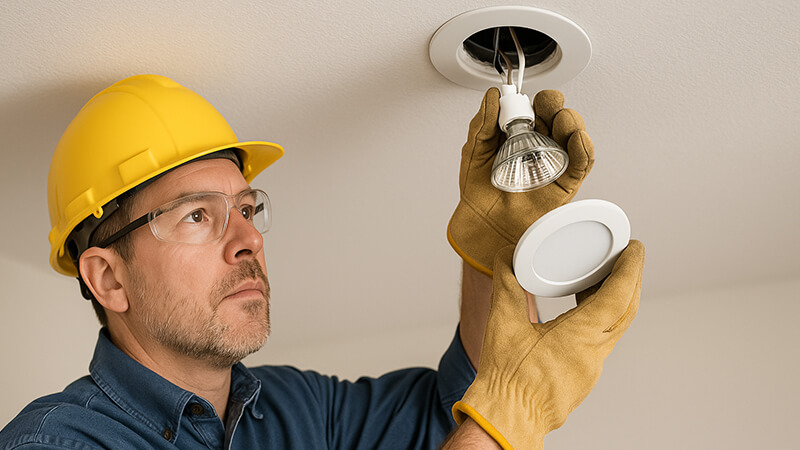
The myth that replacing halogens with LEDs is "illegal" usually comes from a misunderstanding of electrical safety regulations. The real issue is compatibility, not legality. Most old halogen downlights use a 12V transformer. These transformers were designed for the high power load of a 50W halogen bulb. When you plug in a 7W LED, the transformer doesn’t see enough load to operate correctly. This is where the danger lies. The transformer can overheat, or it can send unstable power to the LED, causing it to fail prematurely. I’ve seen this happen on projects where the client tried to cut costs by only replacing the bulbs.
The Right Way to Retrofit
To ensure a safe and effective upgrade, you have two main options. The best option is to replace the entire fixture—the housing, the transformer, and the light source—with an integrated LED downlight. This guarantees that all components are designed to work together perfectly. It’s the safest and most reliable long-term solution. The second option is to use a "retrofit" LED module designed specifically for halogen housings. These kits often come with a compatible LED driver that replaces the old halogen transformer. You must ensure the new driver is correctly installed and that the LED module has adequate ventilation inside the old housing. Simply "plugging and playing" is not a professional solution and can create serious safety hazards. Always consult with a qualified electrician and use products from a reputable manufacturer that guarantees compatibility.
| Approach |
Description |
Pros |
Cons |
| Full Fixture Replacement |
Remove the old halogen fixture entirely and install a new, integrated LED downlight. |
Safest, most reliable, best performance, long warranty. |
Higher initial cost. |
| Bulb-Only Swap |
Simply replace the halogen MR16 bulb with an LED MR16 bulb. |
Cheapest, easiest. |
Not Recommended. High risk of incompatibility, flicker, and fire. |
| Retrofit Kit |
Replace the halogen bulb and transformer with a new LED module and driver. |
Good balance of cost and safety. |
Requires more installation labor than a bulb swap. |
What’s the lifespan of an LED?
You see claims of 50,000 or even 100,000 hours for LED life. This sounds amazing, but can you trust it? Understanding what this number really means is key to managing expectations.
An LED’s lifespan, often 25,000 to 50,000 hours, isn’t when it burns out. It’s the point where its light output has faded to 70% of its original brightness (L70). This degradation is primarily caused by heat, which is managed by the fixture’s heat sink.
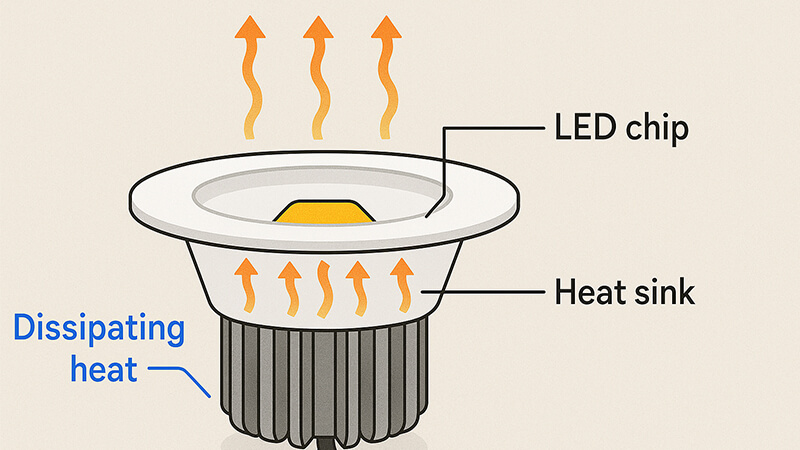
Unlike old incandescent bulbs that fail suddenly when a filament breaks, LEDs fail gracefully by slowly getting dimmer over tens of thousands of hours. The "lifespan" rating, known as L70, is a projection of how long it will take for the light to dim to a level that is noticeably less bright. The single biggest enemy of an LED’s lifespan is heat. The LED chip itself generates a lot of heat in a very small area. If that heat isn’t drawn away effectively, it will permanently damage the chip and cause it to dim much faster. This is why the physical design of the downlight’s body, specifically the heat sink, is so critical.
It’s Not the Chip, It’s the Heat Sink
When I evaluate a new downlight design, I spend more time looking at the heat sink than the LED chip. A good heat sink is made from die-cast aluminum with a large surface area (fins) to dissipate heat into the air efficiently. A poorly designed one might be made of thin, stamped metal or have too little mass to do the job properly. A manufacturer can use the best LED chip in the world, but if they put it in a fixture with a bad heat sink, its lifespan will be drastically cut short. For a purchasing manager like Shaz, this is crucial. A light that is rated for 50,000 hours but is poorly designed might only last 15,000 hours before it’s too dim to be useful. That’s the difference between a product that lasts over a decade and one that needs replacing in just a few years. Always check the physical build quality of the fixture. If it feels flimsy and light, it probably has a poor heat sink.
| Heat Sink Design |
Material |
Performance |
Expected L70 Lifespan |
| Poor |
Thin, stamped aluminum or plastic |
Inefficient heat transfer, chip overheats. |
< 20,000 hours |
| Good |
Extruded aluminum |
Good thermal management for most applications. |
25,000 – 40,000 hours |
| Excellent |
Solid, die-cast aluminum with fins |
Superior heat dissipation, protects the LED chip. |
50,000+ hours |
Conclusion
LED downlights are a superior choice, but their quality lies in the hidden driver and optics, not just the chip. Focus on these components to ensure reliability and performance.