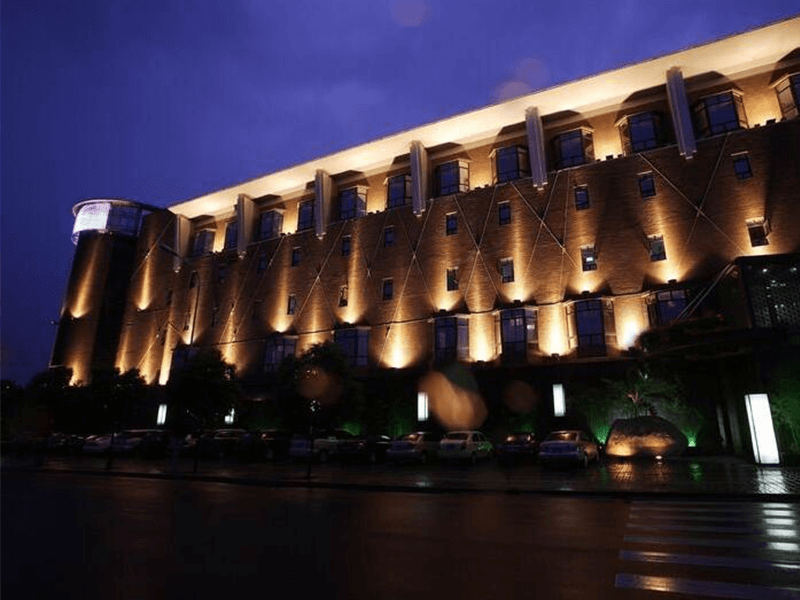
Choosing the right lighting is tough, and the wrong choice can make a space feel dated or cluttered. Recessed downlights offer a clean, modern, and powerful solution.
Yes, recessed downlights are often better because they create a clean, minimalist look. More importantly, they shift the focus from the fixture to the light itself, subtly highlighting architecture, textures, and furniture without drawing attention to the source. This gives you total control over the room’s atmosphere.
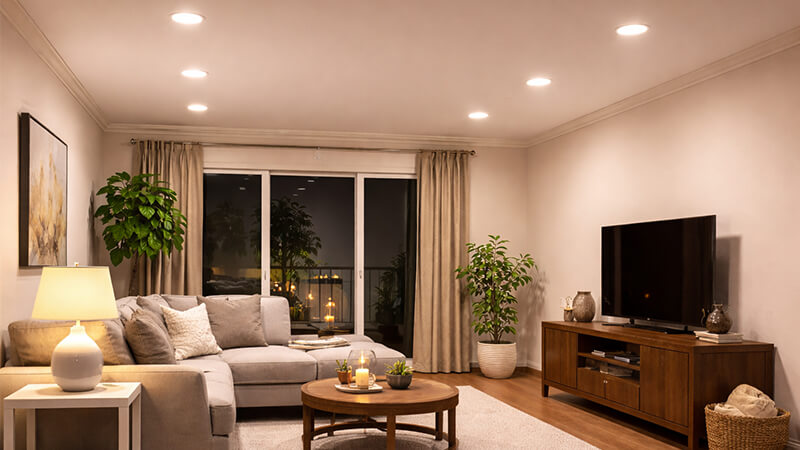
I’ve worked in the LED lighting industry my entire career, from the factory floor to founding my own company. I’ve seen many clients think of recessed lights as just simple fixtures for false ceilings. But there is so much more to it. The real power of recessed lighting is in how it transforms a space, and understanding this can completely change how you approach your projects. Let’s explore the details so you can decide if they are the right fit for your needs.
What is the disadvantage of recessed lights?
Worried about the downsides of recessed lights? Poor planning can lead to dark spots or a ceiling that looks like Swiss cheese. Understanding their limitations helps you avoid these common issues.
The main disadvantages are the need for a false ceiling or specific cavity for installation and the potential for a "ceiling acne" effect if overused or poorly placed. They can also create dark spots on the upper walls if not supplemented with other light sources.
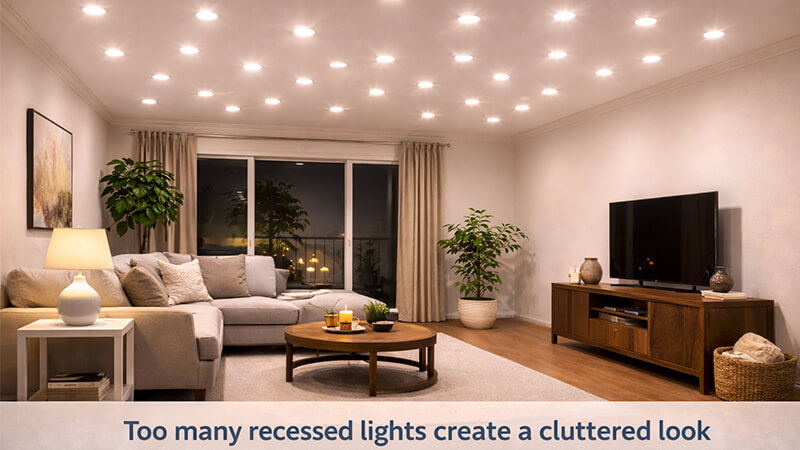
In my experience, almost every "disadvantage" of recessed lighting comes from poor planning, not from a flaw in the product itself. As a purchasing manager, I’m sure you’ve seen projects where the lighting just feels "off." Often, recessed lights get the blame. The truth is, they are precision tools. And like any tool, you need to know how to use them correctly.
The biggest practical hurdle is installation. They need space above the ceiling. For new construction, this is easy to plan for. But for renovations, it can be a challenge. We’ve developed ultra-thin "pancake" style downlights at iPHD specifically for this problem, which need as little as one inch of clearance.
Another common issue is what designers call the "cave effect," where the ceiling itself is dark, making a room feel smaller and shorter. This happens when you only use downlights. The solution isn’t to get rid of the downlights; it’s to layer your lighting. Add some wall washers or even uplights to gently illuminate the ceiling and make the space feel open and airy.
Common Challenges and How to Solve Them
Here’s a quick breakdown of the most common issues I see and how we advise our partners to solve them. Your role in sourcing the right product is key to avoiding these problems from the start.
| Challenge |
Description |
Solution |
| Installation Complexity |
Requires a void above the ceiling. It can be difficult to retrofit into existing solid ceilings. |
Plan for recessed lighting during the construction phase. For renovations, use ultra-thin downlights designed for minimal clearance. |
| "Ceiling Acne" |
Too many fixtures are installed, creating a cluttered, pockmarked look on the ceiling. |
Follow a proper lighting plan. Use fewer, higher-lumen fixtures with wider beam angles for general light. Space them out thoughtfully. |
| Cave Effect |
The ceiling plane remains dark, which can make the room feel shorter or closed-in. |
Layer your lighting. Supplement downlights with other sources like wall washers, cove lighting, or uplights to brighten the ceiling. |
| High Glare |
Poorly designed reflectors or exposed LEDs can cause uncomfortable, direct glare for occupants. |
Choose high-quality downlights with deep-set LEDs, anti-glare baffles, or honeycomb louvers. Always check the UGR (Unified Glare Rating). |
Need lighting that enhances your space without being the center of attention? Bulky fixtures can easily distract from your design. Recessed downlights put the focus back on your architecture and decor.
The key benefit is their ability to disappear. They provide clean, focused light without cluttering the ceiling, making rooms feel larger and more modern. This allows the light itself to define textures, art, and pathways, creating a sophisticated and controlled atmosphere.
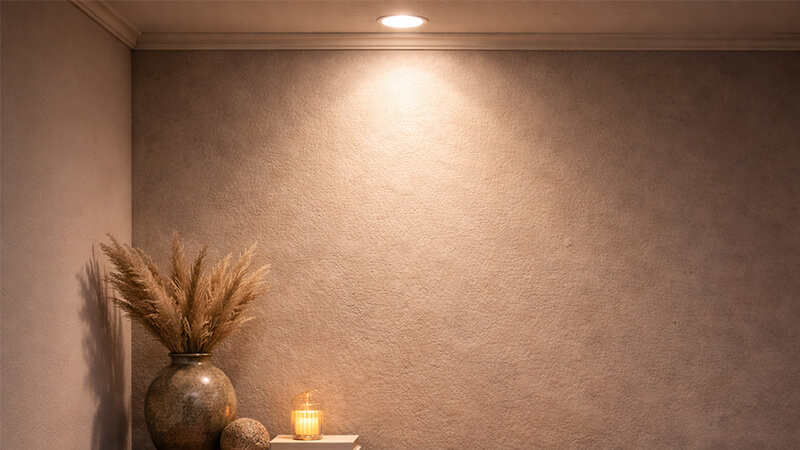
The most powerful benefit of recessed lighting is a concept I call the "visual power shift." Think about a traditional chandelier. It’s a beautiful object. But it is an object. Your eye is drawn to it. The fixture is the star of the show. Recessed lighting does the exact opposite. It makes the light itself the star. By hiding the source, it allows you to focus on what is being lit. You see the soft texture of a stone wall, the vibrant colors in a painting, or the clean lines of a countertop. The light does the work, and the fixture gets out of the way.
Shifting Power from Fixture to Light
This is a fundamental change in design philosophy. You are no longer just hanging a lamp. You are painting with light. A few years ago, we worked on a boutique hotel project. The client wanted the long, narrow hallways to feel luxurious and spacious, not like tunnels. Instead of using decorative ceiling lights every few meters, we used a series of recessed wall-washers aimed at one side of the hallway. The light grazed across the textured wallpaper, creating a beautiful play of light and shadow. Guests were guided by a soft glow, the hallway felt wider, and the ceiling disappeared. The experience was elevated, but you’d never be able to point to a single fixture and say, "that’s what did it." That is the power of recessed lighting.
Practical Advantages for Projects
For a purchasing manager like you, Shaz, the practical benefits are just as important. These lights are not just for high-end designers; they are workhorses for all kinds of projects.
| Benefit |
Why It Matters for Commercial & Residential Projects |
| Space Saving |
Ideal for rooms with low ceilings where a hanging fixture would be intrusive. It creates a feeling of openness and height. |
| Versatility |
Can be used for general ambient lighting, focused task lighting (over a desk), and dramatic accent lighting (on artwork). |
| Clean Aesthetics |
Contributes to a minimalist, modern, and high-end feel. It doesn’t compete with furniture, art, or architectural details. |
| Controlled Illumination |
You can precisely direct light where it’s needed, reducing light waste and creating intentional, dramatic effects. Adjustable "gimbal" versions offer even more flexibility. |
Are recessed lights in style?
Are you afraid that recessed lights are just a passing trend? No one wants to invest in a style that will look dated tomorrow. The good news is their minimalist design is truly timeless.
Yes, recessed lights are absolutely in style and have become a timeless classic in lighting design. Their minimalist aesthetic fits perfectly with modern, contemporary, and even traditional designs that favor clean lines. Their popularity is growing because they focus on atmosphere, not on ornamental distraction.
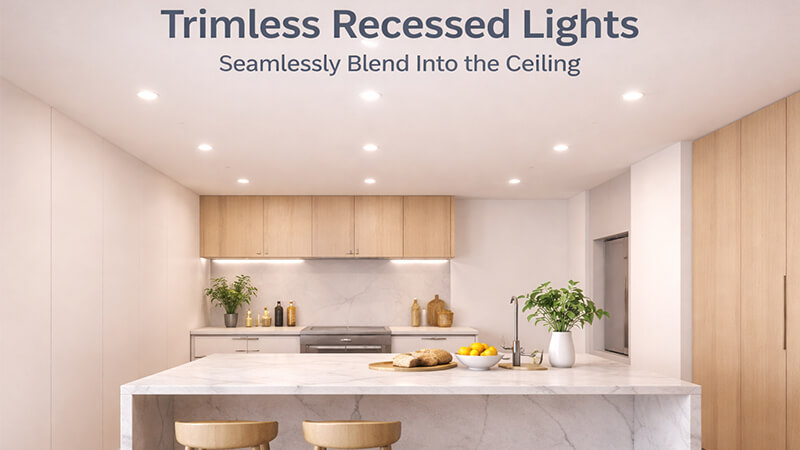
Recessed lighting is not a trend; it’s an evolution. For centuries, the light source itself—from the candle sconce to the crystal chandelier—was a symbol of status. It was a decorative object meant to be seen. But modern design has shifted. The focus is now on the human experience within the space. We want to create a feeling, a mood, an atmosphere. Style is no longer just about the objects in a room, but about how the room makes you feel. Recessed lights are the single most important tool for controlling that feeling.
From Ornament to Experience
This is why they will never go out of style. Their function is to disappear. A classic chandelier from 1920 looks like it’s from 1920. A well-placed recessed light from 1980 can look as modern today as it did then, because your focus is on the light, not the fixture. At iPHD, our innovation is focused on making them even less visible. We design trimless models that can be plastered directly into the ceiling for a completely seamless look. We’ve engineered ‘dark light’ reflectors with incredibly low glare, so you see the light on the floor or wall, but you can barely tell the light on the ceiling is even on.
Adapting to Modern Design Trends
Think about the biggest design trends right now. Recessed lighting is essential to all of them.
- Minimalism: What could be more minimal than a light source that is practically invisible? It’s the definition of "less is more."
- Biophilic Design: Recessed spotlights can be used to precisely highlight indoor plants or bring out the natural grain in wood and stone materials, connecting the indoor space with nature.
- Open-Concept Spaces: In a large room, you can use groups of recessed lights to define different "zones"—a pool of light over the dining table, a line of light over the kitchen island, and soft washes on the living room walls—all without building a single wall.
Investing in quality recessed lighting is a future-proof decision for your projects. It’s not about following a trend, but about embracing a more sophisticated and permanent philosophy of light.
Why are recessed lights better?
Still deciding on your primary lighting strategy? Choosing between pure function and a specific style can be difficult. Recessed lights offer the best of both, providing superior control.
Recessed lights are better because they give the designer complete control. Instead of the light fixture dictating the room’s style, recessed lights empower you to use light as a tool to shape the space, highlight features, and create a specific mood or atmosphere.
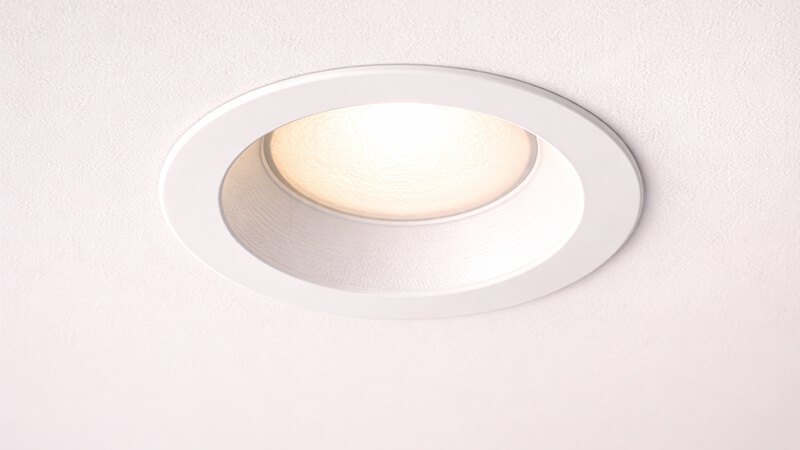
This brings us back to my core belief about recessed lighting. Most people think they are just lights installed in the ceiling. But their greatest advantage is not just being "neat." It’s that they create a complete reversal of visual power. A traditional fixture is a visual object; you see the lamp first. A recessed downlight hides itself, making the light the only subject.
The Power of Invisibility
This is what I mean when I say it’s a more advanced way to design. It quietly defines the texture of a wall, the outline of furniture, or the depth of a room, but it leaves no trace of its manipulation. I remember visiting a high-end art gallery in Europe. I was completely captivated by the paintings. The colors were rich, and every brushstroke was visible. I was in there for over an hour. It was only as I was leaving that I happened to look up. The ceiling was a simple, dark gray, dotted with small, black recessed lights. I hadn’t noticed them at all. They had done their job perfectly by being invisible, allowing the art to be the one and only hero. That is the ultimate goal of architectural lighting.
A Comparison of Control: Recessed vs. Traditional
For your projects in the UAE, Shaz, where you are dealing with everything from high-end commercial spaces to modern residences, this level of control is invaluable. Here’s a final comparison to make it clear.
| Feature |
Traditional Fixture (e.g., Chandelier) |
Recessed Downlight |
| Visual Impact |
High. It is a decorative object in itself. |
Low. It disappears into the architectural plane. |
| Focal Point |
The fixture is the focal point. |
The light creates the focal point (on art, a table, etc.). |
| Control |
Provides general, often diffuse, light. |
Provides precise, directed light for specific tasks or effects. |
| Design Role |
Acts like a statement piece of furniture. |
Acts as an architectural tool to shape perception. |
| Atmosphere |
Defines the style (e.g., classic, rustic, industrial). |
Creates the mood (e.g., dramatic, calm, focused, intimate). |
Ultimately, recessed downlights are "better" when your goal is to create a sophisticated, controlled, and intentional environment where the space and its contents are the priority, not the light fixtures themselves.
Conclusion
Recessed downlights are more than just lights. They are a powerful design tool that puts the focus on your space, giving you complete control to create the perfect atmosphere.