Installing loft insulation but worried about your LED downlights? Covering them incorrectly can create a fire risk and ruin the lights. You need to know the safe way.
Yes, you can, but only with the right type of downlight. Use lights specifically rated as "insulation coverable" (IC-rated). For non-IC-rated lights, you must use a loft cap or maintain a clear air gap to prevent overheating and fire hazards.
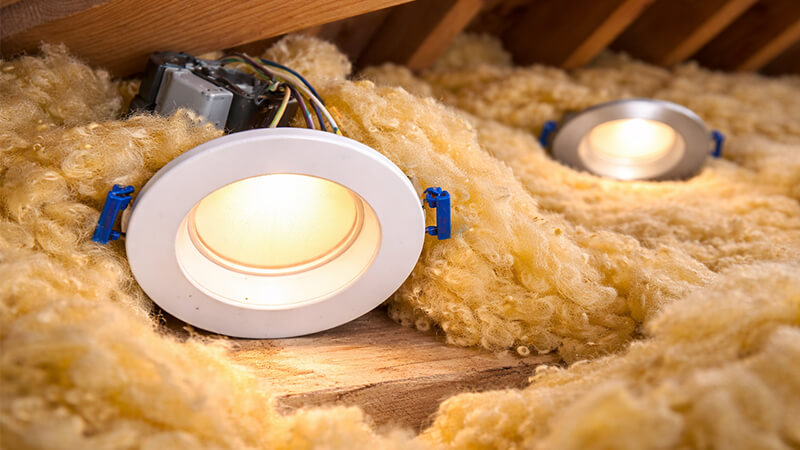
People often ask me if insulation can touch LED lights. But my experience in the factory taught me the real question is different. It’s not about simple contact; it’s about trapping heat. The light itself might feel cool, but other parts get warm, and that’s where the danger lies. This is a critical detail I always stress with my partners, from distributors to contractors.
Let’s break down exactly what you need to know to do this job safely and protect your investment.
Can you put insulation on top of LED lights?
You want to improve your home’s energy efficiency with insulation. But throwing it directly on top of your LED lights feels risky. Let’s clarify what is safe and what is not.
You can only put insulation directly on top of LED lights if they are IC-rated (Insulation Contact rated). These fixtures are built to handle direct contact with insulation. For all other LEDs, you must leave a clear air gap around them.

Dive Deeper
In my years of manufacturing, the distinction between IC-rated and non-IC-rated lights has become one of the most important safety topics I discuss with clients. A purchasing manager I work with, Shaz from the UAE, was sourcing for a huge residential project. He was focused on lumens and color temperature, but I urged him to make the IC rating a top priority for fixtures in insulated ceilings. It’s not just about passing an inspection; it’s about long-term reliability and the safety of the homeowner.
Understanding IC Ratings
An IC-rated downlight is specifically designed to be in direct contact with insulation. These fixtures are built with a "can" or a double-walled housing that contains the fixture’s heat and allows it to dissipate safely, even when completely buried. They undergo rigorous testing to ensure their temperature remains below the safe limit of 90°C. When you buy an IC-rated light, you are buying a tested and certified safety system.
What Happens to a Non-IC Rated Light?
A non-IC-rated light is different. It relies on the free circulation of air in the ceiling void to cool down. It has an open frame and is not designed to contain heat. If you cover it with insulation, you are essentially putting it in an oven. The heat generated by the LED driver has nowhere to go. This trapped heat flows back into the light fixture, causing two major problems. First, it dramatically shortens the life of the LED chips and driver, leading to premature failure. Second, it can degrade the light’s internal wiring and become a serious fire hazard.
| Feature |
IC-Rated Downlight |
Non-IC Rated Downlight |
| Direct Contact |
Yes, designed for it. |
No, requires an air gap. |
| Construction |
Sealed can or housing. |
Open frame, needs ventilation. |
| Safety |
Certified for safe operation. |
Fire hazard if covered. |
| Installation |
Simple, cover with insulation. |
Needs a loft cap or clear space. |
Are LED lights safe with insulation?
You know LED lights are efficient and safer than old halogens. But when you introduce insulation into the equation, you might start to second-guess their safety. Let’s confirm the facts.
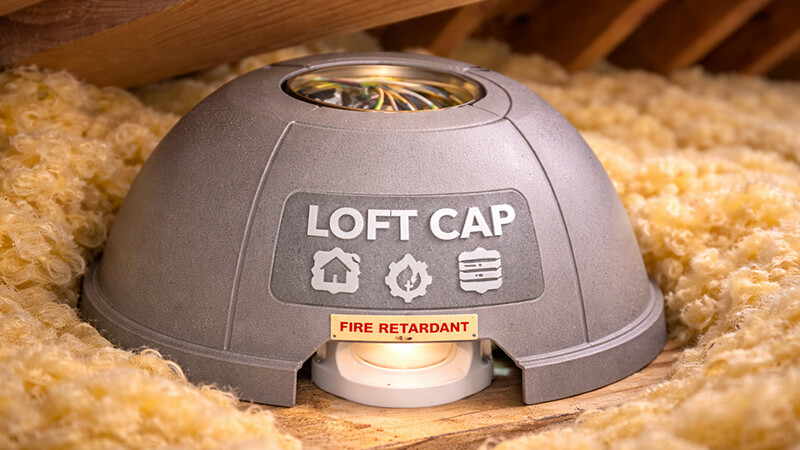
LED lights are safe with insulation when installed correctly. Safety depends on using IC-rated lights for direct contact or ensuring proper ventilation for non-IC-rated lights with loft caps. Incorrect installation is what creates the hazard, not the LED itself.
Dive Deeper
Safety is the foundation of our mission at iPHD. An LED downlight is a system, and its safety depends on how all the parts work together, including the environment it’s installed in. When we talk about safety with insulation, we have to look beyond the LED chip and focus on its power source.
The Role of the Driver
The true source of most heat in an LED fixture is the driver. This is a small electronic device that converts the high-voltage AC from your home’s wiring into the low-voltage DC that the LED chip needs. This conversion process is not 100% efficient; the waste energy is released as heat. In a non-IC rated fixture smothered by insulation, the driver’s temperature can climb fast. A well-made driver, like the ones we use, will have thermal protection. It will sense the excessive heat and either dim the light or shut it off completely to prevent a catastrophe. This is a crucial safety feature. However, cheaper, uncertified drivers may lack this protection, allowing them to overheat to dangerous levels.
Fire Risk vs. Product Failure
When a non-IC light is covered, you face two potential outcomes. The most common one is product failure. The excessive heat cooks the sensitive electronics in the driver and accelerates the degradation of the LED chips. We call this lumen decay. Your bright new lights will become dim and fail in a fraction of their advertised lifespan. The second, more dangerous outcome, is a fire. If a low-quality driver overheats without thermal protection, it can melt its own housing and the insulation on nearby wires. This creates a risk of a short circuit and fire, especially if the insulation material itself is flammable. Using a loft cap or downlight cover for non-IC lights is a non-negotiable safety step. It creates the air gap the light needs to breathe and operate as designed.
| Safety Check |
IC-Rated Light |
Non-IC Rated Light |
| Driver Heat |
Managed by the housing. |
Dissipated into air. Must not be blocked. |
| Fire Risk |
Very low if properly certified. |
High if covered by insulation. |
| Failure Mode |
Normal end-of-life failure. |
Premature failure from overheating. |
| Solution |
Install and cover directly. |
Must use a loft cap/cover for ventilation. |
Can you put loft insulation on top of spotlights?
You have spotlights in your ceiling and want to add loft insulation. But "spotlight" can mean many things, from old halogens to new LEDs. Are the rules the same for all?
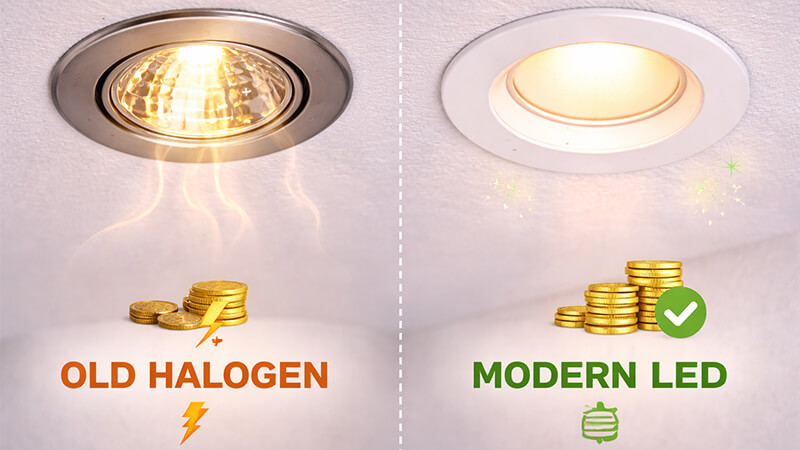
The rules depend on the type of spotlight. Never cover old halogen spotlights; they are a major fire hazard. For LED spotlights (downlights), you must follow the same rule: only cover them if they are explicitly IC-rated. Otherwise, use a loft cap.
Dive Deeper
When I first started in this industry, halogen spotlights were the standard. The rules for dealing with them are completely different from modern LEDs, and it’s vital to know which type you have in your ceiling before you even think about insulation.
The Danger of Halogen Spotlights
A halogen bulb is basically a supercharged incandescent bulb. It creates light by heating a filament until it glows white-hot. The surface temperature of a halogen bulb can easily exceed 200°C (392°F). They radiate immense amounts of heat forward and backward. Laying loft insulation, which is designed to trap heat, on top of a halogen spotlight is a recipe for disaster. I have personally seen charred ceiling joists and melted fixtures from this exact scenario. It is a severe and immediate fire risk. There are no exceptions to this rule: you must never cover halogen spotlights with insulation. You must keep a large, clear air gap around them, often recommended to be at least 200mm in all directions.
Why LEDs are Different (But Still Need Care)
Modern LED spotlights, or downlights, are thankfully a world apart in terms of safety. They are significantly more efficient and operate at much lower temperatures. The risk of fire is vastly reduced. However, as we have already discussed, "cooler" does not mean "cold." They still produce heat, primarily at the driver and the heatsink on the back of the fixture. While the risk shifts from an immediate fire hazard to one of product failure, the core principle remains: heat must be allowed to escape. For a project contractor replacing old halogens with new LEDs, this is a critical point. It’s not a simple one-for-one swap. You must also address the insulation. If the new LED downlights are not IC-rated, you must still install loft caps to create that necessary air pocket for ventilation. This ensures the new, efficient LEDs will last their full lifespan and operate safely for years to come.
Do LED downlighters get hot?
We all hear that LEDs run cool, and you can touch the bulb without getting burned. Yet, the fixture itself can feel warm to the touch. Is this a sign of a problem?
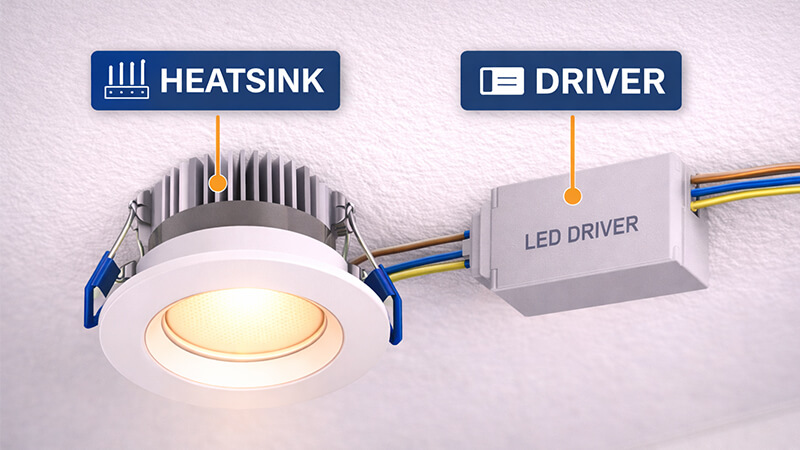
Yes, the fixture and heatsink of an LED downlighter do get warm, but they should not be dangerously hot. While the light itself is cool, the electronics (the driver) and the LED chip generate heat. This heat is drawn away from the chip by a heatsink.
Dive Deeper
This is one of the biggest misunderstandings about LED technology. The coolness of an LED is about the light it produces, not the hardware that produces it. Let me explain the journey of heat inside an LED downlight.
Heat: The Enemy of LEDs
An LED chip is a semiconductor. Like any electronic component, it’s not perfectly efficient. A good quality LED might convert 50% or 60% of its electrical energy into light; the remaining 40-50% is converted directly into heat. Unlike an old-fashioned bulb that throws this heat forward with the light, an LED generates this heat at its base, on the chip itself. This heat is the number one killer of an LED. If it is not effectively managed and removed, the temperature of the semiconductor junction will rise, causing the materials to break down. This leads to a rapid drop in light output and a dramatic shift in color. In short, heat kills LEDs.
The Heatsink’s Critical Job
This is why every single well-designed LED downlight has a heatsink. The heatsink is the metal body of the fixture, often designed with fins to increase its surface area. Its sole purpose is to act like a radiator for the LED chip. It uses thermal conduction to pull heat away from the sensitive LED and dissipate it into the cooler, surrounding air. When I design a new product, a huge amount of engineering and computer modeling goes into the heatsink. We have to ensure it is large enough and shaped correctly to handle the thermal load of the LED and driver. So, when you feel a warm LED fixture, it’s often a good sign. It means the heatsink is working perfectly, drawing the damaging heat away from the core components. A fixture that is too hot to touch, however, signals a problem. It means its ventilation is blocked, and the heatsink can no longer do its job.
| Light Source |
Typical Operating Temp (at source) |
Heat Direction |
| Incandescent |
>200°C (392°F) |
Radiated forward with light |
| Halogen |
>200°C (392°F) |
Radiated forward with light |
| LED |
60-100°C (140-212°F) at the chip |
Conducted backward to heatsink |
Conclusion
In conclusion, always use IC-rated downlights if they will be covered by insulation. For non-IC lights, use a protective cap to allow airflow and prevent heat-related damage and risks.