Struggling with confusing lumen ratings for downlights? Choosing the wrong brightness can ruin a room’s ambiance. Let’s demystify what a "standard" lumen count really means for your projects.
A standard downlight for residential use typically falls between 600 and 900 lumens. This range provides comfortable, general illumination for spaces like living rooms and hallways. The ideal number, however, depends on room size, ceiling height, and the specific activities in that area.
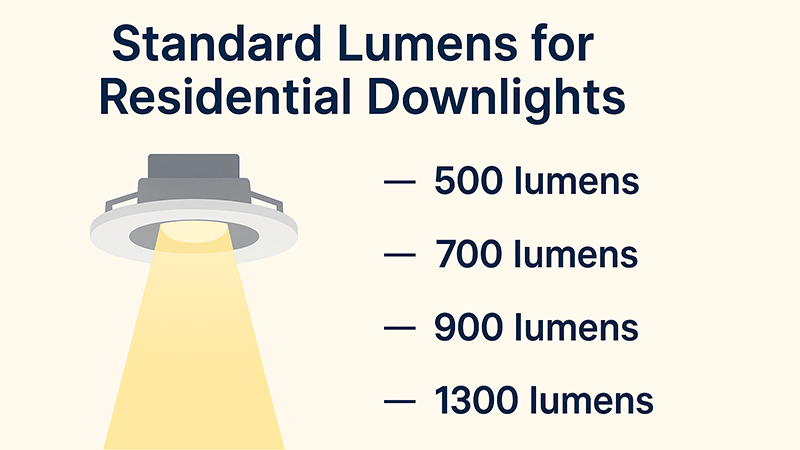
But the lumen number printed on the box is only part of the equation. The real secret to achieving perfect lighting isn’t just about raw power; it’s about how efficiently that light is delivered into your room. To make the best choice, you need to understand the details beyond the basic specs. Let’s break it down so you can select your next downlights with complete confidence.
How many lumens are in a downlight?
Are you finding it difficult to pinpoint a single lumen value for downlights? This uncertainty can lead to expensive purchasing errors and poorly lit spaces. Let me give you a clear framework.
Downlight lumens can range from 400 for soft accent lighting to over 1500 for high-ceiling commercial areas. For most homes, a downlight between 600 and 900 lumens is the most common choice, creating a balanced and comfortable level of light for general use.
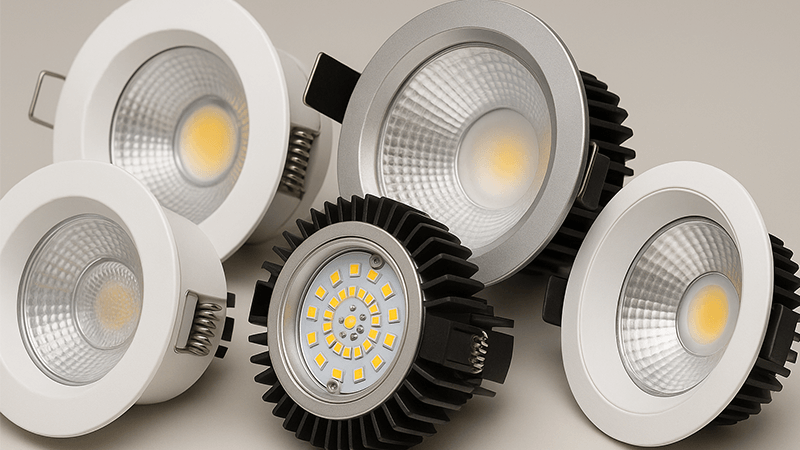
When I work with purchasing managers like Shaz in the UAE, the first thing we clarify is that "standard" varies by application. A downlight for a hotel lobby is completely different from one for a bedroom. It’s crucial to match the lumen output to the environment to avoid creating a space that’s either too dim to be functional or too bright to be comfortable.
Matching Lumens to Application
The purpose of the room is your best guide. A kitchen needs bright, task-oriented light, while a living room benefits from softer, more ambient illumination. Thinking about the activities in each space helps you define the right lumen target.
Here’s a simple guide I use with my clients:
| Application |
Recommended Lumens (Per Downlight) |
Reason |
| Hallways/Corridors |
400 – 600 lm |
Provides safe navigation without being overly bright. |
| Bedrooms/Living Rooms |
600 – 900 lm |
Creates a comfortable, general ambient light. |
| Kitchens/Bathrooms |
800 – 1200 lm |
Offers bright, clear light needed for tasks like cooking and grooming. |
| Office/Commercial |
1000 – 1500+ lm |
Ensures a productive and well-lit environment, especially with high ceilings. |
The Hidden Factor: Luminous Efficacy
Here’s something I’ve learned after years in manufacturing: not all lumens are equal. The specified lumen output is the total light produced by the LED chip, but how much of that light actually leaves the fixture? This is where quality comes in. A high-quality downlight uses precision-engineered reflectors and lenses to ensure maximum light output. In contrast, a poorly designed, cheap product can trap as much as 30% of the light inside the housing. This means a well-made 700-lumen downlight can appear brighter in a room than a cheap 900-lumen one. It’s a critical detail for anyone sourcing lighting.
Is 1200 lumens enough to light a room?
Thinking a single 1200-lumen downlight is the simple solution for a room? Relying on one powerful light source often creates harsh shadows and an uneven feel. Let’s explore if this is the right strategy.
A single 1200-lumen downlight is great for a small utility space, a walk-in closet, or a laundry room. However, for primary living areas like bedrooms or offices, one light is not enough. You will need multiple downlights to achieve even and comfortable illumination across the entire room.
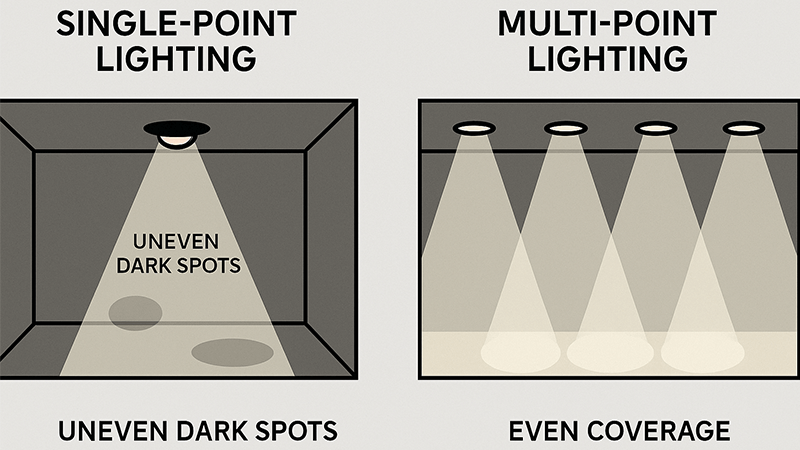
The goal of good lighting design is not just brightness, but uniformity. You want to eliminate dark corners and prevent the "spotlight effect," where the area directly under the light is intensely bright while the rest of the room feels dim. This is why using multiple, lower-lumen downlights is almost always better than using a single, high-powered one. It creates a layered, balanced, and more professional-looking result.
Total Lumens vs. Light Distribution
The effectiveness of your lighting plan depends on distribution. A single 1200-lumen source might provide enough total light for a space, but it will be concentrated in one spot. Using three 400-lumen downlights, for example, gives you the same total of 1200 lumens but spreads the light evenly throughout the room. This approach dramatically improves visual comfort and functionality.
A Simple Calculation for Total Room Lumens
To figure out how many total lumens you need for a room, you can use a basic formula. This helps you plan how many fixtures you’ll need.
Room Area (in square feet) x Recommended Foot-Candles (fc) = Total Lumens Needed
A "foot-candle" is a unit that measures how much light falls on a one-square-foot surface. Here are some common recommendations:
| Room Type |
Recommended Foot-Candles (fc) |
| Living Room (General) |
10-20 fc |
| Kitchen (Task Areas) |
30-40 fc |
| Bedroom (General) |
10-20 fc |
| Bathroom (General) |
20-30 fc |
| Office |
40-50 fc |
Let’s use an example. For a 12 ft x 15 ft living room (180 sq ft), you would need:
180 sq ft x 15 fc = 2,700 total lumens.
You could achieve this with four 700-lumen downlights (2,800 lumens total), giving you excellent, uniform coverage.
How many lumens is a normal LED light?
Are you trying to compare downlights to other LED lights, like bulbs? The term "normal" is broad and can be misleading. Let’s narrow it down to what it means in practice.
There isn’t one "normal" lumen count for all LED lights. A standard A19 replacement bulb is typically around 800 lumens (a 60W equivalent). An LED downlight is considered normal in the 600-900 lumen range, but other LED types vary greatly based on their intended use.
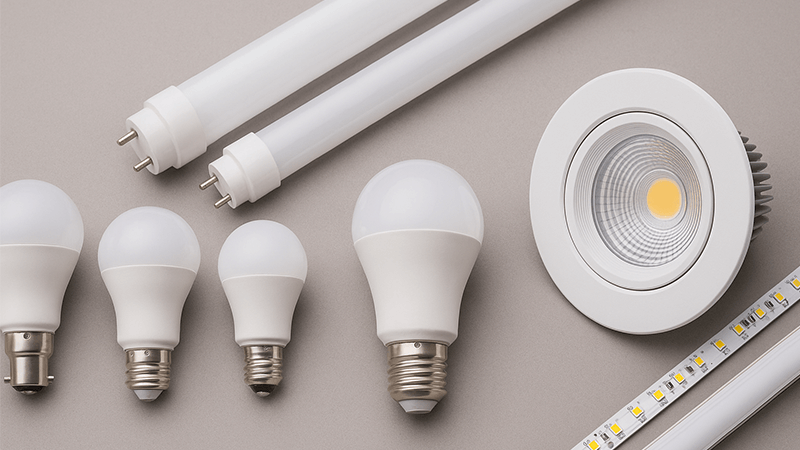
When I started in this industry, we talked mostly about watts. Now, the conversation has shifted entirely to lumens, which is a much better measure of brightness. However, the type of fixture still matters. The design of a downlight directs light downwards, while a bulb is designed to scatter light more broadly. This means comparing the lumen numbers of different types of lights isn’t always a direct, apples-to-apples comparison for how they will light a space.
Comparing Common LED Light Types
The "normal" lumen output is completely dependent on the product’s form and function. A small candelabra bulb for a chandelier has a very different job than a large panel light for an office ceiling. Understanding these differences is key for any purchasing manager sourcing a variety of lighting products. You need the right tool for the right job.
Here is a table to put it all into perspective:
| LED Light Type |
Common Lumen Range |
Primary Use |
| A19 Bulb (60W Equiv.) |
800 – 850 lm |
General purpose lamps and fixtures. |
| Recessed Downlight |
600 – 1200 lm |
Focused, directional overhead lighting. |
| LED Tube (T8) |
1800 – 2500 lm |
Office, garage, and commercial overhead lighting. |
| LED Strip Light |
200 – 500 lm per foot |
Accent, cove, and under-cabinet lighting. |
| PAR38 Flood Light |
1000 – 1500 lm |
Outdoor security and landscape lighting. |
Why Downlights Are Different
What makes a downlight unique is its integrated design. Unlike a simple bulb, a downlight includes the LED source, driver, housing, and optics (reflector or lens) in one unit. As I mentioned before, this is where quality makes a huge difference. In a downlight, the design of the reflector is what shapes the beam and ensures the lumens are directed efficiently. A "normal" 800-lumen bulb in an inefficient can-style fixture might only deliver 500 lumens into the room. A well-designed 700-lumen integrated downlight, on the other hand, could deliver nearly all 700 lumens. That efficiency is what defines a quality downlight.
How many lumens is a 9W downlight?
Seeing a 9W downlight and wondering how bright it is? Wattage doesn’t directly tell you brightness anymore, which can be confusing. Let me help you translate watts into expected lumens.
A typical 9W LED downlight produces approximately 700 to 850 lumens. This is a very common and versatile brightness level, often used to replace old 65W incandescent or halogen recessed lights, making it a great choice for general residential lighting.
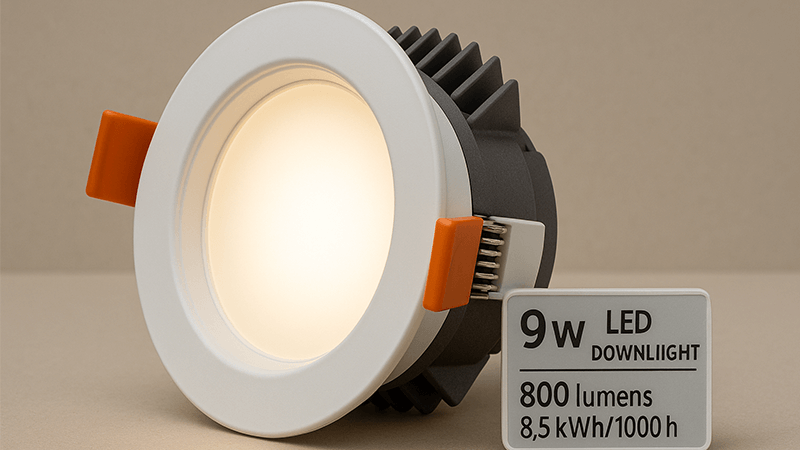
In my experience manufacturing LED lights, the relationship between watts and lumens is a key performance indicator called "lumens per watt" (lm/W). This metric tells you how efficient a light is. A higher lm/W value means you get more light for less energy. This is not just good for the environment; for project contractors and building owners, it means significant cost savings on electricity over the long term.
Understanding Lumens per Watt (lm/W)
Efficacy, or lm/W, is the true measure of LED performance. Early LEDs had an efficacy of around 60 lm/W. Today, quality commercial downlights can easily exceed 100 lm/W.
Let’s break down what this means for a 9W downlight:
- Low Efficacy (70 lm/W): 9W x 70 lm/W = 630 lumens. This is often found in cheaper, lower-quality products.
- Good Efficacy (90 lm/W): 9W x 90 lm/W = 810 lumens. This is a solid, industry-standard performance level.
- High Efficacy (110 lm/W): 9W x 110 lm/W = 990 lumens. This represents a premium, high-performance downlight.
This is why you can see different 9W downlights with very different lumen outputs. When a client like Shaz is comparing datasheets, I always advise him to look at the lm/W number. It’s a reliable indicator of the technology and quality inside the fixture.
Why Wattage Still Matters (A Little)
While lumens indicate brightness, wattage is still important for two reasons:
- Energy Costs: Lower wattage means a lower electricity bill. Over the life of a large project with hundreds or thousands of lights, this adds up to massive savings.
- Circuit Load: Electricians need to know the total wattage on a circuit to ensure it is not overloaded.
When you’re planning a lighting installation, you need to balance three factors: getting the right amount of lumens for the space, choosing a high-efficacy product to save on energy, and keeping the total wattage within safe electrical limits. A 9W downlight producing 800+ lumens often hits the sweet spot for all three.
Conclusion
Choosing the right downlight comes down to matching lumens to your space, and a standard fixture is about 600-900 lumens. Remember, quality design ensures those lumens actually light the room.