Worried about the high cost of replacing LED downlights? Unpredictable electrician bills can be a major headache. The real cost driver is often hidden in the product itself.
Replacing an LED downlight typically costs between $70 and $200 per fixture, including labor and materials. The biggest factor influencing this cost is the luminaire’s design, which can determine up to 70% of the electrician’s labor time and the final bill.

You might think the cost to replace your downlights is all about the electrician’s hourly rate or the price of the new fixture. I’ve spent my entire career in LED lighting manufacturing, from the factory floor to running my own business. I can tell you that those are only small parts of the full picture. The most significant cost is one most people overlook. Let’s dig deeper into what truly determines the final price you pay.
How much does an electrician charge to replace a downlight?
Are you getting quotes for an electrician and the prices seem all over the place? It’s frustrating when you can’t pin down the real cost. Let’s clarify what they charge.
An electrician usually charges between $50 to $100 per hour, or a flat fee of $70 to $150 per downlight. The final cost depends less on their rate and more on how long the job takes, which is dictated by the downlight’s design.

When you get a quote from an electrician, they are estimating their time. If a job looks simple, the price will be lower. If it looks complex, the price goes up. I’ve seen this firsthand. The real question isn’t "What’s your hourly rate?" but "How fast can you install this specific light?" The answer to that question is found on the product’s spec sheet and in its physical design, long before the electrician even sees it. From my experience, up to 70% of the labor cost is already locked in by the choices made at the factory. A well-designed product saves time, and time is money.
Installation Time is the Real Cost
The difference between a 10-minute installation and a 30-minute installation per light is huge, especially on a large project. As a purchasing manager, you can control this cost by looking at the product’s design features. A smart design makes the electrician’s job faster and your final bill much lower.
Good Design vs. Bad Design: A Cost Breakdown
Let’s look at how specific design choices affect installation time and cost. I have seen countless products, and the differences are clear. A product designed for the installer is a product designed to save the client money.
| Feature |
Poor Design (High Labor Cost) |
Well-Designed (Low Labor Cost) |
| Driver |
External, bulky driver that is hard to place in a crowded ceiling void. Requires separate mounting. |
Integrated or compact driver with a simple plug-and-play connection. Fits easily through the cutout. |
| Connection |
Fiddly screw terminals that require a screwdriver and are slow to secure, especially when on a ladder. |
Push-in, tool-free terminal blocks. The wires are simply pushed in for a secure, fast connection. |
| Mounting Clips |
Stiff, weak springs that are hard to engage or break easily. Requires force and can damage the ceiling. |
Strong, yet flexible spring clips that are easy to operate with one hand and hold the fixture securely. |
| Cutout Size |
Requires an exact, non-standard cutout size. Any deviation makes installation very difficult. |
Has a wider trim or adjustable clips that allow for some tolerance in the cutout hole size. |
I remember a project in Dubai where the contractor chose a cheaper downlight. The electricians were taking nearly 25 minutes to install each one because the driver was separate and the wiring was difficult. Halfway through, they switched to one of our products with an integrated driver and quick connectors. The installation time dropped to 7 minutes per unit. For their 1,000-light project, this simple product choice saved them over 280 hours of labor. This is the hidden cost I’m talking about.
How much does it cost to replace LED lights?
Are you planning an LED upgrade and trying to budget for it? The total cost can add up quickly, and the fixture price is just the beginning of the story.
The cost to replace LED lights is the sum of the new fixture’s price and the labor charge for installation. A cheaper light might save you money upfront but can lead to higher total costs due to difficult installation and a shorter lifespan.

As someone who helps clients source lighting, I always advise them to look beyond the initial unit price. The true cost of any lighting product is its Total Cost of Ownership (TCO). This includes the purchase price, the installation cost, energy use, and any future replacement costs. A purchasing manager like yourself, Shaz, understands that value is more important than the initial price tag. A well-made, thoughtfully designed product delivers better value every time because it lowers costs in other areas, especially labor and maintenance.
A low-quality fixture might seem like a good deal, but it often carries hidden expenses. These expenses show up in higher labor bills and the need for more frequent replacements. Over the life of a project, a slightly more expensive but better-designed light is almost always the cheaper option.
Comparing Low-Quality and High-Quality Fixtures
Let’s break down the real costs over a five-year period. The numbers show a clear story. The initial saving from a cheaper product gets wiped out very quickly by higher ongoing expenses.
| Cost Factor |
Low-Quality Fixture |
High-Quality Fixture |
| Unit Price |
$15 |
$25 |
| Labor for Installation |
30 minutes ($50) |
10 minutes ($16.67) |
| Initial Cost per Light |
$65 |
$41.67 |
| Lifespan |
2-3 years |
5+ years |
| Replacements in 5 years |
1 |
0 |
| Labor for Replacement |
$100 (call-out fee + 30 min) |
$0 |
| Total Cost Over 5 Years |
$165 |
$41.67 |
As you can see, the "cheaper" fixture ends up costing almost four times as much over five years. This doesn’t even include the disruption and hassle of having to replace failing lights in an active commercial or residential space. When I work with project contractors, this is the calculation we focus on. We build solutions that are not just cost-effective on day one, but for many years to come. That is how you build a reputation for quality and reliability.
How much will an electrician charge to change a ceiling light?
Thinking of swapping out a ceiling light? It seems like a simple job, but the cost can vary more than you think. Different lights have very different needs for installation.
An electrician will typically charge a flat fee of $75-$200 or an hourly rate to change a ceiling light. The price depends on the fixture’s complexity, weight, and wiring requirements, all of which are determined by its design.

Not all ceiling lights are created equal. From my factory experience, I know that how a light is designed has a direct impact on how it’s installed. A simple, lightweight LED oyster light might be a 15-minute job. A heavy decorative chandelier that needs extra support in the ceiling and complex wiring could take hours. An electrician has to account for these things. They will look at the fixture and the location and estimate their time. The more complex the design, the more time it takes, and the more you pay.
Simple Swap vs. Complex Installation
The difference in labor cost comes down to the tasks the electrician must perform. A simple swap involves turning off the power, disconnecting a few wires, connecting the new light, and attaching it to the existing bracket. A complex job is another story. It might involve cutting new holes, installing a new support brace in the ceiling joists, running new wires from the switch, or programming a smart dimmer. These are the things that turn a quick job into an expensive, all-day project.
How Smart Design Makes the Job Cheaper
This is where my core belief comes in: the manufacturer has a responsibility to design products that respect the installer’s time. A smartly designed product makes the electrician’s work faster, safer, and easier. This directly translates to lower costs for you.
Here are features I always look for that signal a well-designed, easy-to-install product:
- Push-in Terminal Blocks: These are a game-changer. Instead of using a screwdriver to tighten tiny screws on a terminal, the electrician just pushes the stripped wire in. It’s faster and often more secure.
- Integrated Components: A fixture with an integrated driver and a single point of connection is much simpler than one with a separate driver, a lamp, and a housing that all need to be wired together.
- Adjustable or Forgiving Brackets: A universal mounting bracket that works with multiple junction box sizes saves a lot of time. No need for the electrician to drill new holes or find extra parts.
- Lightweight Materials: A lighter fixture is easier and safer for one person to install on a ladder. Heavy fixtures might require two people, doubling your labor cost.
I once consulted on a hotel project where the developer had chosen a very stylish but poorly designed pendant light. It looked great in the catalog, but it had no easy way to be mounted and the wiring was difficult to access. The electricians were frustrated. The project fell behind schedule. By choosing a product based only on looks, the developer had created a massive, expensive problem. A little foresight into the installation process would have saved them tens of thousands of dollars.
Is replacing a ceiling expensive?
Are you worried that replacing a ceiling light will be a major expense? It can be, but it is not a given. The power to control the cost is in your hands.
Replacing a ceiling light can be expensive, but it doesn’t have to be. The final cost is a mix of product price and labor, and you can significantly reduce the labor portion by choosing a well-designed fixture.
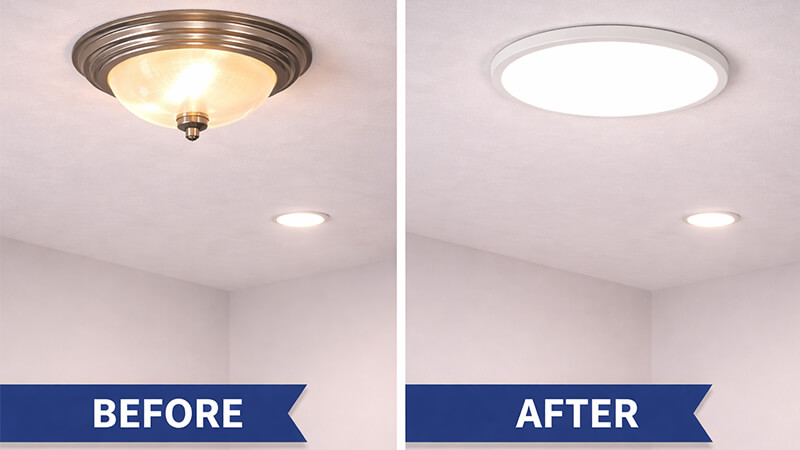
The word "expensive" is relative. For a large-scale project, an extra $50 per fixture in labor can add up to a huge sum. The good news is that this labor cost is the most manageable part of the equation. While the electrician’s hourly rate is fixed, the number of hours they spend is not. This is where your choice as a purchaser makes all the difference. By selecting a product that is designed for efficient installation, you are actively cutting down the most variable and significant part of the replacement cost.
Breaking Down the "Expense"
Let’s put some numbers to this idea. Imagine you have to replace 100 lights. We will assume a labor rate of $80 per hour. The difference between a poorly designed light and a well-designed one becomes very clear.
| Cost Component |
Example 1: Poorly Designed Light |
Example 2: Well-Designed Light |
| Unit Price |
$40 |
$55 |
| Electrician Time (per unit) |
45 minutes |
15 minutes |
| Labor Cost (at $80/hr) |
$60 |
$20 |
| Total Cost Per Light |
$100 |
$75 |
| Total Project Cost (100 units) |
$10,000 |
$7,500 |
In this scenario, paying an extra $15 per unit for the better-designed light saves you $25 per unit in total. Across the whole project, that’s a saving of $2,500. The "more expensive" light is actually the cheaper option.
Your Power as a Purchaser
As a purchasing manager, you hold the key to these savings. Your job is not just to negotiate the best unit price, but to source the best overall value. You have the power to slash project costs before a single electrician arrives on site.
When you are evaluating suppliers, go beyond the price list. Ask for installation manuals. Watch installation videos. If you can, get a sample and have a technician look at it. Ask the supplier directly: "What have you done to make this product easy to install?" A good manufacturer will be proud to answer. They will point out the push-in connectors, the all-in-one design, and the flexible mounting options. A manufacturer who cannot answer that question is telling you they have not thought about it. And that means you will be the one paying for their oversight with higher labor bills. I have built my business, Upward Lighting, on this principle. We engineer our products not just to perform well, but to install well. Because in the real world, quality you can see starts with an installation you can do quickly and easily.
Conclusion
Replacing LED downlights does not have to break your budget. The real cost is in labor, which you control by choosing wisely designed fixtures from the very beginning.