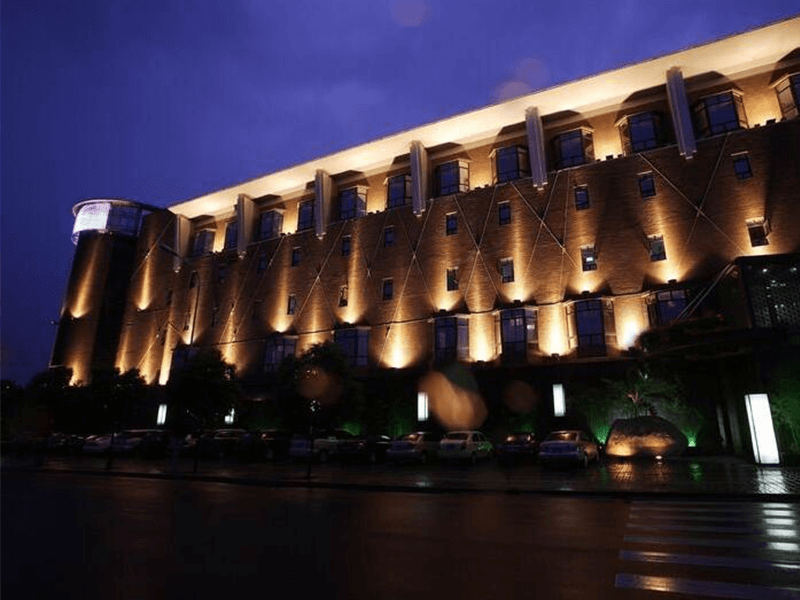
Specifying the wrong downlight can ruin a project’s lighting design. This mistake costs time, money, and your reputation. Master these key specifications to get it right the first time.
To correctly specify commercial LED downlights, you must define the cutout size for installation, the beam angle for light distribution, UGR for glare control, CCT for color temperature, and CRI for color accuracy. Getting these five parameters right is essential for any professional lighting project.
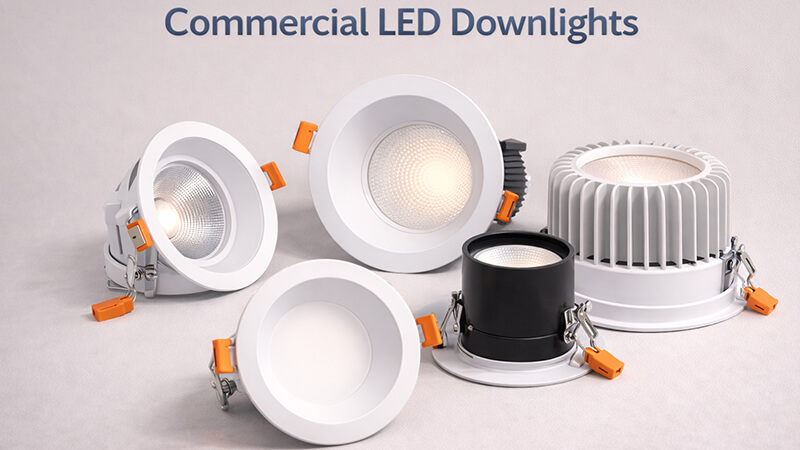
Getting these details right is what separates a good project from a great one. I’ve seen it countless times over my years in manufacturing. A small change in one specification can completely transform a space. But as a purchasing manager like Shaz, you need to know not just what they are, but why they matter for your specific project in the UAE. Let’s break them down, starting with the one that can create the most dramatic effect.
What is the beam angle for LED downlights?
The wrong beam angle creates a flat, boring space. You want lighting that adds depth and focus, but everything just looks washed out. Understanding beam angles gives you artistic control.
Beam angle measures how wide the light spreads from the downlight. A narrow beam (e.g., 15°) creates a focused spotlight, while a wide beam (e.g., 60°) provides broad, general illumination. The choice depends entirely on the desired effect and ceiling height.
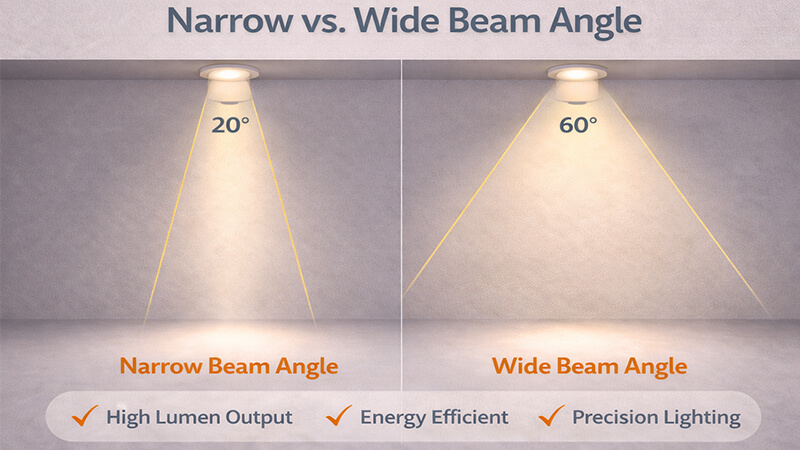
Many people think a narrow beam angle, like 15° or 24°, is just for creating a simple spotlight. But it does so much more. From my experience in the factory, I’ve learned to see it differently. In a space with high ceilings, like a hotel lobby or a grand hall, a narrow beam creates what I call "light anchors." These are like invisible pillars of light that stretch from the ceiling to the floor. They ground the space, making it feel stable and private. When you shine this light on an object, it gives it a powerful, sculptural quality. The contrast between light and shadow creates drama and pulls your attention.
On the other hand, a wider beam angle, such as 45° or 60°, washes an area with even light. This is useful for general illumination, but it eliminates that dramatic tension. The space can feel "flat" and very commercial, without any distinct character.
A Tale of Two Lobbies
I remember working with a client in Dubai on a luxury hotel lobby. They initially requested wide-angle downlights for maximum coverage. I suggested we do a small mockup in a corner of the space. We installed a few 24° downlights over a seating area. The effect was instant. It created an intimate, defined zone within the larger lobby. The light highlighted the texture of the expensive furniture. The client immediately saw the value and changed the entire specification. That small change made the space feel far more exclusive and high-end.
Practical Beam Angle Comparison
| Beam Angle |
Best For |
Effect |
| 10°-24° |
High ceilings, accent lighting, creating drama |
Creates focused "pools" of light, strong contrast, sculptural feel. |
| 25°-40° |
Medium ceilings, task lighting, general accenting |
A versatile middle-ground, balances focus with decent coverage. |
| 45°-60° |
Low ceilings, open areas, general illumination |
Soft, even light distribution, minimizes shadows, feels open. |
| >60° |
Wall washing, utility areas, very low ceilings |
Very wide and diffuse light, maximum coverage with low intensity. |
For a purchasing manager, choosing the beam angle isn’t just a technical choice. It’s an artistic one that has a huge impact on the final project.
What is CRI in downlights?
Your project’s colors look dull and inaccurate under the new lights. The expensive finishes and furniture appear lifeless, making the client question your choices. High CRI is the solution.
CRI, or Color Rendering Index, measures how accurately a light source reveals the true colors of objects compared to natural daylight. It’s rated on a scale of 0 to 100. For commercial spaces, a CRI of 80+ is good, while 90+ is excellent.
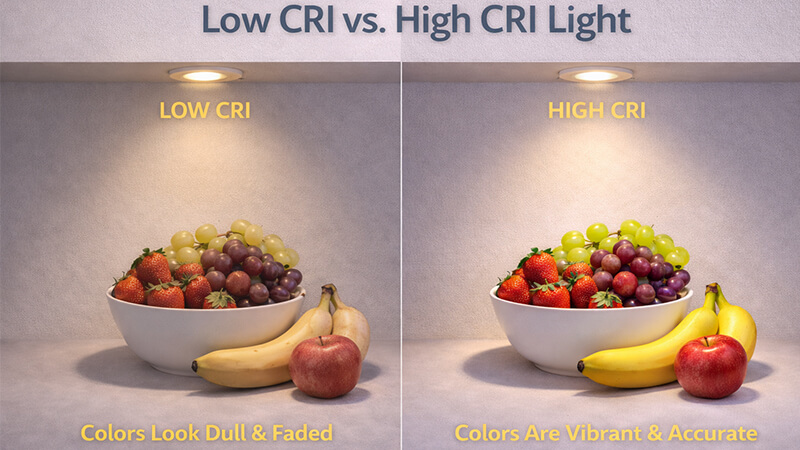
Think of CRI like the resolution of a camera. A low-resolution photo looks blurry and lacks detail. A high-resolution photo is crisp and clear. In the same way, low CRI light makes colors look washed out and incorrect. High CRI light makes colors appear vibrant and true. This is absolutely critical in commercial projects where aesthetics and product appearance determine success. For example, in the bustling souks and modern malls of the UAE, color is everything.
As a manufacturer, I’ve seen the direct impact of CRI. A retail client once complained that their new collection of fabrics looked "muddy" in their store. They were using lights with a CRI of 70. We replaced them with our CRI 90+ downlights. The change was incredible. The deep reds and rich blues of the fabrics popped, and the display looked luxurious and inviting. Their sales increased in the following quarter.
Why CRI is a Non-Negotiable Specification
In different environments, the need for high CRI becomes obvious.
- Retail and Showrooms: For clothing, furniture, or cars, a CRI of 90+ is essential. It makes products look their best and helps customers make purchasing decisions with confidence.
- Restaurants and Hospitality: High CRI light makes food look more appetizing and skin tones look more natural and healthy. A CRI of 85+ is a good starting point here.
- Offices and Schools: While 80+ CRI is standard, higher CRI can reduce eye strain and create a more pleasant working environment.
The Secret of "R9"
Here’s an insider tip: always ask about the "R9" value. Standard CRI averages eight pastel colors, but R9 specifically measures how well a light renders the color red. This is crucial for warm wood tones, certain foods, and especially skin tones. A light can have a CRI of 80 but a very low R9, making people look pale and unhealthy. For premium projects, I always recommend a light with both CRI 90+ and an R9 value greater than 50.
| CRI Value |
Quality |
Typical Application |
| CRI <80 |
Poor |
Basic utility, garages, areas where color accuracy is not important. |
| CRI 80+ |
Good (Standard) |
Most commercial applications: offices, public spaces, general retail. |
| CRI 90+ |
Excellent |
High-end retail, art galleries, museums, medical facilities. |
| CRI 95+ |
Professional Grade |
Professional photography, art restoration, printing inspection. |
Never compromise on CRI. It’s a small part of the budget that makes a huge difference in the perceived quality of the entire project.
How to measure downlight cutout?
You ordered hundreds of downlights, but they don’t fit the pre-drilled holes. This is a disaster causing project delays and costly rework. Accurate cutout measurement prevents this.
To measure a downlight cutout, you measure the diameter of the hole in the ceiling where the fixture will be installed. Do not measure the fixture’s outer trim (flange). Always use the manufacturer’s specification sheet, which clearly states the required cutout diameter.
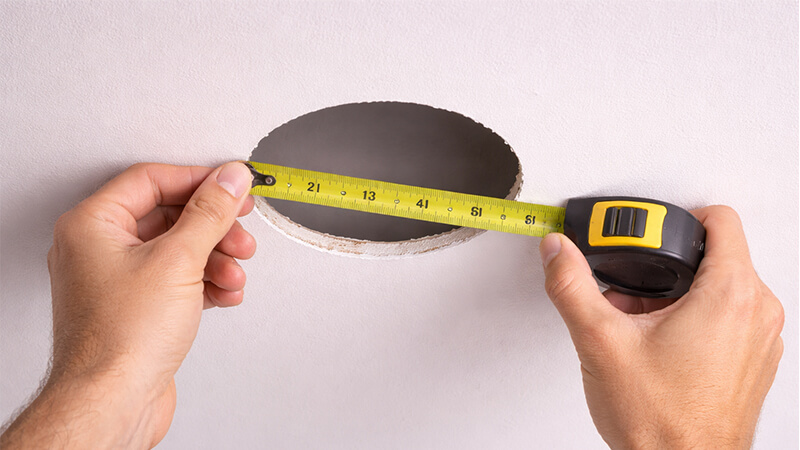
This seems like the simplest step, but it’s where the most expensive mistakes happen. I once got a panicked call from a contractor working on a large office tower. They had drilled 500 holes in the ceiling for the downlights they ordered from us. But every downlight was just falling right through the hole. The problem? They measured the total diameter of the downlight sample I sent them, which included the outer trim. They drilled 90mm holes. But the cutout size required for the fixture to clip in properly was 75mm. It was a nightmare for them. They had to get a plasterer to patch and re-drill every single hole.
This taught me a valuable lesson: always over-communicate the difference between cutout size and fixture size.
Cutout vs. Fixture Diameter: The Critical Difference
It is vital to understand these two separate measurements.
- Cutout Diameter: This is the diameter of the actual hole you need to cut in the ceiling material (like drywall or a ceiling tile). This is the number your electrician needs.
- Fixture Diameter (or Trim Diameter): This is the overall width of the downlight, including the visible ring or square trim (also called a flange). This trim is designed to be larger than the cutout to neatly cover the edge of the hole.
The Specification Sheet is Your Guide
Never guess or measure a sample by hand and assume that’s the cutout size. Every professional lighting manufacturer provides a technical specification sheet for each product. This document is your single source of truth. It will clearly label the cutout dimension, often with a symbol like "Ø75mm" or "Cutout: 90mm". It may also give a small tolerance, like +/- 2mm. You must give this sheet to the installation team and ensure they use the correct size hole saw.
| Common Term |
What It Means |
How to Use It |
| Cutout |
The diameter of the hole in the ceiling. |
This is the measurement for the installer/electrician. |
| Trim/Flange |
The visible outer ring of the downlight. |
This determines the final look and covers the cutout hole. |
| Recess Depth |
How much space is needed above the ceiling. |
Ensures the fixture will fit without hitting pipes or ducts. |
| Spec Sheet |
The manufacturer’s technical document. |
Your primary reference for all dimensions before ordering or cutting. |
As a purchasing manager, your job is to get this information from the manufacturer and deliver it clearly to the project team. A simple email with the spec sheet attached can save thousands of dollars and weeks of delays.
What does CCT mean in downlights?
The lighting in your new space feels wrong. It’s either cold and clinical or too yellow and sleepy, creating the wrong atmosphere. CCT is the key to setting the perfect mood.
CCT stands for Correlated Color Temperature, measured in Kelvin (K). It describes the color appearance of the light, from warm (yellowish) to cool (bluish). Lower Kelvin values (e.g., 2700K) are warm, while higher values (e.g., 5000K) are cool.
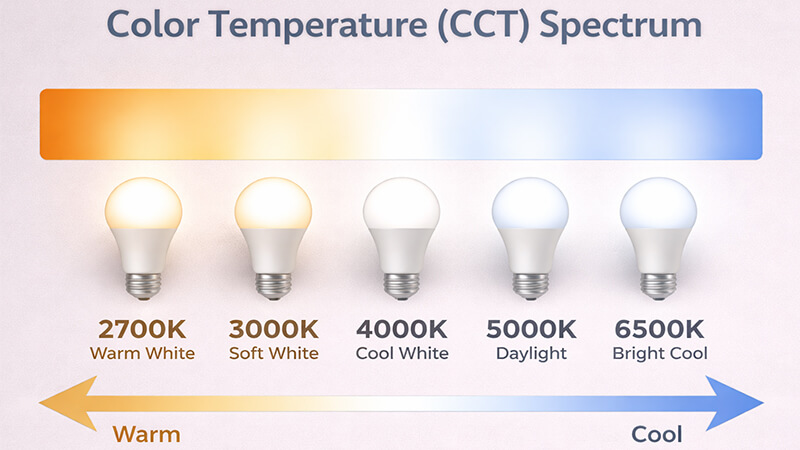
The easiest way to understand CCT is to think about the light at different times of the day. The light from a candle or a sunset is very warm and has a low CCT (around 1800K-2700K). The light on a bright, sunny afternoon is very cool and has a high CCT (5000K-6500K). CCT is not about brightness; it is about the color and feeling of the light itself. Choosing the right CCT is one of the most important decisions for setting the mood of a space. It directly affects how people feel and behave in that environment.
In my factory, we produce downlights in a wide range of CCTs because every project has a different goal. A spa wants its clients to feel relaxed, while a laboratory needs its technicians to be alert and focused. The right CCT helps achieve these goals.
Setting the Mood with Kelvin
The CCT you choose should match the function of the space.
- Warm White (2700K – 3000K): This CCT creates a cozy, comfortable, and intimate atmosphere. It’s perfect for fine-dining restaurants, hotel guest rooms, and residential living areas. 3000K has become a very popular standard in modern hospitality in places like the UAE, as it feels welcoming but also clean and contemporary.
- Neutral White (3500K – 4000K): This is a clear, clean, and professional light. It’s the most common choice for commercial applications because it’s a great balance. It makes spaces feel vibrant and efficient without being harsh. You will find 4000K in almost every modern office, retail store, school, and public building.
- Cool White / Daylight (5000K – 6500K): This light is bright and energizing, closely mimicking natural daylight. It enhances alertness and is excellent for task-oriented environments. It’s best used in hospitals, warehouses, workshops, and industrial settings. Use it with caution in social spaces, as it can feel sterile and unwelcoming.
A Quick Guide to CCT Selection
| CCT Value |
Color Name |
Feeling / Mood |
Common Applications |
| 2700K |
Extra Warm White |
Cozy, Intimate, Relaxing |
High-end restaurants, hotel rooms, lounges. |
| 3000K |
Warm White |
Welcoming, Comfortable, Clean |
General hospitality, cafes, modern homes. |
| 4000K |
Neutral White |
Professional, Clean, Focused |
Offices, retail stores, schools, reception areas. |
| 5000K |
Cool White |
Alert, High-Contrast, Crisp |
Hospitals, workshops, warehouses, task lighting. |
For projects with multi-purpose rooms, you can also specify "Tunable White" downlights. These fixtures allow the user to change the CCT with a remote or wall control, which offers incredible flexibility. This is a great feature to offer clients for spaces like boardrooms or event halls.
Conclusion
Mastering cutout, beam angle, CCT, and CRI transforms spaces. Getting these details right is the secret to successful lighting projects and satisfied clients every single time.