Confused by lighting specs? Struggling to compare downlights effectively? This technical jargon can lead to poor choices and wasted money on inefficient products.
Luminous efficacy is a key metric measuring how well a downlight produces visible light from a certain amount of power. It’s measured in lumens per watt (lm/W). A higher number means more light for less energy, indicating greater efficiency and significant cost savings over time.
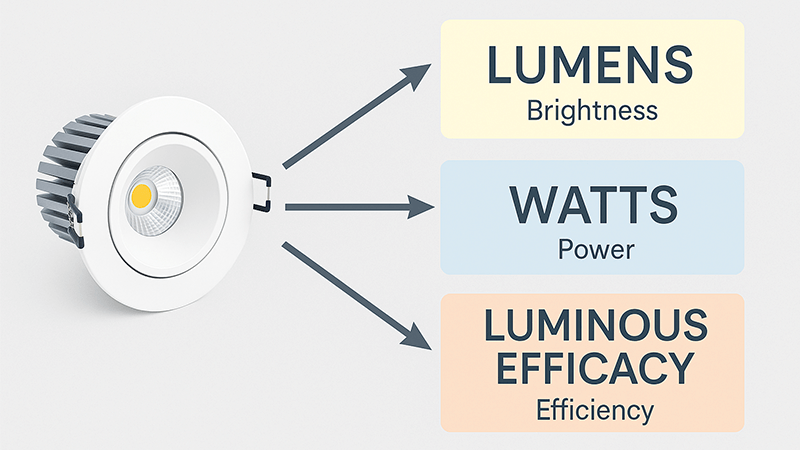
I’ve been in the lighting industry for a long time, starting on the factory floor. I’ve seen many purchasing managers, just like you, get lost in the numbers. They focus on watts or lumens alone, but the real story is in how they work together. Understanding this simple ratio can completely change how you source lighting and ensure you get the best value. Let’s break it down further so you can make confident decisions for your projects.
Which is brighter, 5 or 10 lumens?
Choosing between two lumen values seems simple. But picking the wrong one can lead to an under-lit or overly bright space, wasting energy and creating discomfort for users.
A 10-lumen light source is brighter than a 5-lumen one, assuming all other conditions are equal. Lumens are the direct measure of the total amount of visible light emitted by a source. The higher the lumen value, the brighter the light will appear to the human eye.
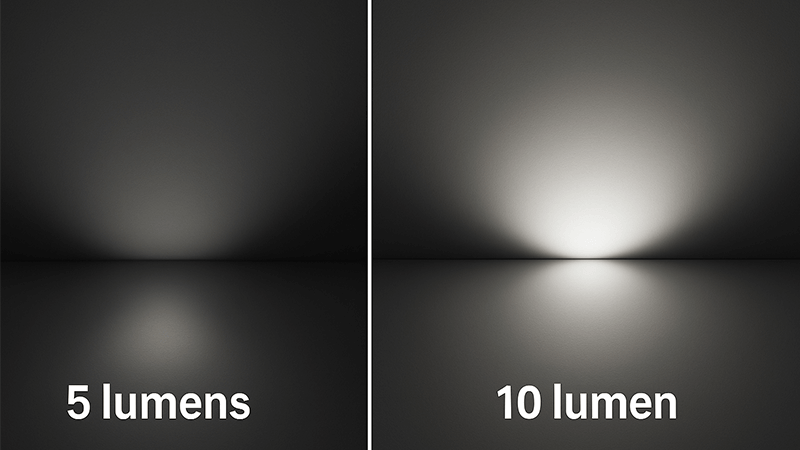
When we talk about brightness, lumens are the only number that matters directly. The concept can be confusing because for decades, we were taught to think about watts. I remember a client from a few years back who kept insisting on a downlight with "100-watt brightness." He was used to old incandescent bulbs where higher wattage meant a brighter light. I had to sit down with him and explain that with LEDs, watts only tell us about energy consumption, not light output. Lumens tell us the real story about brightness.
What is a Lumen?
A lumen (lm) is the standard unit of luminous flux. In simple terms, it measures the total quantity of visible light emitted from a source per unit of time. Think of it like the volume of water flowing from a showerhead. More lumens mean more light is being projected into the space, making it appear brighter.
Moving from Watts to Lumens
The shift to LED technology forced the industry to change how we talk about brightness. With inefficient incandescent bulbs, there was a direct and predictable relationship between power consumed (watts) and light produced. LEDs are so much more efficient that this relationship is no longer useful. A 10W LED downlight can easily be brighter than a 60W incandescent bulb.
To help with this transition, here is a general guide:
| Incandescent Watts |
Approximate LED Lumens |
| 40W |
450 lm |
| 60W |
800 lm |
| 75W |
1100 lm |
| 100W |
1600 lm |
Matching Lumens to the Application
For a purchasing manager like Shaz, the real question isn’t just "which is brighter?" but "what brightness level do I need?" Five lumens might be perfect for a subtle accent light on a staircase, but 10 lumens would be too harsh. Conversely, for general office lighting, you might need 3000-4000 lumens per fixture. Always refer to the lighting plan or project specifications to determine the required lumen output for each area. Choosing the correct lumen package ensures you don’t over-light a space, which wastes energy, or under-light it, which can be a safety hazard.
Which is brighter, 4000K or 6000K?
Picking a color temperature feels subjective. But choosing incorrectly can ruin the atmosphere of a space, making it feel sterile or dingy, and can even affect people’s mood and productivity.
Neither 4000K nor 6000K is inherently brighter. These values refer to the Correlated Color Temperature (CCT) of the light, not its brightness. 4000K is a neutral white, while 6000K is a cool, bluish-white. Brightness is measured separately in lumens.
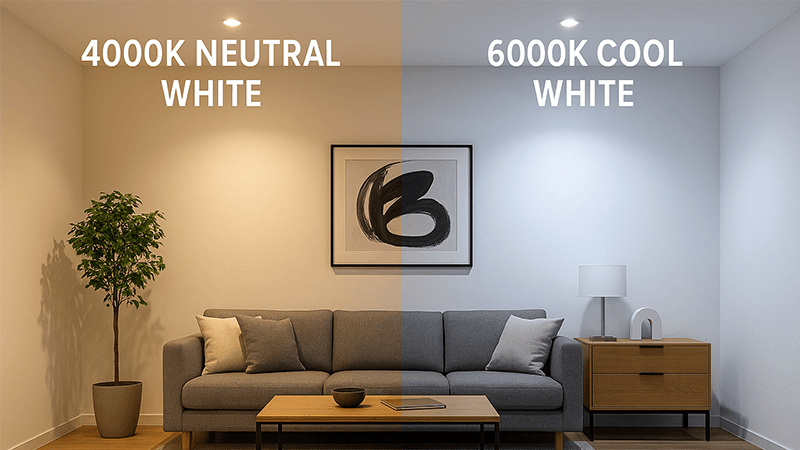
This is a very common point of confusion. Sometimes, a cooler light like 6000K can be perceived as "brighter" or "harsher" by the human eye, but this is a psychological effect, not a physical measurement of light output. Two LED downlights, one 4000K and one 6000K, can have the exact same lumen rating, meaning they are equally bright. The only difference is the color of the white light they produce. It’s my job to help clients understand this distinction so they can select the right CCT to create the desired environment for their project, whether it’s a warm and inviting restaurant or a crisp, focused office.
Understanding Correlated Color Temperature (CCT)
CCT is measured in Kelvin (K) and describes the appearance or "color" of the white light. Think of it like heating a piece of metal. As it gets hotter, it first glows red, then yellow, then white, and finally blue. Lower Kelvin values represent warmer, yellowish light, while higher values represent cooler, bluish light.
How CCT Affects an Environment
The choice of CCT has a huge impact on the mood and functionality of a space. You must select the right CCT based on the intended use of the area.
| CCT Range |
Color Description |
Common Applications |
Feeling / Mood |
| 2700K – 3000K |
Warm White |
Homes, restaurants, hotel lobbies |
Cozy, relaxing, inviting |
| 3500K – 4100K |
Neutral White |
Offices, retail stores, kitchens |
Clean, efficient, focused |
| 5000K – 6500K |
Cool White / Daylight |
Hospitals, workshops, warehouses |
Alert, energetic, sterile |
A 4000K downlight is a great all-around choice for commercial spaces because it’s neutral and doesn’t distort colors too much. A 6000K light is often used in industrial or task-heavy environments where high visual acuity is needed. Using 6000K in a home would likely feel cold and clinical.
A Note on Efficacy and CCT
Interestingly, there can be a slight difference in luminous efficacy between different CCTs within the same product family. Often, cooler CCTs (like 6000K) can achieve slightly higher lumens per watt than warmer CCTs (like 3000K). This is due to the physics of the phosphors used to create the white light. However, this difference is usually very small and should never be the main reason for choosing a CCT. The atmosphere and visual comfort of the space are far more important.
How to find luminous efficacy?
Trying to compare LED downlights without looking at efficacy is a big mistake. You might buy a product that seems cheap upfront but costs a fortune in electricity bills over its lifetime.
To find luminous efficacy, you simply divide the total lumen output of the downlight by its total power consumption in watts. The result is expressed in lumens per watt (lm/W). You can find the lumen and wattage values on the product’s specification sheet or packaging.
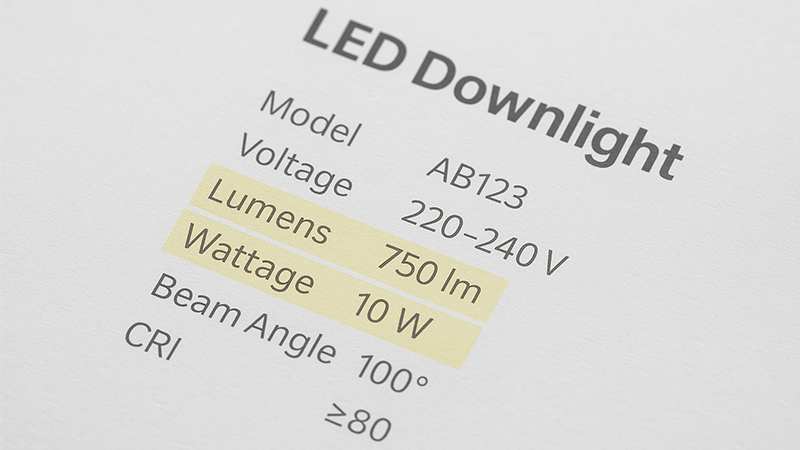
As a manufacturer, I make sure this information is clear on all our technical data sheets. It’s the most honest way to compare the performance of two different light fixtures. When I work with a new purchasing manager, one of the first things I teach them is to look for this lm/W value. It’s a simple calculation: Lumens ÷ Watts = Luminous Efficacy. A higher number is always better from an energy-saving perspective. It tells you that the manufacturer has invested in good quality components, from the LED chips to the driver.
The Formula and What it Means
The formula is straightforward:
Luminous Efficacy (lm/W) = Luminous Flux (lm) / Power Consumption (W)
Let’s look at a practical example. You are comparing two downlights for a large office project:
- Downlight A: 1200 lumens / 15 watts = 80 lm/W
- Downlight B: 1200 lumens / 10 watts = 120 lm/W
Both downlights produce the same amount of light (1200 lumens), making them equally bright. However, Downlight B is far more efficient. It uses 33% less energy to produce the same amount of light. For a project with hundreds or thousands of fixtures, choosing Downlight B will result in massive long-term savings on electricity costs.
What Factors Create High Efficacy?
High luminous efficacy isn’t an accident. It’s the result of excellent engineering and high-quality components working together. When I design a new iPHD downlight, I focus on three key areas to maximize the lm/W rating.
- High-Quality LED Chips: The chip is the heart of the fixture. Top-tier chips from leading brands are inherently more efficient at converting electricity into light.
- Efficient Driver: The driver is the power supply that converts AC power from the wall to the DC power the LEDs need. A poorly designed driver can waste a lot of energy as heat, lowering the overall system efficacy.
- Superior Thermal Management: Heat is the enemy of LEDs. A well-designed heat sink pulls heat away from the chips, allowing them to run cooler and more efficiently, which also extends their lifespan.
When you see a high lm/W rating, it’s a strong indicator that the manufacturer hasn’t cut corners on these critical components.
Is 4000K too bright for the eyes?
Worried about creating a harsh, uncomfortable environment? Choosing a light that is perceived as too bright can lead to eye strain, headaches, and general dissatisfaction with the space.
4000K is not inherently too bright for the eyes; it’s a measure of color, not brightness. However, a 4000K light with a very high lumen output and poor glare control can certainly cause discomfort and eye strain. The key is to balance CCT with appropriate brightness and good optical design.

I often get this question from clients designing office or retail spaces. They want a clean, modern look, but they are afraid of the light feeling too clinical or causing glare. My answer is always the same: color temperature alone doesn’t create discomfort. The problem usually comes from using too many lumens for the space or, more importantly, from using poorly designed fixtures that don’t control the light properly. A quality downlight should direct light where it’s needed without shining directly into people’s eyes. This is why we pay so much attention to things like reflector design and UGR ratings.
Brightness vs. Glare
It is crucial to understand the difference between a brightly lit space and a space with high glare.
- Brightness (Luminance): This is the measured amount of light in a space. You need a certain level of brightness for different tasks. Reading a book requires more brightness than watching TV.
- Glare: This is a visual sensation caused by excessive and uncontrolled brightness. It can be disabling (making it impossible to see) or simply uncomfortable (causing eye strain).
A 4000K downlight with 2000 lumens might be perfect for a high-ceiling retail store. But that same fixture in a low-ceiling office would create terrible glare and discomfort. The problem isn’t the 4000K color; it’s the misapplication of the brightness and the fixture’s poor optical control.
Key Factors for Visual Comfort
Efficacy is a vital metric, but it is not the only one. For true lighting quality, you must consider it alongside other parameters that impact visual health and comfort. As my insight says, we must find the best balance.
| Metric |
What it Measures |
Why it’s Important for Comfort |
| Color Rendering Index (CRI) |
How accurately a light source reveals the true colors of objects. |
A high CRI (80+, preferably 90+) makes spaces look more natural and vibrant. Low CRI can make things look dull and can strain the eyes. |
| Unified Glare Rating (UGR) |
A metric for predicting the level of discomfort glare from light fixtures. |
A lower UGR value (e.g., UGR<19 for offices) is essential for preventing eye strain and headaches in task-oriented environments. |
| Flicker (Stroboscopic Effect) |
The rapid, often invisible, fluctuation in a light’s output. |
High flicker can cause headaches, eye strain, and migraines for sensitive individuals, even if it’s not consciously perceived. |
A 4000K downlight can be perfectly comfortable for the eyes if it has a high CRI, a low UGR, and is flicker-free, all while being set to an appropriate lumen level for the specific task and space.
Conclusion
Understanding luminous efficacy is crucial, but it’s only one piece of the puzzle. The best lighting solutions balance high efficiency with color quality, visual comfort, and glare control.