Your store layout changes, but your lighting doesn’t, costing you sales. This inflexibility means missed opportunities. Adjustable LED downlights let you adapt your lighting instantly to boost products.
Adjustable LED downlights transform retail spaces by providing ultimate flexibility. You can tilt and rotate them to highlight specific products, adapt to new layouts, and create dynamic displays. This boosts sales and cuts redesign costs significantly, making your store more profitable and visually appealing.
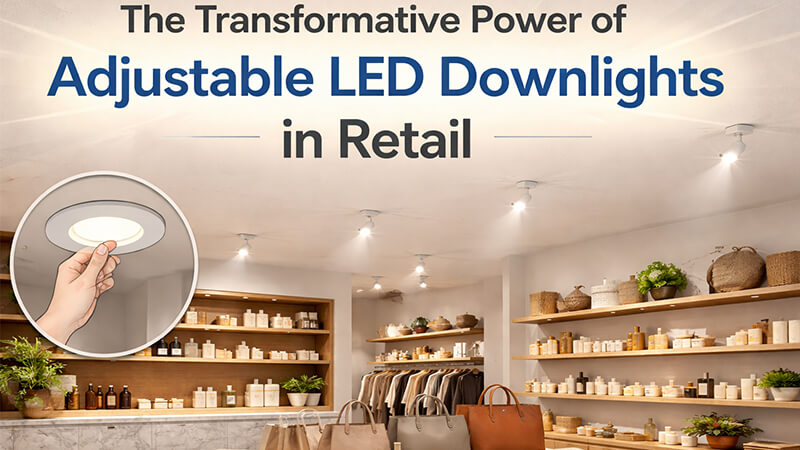
I’ve seen this transformation happen many times. A client of mine was struggling with exactly this problem. Their beautiful store felt static. After we installed adjustable downlights, they could finally create the dynamic, engaging experience they wanted. But to really understand their power, we need to look at the basics first. Let’s break down what makes these lights, and downlights in general, so effective for a business.
What Are the Core Benefits of LED Downlights?
Old halogen lights run up huge electricity bills and burn out fast. You’re constantly replacing bulbs and watching your operational costs climb, eating into your profits and creating maintenance headaches.
LED downlights provide huge benefits over traditional options. They dramatically reduce energy consumption by up to 80%, have a much longer lifespan, and offer better light quality. This means lower bills, less maintenance, and a better-lit environment for your customers and staff.
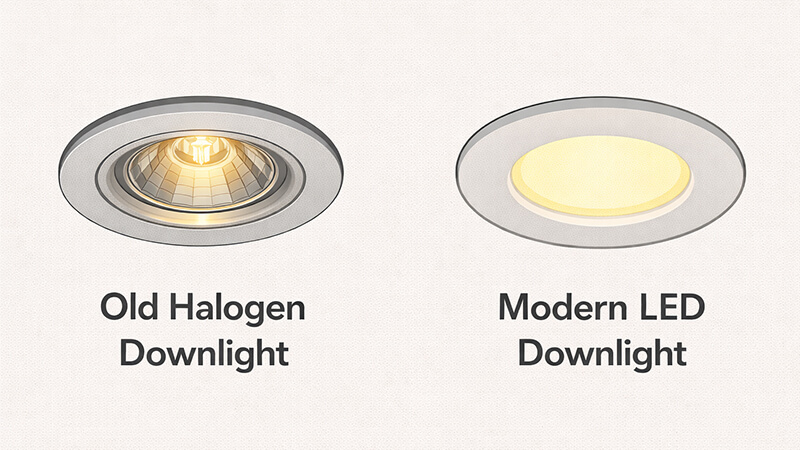
When I started in this industry, halogen was the standard. I remember walking through factories and warehouses where maintenance teams were constantly on lifts, swapping out bulbs. It was a never-ending cycle of cost and labor. The switch to LED technology changed everything. For my clients, especially purchasing managers like Shaz in the UAE who are focused on long-term value, the benefits are impossible to ignore. It’s not just about a brighter light; it’s about a smarter investment. The true value of LED downlights becomes clear when you break it down into tangible business advantages.
Long-Term Cost Savings
The most immediate benefit is the reduction in operational costs. LEDs consume significantly less power than their halogen or CFL counterparts. This isn’t a small saving; it’s a major reduction in your monthly electricity bill. In a retail environment with dozens, or even hundreds, of lights running for 10-12 hours a day, these savings add up very quickly. I worked with a retail chain that switched to our LED downlights, and they saw a 65% drop in their lighting-related energy costs in the first year alone.
Reduced Maintenance Burden
The lifespan of an LED is another game-changer. A typical LED downlight can last 30,000 to 50,000 hours. Compare that to a halogen bulb’s 2,000 hours. This means you are replacing bulbs far less often. This reduces the direct cost of new bulbs and, more importantly, the labor cost and disruption associated with maintenance. No more calling in technicians or having staff climb ladders during business hours. For a busy retail store, this increased reliability is a huge operational win.
Superior Lighting Quality
Finally, the quality of light from LEDs is simply better. You get a higher Color Rendering Index (CRI), which means colors appear more true and vibrant. For retail, this is critical. It makes your merchandise—whether it’s clothing, fresh produce, or electronics—look more appealing. You can also choose the exact color temperature, from a warm, inviting glow to a cool, modern white, to match your brand’s atmosphere perfectly. Better light creates a better shopping experience, which directly impacts customer perception and sales.
What Is an Adjustable Downlight?
A fixed downlight shines straight down, and that’s it. If you move a display or want to highlight a new feature wall, you’re stuck. The light is in the wrong place.
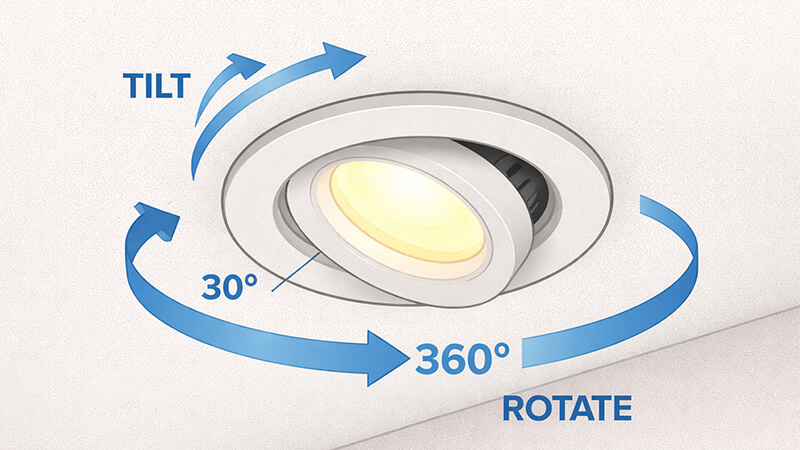
An adjustable downlight, often called a gimbal or directional downlight, is a recessed fixture that you can tilt and rotate. This allows you to aim the beam of light precisely where you need it, giving you complete control over your lighting scheme even after installation.
The concept sounds simple, but its impact is profound. I remember visiting a new high-end boutique that had just installed fixed downlights. They spent a fortune on the fixtures, but a month later, they rearranged their main display for a seasonal promotion. Suddenly, their star products were sitting in shadow, while a patch of empty floor was brilliantly lit. They had to call in electricians to move the fixtures. It was expensive and disruptive. This is the exact problem that adjustable downlights solve. They separate the fixture’s location from the light’s destination.
Breaking Down the "Adjustable" Feature
The term "adjustable" refers to specific mechanical capabilities built into the light fixture. These features are what give you the flexibility that is so valuable in a dynamic space like a retail store. Let’s look at the two main movements.
- Tilting (Vertical Adjustment): This is the ability to angle the light source up and down within its housing. A standard adjustable downlight offers a tilt angle of around 30° to 45°. This movement is perfect for "wall washing," where you aim the light at a vertical surface to create a soft, even glow, or for "accent lighting," where you pinpoint an object on a shelf or a mannequin.
- Rotating (Horizontal Adjustment): This is the ability to spin the light source around a central axis. Most adjustable downlights can rotate 350° to 360°. This allows you to direct the tilted beam to any point in a wide circle around the fixture.
When you combine these two movements, you get complete directional control. You can install the downlight in the ceiling grid and then aim the light beam almost anywhere you need it below.
The Value of Flexibility
This flexibility is the core value proposition. Traditional lighting is a fixed installation. You plan the layout, install the lights, and you’re done. But retail is not static. Your layout needs to change with seasons, sales, and new product arrivals. With fixed lighting, every layout change creates a lighting problem. With adjustable lighting, you simply get a ladder and re-aim the lights. It takes minutes, not days, and costs nothing. Based on industry data, stores using adjustable lighting can cut the time spent on layout adjustments by up to 45% and reduce the associated costs by 22%. That’s a huge competitive advantage.
How Do Adjustable Lights Work?
You know you need flexible lighting, but you worry it will be complex. You imagine complicated controls or fixtures that are difficult for your staff to manage, leading to inconsistent lighting.
Adjustable lights work through a simple mechanical design. The central light module is mounted on a gimbal—a pivot system that allows it to tilt on one axis and rotate on another. This lets you manually aim the light beam without moving the fixture’s housing.
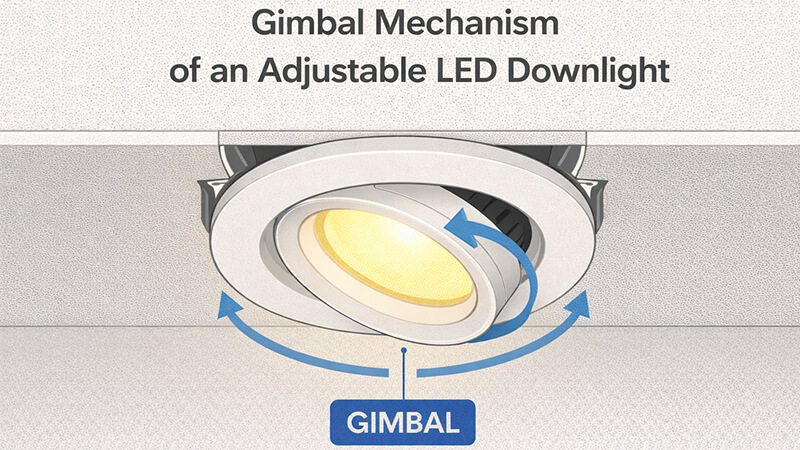
When I explain this to clients, I often bring a sample fixture with me. Once they hold it in their hands and feel how smoothly and simply the gimbal mechanism works, they understand immediately. It’s not high-tech or complicated; it’s just smart, practical engineering. The beauty is in its simplicity. The core of the technology is the housing and the internal mechanism that holds the LED module. Let’s dive a bit deeper into the components that make this possible.
The Gimbal System
The heart of an adjustable downlight is the gimbal. Think of it like the mounting for a telescope or a camera on a tripod. It has two key parts:
- The Tilting Frame: This piece holds the light source (the LED module and its lens). It’s attached to the main housing with pins that act as a pivot point, allowing it to tilt back and forth.
- The Rotating Base: The tilting frame is often mounted on a base that can spin freely within the main housing. This provides the horizontal rotation.
When you adjust the light, you are simply moving this internal gimbal. The outer trim of the downlight remains flush with the ceiling, so the look is always clean and integrated. The adjustment is done by hand. It’s firm enough to hold its position for years but smooth enough to be re-aimed without any special tools.
The Role of Optics
The mechanical adjustment is only half the story. The other half is the optic, or the lens, which shapes the light beam. Adjustable downlights are most effective when paired with a specific beam angle. Here’s a simple table to show how beam angles are used:
| Beam Angle |
Common Use |
Description |
| Narrow Spot |
Accent Lighting |
Creates a tight, focused beam to highlight small objects like jewelry or watches. |
| Spot |
Product Highlighting |
A slightly wider beam perfect for focusing on mannequins or specific merchandise. |
| Flood |
Wall Washing/General |
Creates a broad wash of light to illuminate larger areas or vertical surfaces. |
By choosing the right beam angle and then aiming it with the gimbal, you gain total control over how your space is lit. You can create layers of light—a general ambient layer with wider beams, and then focused accent layers with narrow beams—to guide your customers’ eyes and make your products pop. This level of control is what separates average retail lighting from exceptional retail lighting.
What Is the Purpose of a Downlight?
Your project needs general lighting, but you’re unsure which fixture is right. You see many options, and it’s hard to know if a downlight is the best choice for a clean, modern look.
The main purpose of a downlight is to provide functional light from a ceiling-mounted source. It casts light in a downward direction, serving as a primary source for ambient, task, or accent lighting while keeping the fixture itself discreet and unobtrusive.
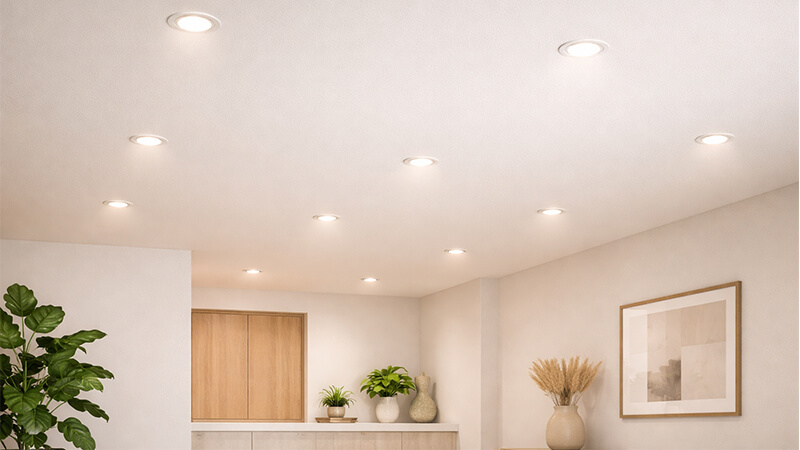
In my experience, downlights are one of the most versatile tools in a lighting designer’s kit. They are the foundation of many great lighting plans. The reason is simple: they do their job effectively without drawing attention to themselves. Unlike a decorative chandelier or a pendant light, a recessed downlight’s job is to provide light, not to be a feature. This allows the focus to remain on the architecture of the space and the products within it. Their purpose, however, can be broken down into three distinct lighting roles.
Three Primary Lighting Functions
A downlight isn’t just for one thing. Depending on its placement, beam angle, and intensity, it can serve different strategic purposes within a single space. This is how lighting designers create layered and effective lighting schemes.
1. Ambient Lighting (General Illumination)
This is the most common use for downlights. When spaced correctly in a grid pattern, they provide the base layer of light for an entire room. This ensures the space is safe, navigable, and comfortable. For this purpose, you would typically use downlights with a wider beam angle (e.g., 60 degrees) to create broad, overlapping pools of light that minimize shadows on the floor. The goal is to create a uniform level of brightness throughout the store.
2. Task Lighting
Task lighting is more focused. It’s meant to illuminate a specific area where a task is performed. In a retail setting, this could be the checkout counter, a fitting room mirror, or a product demonstration area. Here, you would use downlights placed directly over the task area. The beam might be slightly narrower to concentrate the light exactly where it’s needed for clarity and focus. For a cashier, this means easily seeing the money and screen. For a customer in a fitting room, it means seeing the clothes clearly and accurately.
3. Accent Lighting
This is where adjustable downlights truly excel. Accent lighting is used to create visual interest and highlight specific objects or architectural features. By using a downlight with a narrow beam (e.g., 15-24 degrees) and aiming it at a piece of merchandise, a mannequin, or a branded wall sign, you draw the customer’s eye to it. The rule of thumb is that accent light should be about three times brighter than the surrounding ambient light to be effective. This contrast creates drama and directs attention, which is a powerful tool for guiding a customer’s journey through your store.
Conclusion
In short, adjustable LED downlights offer unmatched flexibility. They cut costs, reduce maintenance, and give you the power to adapt your retail space instantly, ensuring your products always look their best.