Struggling to find bathroom lighting that’s both functional and relaxing? Choosing wrong can ruin a bathroom’s feel, making it feel harsh or dim, and can even be a safety risk.
The best downlights for bathrooms are IP-rated (at least IP44) for moisture protection. For ultimate versatility, choose dimmable and tunable white downlights. This allows you to switch between bright, cool light for tasks like shaving and warm, soft light for a relaxing bath.
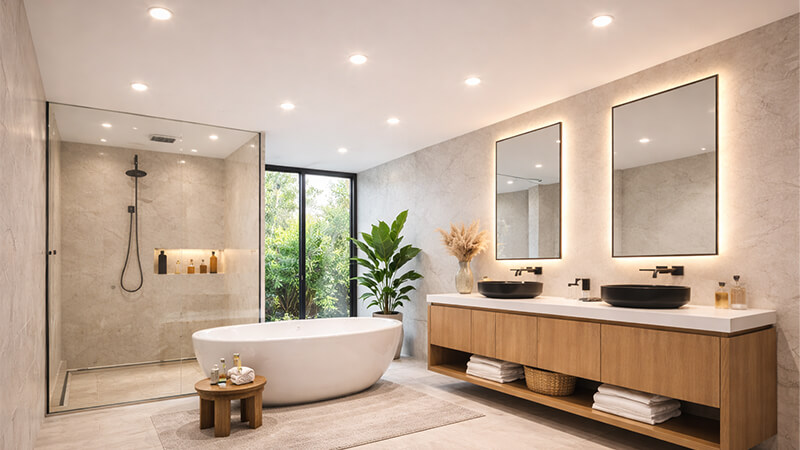
I’ve been in the LED lighting business for a long time, and I’ve seen how the right light can completely transform a space. When it comes to bathrooms, the stakes are even higher. It’s not just about looks; it’s about safety, function, and creating a personal sanctuary. Many people just pick a "bathroom light" without understanding what that really means. Let’s dig deeper into the specifics so you can choose with the confidence of an expert.
What features make a downlight perfect for a bathroom?
You see many downlights labeled for ‘bathroom use,’ but the term is vague. Picking one without knowing the key specs can lead to safety hazards, flickering, or unhappy clients.
The best bathroom downlights combine a high IP rating (IP44 or higher) for water resistance, a high CRI (90+) for accurate color rendering, and dimming capabilities. CCT tunable options offer the most flexibility, letting users change the light’s warmth to match their activity.

When I work with purchasing managers like Shaz, who have years of experience, they know quality matters. But the definition of "quality" in a bathroom goes beyond just the materials. It’s about a specific set of technical features that work together to create the perfect environment. I always advise my partners to think of bathroom lighting like clothing. You need your formal wear for important events and your comfortable pajamas for relaxing. Your lighting should do the same. This means you need more than just a single, static light. The fixtures must be adaptable. Here’s how we break it down for our clients to ensure they get a solution that truly performs.
The Non-Negotiable: IP Ratings Explained
The most critical feature for any bathroom light is its IP (Ingress Protection) rating. This two-digit number tells you how well a fixture is protected against solids (first digit) and liquids (second digit). In a bathroom, the second digit is what we focus on. Water and electricity are a dangerous mix, so this isn’t something to overlook. I always tell my clients that using a non-rated downlight in a bathroom is a risk you should never take. For a professional like Shaz, specifying the correct IP rating isn’t just about quality; it’s about liability and safety compliance.
Different areas in the bathroom have different requirements, which are categorized into zones:
| Bathroom Zone |
Description |
Minimum IP Rating |
| Zone 0 |
Inside the bath or shower tray itself. |
IP67 |
| Zone 1 |
The area directly above the bath or shower, up to 2.25m. |
IP65 |
| Zone 2 |
The area 0.6m outside the bath/shower and above the sink. |
IP44 |
| Outside Zones |
Any area outside zones 0, 1, and 2. |
No IP rating required (but IP20 is good practice) |
For most general ceiling downlights in a standard bathroom, IP44 is sufficient as they fall into Zone 2. However, for fixtures directly over a shower, IP65 is the safe and correct choice. At iPHD, we ensure every bathroom-designated product clearly states its IP rating so our partners can source with complete confidence.
Do I need special downlights for the bathroom?
You see standard downlights that look great, and they’re often cheaper. It’s tempting to use them in a bathroom project to save on costs, but is it a safe or wise decision?
Yes, you absolutely need special downlights for a bathroom. Standard downlights lack the necessary water and moisture resistance (IP rating), which can lead to electrical shorts, corrosion, and safety hazards. Using fixtures specifically designed for wet environments is essential for longevity and safety.
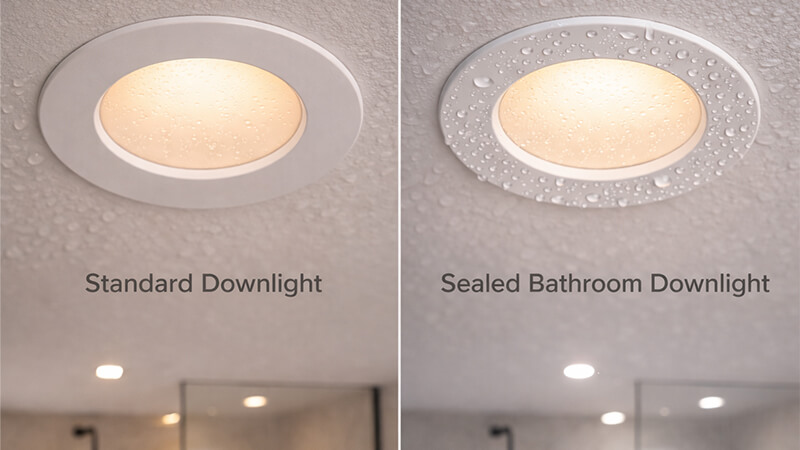
I remember a project with a hotel developer early in my career. They wanted to cut costs and asked if they could use our standard IP20 downlights throughout their new building, including the bathrooms. I strongly advised against it. I explained that while the lights might work for a few months, the constant steam and humidity would eventually get inside. This would corrode the electronics, cause flickering, and create a serious fire or shock risk. We ran a test for them, placing an IP20 downlight and an IP44 downlight in a humidity chamber. After just one week, the IP20 light started failing, while the IP44 light performed perfectly. That simple demonstration convinced them.
Beyond IP Ratings: The Hidden Dangers
While the IP rating is the main reason for needing special downlights, other factors are also important. The materials used in bathroom fixtures are chosen to resist corrosion and degradation from moisture and heat.
- Corrosion Resistance: Bathroom downlights often use materials like marine-grade aluminum, stainless steel fasteners, and powder coatings that are designed to withstand humid environments. A standard downlight might use steel that can rust quickly, staining the ceiling and becoming a structural risk over time.
- Sealed Components: It’s not just about a gasket. The entire unit, from the lens seal to the driver housing, is designed as a closed system. This protects the sensitive LED chip and internal electronics from the "micro-climate" of a bathroom, where temperature and humidity can change dramatically in minutes. A standard downlight is an open system, allowing air and moisture to flow freely over its components.
- Driver Protection: The LED driver, which is the power supply for the light, is often the first thing to fail from moisture damage. In quality bathroom downlights, the driver is either integrated into the sealed housing or is a separate, IP-rated unit designed to be installed safely in a ceiling void where condensation can occur.
For a purchasing manager, specifying a "bathroom downlight" isn’t just about ticking a box. It’s about ensuring the long-term safety, performance, and reputation of your project. The small initial cost saving of using a standard downlight is never worth the long-term risk and potential for failure.
Is a daylight bulb too bright for a bathroom?
Many people think ‘brighter is better’ in a bathroom for tasks like makeup or shaving. So they install daylight bulbs (5000K-6500K), but then find the room feels cold and clinical, like a hospital.
A daylight bulb (5000K+) is not necessarily "too bright," but it can be too harsh or "cold" for a relaxing bathroom atmosphere. While excellent for task-oriented activities, its clinical, blue-toned light is not ideal for winding down. The perceived brightness depends more on lumen output.

Brightness, measured in lumens, and color temperature, measured in Kelvin (K), are two different things. A 1000 lumen bulb at 3000K and a 1000 lumen bulb at 6000K have the same brightness, but they feel completely different. The 6000K light will feel more intense and stark because its cool, blueish hue is similar to direct midday sun. This type of light triggers our brains to be alert and focused. That’s great when you’re trying to get a perfect shave in the morning, but it’s the last thing you want when you’re trying to take a relaxing bath at night. The core insight I share with all my clients is this: high-end bathroom lighting is about planning your state of mind with light. You need to be able to change the light to match your activity.
The Case for Task Lighting
There is a time and place for daylight-equivalent light in the bathroom. This is what we call "task lighting." For a mirror or vanity area, a crisp, high CRI light around 5000K can be invaluable. It provides the most accurate color rendering for applying makeup or checking your appearance. The key is to make it localized. Instead of flooding the entire bathroom with harsh daylight, use it strategically.
- Vanity Sconces or Vertical Lights: Placing lights on either side of the mirror provides even, shadow-free illumination on the face.
- Dedicated Downlights: A pair of narrow-beam downlights focused on the counter space in front of the sink can also work well.
- Backlit Mirrors: Many modern mirrors come with integrated LED lighting, often with adjustable color temperature, providing this task lighting in a sleek package.
The Problem with a Single Color Temperature
The issue arises when this is the only light source. A bathroom lit entirely by 5000K+ downlights will always feel sterile. It strips away the warmth from materials like wood or stone and can make skin tones look pale and unhealthy. It works against the very idea of a bathroom as a place of rest and retreat. This is why a one-size-fits-all approach to bathroom lighting fails. You wouldn’t wear a business suit to bed, so why force your brain into "daylight focus mode" when you’re trying to relax? This leads us directly to the next crucial question.
Is 3000K or 4000K better for bathrooms?
Choosing between color temperatures is a common dilemma. You want a clean, modern look, but also a space that feels comfortable. A light that’s too warm can feel dated, while one that’s too cool feels sterile.
Neither 3000K nor 4000K is definitively "better"; they serve different purposes. 3000K (Warm White) creates a relaxing, spa-like atmosphere, while 4000K (Cool White) provides a clean, modern, and energizing light better suited for tasks. The ideal solution is to have both.

This is where my core philosophy truly comes into play. Asking whether 3000K or 4000K is better is like asking if you should buy pajamas or a work uniform. You need both for different situations. Modern lighting technology gives us the ability to have both in a single fixture. CCT (Correlated Color Temperature) tunable downlights are the ultimate solution for high-end bathroom design. They allow the user to change the color temperature of the light, usually from a warm 2700K/3000K up to a cool 5000K/6000K. This is the technology that allows lighting to adapt to your needs. In the morning, you can set the lights to 4000K or 5000K for an energizing shower and to see clearly while getting ready. In the evening, you can tune them down to a soothing 3000K and dim them for a relaxing bath.
A Practical Guide to Choosing Color Temperature
If you must choose a single color temperature due to budget or project constraints, here’s how I advise my partners to decide:
| Color Temperature |
Best For |
Vibe |
Considerations |
| 3000K (Warm White) |
General ambiance, relaxation, residential settings |
Cozy, inviting, spa-like |
Can sometimes feel slightly yellow. Good for accentuating warm materials like wood, brass, and natural stone. |
| 4000K (Cool White) |
Task areas, modern aesthetics, commercial settings |
Clean, crisp, energizing |
Can feel clinical if not paired with dimmers. Excellent for making white tiles and chrome fixtures look sharp and clean. |
From my experience, if a client has to pick just one, they are often happiest with 3000K paired with a dimmer. It provides a comfortable base level of light that aligns with the "sanctuary" feeling most people want in their personal bathroom. The 4000K option is often preferred in commercial projects like office or gym bathrooms, where the primary function is utility and energy.
However, as a manufacturer, I see the market moving rapidly towards tunable solutions. For a purchasing expert like Shaz, sourcing CCT tunable and dimmable downlights is a way to future-proof projects and deliver a premium experience that sets his company apart. It transforms the conversation from "which color is better?" to "let’s give the user the power to choose what’s best for them at any moment."
Conclusion
The best bathroom downlights are safe, functional, and adaptable. Always choose IP44+ rated fixtures, and for the ultimate experience, specify dimmable and CCT tunable options to match any mood or task.