Confused about which IP rating your bathroom needs? You want safety and compliance, but the technical jargon is overwhelming. Picking the wrong one could lead to costly mistakes or safety hazards.
For most bathroom ceiling areas, an IP44 rating is sufficient. However, for downlights installed directly over a shower or bath (Zone 1), you must use a rating of IP65 or higher to ensure protection against direct water jets and ensure long-term safety.

Choosing the right downlight for a bathroom goes beyond just picking a style you like. It involves understanding a crucial safety standard called the Ingress Protection (IP) rating. This two-digit number is vital because bathrooms are wet environments, and water and electricity are a dangerous mix. As someone who has spent his career in the LED lighting industry, I’ve seen many clients, like Shaz, a purchasing manager from the UAE, grapple with this. They need to ensure safety for their projects without overspending on features they don’t need. Let’s break down what these ratings mean for you, so you can make an informed choice with confidence and keep your project on track.
What IP rating for bathroom downlights?
Struggling to decode the right IP rating for different bathroom areas? This uncertainty can halt your project as you worry about safety regulations and product longevity in a damp environment.
The required IP rating for bathroom downlights depends on the specific zone. Use IP67 for inside the bath (Zone 0), IP65 for above the bath/shower (Zone 1), and IP44 for areas just outside the shower and around the sink (Zone 2).
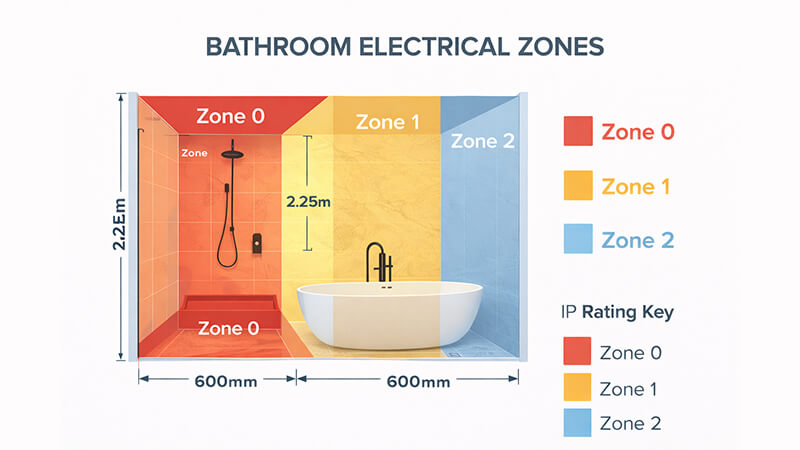
When I first started in the lighting business, one of the first things I had to master was the concept of bathroom zones. It’s a system that divides the bathroom into areas based on the risk of water exposure. Understanding this is non-negotiable for anyone specifying lighting, from a DIY homeowner to an experienced purchasing manager like Shaz. Getting it wrong isn’t just a compliance issue; it’s a serious safety risk. The key is to match the IP rating of the downlight to the zone where it will be installed. Over the years, I’ve helped countless partners navigate these regulations to select products that are both safe and cost-effective.
Understanding Bathroom Zones and IP Requirements
To make it simple, let’s break down the zones and what they mean for your lighting choices. Think of it as a map of your bathroom’s wettest areas.
| Zone |
Location Description |
Minimum IP Rating |
My Recommendation |
| Zone 0 |
Inside the bathtub or shower basin itself. |
IP67 |
This area is fully submerged. You need a low-voltage (12V) luminaire rated at least IP67, which is protected against full immersion. |
| Zone 1 |
The area directly above the bath or shower, up to a height of 2.25 meters from the floor. |
IP44 (or IP65 if water jets are likely) |
I always tell my clients to play it safe here. Showers use jets. For this reason, I strongly recommend IP65 for all of Zone 1. It protects against jets of water from any direction. |
| Zone 2 |
The area stretching 0.6 meters outside the perimeter of the bath or shower and to a height of 2.25 meters from the floor. |
IP44 |
An IP44 rating is sufficient here. It protects against splashes of water, which is the main risk in this zone. This also applies to the area around your sink. |
| Outside Zones |
Any area outside of Zones 0, 1, and 2. This includes most of the ceiling area. |
No specific requirement |
While there’s no official IP requirement, bathrooms are still steamy. I recommend a minimum of IP20, but using IP44 everywhere provides a great baseline of protection. |
By using this table, you can easily identify which IP rating you need for each part of your bathroom, ensuring both safety and compliance without confusion.
Is IP44 ok for a bathroom ceiling?
You’ve found the perfect IP44 downlights, but you’re hesitating. Are they truly safe for the entire bathroom ceiling, or are there hidden risks you haven’t considered in this steamy environment?
Yes, an IP44 rating is perfectly acceptable for the majority of a bathroom ceiling. It provides ample protection against splashes and condensation, making it a safe and standard choice for areas outside the immediate vicinity of a shower or bath.
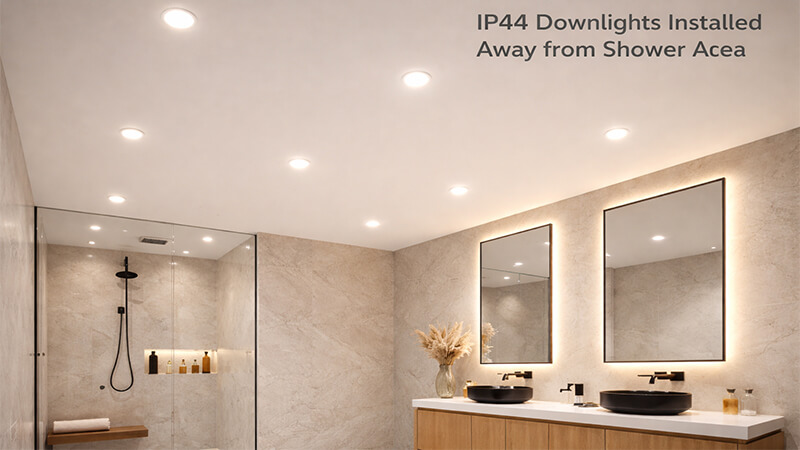
I get this question all the time. Many people assume the entire bathroom is a high-risk water zone, but that’s not the case. For most of the ceiling area—what we call the "Outside Zone"—the primary concern is steam and occasional condensation, not direct water sprays. An IP44-rated downlight is designed to handle splashes of water from any direction. This makes it more than capable of withstanding the typical humidity found in a bathroom environment. A client of mine was retrofitting a hotel and wanted to use the same downlight throughout the bathroom ceilings to keep the look consistent and simplify purchasing. We determined that IP44 was the perfect solution. It met safety standards for all the general areas and offered enough protection without the higher cost of IP65 fixtures, saving them a significant amount on a large-scale project.
Where IP44 Works and Where It Doesn’t
The key is understanding that a bathroom ceiling isn’t one single zone. The part of the ceiling directly above your shower is very different from the part above your doorway.
-
General Ceiling Area (Outside Zones): For any part of your ceiling that is not directly inside the shower enclosure or within 0.6 meters of your tub, IP44 is an excellent choice. This covers probably 90% of most bathroom ceilings. The housing of an IP44 light is sealed well enough to prevent steam and moisture from getting inside and causing damage to the electronics. It offers peace of mind and full compliance.
-
Ceiling Directly Above a Shower/Bath (Zone 1): This is the critical exception. If you are installing a downlight right inside your shower cubicle or directly over your bathtub (below 2.25m from the floor), you must upgrade. In this area, the light can be hit by powerful water jets from a showerhead. Here, an IP44 rating is not sufficient. You need to use a downlight rated IP65. The ‘6’ in IP65 indicates it’s dust-tight, and the ‘5’ confirms it can withstand jets of water. Using IP44 here is a safety risk and would not pass an electrical inspection in many regions.
Think of it this way: IP44 is for splashes, IP65 is for jets. Your ceiling fan isn’t getting hit by jets, but the light in your shower might. This distinction is what ensures a safe and durable lighting installation.
Is IP65 or IP44 better?
Deciding between IP44 and IP65 feels like a tough choice. You want the best protection, but IP65 is more expensive. Are you paying for unnecessary features or making a smart investment in safety?
Neither is universally "better"; it depends entirely on the location. IP65 offers superior water protection and is essential for areas with direct water jets (like showers). IP44 is sufficient and more cost-effective for general bathroom areas where only splashes are a concern.
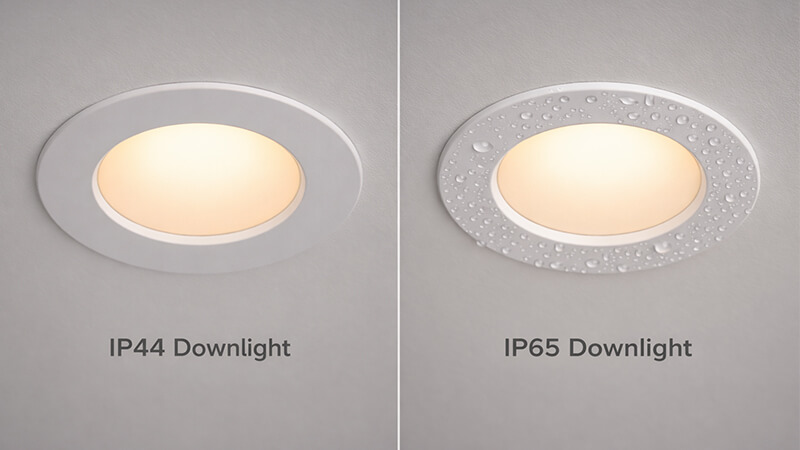
As a manufacturer, I often explain the cost-benefit of IP ratings to my partners. Shaz, the purchasing manager, frequently deals with this. For a large residential project, the cost difference between equipping 100 bathrooms with all-IP65 versus a strategic mix of IP65 and IP44 is huge. The truth is, installing IP65 lights in a dry zone of the bathroom is like wearing a firefighter’s suit to boil an egg. It’s effective but complete overkill. The smart approach, which I always advise, is to use IP65 where it’s mandatory for safety—inside the shower—and use IP44 everywhere else. This optimizes the budget without compromising safety. It’s not about which is "better" overall, but which is the right tool for the specific job.
A Head-to-Head Comparison: IP44 vs. IP65
To help you decide, let’s put these two ratings side-by-side. The IP rating is made of two numbers. The first digit is for solid particle (dust) protection, and the second is for liquid (water) protection.
| Feature |
IP44 Rating |
IP65 Rating |
The Bottom Line |
| First Digit (Solids) |
4: Protected against solid objects larger than 1mm (tools, wires, small insects). |
6: Completely dust-tight. No ingress of dust is permitted. |
For indoor downlights, the difference is minor. The ‘4’ is plenty of protection for a sealed ceiling fixture. |
| Second Digit (Liquids) |
4: Protected against splashing water from any direction. |
5: Protected against low-pressure water jets from any direction. |
This is the crucial difference. A showerhead is a water jet. Steam and splashes are not. |
| Best Use in Bathroom |
General ceiling areas, walls outside the shower, around the sink (Zone 2 & Outside). |
Directly inside a shower enclosure or over a bath (Zone 1). Also great for outdoors. |
Match the rating to the zone. Don’t use a splash-proof light where a jet-proof one is needed. |
| Cost |
More affordable. |
More expensive due to more robust seals and construction. |
Using IP44 where appropriate saves money. Why pay for jet-proofing if the light will never see a jet? |
Ultimately, the smart choice is a blend. You place the high-performance IP65 fixtures where water jets are a real threat, and you use the cost-effective and perfectly adequate IP44 fixtures for the rest of the space. This strategic approach ensures total safety and compliance while respecting your project’s budget.
Is daylight or cool white better for bathrooms?
Choosing the light color seems simple, but get it wrong and your clean bathroom can look dingy. You’re torn between a bright, clean look and a warm, relaxing feel, unsure which is best.
Daylight white softens the appearance of water spots and skin, creating a more flattering and comfortable space. Cool white, while appearing brighter, can harshly highlight every speck of dust and imperfection, making the room feel sterile and less inviting.
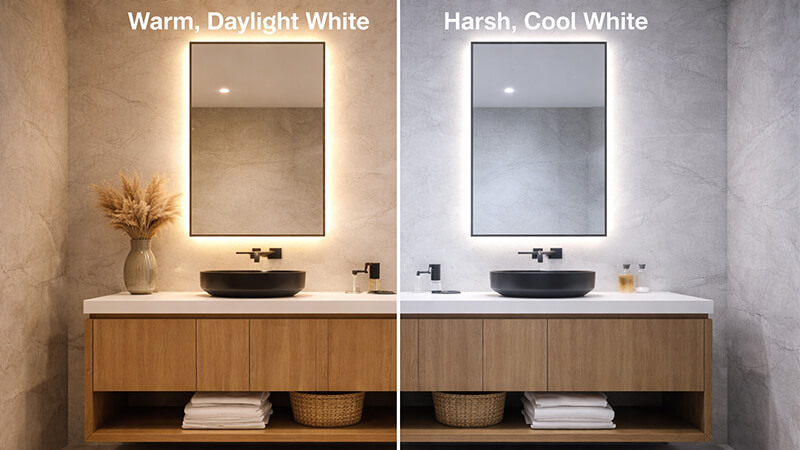
After ensuring safety with the correct IP ratings, we get to what I believe truly defines the bathroom experience: the color of the light. This is measured in Kelvin (K). I once had a client who insisted on using 4000K "Cool White" lights throughout a luxury hotel’s bathrooms because they thought it looked cleaner and more modern. After installation, the feedback was terrible. Guests complained the lighting was harsh and clinical, making them feel exposed and uncomfortable. The bright, cool light magnified every tiny water spot on the chrome fixtures and made skin tones look washed out. We switched to a 5000K "Daylight White," and the complaints stopped. The space felt just as bright but much more natural and forgiving. It was a powerful lesson: light color impacts emotion and perception far more than most people realize.
The Impact of Light Color on Your Bathroom Experience
Choosing the right color temperature is about more than just brightness; it’s about creating the right mood and function for different parts of your bathroom. Let’s compare the two most common choices.
| Light Color (Kelvin) |
Cool White (~4000K) |
Daylight White (~5000K-6500K) |
| The Vibe |
Crisp, bright, and energetic. Can feel sterile or clinical, like an office or hospital. |
Natural, clean, and invigorating. Mimics natural daylight, making spaces feel open and airy. |
| Effect on Surfaces |
Highlights imperfections. Every water spot, streak on the mirror, and piece of lint on the floor becomes highly visible. |
Softens imperfections. It provides clear visibility without being harsh, blending minor spots and making surfaces look cleaner overall. |
| Effect on Skin Tones |
Can make skin look pale, washed out, and unhealthy. It accentuates blemishes and dark circles under the eyes. |
Renders skin tones more naturally and in a flattering way. It’s better for applying makeup and general grooming. |
| Best for… |
Task-specific areas where high-contrast visibility is key, like a dedicated shaving mirror. Use sparingly. |
General ambient lighting for the whole bathroom. It creates a comfortable, clean-feeling, and functional environment. |
My advice is to think in zones, just like with IP ratings. For the main ceiling downlights that provide overall ambient light, Daylight White (5000K) is the superior choice for a welcoming and functional bathroom. It gives you that bright, clean feeling without the harsh, critical eye of Cool White. You can then use a dedicated Cool White light around the vanity mirror if you need that high-contrast light for tasks like makeup application or shaving. By layering different light colors, you create a bathroom that is both beautiful and perfectly functional.
Conclusion
Select your downlight’s IP rating based on bathroom zones for safety. But remember, the light’s color temperature is what truly shapes the look and feel of your space.