Are you trying to find the perfect light for every situation? The wrong color temperature can make a space feel unwelcoming. Tunable downlights give you complete control over your room’s atmosphere.
A tunable downlight is a recessed LED fixture that lets you adjust the color temperature of the white light it emits. You can change it from a warm, cozy yellow to a cool, energetic white, perfectly matching the light to your activity or the time of day.
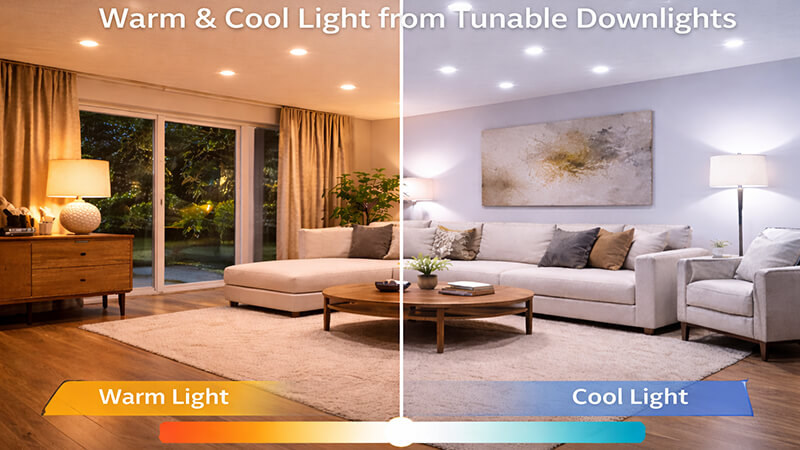
When I first started in this industry, lighting was simple. You chose a bulb, and that was the light you got. There was no changing it. A single choice had to work for every mood and every task, day or night. But technology has changed everything. We now have the power to make light work for us, adapting to our lives in real-time. This is the real magic behind the new generation of LED lighting. It’s a change that has completely reshaped how we think about illuminating a space, and it all starts with understanding what "tunable" really means.
What is a tunable LED light?
Do you feel like your lighting is just a fixed part of the room? This limits how you use a space, forcing one mood on every situation. Tunable LED lights solve this problem.
A tunable LED light is any light source that allows you to change its Correlated Color Temperature (CCT). This technology isn’t just in downlights; it can be in panels, strips, or bulbs. It gives you direct control over the "warmth" or "coolness" of the white light.
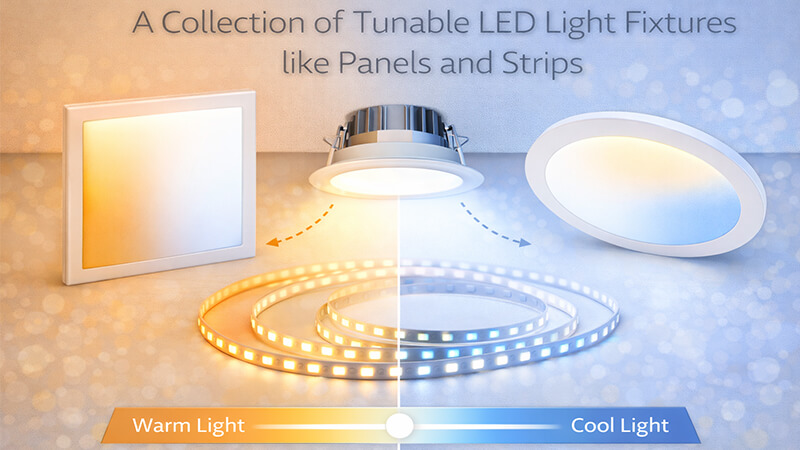
To really understand tunable lights, we have to talk about Correlated Color Temperature, or CCT. We measure CCT in Kelvin (K). A lower Kelvin number means the light is warmer, more like a candle or an old incandescent bulb. A higher Kelvin number means the light is cooler and bluer, like natural daylight. For example, 2700K is a very warm, cozy light you might want in a living room in the evening. 4000K is a neutral white, great for focus in an office or kitchen. 6500K is a very cool, crisp white that mimics bright daylight, often used to increase alertness.
The technology works by using two different types of LED chips inside the light fixture: one set produces warm white light, and the other produces cool white light. By adjusting the power sent to each set, the light can mix them to create any color temperature in its range. This ability is the foundation of human-centric lighting. Our bodies are naturally tuned to the changing color of sunlight throughout the day. By matching our indoor lighting to this rhythm—cool light in the morning for energy, and warm light in the evening to relax—we can support our natural sleep-wake cycle. I once worked on an office project where we installed tunable lights. The client later told me that their employees reported feeling more focused during the day and more relaxed as the workday ended. That’s the power of tunable light.
| CCT Value |
Light Appearance |
Common Application |
| 2700K |
Warm, Cozy Yellow |
Living rooms, bedrooms, restaurants |
| 3000K |
Soft, Warm White |
Kitchens, bathrooms, hotels |
| 4000K |
Neutral, Crisp White |
Offices, retail stores, garages |
| 5000K+ |
Cool, Daylight Blue |
Warehouses, hospitals, task lighting |
What is the best type of downlight?
Are you feeling overwhelmed by all the downlight options available? Choosing the wrong one can lead to bad lighting, high energy bills, and expensive replacements. The "best" downlight depends entirely on your project.
The best downlight is the one that meets your specific needs. Key factors are the beam angle, brightness, color rendering, and whether you need features like dimming or tuning. For maximum versatility, a tunable white downlight is often the superior choice, as it can adapt to many uses.
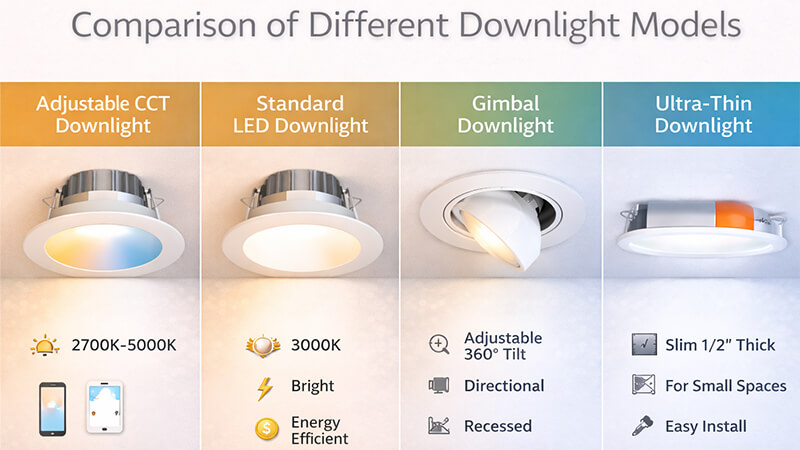
As a purchasing manager, you know that "best" is a complex term. It is not just about the product; it is about finding the right fit for the application to ensure long-term value. Let’s break down the factors you should consider when sourcing downlights. First is the form: do you need a fixed downlight that shines straight down, or an adjustable gimbal that can be aimed to highlight artwork or architectural features? Next, consider the lumen output, or brightness. A taller ceiling requires a downlight with higher lumens to properly illuminate the floor below.
The beam angle is also critical. A narrow beam (15-25 degrees) is perfect for accent lighting, creating dramatic spots of light. A wider beam (40-60 degrees) is better for general illumination to cover a larger area. For spaces where color accuracy matters, like in retail or a gallery, you must look for a high Color Rendering Index (CRI). A CRI of 90 or more means colors will look true and vibrant. For me, the most important decision is choosing between a fixed CCT and a tunable downlight. While a fixed downlight might have a lower initial cost, a tunable downlight offers flexibility that can be priceless. I remember a hotel client who wanted to save money with fixed 3000K downlights in their lobby. I convinced them to invest in tunable ones. They now use cooler light during the busy check-in hours and a warm, inviting light in the evening. They said guest compliments about the lobby’s ambiance have increased significantly. That’s how a tunable downlight proves it’s the "best" choice.
| Feature |
Fixed CCT Downlight |
Dim-to-Warm Downlight |
Tunable White Downlight |
| Flexibility |
Low |
Medium |
High |
| Function |
Single color temperature |
Dims and gets warmer |
Adjustable color temperature |
| Best For |
Spaces with a single, defined use |
Creating a cozy, intimate feel |
Multi-purpose spaces, human-centric lighting |
| Initial Cost |
Low |
Medium |
High |
What is the difference between tunable and dimmable?
Are you confused by the lighting terms "tunable" and "dimmable"? Mixing them up can lead to ordering the wrong products and creating a disappointing result for your client. The difference is actually very simple.
Dimming changes the brightness of a light, making it brighter or dimmer. Tuning changes the color temperature of the light, making it warmer or cooler. These are two separate functions, though some advanced lights can do both.
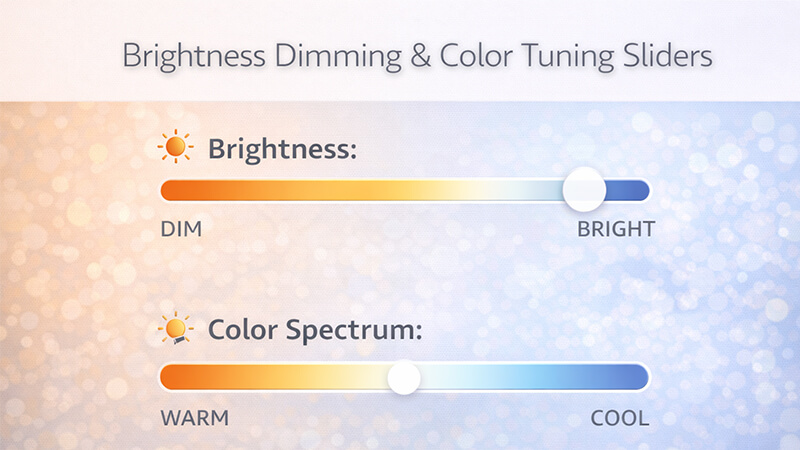
Most people think dimming is just about changing brightness. But from a professional’s perspective, it’s more complex. At its core, light has a "pulse." Cheap dimmers control brightness by turning the light on and off very quickly. This creates a high-frequency flicker that your eyes may not consciously see, but it can cause headaches and eye strain over time. True professional dimming is about eliminating this flicker. It creates a smooth, continuous change in brightness without any invisible pulses or jarring steps. It feels more natural and is much more comfortable for our eyes.
Now, let’s apply that same idea to tuning. Tuning adjusts the color temperature, moving between warm and cool white. Just like with dimming, a low-quality tunable light will have noticeable "jumps" as it changes color. A high-quality one will transition smoothly, creating a seamless shift in atmosphere. There is also a hybrid technology called "Dim-to-Warm." This feature mimics the behavior of an old incandescent bulb. As you dim the light down, its color temperature automatically gets warmer. This is different from a standard tunable light, where you control brightness and color independently. Dim-to-Warm is perfect for creating a cozy, relaxing environment in spaces like restaurants or living rooms.
| Feature |
Dimmable |
Tunable White |
Dim-to-Warm |
| Primary Function |
Adjusts Brightness |
Adjusts Color Temperature |
Adjusts Brightness & Color Together |
| Control |
Intensity (e.g., 100% to 10%) |
CCT (e.g., 2700K to 6500K) |
Intensity (dims down and gets warmer) |
| Analogy |
A volume knob |
A tone control knob |
A sunset effect |
What is the difference between tunable white and full color?
Do you think tunable technology means you can set your lights to any color of the rainbow? This common misunderstanding can lead you to specify the wrong product for a project. Let’s clarify the difference.
Tunable white adjusts the shade of white light, moving along a spectrum from warm yellow to cool blue. Full-color, or RGBW, lighting allows you to create millions of colors—like red, green, and blue—in addition to providing functional white light.
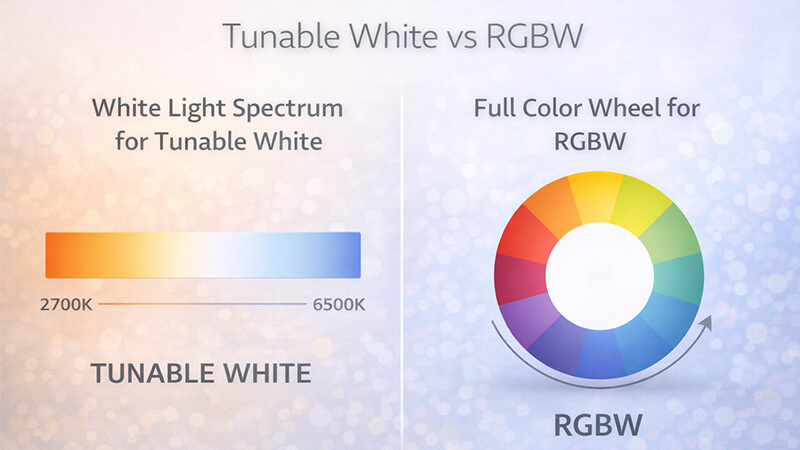
Tunable white, which we have been discussing, focuses entirely on the quality and temperature of white light. It uses a combination of warm white and cool white LED chips to help you create the perfect functional light for a space, whether it is for productivity in an office or relaxation at home. Its main purpose is to support human well-being and adapt a space for different tasks.
Full-color lighting is a completely different tool. The simplest version is RGB, which uses Red, Green, and Blue LEDs. It mixes these three primary colors to create a wide color palette. However, when you mix them to make white, the quality is often poor and has a bluish tint. A much better solution is RGBW, which adds a dedicated White LED chip. This gives you both vibrant, saturated colors and high-quality white light from a single fixture. The most advanced option is RGBCCT, which includes Red, Green, and Blue LEDs plus a full set of tunable white chips. This offers the ultimate flexibility: rich colors and high-quality, fully adjustable white light. The application is key here. Tunable white is for functional lighting. Full-color is for decorative and entertainment purposes—think of architectural facades, theme parks, bars, and theaters. I once had a client ask for "color-changing lights" for their new corporate headquarters. After talking with them, I realized they didn’t want a distracting light show. They wanted tunable white lighting to improve employee focus and well-being. We saved them from making a costly mistake.
| Feature |
Tunable White (CCT) |
Full-Color (RGBW) |
| Purpose |
Functional, Human-Centric |
Decorative, Entertainment |
| Spectrum |
Warm White to Cool White |
Full-color spectrum + White |
| LEDs Used |
Warm White & Cool White |
Red, Green, Blue & White |
| Typical Use |
Offices, Homes, Healthcare |
Bars, Theaters, Building Facades |
| Key Benefit |
Supports well-being and task focus |
Creates dynamic, colorful scenes |
Conclusion
Tunable downlights give you control over light’s color, not just its brightness. This flexibility lets you create the perfect atmosphere, enhancing any space’s function and the well-being of people in it.