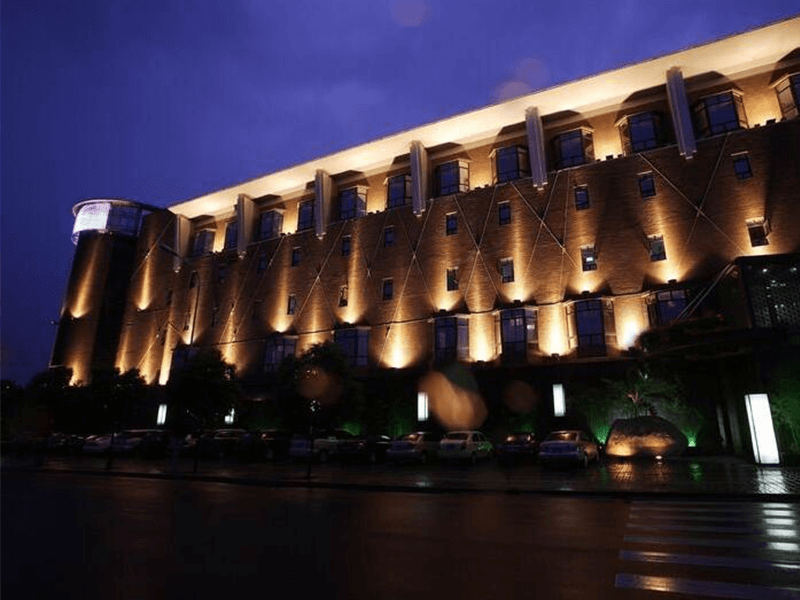
Straining your eyes under harsh lighting? That discomfort is glare, and it ruins an otherwise perfectly lit space. But there is a better way to light a room.
An anti-glare downlight is a light fixture designed to minimize visual discomfort. It controls the light’s direction by recessing the LED chip and using a special reflector. This way, you see the light on the surfaces, not the harsh light source itself.
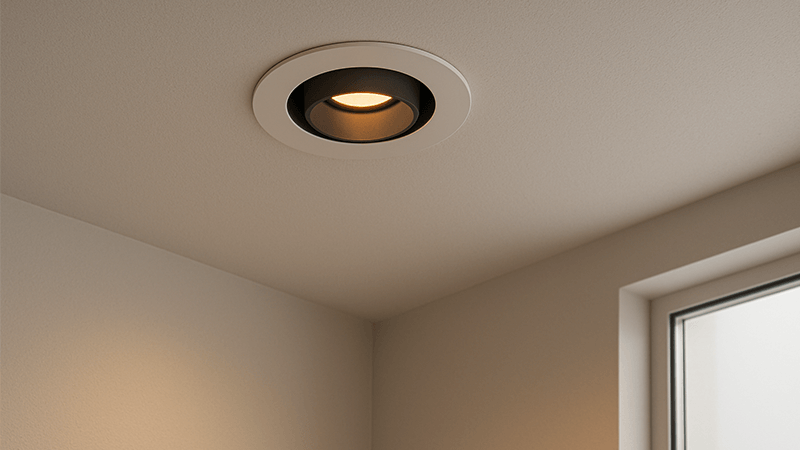
This sounds simple, but the technology behind it is quite clever. In my years of manufacturing, I’ve seen clients transform their spaces just by switching to better-designed lights. Understanding how it works is key to choosing the right lighting for your projects. So, let’s explore what’s really happening when we talk about "anti-glare".
What does anti-glare actually do?
Ever felt a headache from bright office lights? That’s glare actively hurting your eyes and focus. It’s a common problem with a surprisingly sophisticated solution in lighting design.
Anti-glare technology doesn’t block light; it controls it. Its main job is to direct light where it’s needed, like on a desk or the floor, while shielding the bright light source from your direct line of sight. This creates a much more comfortable visual experience.
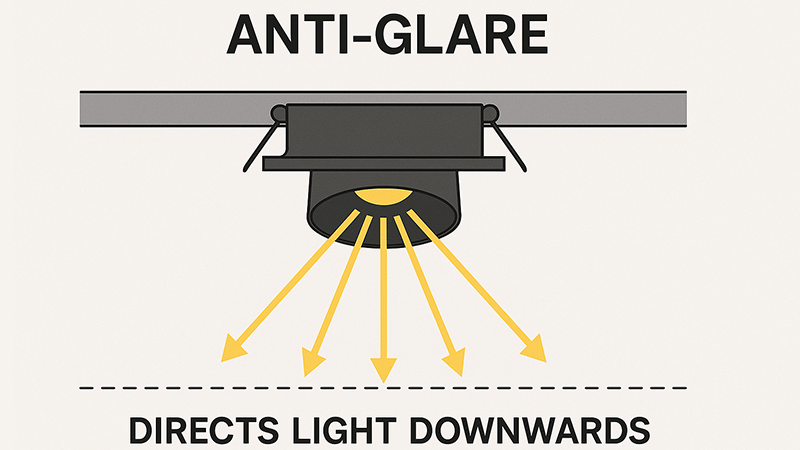
Based on my experience, the best way to understand anti-glare is to think of it as a revolution in how we use light. It changes light from a simple tool "to be seen" into a medium "to be felt". The core idea is to control light, not to eliminate it. We want to hide the source of the light without losing its illumination. This is achieved by manipulating the physical design of the downlight itself.
Shielding the Light Source
The most important factor is hiding the LED chip from direct view. We do this by recessing the chip deep inside the fixture’s housing. The angle from the edge of the fixture to the light source is called the cut-off angle or shielding angle. A larger angle means better glare control. In the industry, we generally agree on these standards:
- < 30°: Minimal anti-glare effect. You can still easily see the light source when looking up.
- 30° – 45°: Good anti-glare performance. This is a common standard for commercial and high-end residential spaces.
- > 45°: Excellent anti-glare performance. It’s almost impossible to see the light source unless you are directly underneath it.
Shaping the Light
The reflector, the cone-shaped part inside the downlight, is also critical. Its job is to gather all the light from the LED chip and direct it downwards efficiently. In an anti-glare downlight, the reflector is engineered to create a precise beam of light, minimizing stray light that could cause glare. This combination of a deep-set LED and a well-designed reflector is what delivers visual comfort without sacrificing brightness on the target surface.
What are the disadvantages of anti-glare?
You might think anti-glare is the perfect solution. But it’s not always the best choice for every situation. There are trade-offs to consider before committing to it for a project.
The main disadvantages of anti-glare downlights are potentially lower light output efficiency and a higher initial cost. Because the light source is recessed, some light can be trapped inside the fixture, and the complex design can make them more expensive to produce.
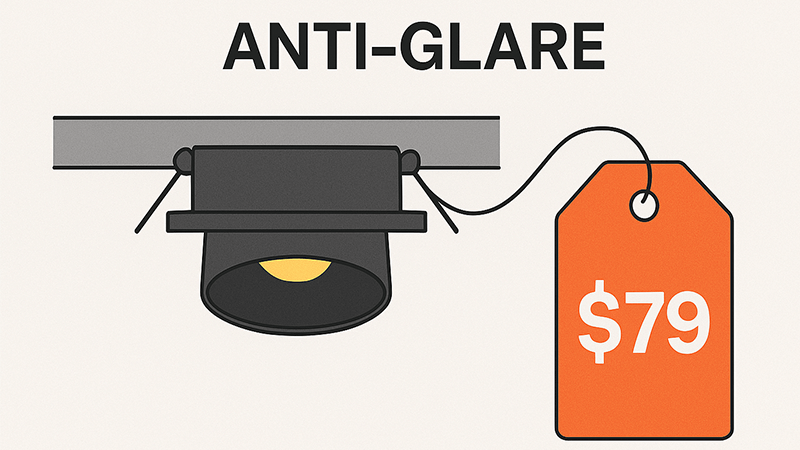
When I consult with clients like Shaz, a purchasing manager with deep industry knowledge, we always discuss the practical implications. An anti-glare downlight prioritizes visual comfort, but this focus comes with certain trade-offs that are important for a purchasing expert to weigh.
Efficiency vs. Comfort
The first trade-off is lumen efficiency. A standard downlight might have a high lumen output per watt because its design is very open, pushing out as much light as possible. An anti-glare downlight, by its very nature, has a more complex internal structure. The LED is set back, and the reflector has a specific shape to control the beam. This structure can trap a small percentage of the light, meaning the overall lumen output might be slightly lower compared to a standard downlight using the exact same LED chip and driver. For a project where maximizing brightness for the lowest energy cost is the absolute priority, and visual comfort is secondary, this slight drop in efficiency might be a deciding factor.
Cost and Application
The second consideration is cost. Manufacturing an effective anti-glare downlight requires more engineering, better materials for the reflector (like high-purity aluminum with specialized coatings), and more precise assembly. These factors increase the unit cost. For a budget-sensitive project covering a vast area, the price difference can add up. It’s also a matter of application. In a warehouse or a utility corridor, for example, high-efficiency, no-frills lighting is often sufficient. The priority is illumination, not ambiance. In these cases, the extra investment in anti-glare might not provide a meaningful return. The key is matching the technology to the needs of the space.
What are anti-glare LED lights?
People often ask me what makes an "LED" anti-glare light special. Isn’t it just a regular light with a shield? The reality is that LED technology is what makes modern anti-glare designs so effective.
Anti-glare LED lights are fixtures that use the small size and directional nature of LEDs to achieve superior glare control. By combining a compact LED chip (like COB) with precision-engineered lenses or reflectors, these lights offer high-quality illumination with minimal eye strain.
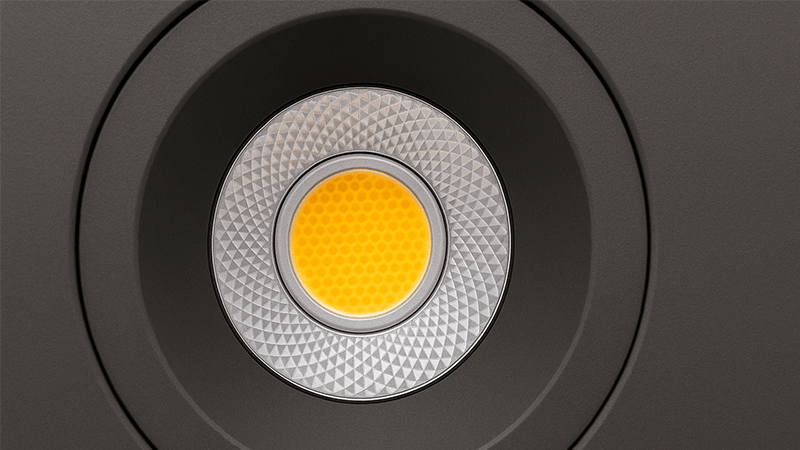
Before LEDs became mainstream, we worked with bulky light sources like halogen or compact fluorescent lamps. It was much harder to control the light from these sources because they emitted light in all directions and were physically large. Creating an effective anti-glare fixture for them required big, cumbersome reflectors. LED technology completely changed the game, and I’ve seen this evolution firsthand in my factory.
The Power of a Small Source
The biggest advantage is the compact size of the light source. We primarily use Chip-on-Board (COB) LEDs for our premium downlights. A COB is a single, small module packed with many tiny LED diodes. This creates a very intense, point-like source of light. Because the source is so small, it’s much easier to control with optics. We can design a relatively small reflector or lens that precisely captures and directs almost all the light. This allows us to create very sleek, minimalist fixtures that still have an excellent cut-off angle (like 45° or even 60°) for superior anti-glare performance.
Precision Optics
This small source size allows for the creation of advanced optics. We can design reflectors with complex, multi-faceted surfaces that shape the light beam perfectly, eliminating stray light and ensuring a smooth, even distribution on the floor or wall. Lenses with Total Internal Reflection (TIR) technology can also be used. A TIR lens sits directly over the LED and uses both refraction and reflection to control the light with incredible precision, often achieving high efficiency and perfect beam control. This level of precision was simply not possible with older, larger light sources.
What is the difference between low glare downlights and normal downlights?
Walking through a project site, you can instantly feel the difference. One area feels calm and inviting, another feels harsh and clinical. Often, the only difference is the choice between a low-glare and a normal downlight.
The main difference is in the design and its effect on visual comfort. A low-glare downlight has a recessed light source and a controlling reflector to hide the bulb from sight, while a normal downlight often has a flat, exposed light source.
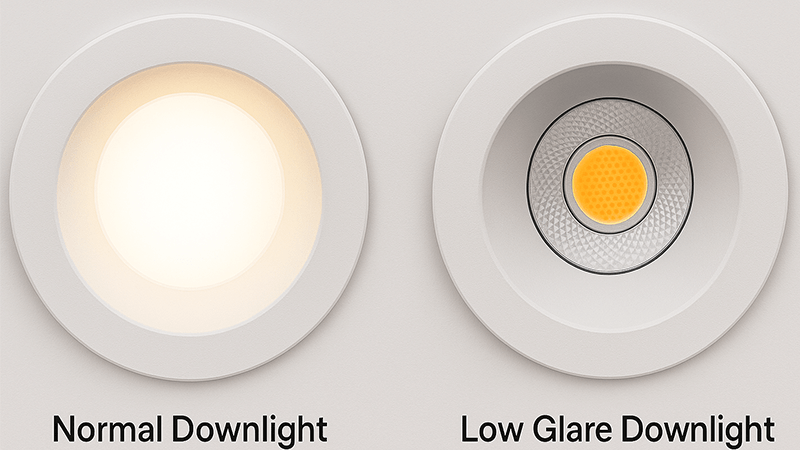
To help my clients make informed decisions, I always break down the differences into clear, structural points. The choice impacts not just the look and feel of a space, but also its usability and the well-being of the people in it. The core difference lies in the design philosophy: one is designed to be seen, the other is designed to help you see. Let’s compare them directly.
Structural and Performance Comparison
The best way to see the difference is with a side-by-side comparison of their key features.
| Feature |
Normal Downlight |
Low Glare (Anti-glare) Downlight |
| Light Source Position |
Exposed and flush with the ceiling. The light source is clearly visible from most angles. |
Recessed deep inside the fixture. The light source is hidden from direct line of sight. |
| Reflector/Diffuser |
Often uses a simple, flat diffuser (like frosted plastic) to spread light. |
Uses a deep, cone-shaped reflector to precisely control and direct the light beam downwards. |
| Shielding Angle |
Very small or non-existent (<15°). Glare is very likely. |
Significant (>30°, often 45° or more). This provides excellent glare protection. |
| Visual Comfort |
Low. Can cause eye strain, headaches, and discomfort, especially in an office or home setting. |
High. Creates a soft, comfortable environment where you see the illuminated space, not the light source. |
| UGR (Unified Glare Rating) |
Typically high (UGR > 22). Not suitable for tasks requiring focus. |
Low (UGR < 19 is common). Ideal for offices, schools, and high-end residential use. |
| Application |
Best for general, non-critical areas like hallways, storage rooms, or where budget is the main concern. |
Best for living spaces, workplaces, galleries, and any environment where comfort and ambiance are important. |
From a manufacturer’s perspective, producing a low-glare downlight requires more precision. But the result is a product that fundamentally improves a space. The goal is to make the lighting disappear, leaving behind only a beautifully and comfortably lit environment.
Conclusion
In summary, an anti-glare downlight prioritizes visual comfort by controlling light, not just producing it. It’s a choice that elevates a space from simply being lit to being well-lit.