Your majestic palm trees disappear into the darkness every night. This leaves your landscape feeling incomplete and less impressive. The right uplighting strategy can transform them into stunning nighttime features.
The best lighting for palm trees uses a combination of fixtures. Use narrow-beam spotlights aimed up the trunk to highlight its texture and height. Then, add one or two wider-beam floodlights to illuminate the lush fronds of the canopy, creating a balanced and dramatic effect.

I’ve been in the lighting business for a long time, starting on the factory floor. I’ve learned that lighting a palm tree is more than just pointing a lamp at it. There is an art to it that enhances its natural form without creating a spectacle. Getting the details right is what separates a good project from a great one. Let’s dive into how you can achieve that perfect look for your palm trees.
How many lumens to light up a palm tree?
Choosing the wrong brightness makes your palm tree look either washed out or barely there. Too much light creates harsh glare, while too little loses the effect entirely. Getting the lumen output right is the key to creating a beautiful, balanced look.
For most residential palm trees, aim for 300-800 lumens per fixture. Taller, more dramatic trees in commercial settings may need 1000-1500 lumens. The key is to use multiple lower-lumen lights to create depth rather than one overpowering light source.
When my clients ask about lumens, I always tell them to think in layers, not just in raw power. A palm tree has two main features: its tall, textured trunk and its wide, leafy canopy. Each part needs a different approach to lighting. It’s not about finding one single "best" lumen number, but about combining different lights to create a complete picture. This is how we achieve a professional, high-end look that feels natural and inviting.
Trunk Illumination
The trunk of a palm tree has a unique texture and a strong vertical line. Your goal here is to graze the trunk with light, which means shining the light almost parallel to the surface. This technique, called grazing, makes the texture pop. For this, a narrow beam angle (10-25 degrees) is perfect. You don’t need a huge amount of lumens. Often, 300-500 lumens is enough to travel up the trunk and create a beautiful visual line for the eye to follow. For very tall trees, you might use two fixtures to ensure the light reaches high enough without creating a "hot spot" at the base.
Canopy Illumination
The canopy, with its sprawling fronds, needs a different kind of light. You want to give it a soft, full glow that shows its shape and volume. A wide beam angle (40-60 degrees) is the right tool here. This spreads the light out to cover the entire canopy without leaving dark patches. The lumen requirement depends on the canopy’s size and density. A good starting point is 500-800 lumens. For very large or dense canopies, you might need over 1000 lumens, sometimes using two fixtures placed at different angles to ensure full coverage.
Here is a simple guide I use for projects:
| Tree Height |
Recommended Total Lumens |
Fixture Breakdown Example |
| Up to 15 ft (5m) |
400 – 800 lm |
1x 400lm (trunk) + 1x 400lm (canopy) |
| 15 – 30 ft (5-9m) |
800 – 1500 lm |
2x 400lm (trunk) + 1x 700lm (canopy) |
| Over 30 ft (9m+) |
1500 – 2500+ lm |
2x 600lm (trunk) + 2x 800lm (canopy) |
Remember, this is a starting point. Factors like ambient light and desired intensity will influence the final choice. It’s always better to have dimmable fixtures to fine-tune the brightness on-site.
How much light do palm trees need?
Your palm trees are living things, not just landscape features. You worry that putting lights on them might cause harm or stress. The wrong type of light can interfere with their natural cycles. You need a solution that is both beautiful and safe for the trees.
Palm trees are not sensitive to the amount of light in the way many other plants are. Modern LED fixtures produce very little heat and no harmful UV radiation. The key is physical placement, ensuring fixtures and wiring do not constrict or damage the tree as it grows.
When I first started manufacturing outdoor lights, one of the biggest concerns from landscape architects was the health of the plants. The old halogen lights got incredibly hot and could easily scorch leaves and bark. That’s one of the main reasons my company, Upward Lighting, focuses exclusively on LED technology. With LEDs, the question is less about the "amount" of light from a biological perspective and more about the quality and type of the light and fixture.
Heat and Its Impact
The biggest threat from old lighting technology was heat. Halogen and incandescent bulbs waste most of their energy as heat. If a fixture was placed too close to the trunk or leaves, it could literally cook the plant tissue, causing permanent damage. This is not a concern with quality LEDs. They are incredibly efficient and produce very little forward heat. The minimal heat they do generate is managed by a heat sink at the back of the fixture. This means you can place an LED light close to the tree to achieve the desired grazing effect without any risk of burning it. It’s a major reason why LEDs have become the industry standard for landscape lighting.
Light Spectrum and Photoperiod
Plants respond to different spectrums of light for processes like photosynthesis and flowering. The "photoperiod" is the daily duration of light a plant receives, which can signal seasonal changes. For a mature, established palm tree, the low-intensity light from a few landscape fixtures is highly unlikely to disrupt its natural cycles. The light is focused on the trunk and canopy for aesthetic effect, not on providing energy for photosynthesis. We recommend using warm white light (2700K-3000K) for palm trees. It creates a welcoming, natural look and is less disruptive to local wildlife and the tree’s own cycles than cooler, blue-toned light.
Here’s a comparison of lighting technologies:
| Feature |
LED Lighting |
Halogen Lighting |
| Heat Output |
Very Low |
Very High |
| Risk of Burning Tree |
Extremely Low |
High |
| Energy Efficiency |
High (80-90% efficient) |
Low (20% efficient) |
| UV Radiation |
None |
Minimal |
| Lifespan |
50,000+ hours |
2,000-4,000 hours |
| Color Temperature |
Wide range of choices |
Typically warm |
In my experience, the only real danger to the tree comes from poor installation, which we’ll discuss later. From a purely "light" perspective, modern LEDs are completely safe for your palm trees.
What not to do with a palm tree?
You want to light your palm trees but are afraid of making a costly mistake. You see poor lighting jobs everywhere—hot spots, glare, and messy wires. These mistakes can make an expensive property look cheap and can even damage the trees themselves over time.
Never mount lights directly onto a palm tree’s trunk by drilling or using tight straps. This damages the tree and restricts its growth. Also, avoid using a single, overly powerful light source, which creates harsh shadows and a flat, unnatural look. Poor wiring is another major risk.
I’ve been called in to fix many lighting projects over the years. The most common problems I see are not about the lights themselves, but about how they were installed. People often forget that a palm tree is a living, growing thing. You have to think about its long-term health, not just how it looks tonight. A few simple rules can help you avoid the most common and damaging mistakes.
Avoid Damaging the Trunk
The single worst thing you can do is pierce the trunk of a palm tree. Unlike regular trees, palms don’t have a protective outer layer of bark that can heal itself. Any hole you drill is a permanent wound. It creates an entry point for insects, fungus, and disease that can eventually kill the tree. Similarly, using tight metal bands or zip ties to strap fixtures or wires to the trunk is a terrible idea. As the tree grows and its trunk expands, these bands will girdle it, cutting off the flow of nutrients and strangling the tree over time. It’s a slow death, and a completely avoidable one. All lighting fixtures should be ground-mounted on stakes.
Say No to Glare and Hot Spots
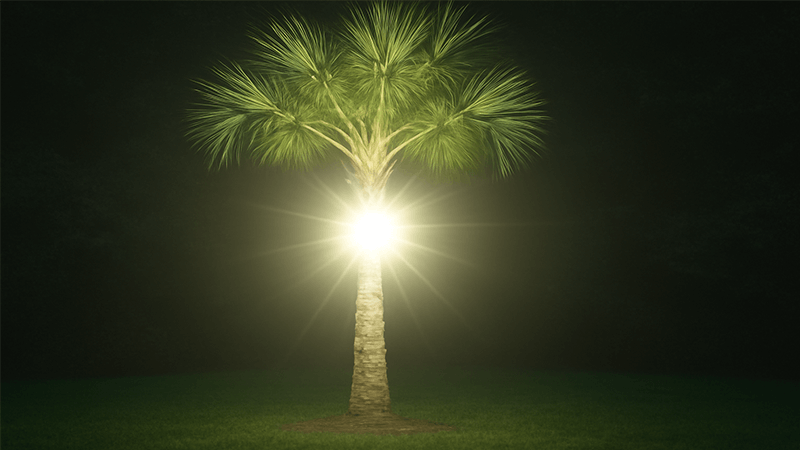
Another common mistake is using one massive floodlight to illuminate the whole tree. This approach is lazy and ineffective. It creates a "hot spot" at the base of the trunk, washing out all the beautiful texture, while leaving the canopy in relative darkness. It also creates a blinding glare for anyone walking by. Good lighting is about creating layers and contrast. Use multiple, lower-powered fixtures positioned strategically. This allows you to control the light, highlighting the parts you want to see and creating a much more sophisticated and visually comfortable scene.
Here’s a quick checklist of what to avoid:
| Don’t Do This |
Why It’s Bad |
What to Do Instead |
| Drill into the trunk |
Creates permanent wounds, invites disease. |
Use ground-mounted stakes for all fixtures. |
| Strap fixtures to the tree |
Girdles and strangles the tree as it grows. |
Place fixtures in the landscape bed around the tree. |
| Use one powerful light |
Creates glare, hot spots, and harsh shadows. |
Use multiple, smaller fixtures to layer light. |
| Point lights at windows |
Causes light trespass and annoys neighbors. |
Aim lights carefully at the tree itself. |
| Leave messy wires |
Looks unprofessional and is a trip hazard. |
Bury wires properly and secure them neatly. |
By avoiding these common errors, you protect your investment in both your trees and your lighting system.
How to put lights on palm trees?
You know what lights to use and what mistakes to avoid. But how do you actually position them for that perfect, professional look? Proper placement and aiming are what separate an average lighting job from a truly stunning one that enhances your entire property.
Position one or two narrow-beam spotlights 1-3 feet from the base of the trunk, aimed straight up to highlight its texture. Then, place one or two wider-beam floodlights further back, aimed at the center of the canopy to illuminate the fronds evenly.
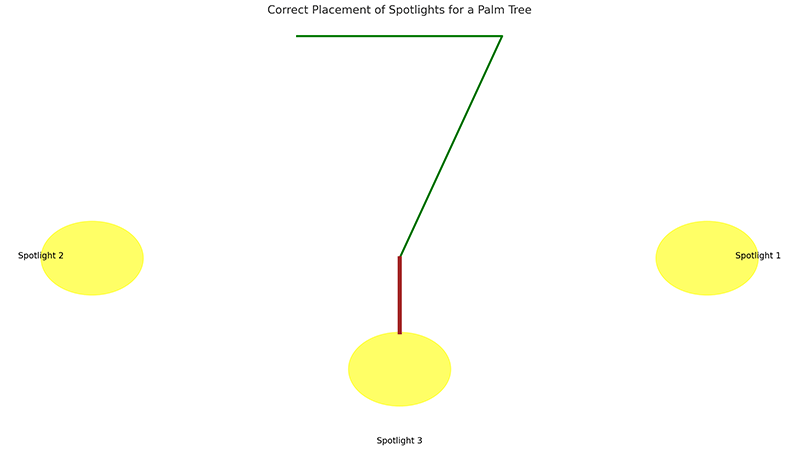
This is the part of the job I enjoy the most. It’s where the technical side meets the artistic side. I once worked on a resort project in the UAE where the entrance was lined with dozens of tall Canary Island Date Palms. The client, Shaz, was very specific; he wanted a look that felt luxurious but not overwhelming. We used this exact two-part technique, and the result transformed the entire feel of the property at night. It’s a reliable method that works every time.
Step 1: Lighting the Trunk (Uplighting)
The goal here is to create that dramatic sense of height and texture. This technique is called uplighting.
- Fixture: Use a spotlight with a narrow beam angle (10-25 degrees).
- Placement: Place the stake-mounted fixture about 1-3 feet (30-90 cm) away from the base of the palm tree. The taller the tree, the further back you might place it to get a wider spread higher up.
- Aiming: Aim the fixture almost straight up, so the light grazes the trunk. Play with the angle slightly. A little tilt can reveal more texture. For very large trunks or for a 360-degree view, you may want to use two fixtures on opposite sides. This creates a full, dimensional look and prevents harsh shadows.
Step 2: Lighting the Canopy (Accenting)
Now you need to illuminate the fronds to complete the picture. This is accent lighting.
- Fixture: Use a floodlight with a wider beam angle (40-60 degrees).
- Placement: Place the fixture further back from the trunk, typically 5-10 feet (1.5-3 meters) away. You want to be far enough back so the beam can spread out and cover the entire canopy.
- Aiming: Aim the light towards the heart of the canopy, where the fronds emerge from the trunk. This creates a beautiful glow from within. If the canopy is very wide, you might use two floodlights placed at 10 o’clock and 2 o’clock positions relative to the trunk. This ensures the canopy is lit evenly from all primary viewing angles.
I always recommend doing the final aiming at night. What looks right during the day can be completely different in the dark. Turn the lights on, step back, and look at the tree from all the main angles people will see it from—the driveway, the patio, the street. Adjust the position and angle of each fixture until the balance is just right. This final touch makes all the difference.
Conclusion
Choosing the right lumens and using a layered uplighting technique is key. By lighting the trunk and canopy separately, you can turn any palm tree into a stunning nighttime showpiece.