Choosing the wrong downlight can cause safety issues or waste money. Understanding the IP rating is simple and ensures you get it right every time for every space.
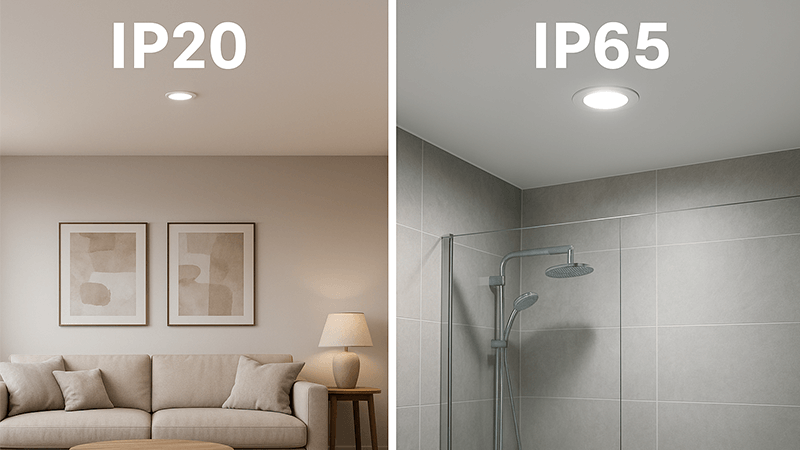
IP20 downlights are for dry indoor areas, protected against fingers but not water. IP65 downlights are for wet or dusty locations, as they are fully dust-tight and protected against water jets. Essentially, IP20 is for living spaces, and IP65 is for bathrooms and outdoors.
I’ve been in the lighting business for a long time. I started on the factory floor and now run my own manufacturing company. I’ve seen many clients, like my friend Shaz from the UAE, grapple with technical specs. One of the most common points of confusion is the IP rating. Many believe a higher number is always better, but that’s not the case. In a smart lighting plan, IP20 and IP65 downlights are partners, not rivals. They work together to create a lighting environment that is safe, durable, and cost-effective. You just need to know where to use each one. Let’s break it down so you can plan your projects with confidence.
Is IP20 better than IP65?
You might think a higher IP rating is always the superior choice. This common assumption can lead you to overspend significantly on lighting projects, installing protection you don’t need.
No, IP65 is not automatically better than IP20. The "better" option depends entirely on the specific location and its needs. IP20 is the ideal, cost-effective choice for dry indoor areas. IP65 is the necessary, safe choice for areas exposed to moisture or dust.
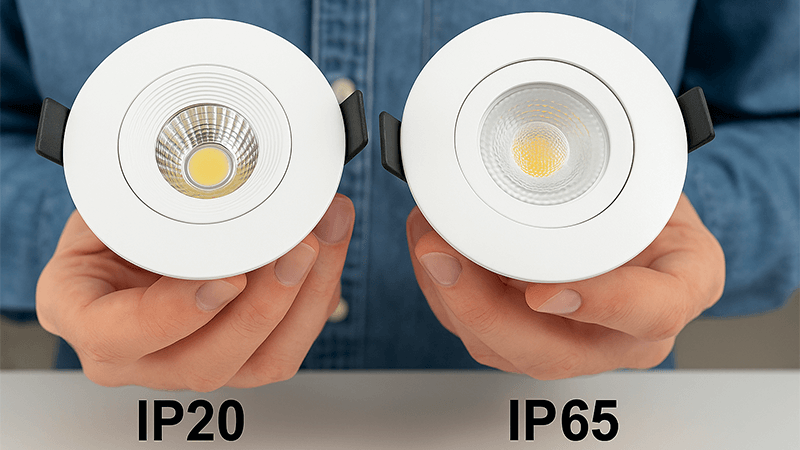
Thinking one IP rating is universally "better" is a common trap in lighting specification. I always tell my clients to think of it like choosing shoes. You wouldn’t wear heavy-duty waterproof boots to a business meeting in a dry office, right? It would be uncomfortable and unnecessarily expensive. You’d wear dress shoes. The same logic applies here. IP65 downlights are the heavy-duty boots, and IP20 downlights are the everyday dress shoes.
The primary difference comes down to construction and cost. An IP65-rated downlight requires special gaskets, seals, and a more robust housing to prevent ingress from dust and water. This extra engineering and material adds to the cost. An IP20 downlight has a simpler, more open construction because it doesn’t need to be sealed. This not only makes it more affordable but can also help with heat dissipation, which is crucial for the longevity of the LED chip. In a sealed IP65 unit, managing heat is a more complex design challenge.
Here’s a simple breakdown:
| Feature |
IP20 Downlight |
IP65 Downlight |
| Protection |
Solids >12.5mm (finger-safe) |
Dust-tight, water jets |
| Best For |
Living rooms, bedrooms, hallways, offices |
Bathrooms, kitchens, outdoors, washrooms |
| Cost |
Lower |
Higher |
| Design |
Open, prioritizes ventilation |
Sealed, prioritizes protection |
Using an IP65 fixture in a dry hallway is over-engineering. You’re paying for protection you will never use. For a large project, this can add up to thousands of dollars in unnecessary costs. The truly "better" choice is the one that provides the necessary safety for its specific environment at the most reasonable cost.
Does IP20 mean waterproof?
The term "IP rated" is often seen as a general promise of durability. This misunderstanding can lead you to assume IP20 offers some water protection, creating a dangerous situation in wet areas.
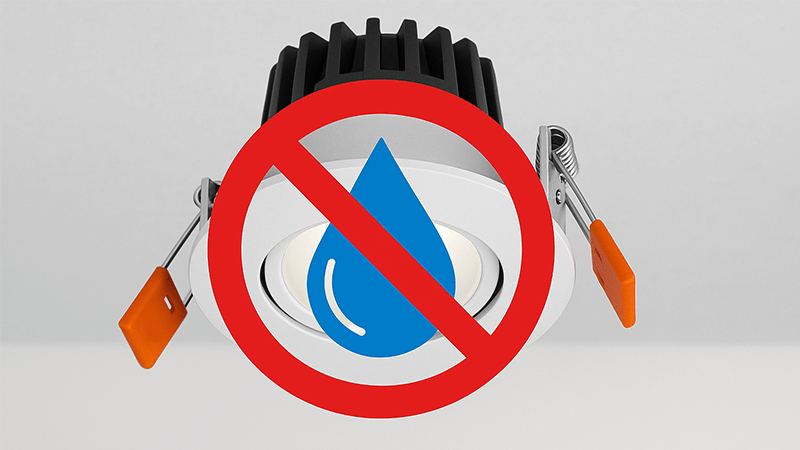
No, IP20 is absolutely not waterproof. It offers no protection against moisture of any kind. The ‘2’ rating refers to protection against solid objects larger than 12.5mm, like a finger. The ‘0’ means it has zero protection against liquids. It is only safe for dry locations.
Let’s demystify the IP code. "IP" stands for Ingress Protection. It’s a universal standard that classifies how well an electrical enclosure protects against intrusion from foreign bodies (like dust and fingers) and moisture. The code is simple:
-
The First Digit (Solids): This number runs from 0 to 6. It tells you how well the fixture is protected against solid particles.
0: No protection.2: Protected against objects larger than 12.5mm. This is an important safety feature for luminaires, as it means the internal electrical parts cannot be touched by a person’s finger. This is what the ‘2’ in IP20 signifies.6: Completely dust-tight. No dust can get inside. This is what the ‘6’ in IP65 signifies.
-
The Second Digit (Liquids): This number runs from 0 to 9. It tells you how well the fixture is protected against moisture.
0: No protection. This is the ‘0’ in IP20. It means the downlight must be kept completely dry.5: Protected against low-pressure water jets from any direction. This is the ‘5’ in IP65. This level of protection is more than enough for showers, kitchens, and outdoor soffits.
So, when you see IP20, you should think:
IP 2 0
(Ingress Protection) (Finger-Safe) (No Water Protection)
It is designed for the vast majority of indoor spaces where water is not a factor: living rooms, bedrooms, studies, corridors, and general office spaces. Its design prioritizes aesthetics, cost-effectiveness, and easy installation over environmental sealing. Installing an IP20 downlight in a bathroom shower or above a kitchen sink is a serious electrical hazard and violates safety codes in most countries.
What does IP65 mean on a downlight?
You see IP65 on a spec sheet, but what does that really mean for performance? Without a clear understanding, you might not be using the fixture to its full, protective potential.
IP65 means the downlight is completely protected from dust ingress and can withstand low-pressure water jets from any direction. The ‘6’ signifies it is dust-tight, and the ‘5’ signifies protection against water. This makes it ideal for wet and dusty environments.
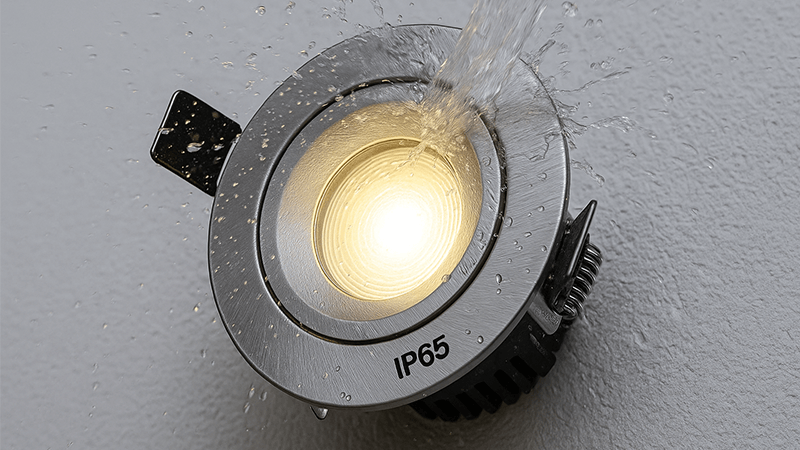
When I source a product for a client like Shaz, who manages large-scale projects, the IP65 rating is a guarantee of durability in challenging conditions. It’s not just a number; it’s a promise that the fixture is built to a higher standard. To achieve an IP65 rating, a downlight must be engineered with specific features. This includes silicone gaskets around the lens, sealed cable entry points, and a robust housing that can be tightly screwed or clipped together to form a barrier.
Let’s look at the numbers again, this time for IP65:
IP 6 5
(Ingress Protection) (Dust-Tight) (Water Jet Protection)
-
The ‘6’ for Dust-Tight Protection: This is the highest level of protection against solid particles. It means the enclosure is hermetically sealed. No amount of dust or debris can penetrate the fixture and interfere with the electronics or the LED components. This is crucial in dusty environments like workshops, garages, or even certain commercial facilities. Dust buildup inside a luminaire can cause overheating and short circuits, leading to premature failure.
-
The ‘5’ for Water Jet Protection: This means the downlight can resist a sustained, low-pressure jet of water projected by a nozzle (6.3mm) from any angle. In practical terms, it can handle much more than just steam or splashes. It can be directly sprayed for cleaning or exposed to heavy rain under a soffit. This is why it’s the go-to standard for bathroom zones 1 and 2 (the areas near showers and tubs), kitchens, laundry rooms, and covered outdoor areas. It ensures safety and longevity where moisture is present.
Choosing an IP65 downlight gives you peace of mind that the product is sealed, safe, and built to last in its intended environment.
Where are IP65 downlights best used?
You know IP65 is for wet areas, but which specific areas? Using them incorrectly is a waste, but not using them where needed is a safety risk. A clear zone-based approach is key.
IP65 downlights are best used in any location where they might be exposed to dust, steam, splashes, or jets of water. This primarily includes bathrooms (especially in and around showers), kitchens, laundry rooms, covered outdoor spaces like soffits, and commercial washrooms.
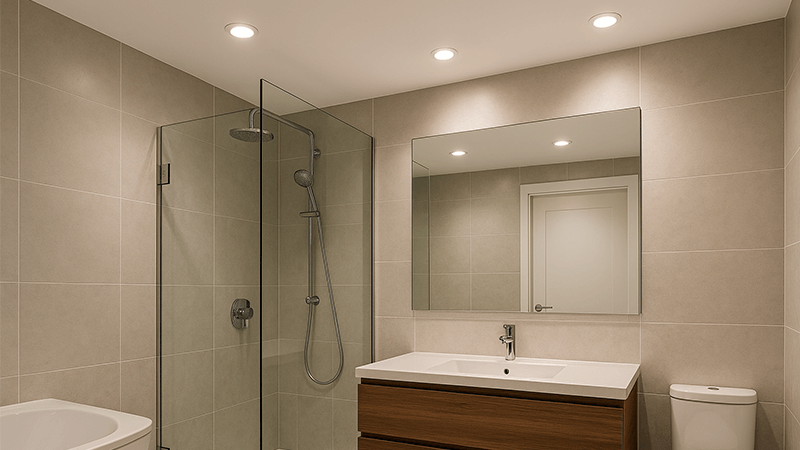
In my experience advising on lighting projects, the most effective way to plan is by dividing a building into "dry zones" and "wet/damp zones." This simple step at the design stage prevents mistakes and optimizes the budget.
Common Wet/Damp Zones for IP65 Downlights:
-
Bathrooms: This is the most critical application. Electrical regulations often divide bathrooms into zones.
- Zone 0: Inside the bath or shower. Requires IP67 (submersible).
- Zone 1: The area directly above the bath or shower up to 2.25m. IP65 is strongly recommended here.
- Zone 2: The area 0.6m outside the bath or shower. IP44 is the minimum, but using IP65 provides an extra margin of safety and is a common best practice.
-
Kitchens: The area directly above a sink or stove can be exposed to steam and splashes. While the entire kitchen may not need IP65, using them in these specific task areas is a smart move to prevent moisture-related failures.
-
Covered Outdoor Areas: Think of soffits, eaves, porches, and covered patios. These areas are exposed to humidity, wind-driven rain, and dust. IP65 downlights are essential here to ensure they withstand the elements without failing or becoming a hazard.
-
Utility and Commercial Spaces: Places like laundromats, commercial kitchens, food processing plants, car washes, and public washrooms all have high levels of moisture and require robust, sealed lighting like IP65 fixtures.
I always explain to my clients that in a complete home or commercial lighting plan, IP20 and IP65 downlights are teammates. By deploying the right fixture in the right zone, they work together to create a lighting system that is safe, reliable, beautiful, and economical. Don’t think of it as one versus the other; think of it as using the entire team correctly.
Conclusion
In any complete lighting design, IP20 and IP65 downlights are partners. By using them in the right dry and wet zones, you create a system that is safe, durable, and economical.