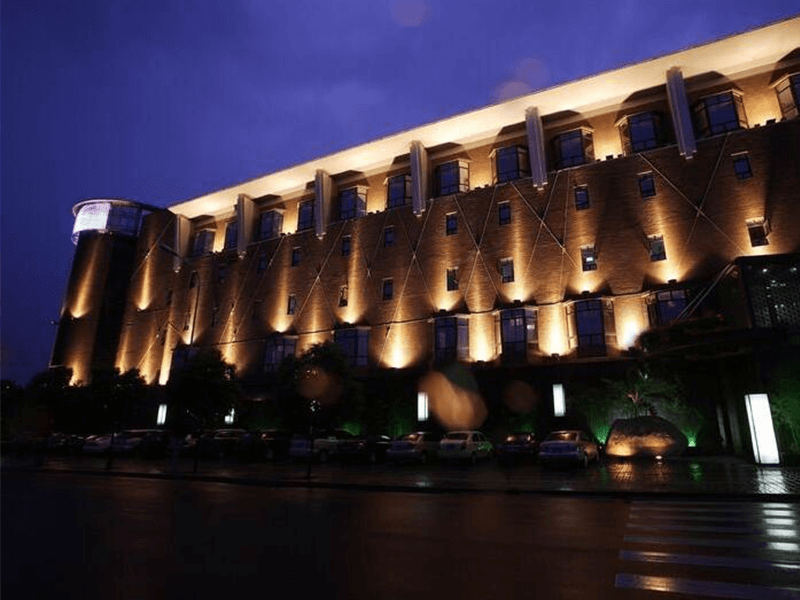
Your lighting looks wrong despite the right brightness. Harsh spots or flat light can ruin a space. Understanding the beam angle is the key to fixing your design.
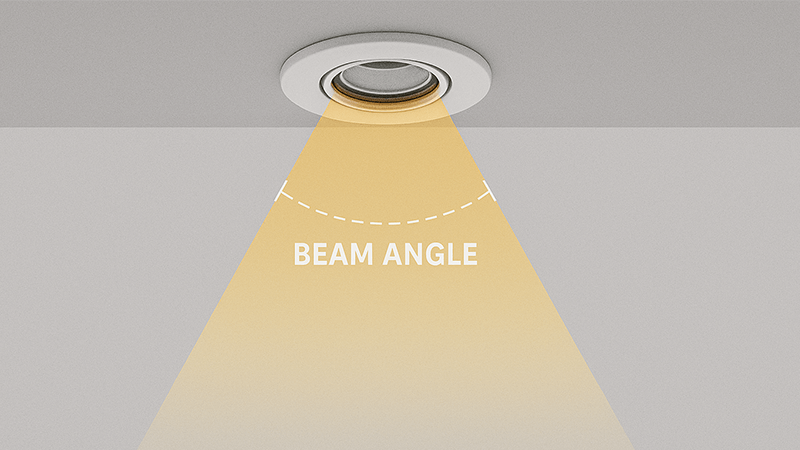
The downlight beam angle is the angle at which light spreads from the source. It determines the size of the light pool on the floor or wall. Measured in degrees, a narrow angle creates a spotlight, while a wide angle provides broader, general illumination for a room.
This seems simple, but just knowing the definition isn’t enough. The real magic happens when you choose the right angle for your specific space. Many of my clients, like Shaz, a purchasing manager in the UAE, know that getting the technical details right is crucial for large projects. In my years of manufacturing, I’ve seen too many projects fail because they focused only on wattage. They were stuck on a static number set at the factory. But I believe light should be a dynamic tool, not a fixed instruction. Let’s explore how to make it work for you.
What beam angle for downlights?
Trying to pick the right beam angle for your downlights? A wrong choice can create an uneven, poorly lit room. Let’s break down the simple rules for every space.
For general lighting, use a wide beam angle of 60 degrees or more. For accent lighting on artwork or features, choose a narrow beam of 10-25 degrees. For task lighting over counters or desks, a medium 30-40 degree beam angle works best for focused light.
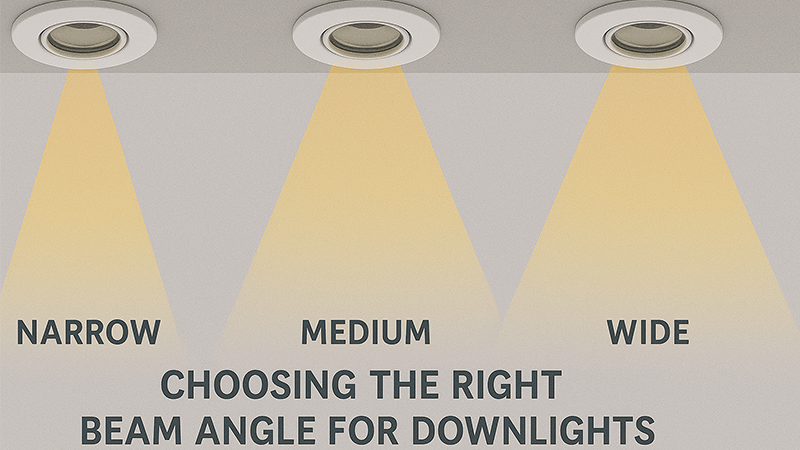
Choosing the right beam angle isn’t just about picking a number. It’s about deciding what you want your light to do. Are you trying to light up a whole room, highlight a beautiful painting, or help someone focus on their work? Each goal needs a different approach. Simply picking a fixture based on its factory-set beam angle is a leftover idea from the industrial age. We saw light as a simple utility. Today, light creates an experience. It has a dynamic conversation with the space it illuminates. The real value is not in a fixed setting but in how light adapts to the needs of the people in the room. This is why I always tell my clients to think about the function of the space first, then choose the tool for the job.
Matching the Angle to the Task
The function of your light dictates the angle you need. It’s the first and most important question to ask.
- General Ambient Lighting: For living rooms, hallways, or open-plan offices, you want soft, even light everywhere. A wide beam angle (60° or more) is perfect. It reduces shadows and creates a comfortable, welcoming atmosphere.
- Focused Task Lighting: For kitchen counters, office desks, or reading nooks, you need clear, direct light without glare. A medium beam angle (30-40°) provides a focused pool of light exactly where you need it, making tasks easier and reducing eye strain.
- Dramatic Accent Lighting: To make an architectural feature, a piece of art, or a retail display stand out, you need high contrast. A narrow beam angle (10-25°) acts like a spotlight, drawing the eye and adding a layer of drama and sophistication to your design.
By thinking about the job before the tool, you ensure the lighting serves the space, not the other way around.
What is the beam angle on LED lights?
You see a beam angle listed on an LED light spec sheet, but what does it really mean? It’s not just a number; it’s a promise of performance that can make or break your design.
The beam angle on LED lights is the measurement of how light spreads from the chip. It’s controlled by lenses or reflectors. This angle determines if the light will be a concentrated spot or a wide flood, directly impacting the light’s intensity and coverage area.
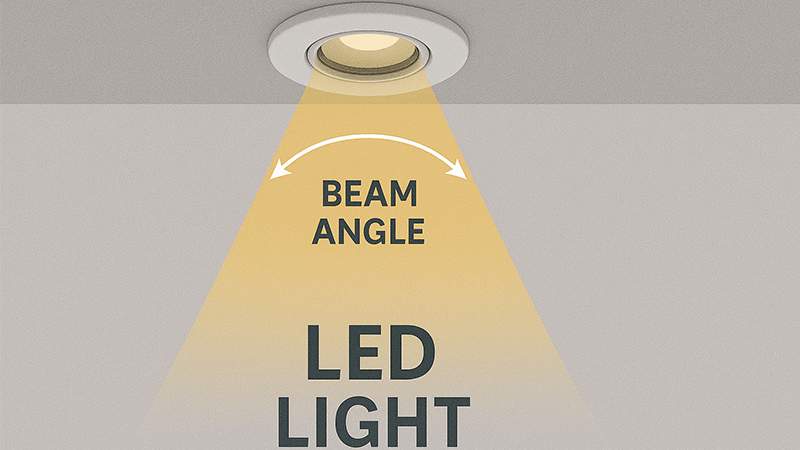
When I started in a lighting factory years ago, the technology was much simpler. But with LEDs, everything changed. We gained incredible control over light. The beam angle is a perfect example. It’s not just an inherent property of the light source; it is a carefully engineered feature. Manufacturers like us use specific Total Internal Reflection (TIR) lenses or reflectors to shape the light coming from the tiny LED chip into a precise, usable beam. This precision is what allows us to create such a wide range of effects, from a tiny, sharp spotlight to a broad, soft wash of light. For a buyer like Shaz, understanding this technology is key. It means he’s not just buying a light; he’s buying a specific tool designed for a specific effect. He can demand and get exactly the light distribution his project needs, which is a huge advantage over older technologies.
The Technology Behind the Angle
The way we control the beam angle in LEDs is a big leap forward. It comes down to two main components: lenses and reflectors.
- Lenses: High-quality optics, often TIR lenses, are placed directly over the LED chip. They capture and redirect nearly all the light produced, shaping it into a very precise beam. This method is highly efficient and allows for clean, sharp light pools with minimal light spill or glare.
- Reflectors: A cone-shaped reflector is placed around the LED chip. The shape and finish of the cone (e.g., specular or faceted) determine how the light is reflected and spread. While sometimes less precise than lenses, reflectors are excellent for creating softer-edged beams and are often used in general lighting applications.
Center Beam Candle Power (CBCP)
A related and important metric is the Center Beam Candle Power (CBCP). This measures the intensity of light at the very center of the beam. A narrow beam angle concentrates all its light into a small area, resulting in a very high CBCP. A wide beam angle spreads the same amount of light over a larger area, resulting in a lower CBCP. This is why a 7W spotlight can appear much brighter on a single object than a 15W floodlight. When you need to create drama or make something pop, you’re looking for a high CBCP, which means you need a narrow beam angle.
What does 90 degree beam angle mean?
You see "90-degree beam angle" on a spec sheet, and it sounds very wide. But what does it mean for your actual room? It’s about total coverage, not focused power.
A 90-degree beam angle creates a very wide, soft cone of light. It’s considered a floodlight, designed to illuminate a large area evenly from a relatively short distance. It is ideal for general ambient lighting in spaces with standard or low ceilings.
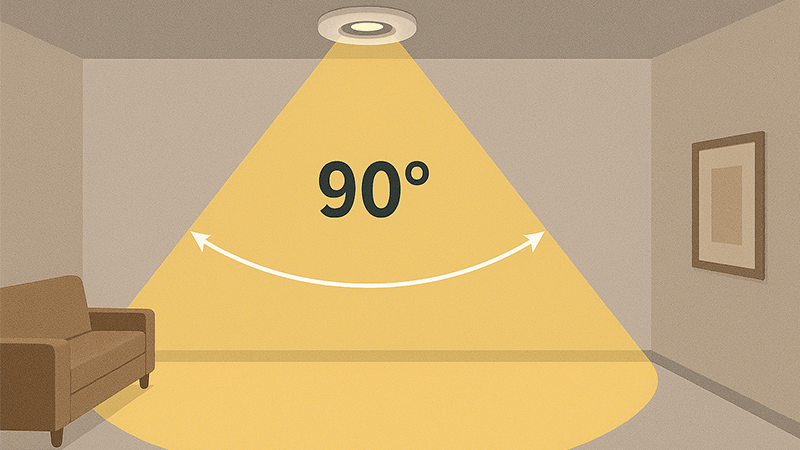
A 90-degree beam angle is a workhorse for general lighting. Think of it as painting a room with a very broad brush. Its purpose is to wash a large area with a uniform layer of light, minimizing shadows and creating a bright, open feel. I often recommend this for residential living rooms, open-concept offices, and retail showrooms where you want customers to see everything clearly. However, its strength is also its weakness. Because the light is spread so wide, the intensity at any single point is lower compared to a narrower beam with the same wattage. This is a common point of confusion. A client might complain that their 10W, 90-degree downlight seems dimmer than their old 7W spotlight. They are not wrong. The total light output might be higher, but it’s distributed over a much larger surface. That’s why it’s a poor choice for task lighting or highlighting features. You would never use a paint roller for fine details, and you shouldn’t use a 90-degree beam to light a kitchen counter.
Where to Use a 90-Degree Beam
This angle excels in specific situations. Here’s a breakdown of its best applications:
| Application |
Why it Works |
Example Space |
| Low Ceilings |
Spreads light out quickly, preventing a "cave" effect and making the room feel bigger. |
Basements, older homes |
| General Illumination |
Provides maximum coverage with fewer fixtures, creating even, shadow-free light. |
Open-plan offices, retail |
| Wall Washing |
When placed close to a wall, it can create a soft, uniform wash of light down the surface. |
Hallways, feature walls |
When to Avoid a 90-Degree Beam
It’s just as important to know when not to use it:
- High Ceilings: The light will spread out too much before it reaches the floor, resulting in a dim, inefficiently lit space.
- Task Areas: It lacks the focused intensity needed for tasks like reading, cooking, or detailed work.
- Accent Lighting: It cannot create the contrast or "punch" needed to highlight artwork or architectural details effectively.
A 25-degree beam angle sounds very specific. What kind of lighting effect does it create? Think of it as a precision tool, designed to draw attention and create visual interest.
A 25-degree beam angle produces a focused, narrow cone of light. It’s considered a spot or narrow floodlight, perfect for accent lighting. It creates high contrast, making it ideal for highlighting artwork, architectural details, or retail merchandise from a moderate distance.
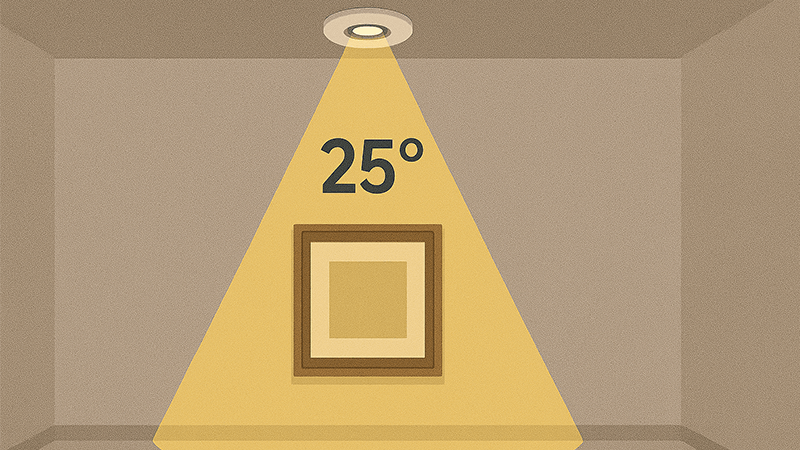
In my experience, the 25-degree beam angle is where lighting design truly comes to life. While wider angles provide the foundation of light in a room, these narrower beams create the highlights and focal points. They add layers and depth. I remember working on a high-end retail project where the client wanted the products to "pop." We used general lighting with a 60-degree beam for the aisles, but over each key display, we installed adjustable downlights with a 25-degree beam. The effect was immediate. The focused light made the colors of the products look richer and drew the customers’ eyes exactly where we wanted them. This is what I mean when I talk about light having a dialogue with the space. The 25-degree beam is not just illuminating an object; it’s saying, "Look at this. This is important." It turns passive viewing into an active experience by guiding the viewer’s attention.
Creating Drama with a 25-Degree Beam
This beam angle is all about control and contrast. It’s a designer’s favorite for several reasons.
- Highlighting Objects: It is the perfect tool for putting a spotlight on a sculpture, a vase of flowers on a table, or a specific product on a shelf. The tight beam ensures that only the intended object is lit, separating it from its background.
- Architectural Grazing: When aimed at a textured surface like a stone or brick wall, a 25-degree beam placed close to the surface creates dramatic shadows that reveal and emphasize the texture. This technique is called "grazing."
Key Considerations for a 25-Degree Beam
To use it effectively, you need to consider spacing and aiming.
| Factor |
Consideration |
| Spacing |
Placing these fixtures too close together can create overlapping hot spots. They should be spaced based on the size of the objects they are highlighting. |
| Aiming |
Since the beam is so focused, precise aiming is critical. Adjustable or "gimbal" downlights are almost always necessary for this application. |
| Height |
From a standard 8-10 foot ceiling, a 25-degree beam will create a light pool of about 3-4 feet in diameter on the floor, perfect for focusing on a small area. |
Choosing a 25-degree beam is a deliberate design choice. It’s a statement that you’re moving beyond simple illumination and into the realm of creating atmosphere and guiding attention.
Conclusion
Understanding beam angle transforms lighting from a simple utility into a powerful design tool. Choose the right angle to create the perfect mood, function, and focus for any space.