Struggling with downlight placement feels confusing. Wrong spacing creates dark spots or blinding glare. But there’s a simple rule to help you start getting it right every time.
The general rule for downlights is to space them about 1.5 times your ceiling height. For an 8-foot (2.4m) ceiling, this means spacing them about 12 feet (3.6m) apart. However, many designers prefer closer spacing for a more uniform and balanced light.

That rule is a good starting point. But it’s just the beginning. Real-world projects need more detail. Factors like room function, beam angle, and lumen output change everything. I’ve learned from countless projects that you need to consider more than just one simple rule. Let’s explore these details so you can plan your lighting like a true professional.
How do you calculate the number of downlights required?
Guessing how many downlights you need is risky. Too few leave rooms dim, and too many waste energy and money. Thankfully, a simple formula can give you a precise number to work with.
Calculate the room’s area (length x width). Then, multiply this by the required lux level for the room type. Finally, divide this total by the lumen output of a single downlight. This gives you the number of downlights needed for proper illumination.
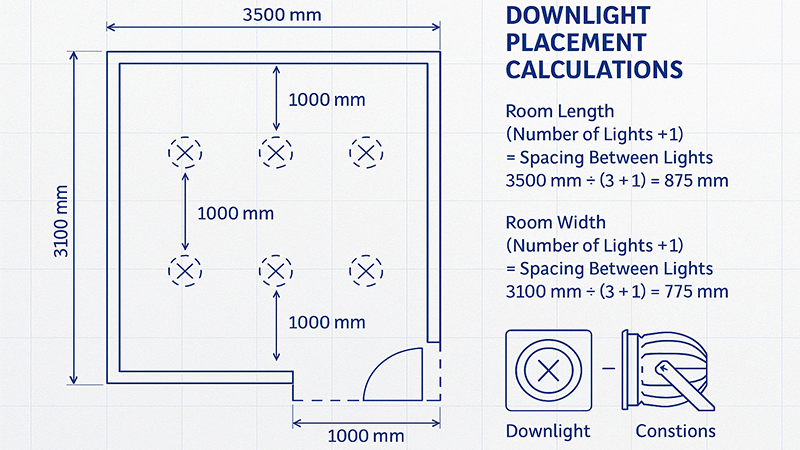
A Step-by-Step Calculation Guide
Over my years in manufacturing, I’ve helped clients like Shaz plan large-scale projects. We always start with a solid calculation to avoid costly mistakes. The formula is your best friend here. It ensures you order the right quantity and achieve the desired lighting effect from the start. Let’s break it down into simple steps that I use every day.
The basic formula is:
Number of Downlights = (Room Area [m²] x Required Lux Level) / Lumens per Fixture
- Measure Your Room: First, get the length and width of your room in meters. Multiply them together to find the area in square meters (m²). For a room that is 5 meters long and 4 meters wide, the area is 20 m².
- Determine Required Lux: Lux is a measure of how much light falls on a surface. Different rooms need different amounts of light. A kitchen workspace needs to be much brighter than a living room. I always refer to a standard chart with my clients.
- Check Your Downlight’s Lumens: Every downlight has a lumen (lm) rating, which tells you how much light it produces. You can find this on the product’s specification sheet. A typical 8W downlight might produce around 700 lumens.
Lux Level Recommendations
Choosing the right lux level is critical. Using the wrong level can make a space feel uncomfortable or unproductive. Here is a table I provide to my partners to guide their decisions. It’s a great starting point for almost any indoor project.
| Room Type |
Recommended Lux (lumens/m²) |
My Notes on Application |
| Living Room (General) |
100 – 200 lux |
Use dimmers to adjust for mood. |
| Kitchen (Task Areas) |
300 – 500 lux |
Focus light over counters and sinks. |
| Bedroom (General) |
100 – 150 lux |
Softer, warmer light is best. |
| Bathroom (Vanity) |
300 – 500 lux |
Essential for grooming tasks. |
| Office / Study |
300 – 500 lux |
Promotes focus and reduces eye strain. |
| Hallway / Corridor |
100 lux |
Just enough for safe navigation. |
Let’s say we are lighting that 20 m² office. We need 400 lux. (20 m² x 400 lux) = 8,000 total lumens needed. If each downlight provides 700 lumens, then 8,000 / 700 ≈ 11.4. You would round up to 12 downlights to ensure the space is bright enough.
Where should downlights be placed?
You have the right number of lights, but where do they go? Placing them incorrectly can create harsh shadows or an uncomfortable glare. Proper placement is key to a professional lighting design.
Place downlights to create even layers of light, focusing on task areas and avoiding shadows on walls. A good starting point is to position the first row of lights about 2-3 feet (60-90cm) away from the walls. This prevents casting scallops and shadows on vertical surfaces.
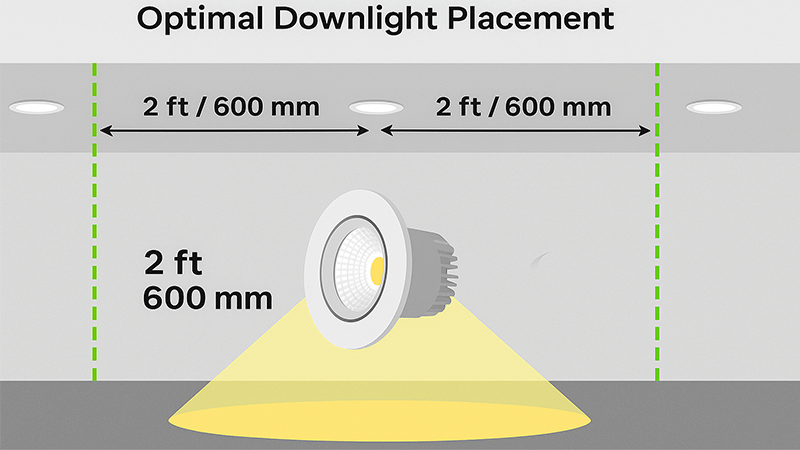
Creating a Balanced Lighting Layout
In my factory, we don’t just make lights; we think about how they will be used. A common mistake I see is placing downlights in a simple grid in the middle of the room. This often lights the floor perfectly but leaves the walls and corners dark, making the room feel smaller. You need to think in terms of lighting "layers."
My approach involves three key considerations:
-
Wall Distance: I always advise my clients to start by defining the perimeter. Keep the first line of downlights about 60cm to 90cm away from the walls. This distance is crucial. Too close, and you create an ugly "scalloping" effect on the wall. Too far, and the edges of your room will be dark. This 60-90cm zone lights the walls gently, making the room feel larger and more inviting. It also provides a good base for accent lighting if you want to highlight artwork.
-
Task Lighting: Where do you perform activities in the room? In a kitchen, you need bright, focused light directly over the countertops, the island, and the sink. In a living room, place lights over seating areas or a coffee table. I always ask, "What will you be doing here?" before suggesting a layout. Don’t just light the floor; light the activity.
-
Beam Angle Impact: The beam angle of your downlight determines how wide the cone of light is. A narrow beam (25°) is great for accenting a feature, while a wide beam (60° or more) is better for general ambient light. If you use a wide beam angle, you can space the lights further apart. For narrower beams, you’ll need to place them closer together to get overlapping pools of light and avoid dark spots. I recently helped a client in the UAE who was lighting a hotel lobby. We used wide-angle downlights for general illumination and narrow-beam ones to pinpoint architectural details. The combination created a dynamic and luxurious feel.
You know where to start from the wall, but what about the gap between each light? This spacing is critical for an even, balanced look. Getting it wrong leads to bright hot spots and dark patches.
A common rule of thumb is to space downlights between 3 to 5 feet (1 to 1.5 meters) apart. The exact distance depends on ceiling height and the light’s beam angle. For taller ceilings or wider beam angles, you can increase the spacing.

Fine-Tuning the Spacing
The simple rule of spacing lights at 1.5 times the ceiling height is a decent start, but it often results in spacing that is too wide for modern tastes. In my experience, most professional lighting plans for residential and commercial spaces use much tighter spacing to achieve a seamless blanket of light.
I teach my partners to think about two key factors to refine the spacing: ceiling height and beam angle.
Spacing Based on Ceiling Height
Taller ceilings allow light to spread out more before it reaches the floor. This means you can have a wider gap between your fixtures. For shorter ceilings, the light has less distance to travel, so you need to place the downlights closer together to ensure the cones of light overlap properly. I use this table as a practical reference:
| Ceiling Height |
Recommended Spacing |
Why It Works |
| 8 ft (2.4m) |
3 – 4 ft (0.9m – 1.2m) |
Prevents dark spots in standard rooms. |
| 9 ft (2.7m) |
4 – 5 ft (1.2m – 1.5m) |
Balances coverage and fixture count. |
| 10 ft (3.0m) |
5 – 6 ft (1.5m – 1.8m) |
Allows for wider spread from a higher point. |
| 12 ft+ (3.6m+) |
6 – 8 ft (1.8m – 2.4m) |
Requires high-lumen lights to be effective. |
The Importance of Beam Angle
The beam angle is just as important as ceiling height. A downlight doesn’t shine straight down in a column; it projects a cone of light. A wider beam angle means a wider cone. When I work with a designer like Shaz, we always look at the spec sheet. If he chooses a downlight with a 60° beam angle, we know we can space them further apart than if he chose one with a 38° beam. For a standard 8-foot ceiling, a 60° beam light might be spaced 4 feet apart, while a 38° beam light would need to be closer, maybe 3 feet apart, to get the same smooth coverage. This technical detail is what separates a good lighting job from a great one.
How many downlights for a 3×3 room?
Planning for a small room seems easy, but it has its own challenges. A 3×3 meter room is a common size for a study, small bedroom, or large bathroom. Getting the lighting right is essential to make it feel functional and not cramped.
For a 3×3 meter (10×10 ft) room, four downlights are typically sufficient for general lighting. Placing them in a square pattern, about 1 meter in from each wall, creates balanced, even coverage without being overwhelmingly bright or leaving dark corners.

Planning for a Small 3x3m Space
When I get an inquiry for a small room, my first thought isn’t just about the number of lights, but their purpose. A 3×3 meter room can serve many functions, and each requires a different approach. I’ve designed lighting for countless spaces of this size, and the layout is just as important as the quantity.
The "Rule of Four" Layout
For general ambient lighting in a 3x3m room with a standard 2.4m ceiling, the "Rule of Four" is my go-to recommendation. Here is how I would map it out for a client:
- Imagine a Grid: Mentally divide the ceiling into four equal quadrants.
- Center Each Light: Place one downlight in the center of each quadrant.
- Check the Spacing: This naturally places the lights about 1 meter from each wall and about 2 meters apart from each other. This layout is incredibly effective. It pushes light to the corners, making the room feel bigger, and provides excellent general illumination across the entire space. You avoid the "runway" look of a single line of lights and the central "hot spot" from just one fixture.
Adapting the Layout for Room Function
However, four lights aren’t always the answer. The room’s function is the most important factor.
- For a Study: I would still start with four downlights for ambient light. But I would strongly recommend adding a dedicated task light, like a pendant over the desk or an adjustable wall lamp. You cannot rely on overhead downlights for reading and computer work, as they can create shadows.
- For a Walk-in Closet: Here, the goal is to illuminate clothes on shelves. I would place two or three downlights in a line, positioned about 50-60cm from the closet wall. This directs the light onto the clothes, not the floor in the middle.
- For a Bathroom: A 3x3m bathroom needs layers. The "Rule of Four" works for general light. But you absolutely need task lighting at the vanity. I suggest two wall sconces on either side of the mirror or a dedicated light bar above it to eliminate face shadows.
One client wanted to light a 3x3m home art studio. We used four adjustable "gimbal" downlights in the standard square pattern. This gave him the flexibility to aim the light directly onto his easel or workspace, combining ambient and task lighting with the same fixtures.
Conclusion
Following basic rules for spacing and calculation is a great start. But achieving perfect lighting means adapting those rules to the specific room, its function, and the hardware you choose.