Choosing the right floodlight wattage feels complicated. A wrong choice leads to wasted energy or poor lighting. Let me show you how to look beyond just watts for the perfect fit.
The wattage you need depends on your goal, not a single number. Focus on lumens (brightness), efficacy (efficiency), and beam angle. For a small yard, 30-50W is often enough, while a large parking lot might need 150-300W lights properly spaced out.

Focusing only on wattage is a common mistake I’ve seen in my years in the lighting industry. It’s an old habit from the days of incandescent bulbs. With modern LEDs, the story is much different. Let’s break down what really matters so you can make a choice you won’t regret. It’s about getting the right amount of light exactly where you need it.
How bright of a flood light do I need?
You know you need a "bright" light, but that term is subjective. Guessing on brightness can lead to harsh, uncomfortable glare or unsafe, dark spots in critical areas.
Brightness is measured in lumens, not watts. For basic security, aim for 700-1500 lumens. For larger spaces like driveways or backyards, 2000-5000 lumens is a good range. High-intensity commercial applications can require 10,000 lumens or even more per fixture.
When I started in this business, the first thing I learned was to stop thinking in watts and start thinking in lumens. Watts tell you how much energy a light consumes. Lumens tell you how much light it actually produces. The goal is always to get the most lumens for the fewest watts. This measure is called luminous efficacy, or lumens per watt (lm/W). A high-quality LED floodlight today should offer at least 130 lm/W. An older or lower-quality model might only be 80 lm/W. This means a 100W high-efficacy light can be much brighter than a 150W low-efficacy light. That’s a huge difference in both light output and your electricity bill.
Matching Lumens to Your Application
The right brightness level, or lux level, depends entirely on the task and the area. You don’t need the same amount of light on a garden path as you do in a commercial loading bay. To help you visualize, I’ve created this simple guide based on projects we’ve supplied for clients like Shaz.
| Application Area |
Recommended Lumens per Fixture |
Why it works |
| Residential Walkway |
700 – 1,300 lm |
Provides safe navigation without creating harsh glare for neighbors. |
| Two-Car Driveway |
1,500 – 3,000 lm |
Ensures good visibility for parking and security around the home’s entrance. |
| Medium Backyard |
3,000 – 6,000 lm |
Illuminates a functional area for activities or general security. |
| Commercial Building Facade |
5,000 – 15,000 lm |
Highlights architectural features and enhances brand presence and security. |
| Small Parking Lot |
15,000 – 30,000+ lm |
Ensures safety and visibility for vehicles and pedestrians across the area. |
Don’t Forget Light Quality
Brightness isn’t just about quantity. The quality of light matters. Two factors to consider are Color Temperature (CCT), measured in Kelvin (K), and Color Rendering Index (CRI). A 5000K light will appear as a crisp, neutral white, which many people perceive as "brighter" than a 3000K warm white light, even at the same lumen output. For security, a higher CCT (4000K-5700K) is often preferred because it improves visibility on camera systems. A high CRI (80+) ensures that colors look natural, which is important for retail spaces or areas where accurate color perception is needed. At my factory, we test every batch to ensure the lumens, CCT, and CRI match the specifications exactly.
How much area does a 100 watt LED flood light cover?
You bought a 100W floodlight, but you have no idea what its reach is. You might install it only to discover it creates one bright hotspot and leaves the corners in total darkness.
A 100W LED floodlight’s coverage depends heavily on its beam angle and mounting height. Mounted at 15-20 feet with a wide 120° beam angle, a quality 100W fixture (around 13,000 lumens) can effectively light an area of about 1,600 square feet for general purposes.
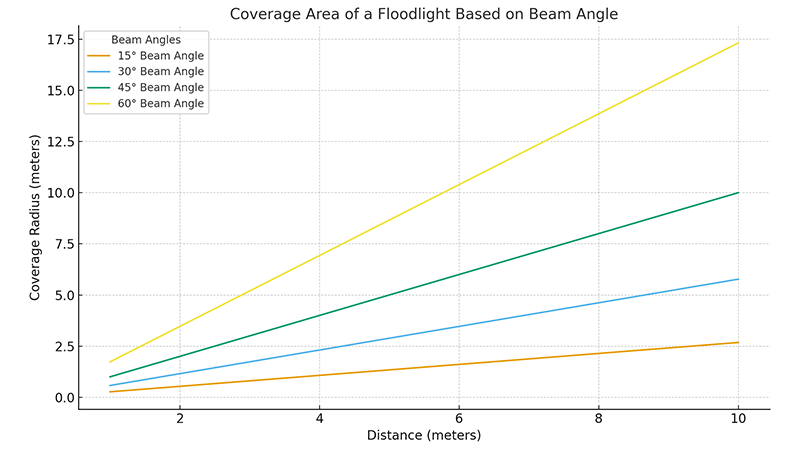
In my experience, beam angle is one of the most overlooked specifications, yet it’s critical for effective coverage. A floodlight doesn’t just shoot light out in one direction. It distributes it in a specific pattern, defined by the beam angle. Think of it like the nozzle on a hose. A narrow setting shoots a powerful stream a long distance, while a wide setting covers a large area up close. The same principle applies to light. The optics, or the lens on the LED fixture, shape the light to achieve a certain beam angle.
Beam Angle and Mounting Height are Partners
The relationship between beam angle and mounting height determines the final lit area. You can’t consider one without the other. Let’s say you have a high-quality 100W LED floodlight that produces 14,000 lumens. Here’s how its coverage changes:
| Mounting Height |
Beam Angle |
Resulting Coverage Area (Approx.) |
Best Use Case |
| 15 feet (4.5m) |
120° |
1,800 sq ft (167 m²) |
Wide area lighting like a backyard or small lot. |
| 15 feet (4.5m) |
60° |
450 sq ft (42 m²) |
Focused lighting for a sign or building feature. |
| 30 feet (9m) |
120° |
3,500 sq ft (325 m²) |
Very wide, but less intense light. Good for ambient security. |
| 30 feet (9m) |
60° |
1,600 sq ft (148 m²) |
Strong, concentrated light from a higher pole. |
As you can see, a wider beam angle spreads the light over a larger area, but the intensity (lux) on the ground will be lower. A narrower beam concentrates the same amount of light into a smaller area, making it much brighter. When clients ask for a specific wattage, my first questions are always, "How high will you mount it, and what are you trying to light up?" This helps us recommend the right optics for the job.
The Role of Light Distribution Patterns
For more advanced projects, like parking lots or streets, we go beyond simple beam angles and look at distribution types (e.g., Type III, Type IV, Type V). These define how light is cast forward, backward, and to the sides. A Type IV forward-throw distribution is perfect for pushing light out from the perimeter of a property, while a Type V symmetrical distribution is ideal for the center of a lot. Choosing the right distribution prevents wasted light, reduces glare, and ensures uniform coverage.
Does wattage matter for flood lights?
With all this talk about lumens and beam angles, it’s easy to wonder if wattage matters at all. You might buy a low-wattage light that isn’t bright enough, wasting your installation investment.
Yes, wattage still matters, but as an indicator of energy consumption and potential brightness, not as the primary measure of light output. It helps you estimate electricity costs and ensure your electrical circuit can handle the load. Always prioritize lumens first, then check the wattage for efficiency.

Wattage is a simple, familiar number, and that’s why people gravitate toward it. For decades, a 100W incandescent bulb meant a specific, predictable amount of light. That direct link is broken with LEDs because efficiency varies so widely between products. However, wattage remains a crucial part of the equation for two very practical reasons: calculating operational cost and planning your electrical system.
Wattage as a Guide to Efficiency and Cost
When I’m helping a purchasing manager like Shaz evaluate suppliers, we always look at the lumens per watt (lm/W). This is where wattage becomes a hero. Let’s compare two 15,000-lumen floodlights for a project.
- Fixture A: 150 Watts. Efficacy = 100 lm/W.
- Fixture B: 100 Watts. Efficacy = 150 lm/W.
Both fixtures deliver the same amount of light, but Fixture B uses 33% less energy. For a project with 50 floodlights running 12 hours a night, Fixture B would save thousands of dollars in electricity costs over its lifetime. The initial price might be slightly higher, but the total cost of ownership is much lower. Wattage is essential for calculating this long-term value. Without it, you’re just guessing.
Wattage for Electrical Planning
The second critical role of wattage is for the electricians. Every circuit has a maximum load it can handle. When planning an installation, you need to add up the total wattage of all fixtures on a single circuit to ensure you don’t overload it.
Imagine you’re replacing old 400W metal halide fixtures. A common LED replacement might only be 150W. This means you can often put more LED fixtures on the same circuit than before, or you can use the existing circuit with confidence, knowing it’s not under strain. Forgetting to calculate the total wattage can lead to tripped breakers and an unreliable lighting system. So, while you should choose your light based on lumens and optics, you must install it based on wattage and voltage. It’s a fundamental safety and performance check that cannot be skipped.
How far will 2000 lumens shine?
You’re looking at a 2000-lumen floodlight, a common size for home use. You wonder if it will be strong enough to light up the far end of your driveway or backyard.
The distance 2000 lumens will shine depends entirely on the light’s beam angle. A narrow beam (30°) could project a useful spot of light over 50 feet away, while a wide beam (120°) will diffuse that same light, effectively covering an area about 20-25 feet out.
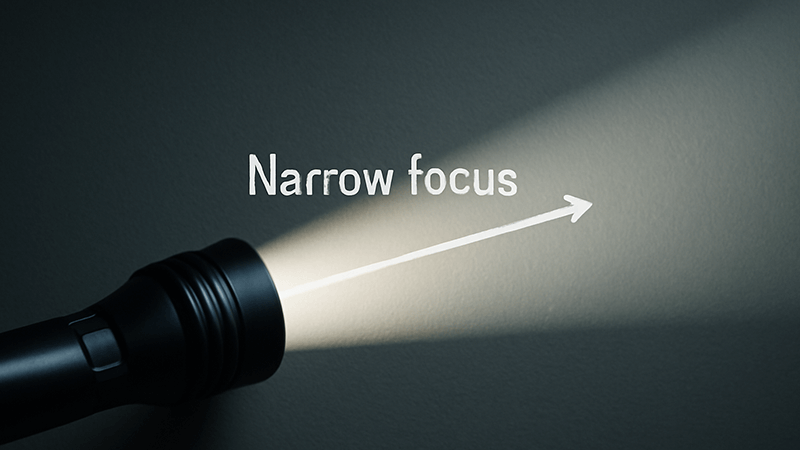
This is a question I get all the time, and the answer always comes back to the optics. Lumens represent the total amount of light coming out of the fixture. The lens is what focuses that light and tells it where to go. A narrower beam angle concentrates all 2000 lumens into a smaller, more intense area, pushing the light further. A wider beam angle spreads those same 2000 lumens over a much larger, closer area. The light doesn’t get "weaker"; it just gets distributed differently.
Understanding Usable Light at a Distance
It’s one thing for light to reach a surface, but it’s another for it to be bright enough to be useful. We measure this "useful" light in foot-candles or lux. For a residential pathway, you might want at least 1-2 foot-candles to see clearly and feel safe. Let’s see how our 2000-lumen floodlight performs when mounted at a height of 10 feet.
| Beam Angle |
Effective Reach (for 1-2 foot-candles) |
Light Pattern on the Ground |
Ideal Scenario |
| 30° (Narrow Spot) |
50-60 feet (15-18m) |
A bright, concentrated circle. |
Highlighting a flagpole, a distant tree, or a specific architectural feature. |
| 60° (Flood) |
30-40 feet (9-12m) |
A balanced, medium-sized oval of light. |
Lighting a driveway, a patio, or the side of a house. |
| 120° (Wide Flood) |
20-25 feet (6-7.5m) |
A very large, soft area of light. |
General area lighting for a small yard where distance isn’t the primary goal. |
The Inverse Square Law in Simple Terms
There’s a law of physics at play here called the Inverse Square Law. It sounds complex, but the idea is simple: as you move away from a light source, the light intensity drops off very quickly. If you double the distance, the light intensity becomes four times weaker. This is why a narrow beam is so effective for long-distance applications. It overcomes the inverse square law by packing the lumens tightly, ensuring that even far away, there’s enough light concentration to be useful. For every project, we consider this law to ensure the fixture we provide isn’t just a light, but the right light for the required distance and task.
Conclusion
Choosing the right LED floodlight is not about a single wattage number. To make the best choice, you must consider lumens, efficiency, beam angle, and where you’ll use it.