Worried about fire safety? A small hole in your ceiling for a light can become a chimney for flames, spreading a fire in minutes. Fire-rated downlights seal that gap.
You should use fire-rated downlights in any ceiling that acts as a fire barrier, especially in multi-story buildings between floors. They are crucial for maintaining the ceiling’s integrity and slowing the spread of fire, giving occupants vital time to escape. It’s about building safety, not just lighting.
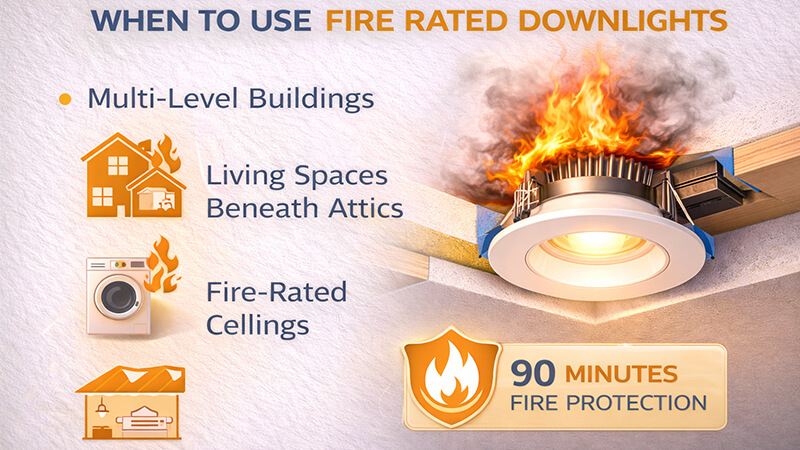
It’s a question I get a lot from experienced buyers. They understand lighting quality, but fire ratings can seem like an extra cost. The truth is, it’s not about the light itself failing; it’s about protecting the entire building from a fire that starts elsewhere. So, how do you know you’re making the right choice? Let’s break down what really matters.
How do you choose the right fire-rated downlights?
Picking a fire-rated downlight feels complex. With so many ratings and specs, how do you know you’re truly protected? Follow a simple checklist to ensure compliance and genuine safety.
To choose fire-rated downlights, check for the fire rating duration (e.g., 30, 60, 90 minutes) that matches your building’s requirements. Ensure it’s certified by a recognized body (like CE, BS). Also, consider the IP rating for moisture protection and compatibility with your ceiling void depth.
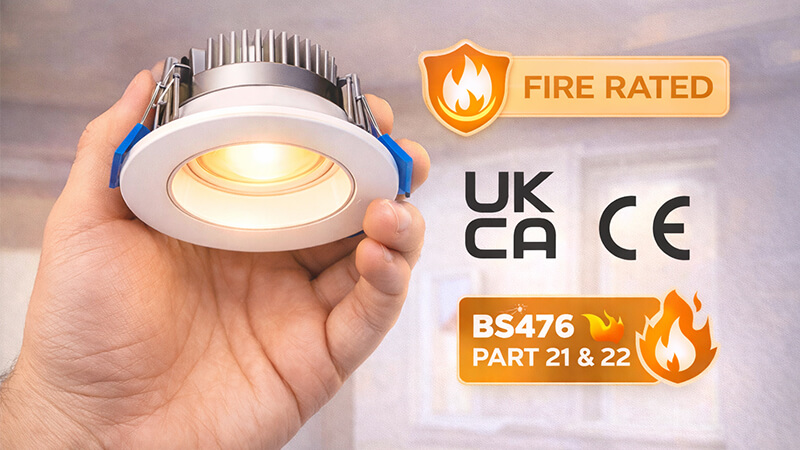
Choosing the right product is more than just ticking a box. I remember a client, a sharp purchasing manager from the UAE much like Shaz, who was about to place a large order. He focused only on the "90-minute" rating but missed the certification part. We paused the order, and I walked him through why a third-party certification is non-negotiable. It’s the only real proof that the product has been independently tested and will perform as promised in a real fire. It’s about trust and verified safety.
Understanding Fire Ratings and Certifications
The fire rating, measured in minutes (30, 60, 90, or 120), tells you how long the downlight will maintain the ceiling’s integrity during a fire. A 30-minute rating is often sufficient for a standard two-story house, while 60 or 90 minutes are typically required for apartments and commercial buildings. The key is to match or exceed the rating of the ceiling itself. Look for certifications like the British Standard BS 476-21. This isn’t just a label; it’s a guarantee that the product has been subjected to intense fire testing in a lab. Without it, you are just hoping it works.
Key Technical Specifications to Check
Beyond the fire rating, you need to consider the practical aspects of the light. I’ve created a simple table to help clients organize their selection process. This ensures nothing gets missed.
| Feature |
What to Look For |
Why It’s Important |
| Fire Rating (Minutes) |
30, 60, 90 minutes |
Must match or exceed the ceiling’s fire resistance requirement. |
| Certification |
BS 476-21, EN 1365-2 |
Independent proof that the product works under fire conditions. |
| IP Rating |
IP20 (Standard), IP65 (Bathrooms/Wet areas) |
Protects against dust and water, ensuring longevity and electrical safety. |
| Intumescent Seal |
High-quality, visible material around the body |
This is the active component that expands with heat to seal the hole. |
Material and Build Quality Matter
The part of a fire-rated downlight that does the work is a special material called an intumescent seal. When it gets hot, this material expands dramatically—up to 40 times its original size—to completely seal the hole you cut in the ceiling. This stops flames and smoke from passing through. The body of the downlight, usually made of steel, provides the structural frame. A well-built fixture ensures that even before the intumescent seal fully expands, the fitting itself acts as a barrier. When you hold a quality fire-rated downlight, you can feel the difference in its weight and sturdy construction. It’s built to withstand extreme conditions, not just to look good.
Do all recessed lights need to be fire rated?
It’s tempting to use standard recessed lights everywhere to save costs. But installing them in the wrong place can compromise the entire building’s fire safety. You need to know the rules.
Not all recessed lights need to be fire-rated. They are essential only when installed in a fire-rated ceiling, which typically separates different dwellings or a home from an integrated garage. In a single-story home with a non-rated roof/ceiling assembly, they are not usually required.
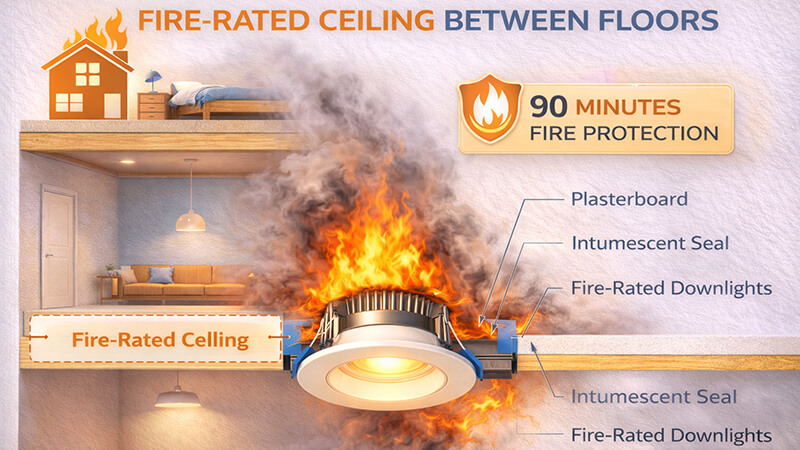
This is one of the most common points of confusion. The requirement isn’t about the light; it’s about the ceiling it’s going into. If the ceiling is just a cosmetic layer under a roof with no living space above, a standard downlight is often fine. But if that ceiling is also someone else’s floor, it has a critical job to do.
What is a Fire-Rated Ceiling?
A fire-rated ceiling is an engineered system. It is not just a single layer of plasterboard. For example, a 60-minute fire-rated ceiling might be constructed from two layers of special fire-resistant plasterboard, fixed to joists with specific types of screws at precise intervals. It is designed to act as a barrier to stop fire from moving from one floor to the next for a set amount of time. This barrier protects the structural integrity of the building and gives people time to escape. When you cut a hole in this system for a light, you create a point of weakness.
The ‘Chimney Effect’ Explained
This is the key concept from my insights. Imagine a fire starts in a kitchen on the ground floor of an apartment building. The one thing protecting the residents on the first floor is the fire-rated ceiling. Now, if you have cut ten holes in that ceiling for ten standard, non-fire-rated downlights, you have just created ten chimneys. Heat and smoke will pour through these openings, allowing the fire to spread upwards incredibly fast. A fire-rated downlight is designed to plug that hole when a fire starts. The intumescent material swells and seals the opening, effectively restoring the ceiling’s fire barrier. It stops the chimney effect before it can take hold.
Exceptions and Local Regulations
The rules on where fire-rated downlights are required can vary. Generally, you need them in these situations:
- Between floors in a home that is three or more stories high.
- Between separate apartments in a block of flats.
- In any ceiling that is below a habitable room.
- In a ceiling between a house and an integrated garage.
However, you should always check the local building codes. As a purchasing manager, you know that regulations in the UAE can differ from those in Europe or Asia. Never assume that a rule is the same everywhere. My advice is always to verify the latest building codes for the specific location of your project. It is the only way to ensure 100% compliance and safety.
But can modern LED lights overheat and catch fire anyway?
We hear about electronics catching fire, making us wary of everything we install. But are modern, high-quality LED lights a genuine fire risk? Let’s separate fact from fiction.
It is extremely rare for a high-quality LED downlight to overheat and cause a fire. LEDs run much cooler than old halogen bulbs. Fires are more likely caused by faulty wiring, improper installation, or covering the fixture with insulation, which traps heat. The product itself is very safe.
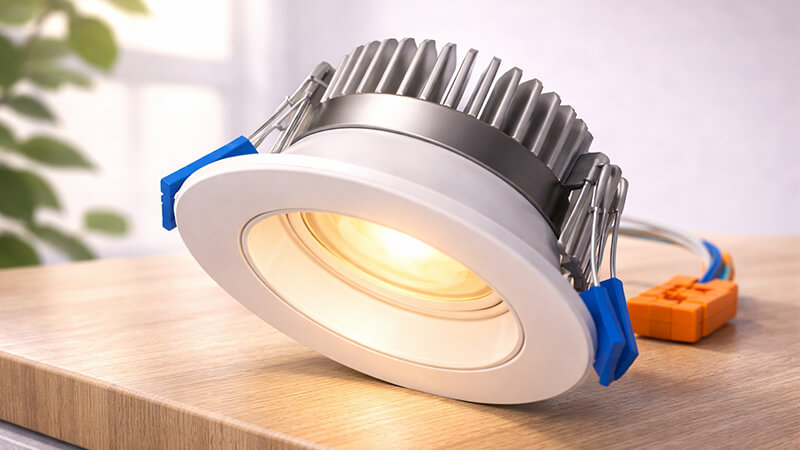
The shift from halogen to LED technology has been a huge leap forward for fire safety. The old halogen bulbs were essentially small heaters that also produced light; they could easily reach temperatures hot enough to ignite surrounding materials. LEDs are completely different.
Why LEDs Run Cooler
The science is simple. LEDs are highly efficient, converting most of their electrical energy directly into light. Very little is wasted as heat. A typical 50W halogen bulb could reach surface temperatures of over 200°C. In contrast, a comparable LED downlight fixture rarely exceeds 60-80°C, a temperature that is not a fire hazard. Any heat that is generated is managed by a heat sink, a component designed specifically to draw heat away from the LED chip and driver. A larger, well-designed heat sink is a key sign of a quality LED product.
The Real Culprits: Installation and Wiring
When fires related to lighting do occur today, the cause is almost always external to the LED product itself. The real risks lie in poor installation practices.
| Mythical Cause |
Real-World Cause |
How to Prevent It |
| The LED bulb spontaneously ignites. |
Faulty wiring or a loose electrical connection. |
Always hire a qualified electrician for installation. |
| The LED fixture overheats on its own. |
Covering a non-IC rated fixture with insulation. |
Use IC-rated (Insulation Contact) lights or keep insulation clear. |
| A cheap LED product causes a fire. |
Failure of a low-quality, uncertified driver. |
Purchase complete lighting solutions from reputable suppliers. |
Using the wrong gauge of wire, creating loose connections that can arc, or, most commonly, smothering a downlight with ceiling insulation are the true dangers. Insulation stops the heat sink from doing its job, causing heat to build up, which can damage the driver and create a hazard.
The Importance of Quality Components
This is where my manufacturing experience becomes so important. I have seen what separates a good LED product from a bad one. It’s not just about the LED chip. It’s about the entire system: the driver, the heat sink, and the internal wiring. The driver, which converts AC power to the low-voltage DC that LEDs use, is often the first component to fail in a cheap product. A low-quality, uncertified driver is the biggest risk. At iPHD, we design and test the entire system to work together reliably and safely. This is why we tell our partners that choosing a supplier with deep manufacturing knowledge protects them from these hidden risks.
So why is the ceiling itself so important for fire safety?
We think of ceilings as just finishing a room. But in a fire, that simple plasterboard is a critical line ofd defense. Understanding this changes how you see every cutout you make.
Fire-rated ceilings are designed to contain a fire within one compartment or floor for a specific period (e.g., 60 minutes). This compartmentalization slows the spread of fire and smoke, protects structural elements from collapse, and provides crucial time for people to evacuate the building safely.
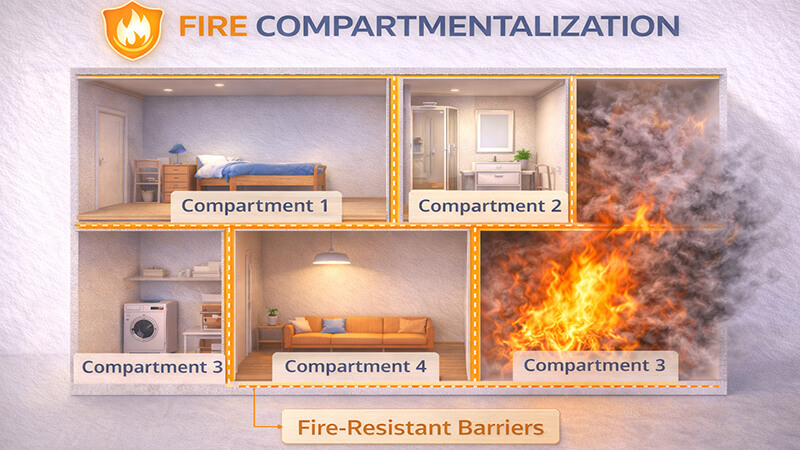
This brings us back to the core idea. The fire-rated downlight is part of a larger safety system. To understand its value, you must first appreciate the job the ceiling is doing.
The Principle of Compartmentation
Think of a large ship. If it gets a hole in its hull, watertight doors automatically close to contain the flooding to one section, preventing the whole ship from sinking. Fire-rated walls and ceilings work in the same way for a building. This principle is called "compartmentation." The building is divided into a series of fire-resistant boxes. The goal is to contain a fire within the "box" where it starts. This strategy saves lives by limiting the spread of fire and smoke and giving everyone time to get out. It also protects the building’s structure from collapsing under the heat of a major fire.
How a Ceiling Achieves its Fire Rating
A ceiling’s fire rating is not an accident; it is the result of a carefully designed and tested construction. A 60-minute fire-rated floor/ceiling assembly is much more than a single sheet of plasterboard. It might involve two layers of specific fire-resistant plasterboard, staggered joints, special fixings, and fire-rated sealant. Every single component and the way it is assembled contributes to its ability to hold back a fire for 60 minutes. It is a complete, engineered system.
Protecting the ‘System’ not Just the Product
This is the most important point I want you to take away from this article. When you cut a hole in a fire-rated ceiling for a standard downlight, you have just broken the integrity of that engineered system. You have created a critical weakness. A fire-rated downlight is designed specifically to plug that weakness. Its purpose is to restore the fire barrier. You are not buying it because you think the LED light will catch fire. You are buying it to protect the building from a fire that starts somewhere else—a cooking fire, an electrical fault, or an accident in a neighboring apartment. You are insuring the integrity of the building’s life-safety system. It is a small component that plays a vital role in the big picture of building safety.
Conclusion
In the end, choosing fire-rated downlights isn’t about the light itself. It’s about preserving the fire integrity of your ceiling and buying precious, life-saving time during an emergency.