Are you tired of bulky light fixtures ruining your clean ceiling lines? They create visual clutter and disrupt modern design. Recessed downlights offer a sleek, integrated lighting solution.
Recessed downlights are the best choice for a minimalist and modern aesthetic. They are installed directly into the ceiling, hiding the fixture to create a clean, seamless look. This allows the light itself, not the hardware, to shape the room’s atmosphere and functionality.
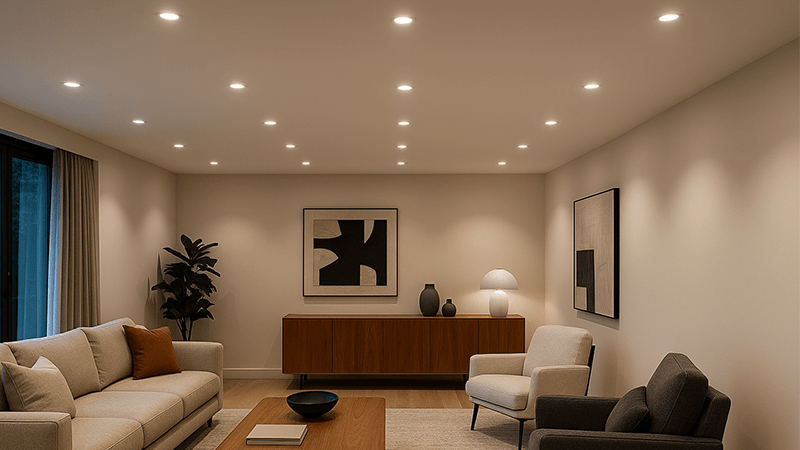
I’ve been in the lighting business for a long time, starting on the factory floor and eventually building my own manufacturing company, iPHD. Throughout my career, I’ve seen lighting trends come and go. But recessed downlights have remained a staple, and for good reason. They are more than just a light source; they represent a modern design philosophy. It’s about hiding the fixture to let the light do the talking. This approach creates a clean, sophisticated, and comfortable environment where the lighting feels natural and integrated. When you "hide" the light source, you unify function and beauty, letting the light truly serve the space and the people in it. Let’s explore why this lighting choice is so powerful for projects you might be sourcing, Shaz.
What are the benefits of recessed lighting?
Does your space suffer from uneven lighting and dark corners? This creates a gloomy and uninviting atmosphere. Recessed lighting provides smooth, layered illumination for a welcoming and functional room.
The main benefits are a clean, minimalist look, saving ceiling space, and providing even ambient light. They can also be used to highlight specific features (accent lighting) and offer incredible versatility through dimmers and smart controls, adapting the room’s mood instantly.

The advantages of recessed lighting go far beyond just looking good. It’s a highly practical solution that solves many common lighting challenges. As a purchasing manager, understanding these benefits helps you source the right products for your clients’ needs. I once worked on a large commercial project for a hotel lobby in the UAE. The designer wanted a grand, open feel but the ceiling height wasn’t exceptionally high. Traditional pendants would have made the space feel cramped. We used a carefully planned layout of recessed downlights to create broad, even illumination. This made the ceiling seem to disappear, making the entire lobby feel more spacious and luxurious. We also used adjustable recessed fixtures to highlight architectural columns and artwork, adding depth and visual interest. The client was thrilled because we achieved a high-end look without compromising on space or function.
Seamless Integration and Space Saving
The most obvious benefit is how these lights integrate into the ceiling. Because the housing is hidden, you only see a clean trim and the light source itself. This is perfect for modern and minimalist designs. It also makes rooms feel larger because there are no fixtures hanging down to break up the visual plane of the ceiling. This is especially useful in rooms with lower ceilings.
Versatile and Layered Lighting
Recessed lights are the foundation of a good layered lighting plan. You can use them for three main purposes:
- Ambient Lighting: General, overall illumination for a room.
- Task Lighting: Focused light for specific activities, like over a kitchen counter.
- Accent Lighting: Directed light to highlight artwork, architectural details, or displays.
Enhanced Aesthetics and Focus
By hiding the fixture, you put the focus on what is being lit, not the light source. This is a sophisticated approach to design. You can use wall-washer recessed lights to create a beautiful scalloped effect on a textured wall or aim gimbal (adjustable) downlights to draw attention to a prized possession. This level of control is hard to achieve with other lighting types.
| Feature |
Recessed Lighting |
Traditional Fixtures (e.g., Pendants, Chandeliers) |
| Aesthetics |
Minimalist, clean, integrated |
Decorative, can be a focal point |
| Space |
Saves ceiling height, makes room feel larger |
Occupies vertical space, can feel cluttered |
| Light Direction |
Directional, precise control |
Often diffused or omnidirectional |
| Versatility |
Excellent for ambient, task, and accent lighting |
Primarily for ambient or decorative light |
What is the rule of thumb for recessed lighting?
Are you trying to plan a recessed lighting layout? It can be confusing, and wrong placement leads to dark spots or uncomfortable glare, ruining the final effect of the room.
A good rule of thumb is to space recessed lights apart by half the ceiling height. For a standard 8-foot (2.4m) ceiling, place lights about 4 feet (1.2m) apart. Also, keep fixtures between 2 to 3 feet (0.6-0.9m) away from walls to prevent harsh shadows.
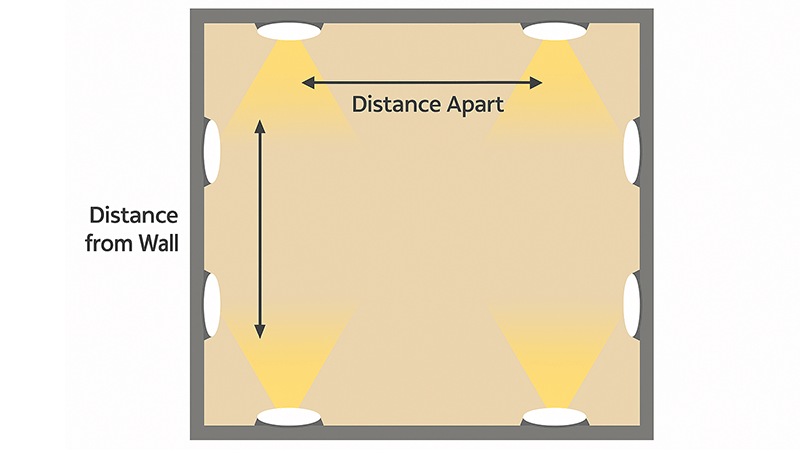
This "rule of thumb" is a fantastic starting point, but it’s not a one-size-fits-all solution. As an experienced buyer, Shaz, you know that details matter. The beam angle of the downlight, the desired brightness (lumens), and the room’s purpose all influence the final layout. I always advise my clients to think about the room’s function first. A kitchen requires brighter, more focused task lighting over workspaces, so you might place lights closer together there. In a living room, you want softer, more flexible ambient light, so wider spacing with dimmers is often better. I recall a project where an contractor installed lights in a perfect grid in a home theater. It looked neat when off, but it created terrible glare on the screen. We had to replace them with a few strategically placed, low-glare downlights at the room’s perimeter. This taught me that the "rule" is a guide, not a command. Always adapt it to the specific application.
Ceiling Height Determines Spacing
This is the core of the rule. Higher ceilings mean the light has further to travel, so it spreads out more. This allows for wider spacing between fixtures. Lower ceilings require tighter spacing to ensure the cones of light overlap and create even coverage without dark spots.
Distance from Walls
Placing lights too close to a wall (less than 2 feet) creates a "hot spot" and harsh shadows, a phenomenon called scalloping. While sometimes used intentionally for effect on a textured wall, it’s usually undesirable for general lighting. A distance of 2.5 to 3 feet is often a sweet spot for washing the wall with a gentle, even light.
Task vs. Ambient Lighting Spacing
The purpose of the light changes the rules. For general ambient lighting, the half-the-ceiling-height rule works well. For task lighting, like over a kitchen island or a reading nook, you need to be more precise. Here, you should position the lights directly above the task area to provide focused, shadow-free illumination, which might mean ignoring the general spacing grid for those specific fixtures.
| Ceiling Height |
General Spacing Between Lights |
Distance From Walls |
| 8 ft (2.4m) |
4 ft (1.2m) |
2-3 ft (0.6-0.9m) |
| 9 ft (2.7m) |
4.5 ft (1.4m) |
2.5-3.5 ft (0.7-1m) |
| 10 ft (3m) |
5 ft (1.5m) |
3-4 ft (0.9-1.2m) |
You hear the terms "downlight" and "recessed downlight" used all the time. This can get confusing and might even lead you to source or specify the wrong product.
Essentially, a "recessed downlight" is a specific type of "downlight." The term "downlight" describes any fixture that casts light downwards. The term "recessed" specifies that the fixture’s housing is installed hidden within the ceiling, wall, or floor.
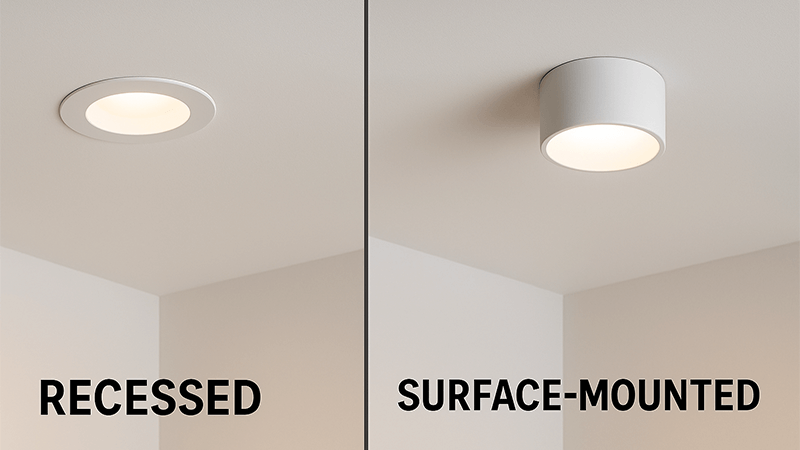
This is a critical distinction that I always clarify with new partners. Thinking all downlights are recessed is a common mistake. I remember a purchasing manager, much like yourself but newer to the industry, who was sourcing for a high-end minimalist office. The spec sheet just said "downlights." He nearly placed a huge order for surface-mounted cylinder downlights because they were slightly cheaper. Luckily, we had a call to review the plans, and I realized the architect’s vision was a completely clean, flat ceiling. We corrected the order to recessed fixtures just in time. That experience taught me to never assume. A "downlight" is a broad category defined by light direction. A "recessed downlight" is a sub-category defined by its installation method. Understanding this difference is key to fulfilling project requirements accurately.
Downlights: The Broader Category
This term is all about function. If a light fixture is mounted on the ceiling and its primary job is to shine light downwards, it’s a downlight. This category is quite large and includes several types of fixtures, each with a different installation style and aesthetic.
Recessed Downlights: A Specific Installation
This is the most popular type of downlight for modern designs. As we’ve discussed, the entire housing is hidden above the ceiling drywall. All you see is the trim (the visible edge) and the inner baffle or lens. This is what creates that seamless, integrated look. They are sometimes called "can lights" or "pot lights" in North America.
Other Types of Downlights
To fully understand the difference, it helps to know the other options:
- Surface-Mounted Downlights: These fixtures are mounted directly onto the surface of the ceiling. They are a great solution for ceilings where you can’t cut holes, like concrete slabs. They often come in cylindrical or square shapes.
- Pendant Downlights: These are downlights that hang from the ceiling on a cord or rod. While many pendants provide ambient light, some are designed specifically to provide a focused pool of light downwards onto a table or counter.
| Fixture Type |
Installation |
Best For |
Aesthetic |
| Recessed Downlight |
Hidden inside the ceiling |
Clean ceilings, layered lighting |
Minimalist, seamless, modern |
| Surface-Mounted Downlight |
Mounted on the ceiling surface |
Concrete ceilings, industrial look |
Bold, visible, architectural |
| Pendant Downlight |
Hung from the ceiling |
Task lighting over tables/islands |
Decorative, statement piece |
Do recessed lights increase home value?
When considering a building upgrade, you want to know if it’s a good investment. Will it just cost money, or will it add real, tangible value to the property?
Yes, a well-executed recessed lighting system can definitely increase home value. It is a premium feature that makes a home feel more modern, spacious, and luxurious. Buyers often associate recessed lighting with a high-end, custom-built home, making it a desirable upgrade.
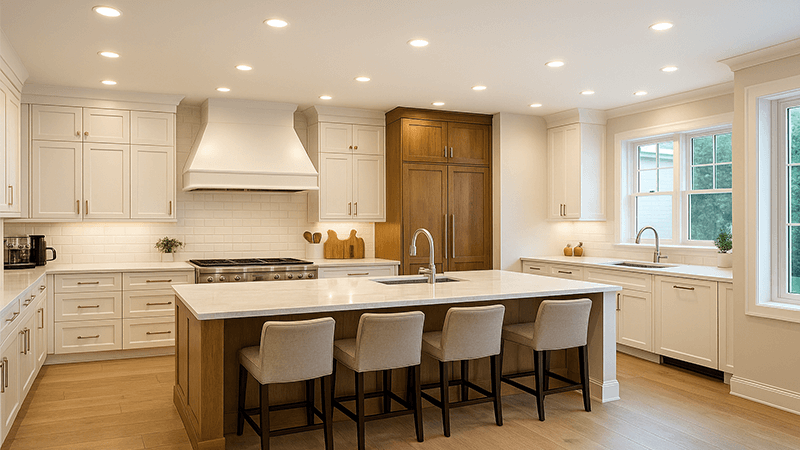
From my experience supplying lighting for countless residential projects, I can tell you that the perceived value is significant. When prospective buyers walk into a home, the lighting is one of the first things they notice, even if only subconsciously. A room lit by a single, harsh ceiling fixture feels dated and small. The same room with a layered lighting plan using recessed lights feels bright, airy, and intentional. It signals that the owner cared about quality and design. I worked with a developer who was building a series of tract homes. Initially, they planned for basic fixtures to save costs. I convinced them to offer a "lighting upgrade package" with LED recessed lights in the main living areas and kitchen. Over 80% of the buyers chose the upgrade. The developer later told me that those homes not only sold faster but were also appraised at a higher value, more than covering the cost of the lighting upgrade.
Modern Appeal Sells
Today’s homebuyer, especially in the premium market, expects modern amenities. Recessed lighting has moved from a luxury item to a standard feature in new, quality construction. Homes without it can feel dated, which can be a major turn-off for potential buyers looking for a move-in-ready property. It immediately updates the look of a room, making it more competitive on the market.
It Highlights the Best Features
Good lighting doesn’t just illuminate a room; it sells it. You can use recessed lights to wash a beautiful stone fireplace with light, highlight the granite countertops in the kitchen, or make a small bathroom feel brighter and cleaner. By controlling where the buyer looks, you are emphasizing the home’s best selling points and adding to its emotional appeal.
Energy Efficiency is a Plus
With the move to LED recessed lights, you can also market the home as being more energy-efficient. Modern LED downlights use a fraction of the energy of old incandescent bulbs and last for years, if not decades. This is a practical benefit that savvy buyers appreciate, as it translates to lower utility bills and less maintenance. For a buyer like Shaz, emphasizing the long-term value and energy savings of quality LED products is a powerful selling point for any project.
| Feature |
Impact on Home Value |
Why It Matters to Buyers |
| Modern Aesthetics |
High |
Makes the home feel new, updated, and high-end. |
| Spacious Feel |
Medium-High |
Bright, evenly lit rooms appear larger and more inviting. |
| Accent & Task Lighting |
Medium |
Highlights valuable features and improves functionality. |
| Energy Efficiency (LED) |
Medium |
Lowers utility bills and maintenance costs (a practical selling point). |
Conclusion
Recessed downlights are a superior choice for creating a modern, clean, and highly functional space. They offer versatility, enhance aesthetics, and can even increase a property’s value when planned correctly.