Worried about your lighting running up the electricity bill? Those old bulbs are not just lights; they are hidden heaters, silently inflating your energy costs and impacting your bottom line.
No, LED downlights use very little electricity. They are incredibly efficient, converting about 95% of energy into light, not heat. This means you get the same brightness as old bulbs for a fraction of the power, leading to significant savings on your energy bills.

Understanding this efficiency is simple on the surface, but the real savings are deeper than you might think. It’s not just about swapping a bulb; it’s about re-engineering your space’s energy consumption. The true impact on your electricity bill comes from both direct and indirect factors. Let’s explore how these savings really add up and what it means for your projects.
Can LED lights run up an electric bill?
You see the low wattage on the box, but still wonder. Can a building full of LED lights still add up to a high electricity bill? The answer might surprise you.
It’s extremely difficult for modern LED lights to run up an electric bill compared to older technologies. An 8-watt LED effectively replaces a 60-watt traditional bulb. This means it provides the same amount of light while using over 85% less energy, making a high bill very unlikely.
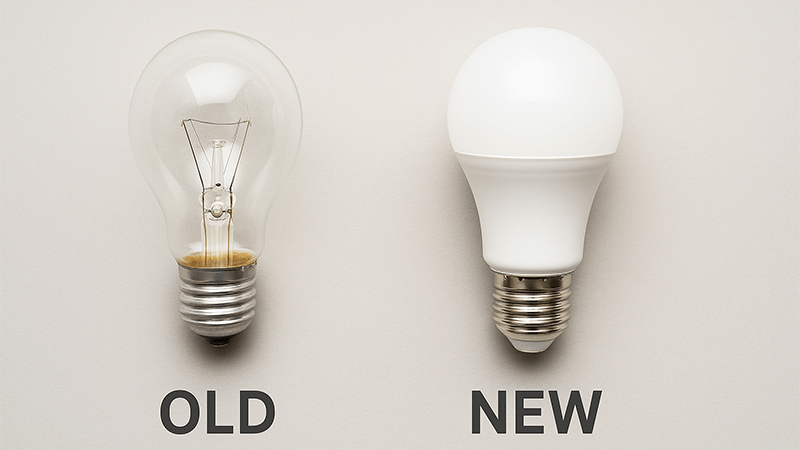
When I started in this industry, we dealt mostly with halogen and incandescent lights. I remember walking into server rooms or large offices and feeling the heat coming off the ceiling. That heat was wasted electricity. Switching to LED is more than just changing a light source; it’s like removing dozens of small, inefficient heaters from a room.
I recall a project for a client’s large conference room. It had 20 halogen downlights, each using 50 watts. That’s 1,000 watts just for lighting. We replaced them with 8-watt LEDs, dropping the total to only 160 watts. That’s an 84% direct energy saving.
But the real story is the indirect savings.
The Hidden Costs of Heat
Old lights waste up to 90% of their energy as infrared heat. This heat forces your air conditioning system to work harder, especially in warmer climates like the UAE.
| Feature |
Halogen Lighting (20 x 50W) |
LED Lighting (20 x 8W) |
| Total Lighting Wattage |
1,000 Watts |
160 Watts |
| Heat Waste (Approx.) |
~900 Watts |
~16 Watts |
| Impact on A/C |
High |
Negligible |
| Associated Cost Savings |
– |
Up to 30% on related A/C costs |
By removing that heat load, the client’s air conditioning didn’t have to fight the lighting anymore. For that conference room project, we calculated that they saved nearly 30% on the portion of their A/C bill related to cooling that space. This is a saving that most people never even consider. So, can LEDs run up a bill? No, they actively work to lower it in more ways than one.
Do LED downlights use much power?
Downlights are a staple in modern design, but you worry about their total power draw. Replacing so many lights feels like a big job with uncertain rewards. But the numbers are clear.
No, LED downlights use very little power. A typical 50-watt halogen downlight can be easily replaced by a 6 to 9-watt LED model. This provides the same, or even better, brightness for about 85% less electricity, making them an incredibly low-power lighting solution.
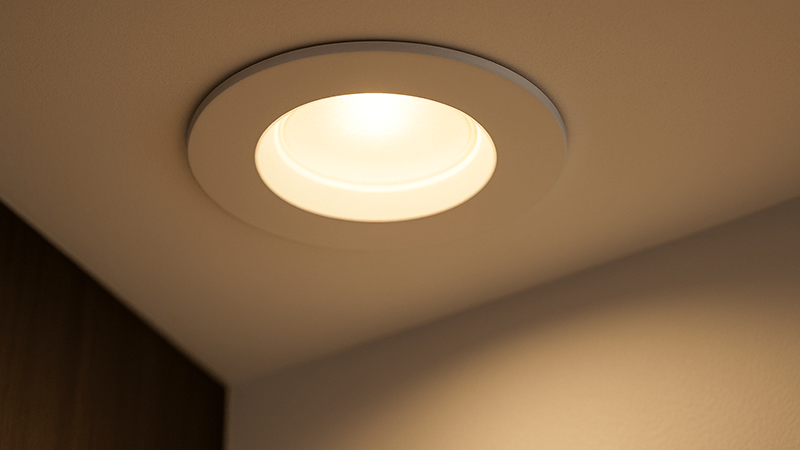
When sourcing products for my partners, the first thing we look at is the lumen-to-watt ratio. This is the measure of efficiency. Old technology was terrible at this. Modern LEDs are masters of it. The core reason lies in how they produce light.
An old incandescent or halogen bulb works by heating a filament until it glows. It’s a brute-force method, and most of the energy is lost as heat. An LED, or Light Emitting Diode, works differently. It uses a semiconductor to convert electricity directly into light. This process is far more elegant and produces very little heat as a byproduct.
The Science of Efficiency
The key takeaway is that with LEDs, nearly all the electricity becomes light. My insight from years of manufacturing is this: about 95% of the electrical energy in a quality LED is converted directly into visible light.
Let’s break down the power usage for a standard residential or commercial space.
| Light Source |
Typical Wattage |
Lifespan (Hours) |
Energy Use for 10,000 hrs (kWh) |
| Halogen Downlight |
50W |
~2,000 |
500 kWh |
| CFL Downlight |
13W |
~8,000 |
130 kWh |
| LED Downlight |
8W |
~25,000+ |
80 kWh |
As you can see, the power consumption of an LED downlight is minimal. Over its lifetime, it uses significantly less energy than any alternative. For a purchasing manager like Shaz, this data is crucial. When you’re outfitting an entire building, multiplying this saving across hundreds or thousands of units results in a massive reduction in operational costs for your client. It’s a powerful selling point that goes far beyond just the initial cost of the fixture.
Is it cheaper to leave an LED light on or turn off?
You’ve heard the old myth that it takes more energy to start a light than to run it. This makes you wonder: should I just leave my LEDs on?
It is always cheaper to turn an LED light off when not in use. Unlike old fluorescent lights, LEDs consume almost no extra energy when starting up. The idea that leaving them on saves money is a myth. Turning them off saves 100% of the energy they would have used.
This is a question I get a lot, and it’s rooted in the era of old fluorescent tube lighting. Those lights did require a high-energy pulse from a ballast to get started. With LEDs, the story is completely different. Their lifespan and efficiency are not negatively impacted by switching them on and off.
The longevity of an LED is determined by the gradual "thermal fatigue" of the chip and driver components, not by the number of times you flip the switch. In fact, turning them off gives them time to cool down, which can even help extend their already long life.
The Impact of Switching and Dimming
High-quality LED drivers, which we focus on at Upward Lighting, incorporate soft-start designs. This means the initial electrical current is managed carefully, creating almost zero stress on the components during startup. So, the idea of a damaging "inrush current" is not a concern for modern, well-made LEDs.
But there’s an even more compelling reason to turn them off or, better yet, dim them. Here’s a key insight from our R&D lab: the power consumption of an LED is not linear when you dim it.
| Dimming Level |
Brightness |
Power Consumption |
| 100% |
100% |
100% (e.g., 8W) |
| 50% |
~50% |
~40% (e.g., ~3.2W) |
| 30% |
~30% |
~20% (e.g., ~1.6W) |
When you dim a modern LED chip to 30% brightness, its power consumption doesn’t just drop to 30%. It drops exponentially, often to around 20% of its maximum draw. So, dimming isn’t just for ambiance; it’s a powerful energy-saving tool. For spaces that don’t always need full brightness, installing dimmers with your LED downlights can unlock even deeper energy savings than just turning them on and off.
Are LED downlights cheaper to run?
You’re weighing the initial investment against long-term costs. Are LED downlights truly the most economical choice once they are installed and running day-to-day? The evidence is overwhelming.
Yes, LED downlights are significantly cheaper to run than any other lighting technology. Their extreme energy efficiency, combined with a lifespan that is 10-25 times longer than old bulbs, results in massive savings on both electricity bills and replacement costs over time.
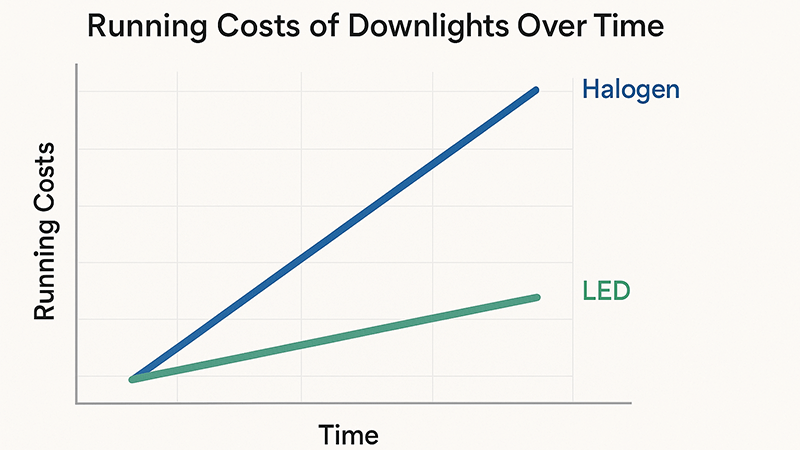
As a manufacturer, I’ve seen the industry evolve. The conversation has shifted from "Can we afford LEDs?" to "How can we afford not to use LEDs?". The Total Cost of Ownership (TCO) is the metric that matters most, and this is where LEDs are unbeatable.
Let’s run the numbers on a single downlight, assuming it’s on for 8 hours a day and electricity costs $0.15 per kWh.
Calculating Total Cost of Ownership
The true cost includes the initial purchase, replacements, and electricity usage over a set period, say, 25,000 hours (the typical lifespan of a quality LED).
| Cost Factor |
50W Halogen |
8W LED |
| Initial Bulb Cost |
$2 |
$5 |
| Lifespan (Hours) |
2,000 |
25,000 |
| Replacements Needed |
12 bulbs (12 x $2 = $24) |
0 bulbs |
| Energy Use (25,000 hrs) |
1250 kWh |
200 kWh |
| Electricity Cost |
$187.50 |
$30.00 |
| Total Cost (25,000 hrs) |
$213.50 |
$35.00 |
This simple table shows everything. Even if the initial LED bulb is more expensive, the total cost to own and operate it over its lifetime is a fraction of the cost of a halogen. For every single downlight, you save nearly $180.
Now, imagine you’re Shaz, the purchasing manager from the UAE, sourcing for a hotel with 2,000 downlights. The saving isn’t $180. It’s $360,000. This is a number that changes budgets and redefines projects. The running cost is so low that the payback period for switching to LED is often less than a year. After that, it’s pure savings.
Conclusion
In summary, LED downlights use very little electricity. Their efficiency saves money directly on your power bill and indirectly by reducing A/C load, making them exceptionally cheap to run.