An LED downlight can look suitable on a data sheet yet create glare, weak task visibility, poor merchandise presentation, or costly rework after installation. I often see buyers begin with wattage or lumen output alone. A safer approach is to start with the space, visual task, ceiling conditions, and procurement limits before narrowing the product specification.
The right LED downlight is the one that supports the intended activity, appearance, and lighting layout in a specific space—not simply the model with the highest wattage, lumen output, or most popular color temperature. Buyers should assess the application, mounting height, beam angle, glare control, CCT, CRI, ceiling type, and supplier consistency together. Qualified lighting professionals should complete final calculations and site validation where a project requires them.
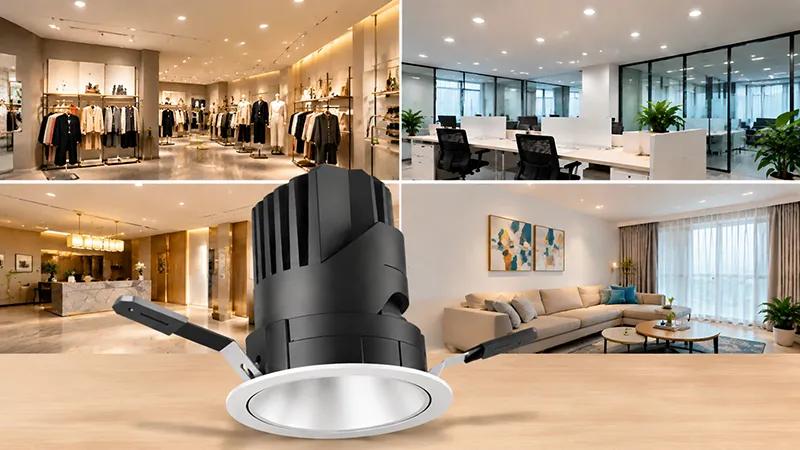
In our OEM/ODM discussions, I find that a “universal” high-lumen request often becomes several different product questions once we discuss the real installation. The following framework helps buyers convert space requirements into clearer LED downlight specifications and more reliable supplier evaluation criteria.
Why Should Buyers Start an LED Downlight Selection With the Application?
A buyer may feel pressure to compare watts, prices, and lumen figures quickly, especially during tendering or bulk procurement. However, a product that appears efficient in isolation can be unsuitable for the room. I recommend defining what people must see, do, or feel in the space before comparing models.
Buyers should begin LED downlight selection by identifying the application, visual task, ceiling height, surface finishes, and required atmosphere. These inputs determine whether the project needs broad ambient lighting, focused accents, low glare, high color quality, warmer tones, or a specific housing style. A lighting professional should then confirm the final layout and illuminance targets.
Define the Space Before Defining the Product
In repeated buyer conversations, I have seen a familiar starting point: “We need a powerful downlight for all rooms.” I understand why this sounds efficient. A single SKU can simplify purchasing, warehousing, installation, and after-sales support.
Still, one universal configuration can create risk because different environments have different visual priorities.
For example:
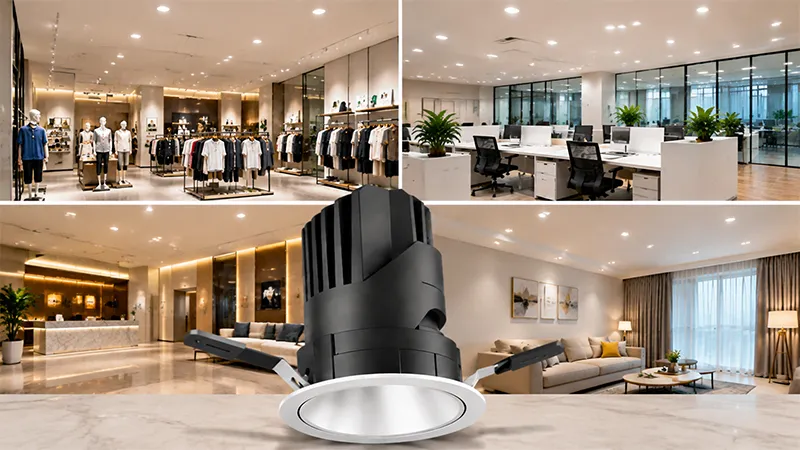
- A retail store may need to make merchandise, colors, textures, and display zones look appealing.
- An office may need comfortable general illumination with controlled glare for screen-based work.
- A hotel corridor may need visual comfort, orientation, and a calm atmosphere.
- A residential kitchen may need functional light on work surfaces, while a living room may benefit from softer ambient light.
- A lobby or reception area may require a balance of atmosphere, architectural appearance, and maintenance practicality.
I encourage buyers to turn broad product requests into application questions:
- What activity happens beneath the fixture?
- Is the light intended for ambient, task, accent, or wall-washing use?
- What is the ceiling height and spacing concept?
- Are ceilings dark, light, reflective, textured, or exposed?
- Are users likely to look directly toward the light source?
- Does the project need one visual mood or several lighting zones?
- What budget, lead time, compliance, and replacement constraints apply?
A downlight does not “perform” in a vacuum. Its suitability depends on its relationship with people, surfaces, furniture, merchandise, and the rest of the lighting system.
This early stage is also the right time to identify project constraints. For example, a shallow ceiling void may limit the available LED downlight housing depth. A renovation may need a particular cutout size. A distributor may need standardized SKUs that can serve multiple common use cases without making unrealistic promises about universal suitability.
How Do LED Downlight Specifications Work Together?
It is easy to treat wattage, lumens, beam angle, CCT, and CRI as separate rankings. Buyers may assume that higher is always better. In practice, I treat these figures as linked inputs. A change in one choice can affect visual comfort, spacing, energy demand, cost, and the overall result.
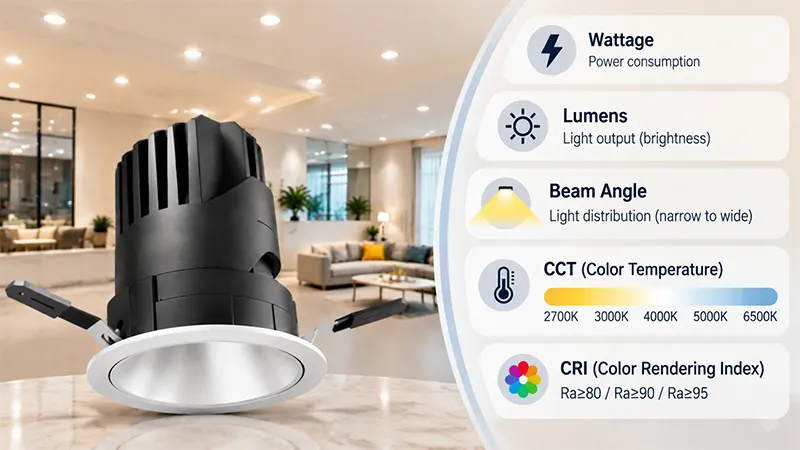
An LED downlight specification should be evaluated as a system. Wattage influences power consumption, lumens indicate available light output, beam angle shapes distribution, CCT affects perceived atmosphere, and CRI affects color rendering. Their correct combination depends on mounting height, target surface, reflectance, visual task, and professional lighting calculations.
Wattage Is Not a Brightness Requirement
Wattage measures electrical power consumption. It does not, by itself, tell a buyer how much useful light reaches a working surface or a display area. LED efficacy, optical design, driver performance, thermal management, and product construction can all affect the relationship between wattage and light output.
For procurement teams, wattage remains important because it affects energy planning, electrical loading, and product positioning. However, it should not be used alone to define an appropriate LED downlight.
Lumens Need Context
Lumens describe the quantity of light emitted by a source, but the installed effect depends on more than total lumens. A high-lumen unit with an unsuitable beam angle or poor spacing can still produce uneven illumination or uncomfortable brightness.
I suggest asking whether the project needs:
- General ambient illumination across a room
- Focused light on a counter, shelf, artwork, or feature wall
- Brighter task areas within a broader, softer lighting scheme
- A mix of different outputs and optics across zones
Beam Angle Shapes the Light
Beam angle is particularly important for ceiling height and target area. A narrower beam can concentrate light, while a wider beam can spread it across a larger area. Neither option is universally superior.
| Specification Input |
Buyer Question |
Potential Risk if Considered Alone |
| Wattage |
What electrical load and product category do we need? |
Assuming higher watts automatically mean better light |
| Lumens |
How much source output may the space require? |
Ignoring spacing, optics, and useful light on the task |
| Beam angle |
Is the target broad ambient light or focused illumination? |
Creating dark gaps, hotspots, or excessive brightness |
| CCT |
What visual atmosphere and surface appearance are required? |
Selecting a trend-based tone that conflicts with the space |
| CRI |
How accurately should colors and materials appear? |
Over-specifying or under-specifying color quality |
| Cutout and depth |
What can the ceiling physically accept? |
Discovering installation conflicts after purchase |
CCT and CRI Support Visual Intent
Color temperature, commonly expressed in Kelvin, affects how warm or cool the light appears. Lower CCT options are often associated with warmer, more relaxed visual environments. Higher CCT options can appear more neutral or cooler. However, I do not recommend choosing CCT only by market preference. Wall finishes, daylight, brand image, and room function all matter.
CRI indicates how faithfully colors may appear under a light source compared with a reference. Higher CRI can be relevant where merchandise, food, finishes, fabrics, or skin tones are important. Yet buyers should define the visual requirement first rather than automatically requesting the highest available CRI.
At our factory, we can discuss adjustable optical parameters such as color temperature, power, and color rendering index for qualifying OEM/ODM programs. I still advise buyers to request documented specifications and have qualified professionals assess application-specific lighting performance.
Which LED Downlight Features Fit Retail, Office, Hotel, and Residential Spaces?
A single downlight family can sometimes offer multiple versions, but it should not be assumed that every environment needs the same configuration. Retail, offices, hospitality spaces, and homes create different visual risks. I recommend selecting options based on the purpose of the zone, not just the building category.
Retail LED downlights often prioritize product presentation and accent control, office downlights usually emphasize visual comfort and uniformity, hospitality projects balance ambience with navigation, and residential applications vary by room task and mood. Buyers should specify each area separately and avoid applying one generic configuration across all spaces.
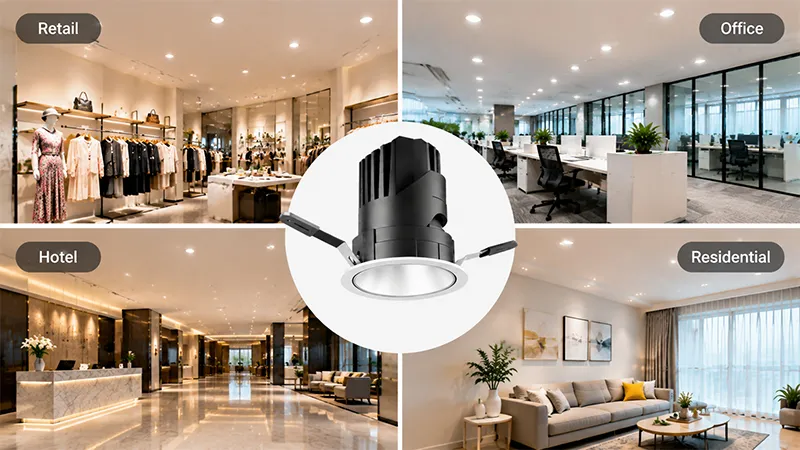
Retail: Support Merchandise and Customer Attention
In retail, I see buyers focus on brightness first. Brightness matters, but a store also needs to direct attention and support how products look. Apparel, cosmetics, food, electronics, jewelry, and furniture all have different presentation needs.
Buyers may consider:
- CRI requirements for product and finish presentation
- Beam angles for display tables, shelving, mannequins, or feature walls
- Glare control near checkout areas and customer circulation paths
- CCT consistency across the store
- Replaceable or standardized SKUs for multi-location rollouts
A lighting designer should determine the intended light levels, fixture locations, and accent-to-ambient relationship.
Offices: Reduce Discomfort and Support Work
Office lighting should support concentration, communication, circulation, and screen-based tasks. A narrow-beam, high-output LED downlight may create uncomfortable contrast if it is used indiscriminately above desks.
For office projects, I would raise questions about:
- Direct glare and reflected glare on screens
- Ceiling height and workstation arrangement
- Uniformity across the working area
- Meeting rooms versus corridors versus reception zones
- Compatibility with other luminaires, controls, and daylight conditions
Downlights can serve as part of the scheme, but they may not be the only lighting type needed for every work area.
Hospitality: Create Mood Without Losing Function
Hotels, restaurants, lounges, and corridors usually need a layered approach. Guests need enough visibility to move safely, read signs, and navigate. The brand may also want warmth, calm, or visual drama.
The selected LED downlight should match the zone. A lobby, guestroom, restaurant, bathroom, and corridor often need different priorities. I recommend that buyers avoid using a single CCT and beam angle simply because it is easier to source.
Residential: Separate Task Zones From Comfort Zones
Residential requirements can change from room to room. Kitchens and bathrooms often involve more task-oriented needs. Living rooms, bedrooms, and dining areas may need more flexible ambience. Dimming compatibility, trim finish, cutout size, and visual comfort can be as important as raw output.
I once discussed a buyer’s request for one high-output recessed model across an entire residential range. After we separated kitchens, hallways, bathrooms, and living areas, the team could see why a single configuration created unnecessary compromises.
How Should Buyers Evaluate an LED Downlight Supplier for Consistency?
A suitable sample is useful, but it is not complete evidence that a supplier can produce the same LED downlight configuration consistently at scale. Buyers should evaluate how the supplier controls materials, assembly, aging, inspection, documentation, and configuration changes.
Buyers should evaluate an LED downlight supplier by reviewing manufacturing controls, incoming material inspection, in-process quality checks, aging procedures, test documentation, change-control practices, and capacity for the requested configuration. Samples, certifications, and specifications should be verified against the actual order requirements and destination-market rules.
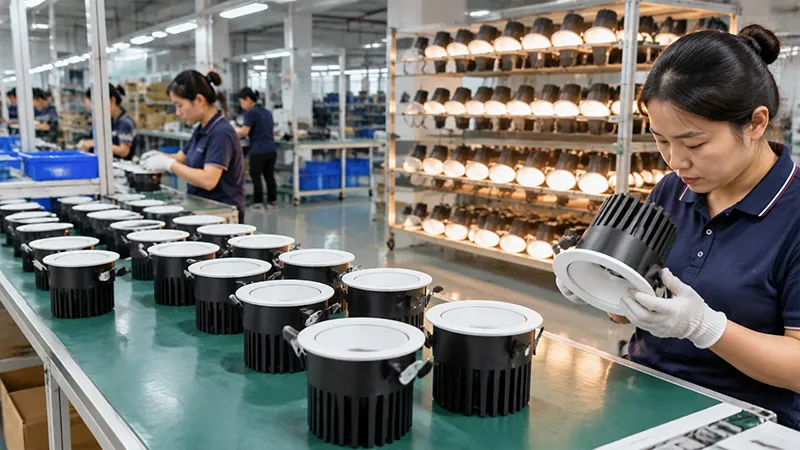
Move From Sample Approval to Production Verification
A sample can help buyers assess appearance, installation fit, light color, and basic construction. However, bulk procurement introduces additional questions:
- Can the supplier maintain CCT consistency across batches?
- Can the requested trim color, power, driver, optics, and cutout be reproduced?
- Are critical components controlled or subject to substitution?
- What inspection steps apply before shipment?
- How will the supplier manage approved changes?
- What production capacity and lead-time assumptions support the order?
At Upward Lighting, we use production lines with quality control supervision and conduct incoming quality control on raw materials. We also use in-process inspection and finished-product inspection practices. Our stated process includes 100% aging testing before shipment, with aging conditions depending on the applicable production arrangement.
I would encourage buyers to ask for clear written confirmation of the specific test plan for their order, rather than relying on general marketing language.
Review Documents, Not Just Claims
For international projects, buyers should confirm compliance needs early. A product may require different documentation depending on its destination market, electrical design, and application. Our business context includes products described as complying with standards or requirements such as CE, EMC, LVD, RoHS, CB, and UL for applicable product programs. Buyers should verify current certificates, reports, model coverage, validity, marking requirements, and destination-market applicability directly.
A practical supplier-review checklist includes:
- Product specification sheet: Confirm power, lumen range, CCT, CRI, beam angle, dimensions, cutout, IP rating where relevant, and driver details.
- Sample and golden sample process: Agree on the approved reference for appearance and key parameters.
- Quality plan: Ask how IQC, in-process inspection, final inspection, and aging testing are performed.
- Reliability evidence: Review available test records for items such as insulation, withstand voltage, temperature rise, and applicable lifespan-related testing.
- Change control: Require notification and approval procedures for material or component changes.
- Packaging and labeling: Confirm carton marks, installation instructions, barcode needs, and private-label requirements.
- After-sales process: Clarify how quality claims, replacement parts, and traceability will be handled.
For complex commercial projects, I recommend involving a qualified lighting professional and, when appropriate, an independent inspection provider. This helps connect product verification with the actual installation environment.
How Can Procurement Teams Turn Lighting Needs Into an LED Downlight RFQ?
Many procurement issues begin before the quotation stage. A vague request may produce quotations that look comparable but include different optics, drivers, trims, color tolerances, testing plans, or packaging assumptions. I find that a structured RFQ makes supplier comparison more meaningful.
An LED downlight RFQ should describe the application, installation conditions, target specification range, compliance needs, expected quantity, customization requirements, and quality documentation requested. Clear RFQs reduce quotation ambiguity and help suppliers confirm whether they can manufacture and validate the requested configuration consistently.
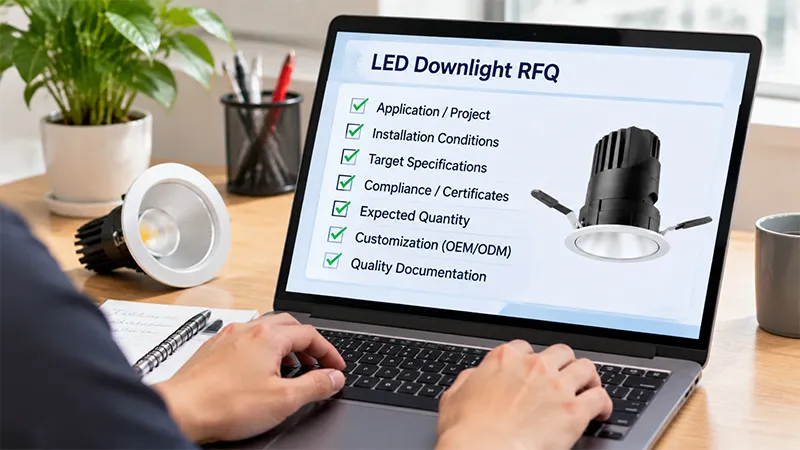
Build an RFQ Around the Real Project Risk
When I receive an inquiry that only says “12W recessed downlight, warm white,” I can provide a preliminary response. Yet I cannot responsibly assume the exact beam angle, cutout, driver type, CRI, trim color, dimming requirement, packaging, or compliance documentation.
A stronger RFQ may include the following fields:
| RFQ Category |
Information to Provide |
| Application |
Retail, office, hotel, residential, corridor, lobby, bathroom, or another use |
| Installation |
Ceiling type, cutout, ceiling void depth, mounting height, and quantity per area |
| Light intent |
Ambient, task, accent, wall wash, or mixed use |
| Optical needs |
Preferred CCT, CRI, beam-angle range, and dimming needs |
| Product format |
Recessed, surface-mounted, fixed, adjustable, trim style, finish color |
| Electrical needs |
Input voltage, driver requirements, controls compatibility |
| Compliance |
Destination market, requested documents, labeling and instruction requirements |
| Commercial needs |
Target quantity, forecast, sample timing, delivery location, packaging, and branding |
| Quality expectations |
Aging, inspection level, test reports, AQL expectations if applicable, and traceability |
Ask Suppliers to Identify Assumptions
I recommend asking suppliers to state assumptions in the quotation. This simple step can reveal differences that price alone hides. One supplier may quote a different driver, a lower CRI option, another optic, or a different housing depth. Those differences may be acceptable, but buyers should see them before placing an order.
For OEM/ODM programs, I also suggest discussing the path from concept to mass production:
- Confirm the target application and preliminary product brief.
- Review drawings, dimensions, optics, finishes, and component options.
- Produce and assess samples.
- Confirm pilot-production requirements where needed.
- Approve specifications, packaging, and quality criteria.
- Begin controlled mass production.
Our team can help translate a product request into manufacturable options, including product appearance, optical parameters, and order-specific packaging needs. However, I keep the boundary clear: final lighting layouts, illuminance calculations, emergency-lighting considerations, and on-site validation belong with qualified project lighting professionals where required.
Frequently Asked Questions
What wattage LED downlight should I choose?
I do not recommend selecting wattage without reviewing the application. Wattage affects electrical consumption, but it does not independently determine useful illumination or visual comfort. Buyers should consider mounting height, beam angle, lumen output, room use, reflectance, and layout, then obtain professional lighting calculations when appropriate.
Is a higher lumen LED downlight always better?
No. Higher lumens can be useful in some applications, but they can also create glare, hotspots, or unnecessary contrast when the optics and layout are unsuitable. I recommend matching light output to the intended task, ceiling height, spacing, and visual environment rather than pursuing the highest available figure.
What CRI should buyers request for retail lighting?
The appropriate CRI depends on the merchandise and desired presentation. Retailers selling color-sensitive items, finishes, food, or cosmetics may place greater importance on color rendering. Buyers should define the visual goal and compare documented product data, samples, and professional lighting recommendations before finalizing the specification.
Can one LED downlight model work in retail, offices, hotels, and homes?
One model may fit some shared requirements, but it is rarely the best answer for every zone. Retail, office, hospitality, and residential spaces have different needs for glare control, beam distribution, color appearance, visual comfort, and atmosphere. I recommend creating application-based product variants where practical.
What should buyers verify before placing a bulk downlight order?
Buyers should verify approved samples, dimensions, cutout size, optical specifications, driver details, finish, labeling, packaging, inspection steps, aging process, lead time, and applicable compliance documents. They should also confirm that certificates and reports cover the ordered model and destination-market requirements.
Conclusion
Choosing the right LED downlight is a specification and supplier-control decision, not a search for the biggest wattage or lumen number. I recommend that buyers begin with the activity, ceiling conditions, visual atmosphere, and procurement risks in each space. They can then evaluate optics, CCT, CRI, output, installation details, and quality controls as connected requirements. If you are sourcing OEM or ODM downlights for a commercial or residential program, contact Upward Lighting to discuss manufacturable options, samples, documentation, and order-specific quality requirements.