Fixed and adjustable LED downlights can look similar in a product catalog, yet they solve different lighting problems. Buyers can waste budget on adjustable fittings that never need aiming, or they can install fixed models where directional control would improve the result. I recommend starting with the lighting task, not the appearance.
Fixed LED downlights direct light in one preset direction, usually straight downward, while adjustable LED downlights allow the installer or user to tilt and sometimes rotate the light source after installation. Fixed models suit stable, general lighting layouts; adjustable models suit applications that need light aimed at an object, wall, display, or changing zone. The best choice depends on beam angle, mounting position, target distance, glare control, ceiling conditions, and project requirements.
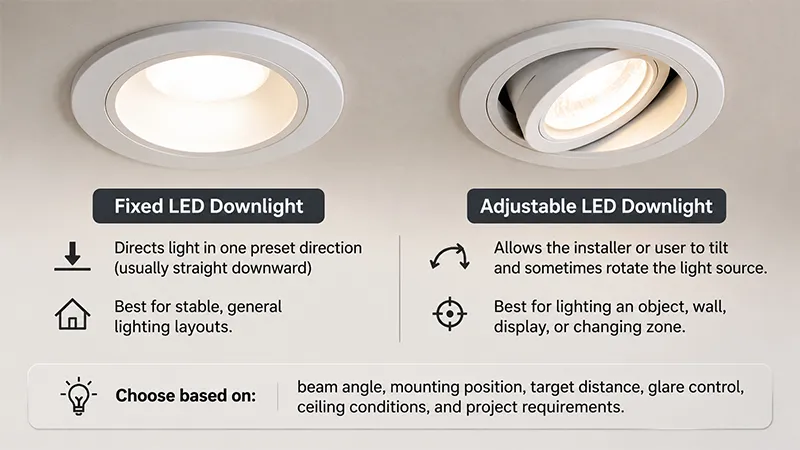
In our conversations with brand owners, contractors, and purchasing teams, I often find that the real decision is not “Which downlight is better?” The more useful question is: Will the direction of light need to change after the product is installed? The answer affects product selection, installation coordination, cost planning, and the final user experience.
What Are Fixed and Adjustable LED Downlights?
Fixed and adjustable LED downlights can create very different results even when they have similar wattage, color temperature, and ceiling cutout dimensions. Buyers sometimes focus only on the visible trim or price, which can lead to a mismatch between the luminaire and the intended lighting task.
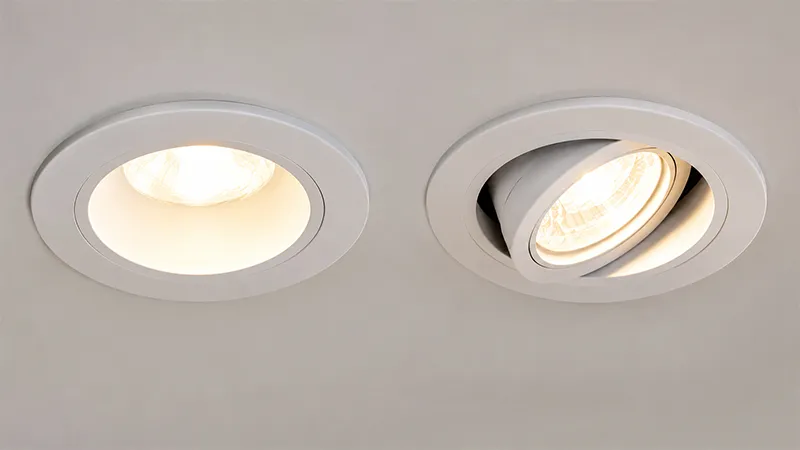
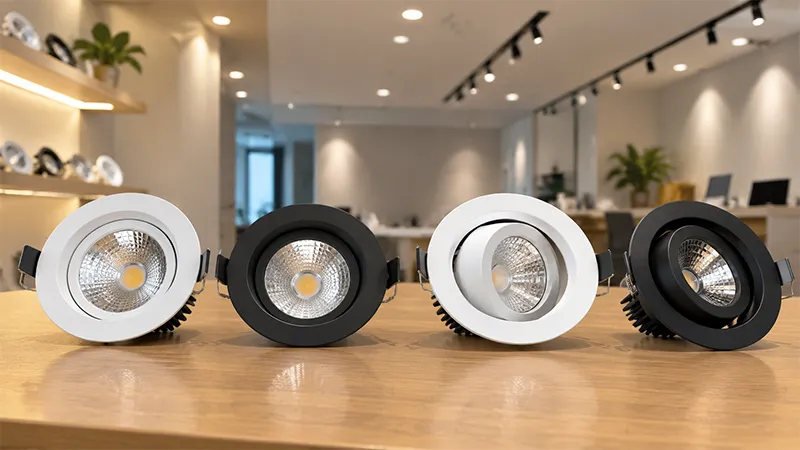
A fixed LED downlight has a stationary optical direction, while an adjustable LED downlight has a movable inner module or gimbal that lets users aim the beam. Fixed downlights are generally selected for consistent ambient or general illumination. Adjustable downlights are selected when the beam needs to highlight, compensate for placement limitations, or adapt to changing interiors.
Fixed downlights: stable light for stable layouts
A fixed downlight typically directs its beam downward through a stationary reflector, lens, or optical assembly. The fixture may be recessed, surface-mounted, trimless, or designed with a deep anti-glare structure, but the aiming direction remains fixed after installation.
This does not make fixed downlights “basic” or inferior. In many projects, a fixed beam is the more appropriate solution because the lighting direction is already known. For example, a grid of fixed downlights can work well in:
- Corridors and circulation areas
- Kitchens with stable work zones
- Offices requiring broad general illumination
- Hotel guestrooms
- Residential living areas
- Retail spaces with consistent aisle layouts
- Bathrooms and utility spaces
When buyers want a clean and orderly ceiling appearance, fixed downlights often support that goal. The ceiling plan can be coordinated around known task areas, furniture positions, and circulation routes. The result can be visually calm because each fitting points in the same intended direction.
Adjustable downlights: directional flexibility when it has a purpose
An adjustable downlight includes a tilting or gimbal-style light engine. Depending on the model, it may allow vertical tilt, limited rotation, or both. The exact aiming range varies by product construction, so buyers should verify the product datasheet rather than assuming all adjustable fittings offer the same movement.
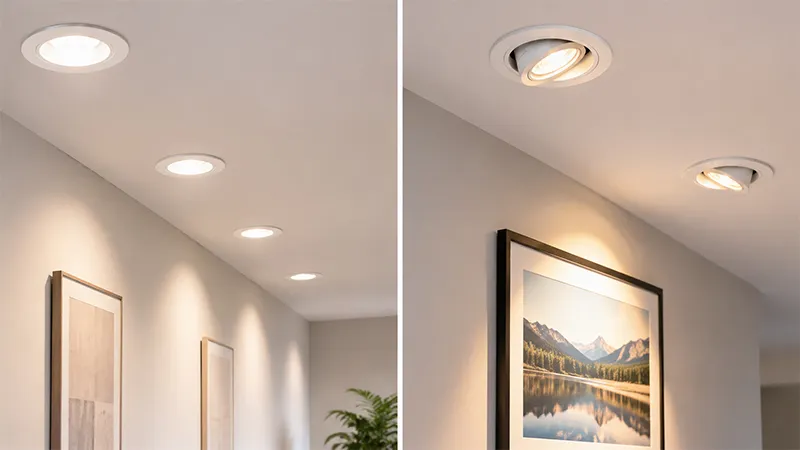
An adjustable unit can be useful when a recessed ceiling location cannot sit directly above the target. I have seen this question come up in customer discussions about wall art, display shelving, reception desks, feature walls, and retail merchandise. In these cases, a fixed vertical beam may miss the intended subject, while a controlled tilt can redirect the light.
However, movement alone does not guarantee useful accent lighting. An adjustable model still needs the right:
- Beam angle for the size of the target
- Mounting distance from the target
- Ceiling height
- Aiming range
- Glare-control design
- Spacing from adjacent fittings
For procurement purposes, I suggest treating adjustability as a functional feature rather than a premium decoration. If it solves no defined lighting task, it may add complexity without adding practical value.
When Should Buyers Choose Fixed and Adjustable LED Downlights?
Many lighting decisions become clearer when buyers define what the luminaire must illuminate. A project can have excellent-looking fittings but still feel uneven, glary, or underlit if the beam direction does not match the room layout. I encourage buyers to identify the target area before comparing models.
Buyers should choose fixed LED downlights when the desired beam direction is known and unlikely to change. They should choose adjustable LED downlights when light must be aimed toward a feature, task area, wall, or off-center zone. The decision should be based on application fit, not on the assumption that adjustable products are automatically more advanced.
Match the fitting to the lighting layer
Most interior projects use more than one lighting layer. General lighting helps users move through a space and see the overall environment. Task lighting supports activities such as food preparation, reading, working, or grooming. Accent lighting draws attention to a visual feature, display, material texture, or architectural element.
Fixed and adjustable downlights may both appear in the same project because they can serve different layers.
| Lighting requirement |
Common fit |
Why it may fit |
| Broad, even room illumination |
Fixed downlight |
A stable downward beam supports a regular ceiling layout. |
| Hallways and passageways |
Fixed downlight |
The lighting target is usually predictable and consistent. |
| Artwork or a feature wall |
Adjustable downlight |
The beam may need to shift toward the target. |
| Retail display updates |
Adjustable downlight |
Aiming flexibility may help when merchandise layouts change. |
| Reception counter or focal zone |
Adjustable or fixed, depending on layout |
The right choice depends on ceiling position and target location. |
| Kitchen worktop |
Fixed or adjustable, depending on ceiling geometry |
Buyers should check whether the beam reaches the task plane without shadows. |
Questions buyers commonly need to clarify before ordering
I recommend that procurement teams ask a short set of practical questions before finalizing a downlight order:
-
What is the actual lighting target?
Is the objective general illumination, a task surface, a vertical wall, a retail shelf, or an architectural feature?
-
Will the target move or change?
Retail displays, gallery arrangements, and furniture layouts can change. Aiming flexibility may have value in these settings.
-
Can the ceiling location be positioned directly above the target?
If ceiling coordination allows the fitting to sit in the ideal location, a fixed downlight may be sufficient.
-
Is glare a concern for occupants?
A tilted beam can become visible from some viewing angles. A deeper light source position, suitable reflector design, and careful aiming may matter more than the fact that a fitting is adjustable.
-
Who will aim the fitting after installation?
Adjustable products need an installation and commissioning process. A fitting that remains at its default position may not deliver the intended value.
In one type of OEM discussion, customers ask for an adjustable model because it looks more versatile in a catalog. I understand that commercial logic. Still, I suggest that brand owners position it honestly: it is a directional tool for defined applications, not a universal upgrade over fixed recessed lighting.
Do Adjustable LED Downlights Replace Track Lighting?
Adjustable downlights can appear to offer a compact alternative to track lighting, especially in spaces that need some accent illumination. However, buyers may be disappointed if they expect a recessed adjustable fitting to provide the same layout flexibility, quantity of aiming positions, or visual impact as a track system.
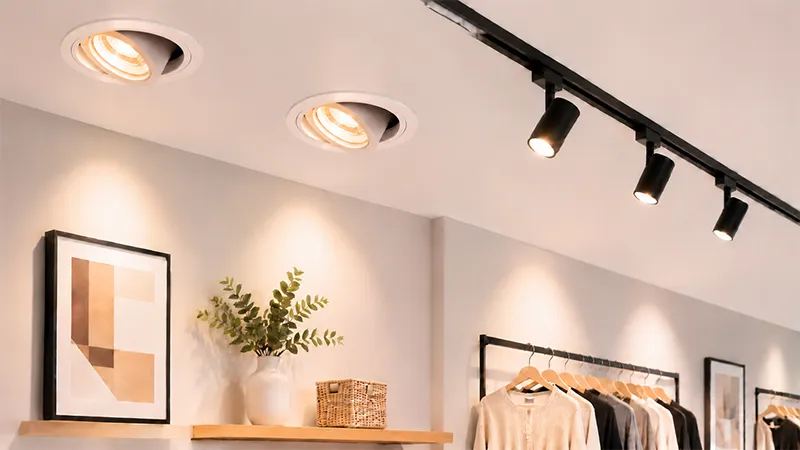
Adjustable LED downlights do not automatically replace track lighting. An adjustable recessed fitting can redirect a beam within its designed aiming range, but track lighting usually offers greater flexibility for fixture location, spacing, fixture quantity, and future reconfiguration. Buyers should compare the complete lighting layout rather than comparing adjustability alone.
Recessed flexibility versus track-system flexibility
An adjustable downlight is fixed in one ceiling cutout. The head may tilt toward a target, but the base location does not move. This is an important limitation when the target is far from the original mounting point or when the layout changes significantly over time.
Track lighting uses a different concept. The track creates a serviceable route where compatible heads can often be moved, added, removed, or redirected. This can be useful in retail, galleries, showrooms, and other spaces where the focal points change.
| Evaluation factor |
Adjustable downlight |
Track lighting |
| Fixture location after installation |
Fixed ceiling location |
Often repositionable along the track |
| Beam aiming |
Available within the product’s designed range |
Usually available at each track head |
| Ceiling appearance |
Integrated, recessed appearance |
More visible architectural element |
| Layout changes |
Limited by ceiling cutout location |
Often easier to adapt |
| Fixture quantity changes |
Requires new ceiling work |
May be easier within track capacity and design |
| Accent-lighting potential |
Depends heavily on optics and placement |
Can support flexible accent layouts when properly specified |
Why beam angle and distance still matter
A movable head does not automatically create a narrow, controlled accent beam. For example, a wide beam aimed at a small wall picture may spill light far beyond the target. Conversely, a narrow beam used too close to a large display may create an overly concentrated bright spot.
Buyers should consider the relationship between beam angle and target size. A basic planning principle is that a wider beam covers more area at the same distance, while a narrower beam concentrates light into a smaller area. Yet actual results also depend on optical design, lumen output, ceiling height, surface reflectance, and aiming angle.
For complex commercial layouts, I recommend that buyers request photometric information where available and work with qualified project professionals for illumination calculations, glare assessment, and local code requirements.
The most reliable approach is to identify whether the project needs subtle directional correction or ongoing lighting-layout flexibility. An adjustable downlight may be suitable for the first need. A track system may be worth evaluating for the second.
What Should Procurement Teams Compare Before Ordering Fixed and Adjustable LED Downlights?
Price is important, but it is rarely the only procurement risk. A low-cost fitting that does not match the cutout, beam requirement, driver arrangement, or installation method can create delays and rework. For wholesalers and brand owners, product-line positioning also matters because fixed and adjustable models may serve different customer groups.
Before ordering fixed and adjustable LED downlights, buyers should compare ceiling integration, optical performance, installation requirements, structural design, quality-control documentation, and supplier support. They should verify all project-specific specifications against the product datasheet, approved samples, and applicable market requirements.
Start with installation coordination
Ceiling coordination is often overlooked during early sourcing. Buyers should confirm whether the selected downlight matches the ceiling construction, cutout size, recess depth, driver space, insulation conditions, and installation method.
For adjustable units, the moving module may require additional internal space or a different trim construction. A small visual difference can affect the ceiling cutout, installation depth, or access requirements. Contractors and engineering firms should coordinate these points before placing a bulk order.
A practical comparison checklist includes:
- Cutout diameter and tolerance
- Overall fixture diameter
- Recessed depth and ceiling void requirement
- Driver type, dimensions, and accessibility
- Heat-management requirements
- Spring clip or mounting method
- Trim style, including white, black, or custom finishes
- Tilt direction and stated adjustment range for adjustable models
- Compatibility with dimming systems, where required
- Packaging method and spare-part expectations
Compare optical specifications in context
Wattage alone does not explain how a downlight will perform. Buyers should review the optical information that relates to their intended application, such as:
For example, a fixed downlight with a carefully selected beam angle may perform better for a stable task area than an adjustable model with an unsuitable optic. Similarly, an adjustable downlight may be useful for a feature wall only if its beam pattern, tilt capability, and installation distance work together.
Evaluate supplier process, not only the sample
At Upward Lighting, we discuss fixed and adjustable downlight requirements with OEM and ODM customers before production. We understand that buyers may need different wattages, color temperatures, CRI options, trim colors, packaging, and product positioning for their markets.
I believe buyers should ask suppliers how they control consistency during mass production. Useful questions include:
- Does the supplier conduct incoming inspection for key materials?
- Are first-article and in-process checks documented?
- Does the supplier conduct aging tests before shipment?
- What inspection level applies to finished goods?
- Can the supplier provide relevant test reports and compliance documents for the exact model?
- Can the factory support pilot samples before large-scale production?
- How are color, labeling, packaging, and accessory changes controlled?
Our factory states that products undergo aging tests before shipment, and our production process includes incoming, in-process, and finished-product quality checks. However, I always advise buyers to verify the exact test scope, product configuration, certifications, and documentation for the model and destination market they plan to purchase. CE, CB, UL, RoHS, EMC, and LVD claims should be checked against valid documents and the specific project’s applicable requirements.
Frequently Asked Questions
Are adjustable LED downlights more expensive than fixed downlights?
Adjustable LED downlights may involve more complex mechanical components, but pricing varies by size, material, driver, optics, finish, order quantity, and customization requirements. I recommend comparing total project value rather than unit price alone. Buyers should only pay for adjustability when it supports a real lighting requirement.
Can I use adjustable LED downlights for general room lighting?
Yes, adjustable LED downlights can contribute to general room lighting, but they are not always necessary for that purpose. A fixed downlight may create a simpler and more consistent result when the desired beam direction is straight downward and the ceiling layout is stable.
How do I choose the beam angle for an adjustable LED downlight?
Buyers should choose a beam angle based on ceiling height, target distance, target size, desired contrast, and glare control. A narrow beam can concentrate attention on a small feature, while a wide beam covers more area. Product datasheets and qualified lighting professionals can help validate complex layouts.
Can fixed LED downlights provide accent lighting?
Fixed LED downlights can provide accent effects when the ceiling location and beam direction are already aligned with the target. They are suitable when the target is permanent and the beam does not need future adjustment. The key is correct placement, optics, and mounting distance.
What should wholesalers stock: fixed or adjustable LED downlights?
Wholesalers may benefit from carrying both types when their customer base includes residential, commercial, retail, and contractor channels. Fixed models can cover common general-lighting demand, while adjustable models can serve directional applications. Stock decisions should reflect local demand, price positioning, and installation preferences.
Conclusion
The difference between fixed and adjustable LED downlights comes down to directional control. Fixed models are often the right choice for stable layouts, clean ceiling integration, and consistent general illumination. Adjustable models add value when the beam must reach an off-center target, highlight a feature, or accommodate layout changes. I recommend that buyers compare application fit, optics, installation conditions, and supplier quality processes before deciding. If you are sourcing OEM or ODM downlights, contact Upward Lighting to discuss your required specifications, samples, customization options, and order requirements.