Choosing the right LED wattage for outdoor lights feels complicated. Get it wrong, and you waste money or end up with poor lighting. Here’s how to pick the perfect wattage.
The best LED wattage depends entirely on your specific application. The goal is to achieve the right amount of brightness for the task, avoiding excessive light that causes glare and light pollution. It’s not about high wattage, but the right wattage for the job.
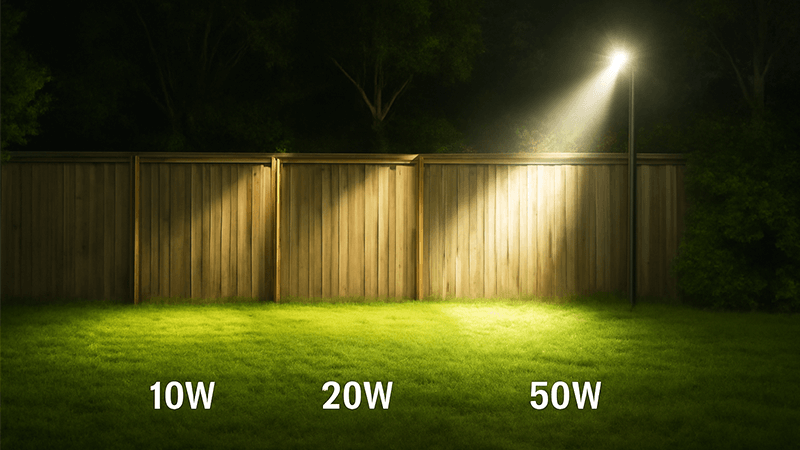
When I first started in an LED lighting factory, I saw customers make the same mistake over and over. They would focus only on getting the highest wattage possible. They thought more watts meant better light. But I learned that lighting is about creating the right atmosphere and ensuring safety, not just blasting an area with brightness. Wattage is just one part of the story. You also need to think about lumens, color temperature, and where the light is going. Getting these details right is the key to a successful project that looks great and saves your client money. Let’s break it down so you can choose with confidence.
What wattage for outdoor LED lights?
Different outdoor spaces need different amounts of light. Using one wattage for everything is inefficient and can look terrible. Let’s match the right wattage to each specific outdoor area.
For general outdoor lighting, LED wattages range from 5W for pathways to over 100W for large area floodlights. For example, path lights often use 5-9W bulbs, while wall sconces might use 9-18W. Security floodlights typically start at 30W and go up from there.
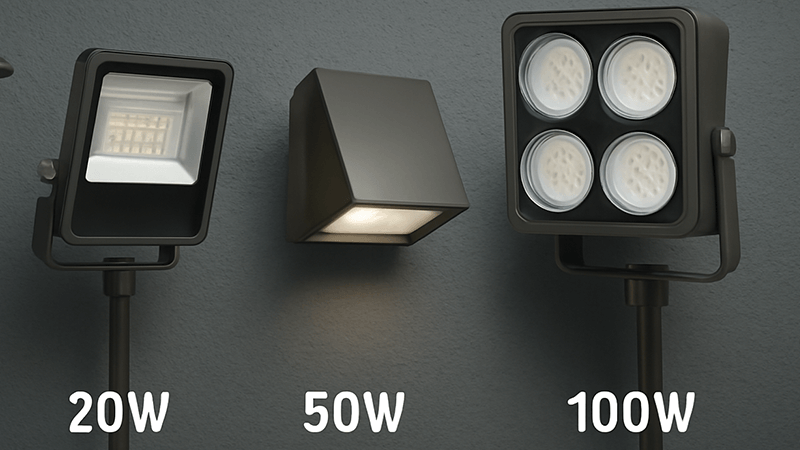
Choosing the right wattage is all about the purpose of the light. I always tell my clients to think about the job first, then the bulb. Is it for walking safely? Is it for highlighting a beautiful tree? Or is it for scaring away intruders? Each of these jobs needs a different tool, and in lighting, that tool is the right amount of light, measured in wattage and lumens.
Pathway and Garden Lighting
For pathways, stairs, and garden beds, you want gentle, guiding light, not a blinding glare. The goal is safety and ambiance. Low-wattage LEDs are perfect here. I recommend using bulbs in the 5W to 9W range. This is enough to illuminate the ground, prevent trips, and create a warm, welcoming feel without overwhelming the space. Over-lighting a garden can wash out the natural colors of your plants and create harsh shadows. A subtle touch is much more effective.
Wall and Accent Lighting
When lighting up the side of a house, a fence, or architectural features, you need a bit more power. This is accent lighting. Its purpose is to draw the eye and add depth. For wall sconces or uplights on a small tree, an LED in the 9W to 18W range usually works well. This provides a focused beam of light that highlights textures and shapes without causing uncomfortable glare for neighbors.
Flood and Security Lighting
For security and large area illumination, you need power. This is where higher wattages come in. A small driveway might only need a 30W to 40W floodlight. But for a large backyard, a commercial parking lot, or the side of a warehouse, you should look at 50W to 200W or even higher. The key is to cover a wide area with bright, clear light to deter intruders and ensure safety.
Here is a simple table to help you choose:
| Application |
Recommended LED Wattage |
Common Lumen Range |
Purpose |
| Path/Step Lights |
5W – 9W |
100 – 300 lm |
Safety and Ambiance |
| Garden Accents |
7W – 15W |
200 – 500 lm |
Highlighting Features |
| Wall Sconces |
9W – 18W |
450 – 900 lm |
Decoration & Entryway |
| Driveway/Security |
30W – 50W |
2500 – 5000 lm |
Safety and Visibility |
| Large Area Flood |
50W – 200W |
5000 – 25,000+ lm |
High-Security & Commercial |
What is the best K for outdoor lighting?
The color of your light completely changes the feel of an outdoor space. But picking the right color temperature, or Kelvin, can be confusing. The wrong choice makes a beautiful area feel harsh.
For most outdoor applications, a color temperature between 2700K and 4000K is best. 2700K-3000K (Warm White) creates a cozy, inviting atmosphere for living spaces. 3500K-4000K (Neutral White) provides clearer visibility for general and security areas without being too harsh.
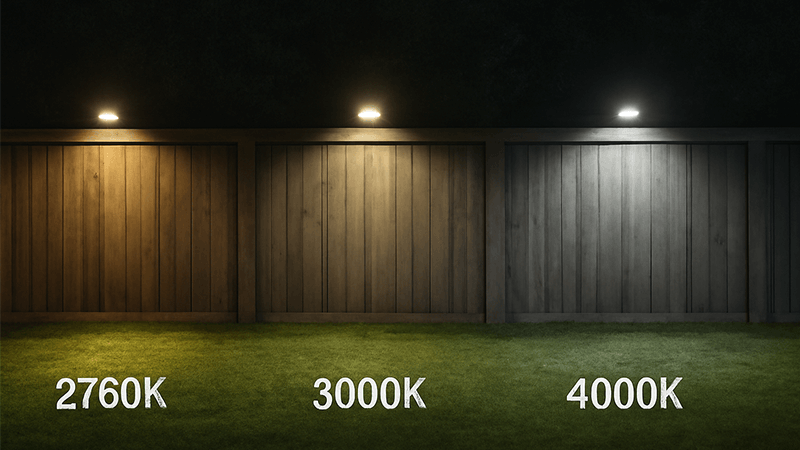
Kelvin (K) simply measures how "warm" or "cool" a light’s color is. Think about a candle flame—that’s a very warm light, around 1900K. Daylight on a clear day is a very cool light, around 5000K-6500K. When I work with clients, especially from regions like the UAE where outdoor living is important, choosing the right Kelvin is critical. We need to match the light to the architecture and the purpose of the space. A warm light can make a modern building feel more inviting, while a neutral light can make a commercial property feel safer and more professional.
Warm White (2700K-3000K) for Ambiance
This is the color range of traditional incandescent bulbs. It has a soft, yellowish glow that feels relaxing and welcoming. I always recommend this range for outdoor living areas like patios, decks, gazebos, and around pools. It’s also perfect for accenting gardens and pathways where you want to create a natural, "moonlight" effect. This warm light is inviting and easy on the eyes, making it ideal for spaces where people gather and relax.
Neutral White (3500K-4000K) for Clarity
This range offers a balance between warm and cool light. It appears as a clean, white light without the yellow tones of warm white or the stark blue tones of cool white. Neutral white is excellent for general outdoor lighting. It renders colors accurately and improves visibility, making it a great choice for lighting up the exterior of your home, driveways, and general security areas. It provides a sense of safety without feeling as sterile or industrial as higher Kelvin options.
Cool White (5000K+) for Security
Cool white and daylight (up to 6500K) produce a very bright, bluish-white light. This is the color you often see in commercial and industrial settings. While it can be too harsh for residential living spaces, it is highly effective for security lighting. The high contrast it creates makes it easier to see details on security cameras. I recommend using 5000K or higher for commercial properties, parking lots, and targeted security floodlights where maximum visibility is the top priority.
| Kelvin Range |
Color Name |
Best For |
Feeling/Effect |
| 2700K – 3000K |
Warm White |
Patios, Gardens, Pathways |
Cozy, Relaxing, Inviting |
| 3500K – 4000K |
Neutral White |
General House Lighting, Driveways |
Clean, Clear, Safe |
| 5000K – 6500K |
Cool White / Daylight |
Security Floodlights, Commercial Areas |
Alert, High-Contrast, Intense |
Is 100W LED brighter than 60W LED?
We often assume that a higher wattage automatically means a brighter light. But with modern LED technology, this isn’t always the full story. This old way of thinking can be misleading.
Yes, a 100W LED from the same product line will be significantly brighter than a 60W LED. However, watts measure energy use, not brightness. The true measure of brightness is lumens. A highly efficient 60W LED can be brighter than an older, less efficient 100W LED.
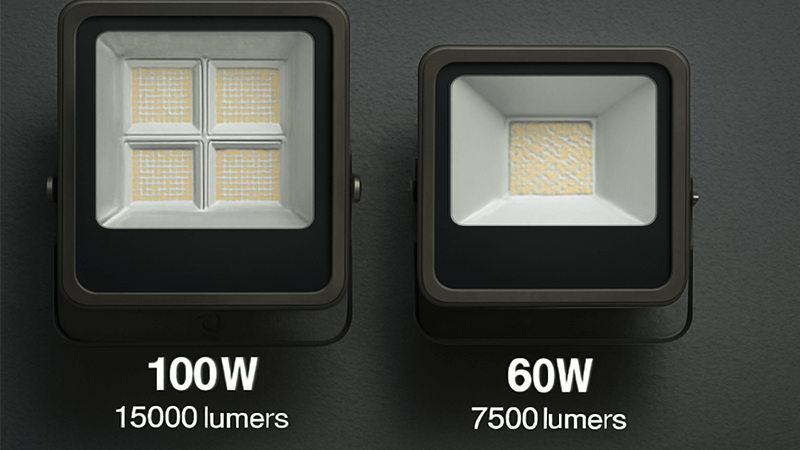
Back when we all used incandescent bulbs, watts were a reliable way to estimate brightness. A 100W bulb was always brighter than a 60W bulb. But LED technology has changed the game. The efficiency of LEDs—how many lumens they produce for each watt of energy—can vary greatly between manufacturers and even between different product generations. As a purchasing manager, focusing on lumens per watt (lm/W) is much more important than focusing on watts alone. This will ensure you get the brightness you need while also maximizing energy savings for your project.
Understanding Watts vs. Lumens
This is the most important concept to grasp.
- Watts (W): This tells you how much electrical energy a bulb consumes. It’s a measure of power usage. A lower watt number means lower energy bills.
- Lumens (lm): This tells you the actual amount of visible light a bulb produces. It’s a measure of brightness. More lumens mean a brighter light.
When you buy LEDs, you should always look for the lumen output first. This is the number that tells you how bright the light will be. The wattage simply tells you how much it will cost to run.
The Role of Luminous Efficacy
The key performance metric is luminous efficacy, measured in lumens per watt (lm/W). This number tells you how efficiently a bulb converts electricity into light.
- An old incandescent bulb might have an efficacy of 15 lm/W.
- A modern, high-quality LED can have an efficacy of 150 lm/W or more.
Let’s look at an example.
- LED A (Low Efficacy): 100W at 80 lm/W = 8,000 lumens
- LED B (High Efficacy): 60W at 150 lm/W = 9,000 lumens
In this case, the 60W LED (B) is actually brighter than the 100W LED (A), and it uses 40% less energy. This is why you cannot judge brightness by wattage alone. I always advise my clients like Shaz to check the product specifications for both lumens and wattage to calculate the efficacy. A higher lm/W ratio means a better, more cost-effective product.
How bright should outdoor LED lights be?
You know you need lights, but how bright is bright enough? Too dim is useless, but too bright creates glare and annoys neighbors. The answer isn’t a single number.
The required brightness (lumens) depends on the task. For ambiance on a patio, 200-400 lumens might be enough. For lighting a pathway, you may need 100-200 lumens per fixture. For security over a large driveway, you could need 3000 lumens or much more.
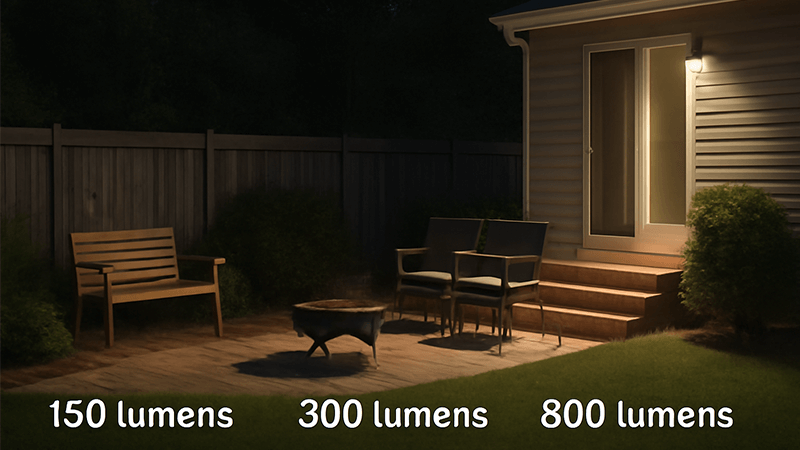
The goal is to use lumens effectively. It’s not just about the total lumen output; it’s also about where those lumens are directed. A well-designed light fixture with good optics can direct 1000 lumens exactly where you need it, making it more effective than a poorly designed 2000-lumen fixture that scatters light everywhere. This is a detail I learned to appreciate during my years in manufacturing. A good product design makes every lumen count, which saves energy and improves the final result. Thinking in lumens, not just watts, is the professional approach.
Task-Based Lumen Recommendations
Let’s move away from wattage and focus on the lumens needed for common outdoor tasks. This gives you a much more accurate way to plan your lighting projects.
- Step & Stair Lighting: The primary goal is safety. You don’t need intense brightness, just enough to see each step clearly. Look for fixtures that provide 100 to 200 lumens.
- Pathway Lighting: Similar to steps, you need enough light to see the path ahead. Spacing is key. Fixtures providing 100 to 300 lumens each, placed every 8-10 feet, work well.
- Patio & Deck Lighting: This is an area for living and relaxing, so you want functional but comfortable light. A total of 400 to 800 lumens, often spread across multiple fixtures like wall sconces or string lights, creates a pleasant atmosphere.
- Flood & Security Lighting: Here, the goal is maximum visibility. For lighting up a dark corner or a small driveway, 1500 to 3000 lumens is a good starting point. For large commercial areas or high-security zones, you may need 5,000 to 25,000 lumens or more.
Factors That Influence Brightness Needs
The lumen numbers above are just a guide. You need to consider other factors for each project.
- Surface Color: Dark surfaces like blacktop or dark brick absorb light, so you may need more lumens to light them effectively. Light-colored surfaces like concrete or white paint reflect light, so you can often use fewer lumens.
- Light Placement: The height and angle of the light fixture matter. A floodlight mounted 20 feet high will need more lumens to light the ground than one mounted at 10 feet.
- Light Shielding: Good outdoor lights have shielding that directs light downward, where it’s needed. This prevents light pollution (light shining up into the sky) and reduces glare. A well-shielded 1000-lumen light can be more effective than an unshielded 2000-lumen one.
Here’s a quick reference table:
| Area |
Goal |
Recommended Lumens (per fixture) |
| Steps & Stairs |
Safety |
100 – 200 lm |
| Pathways |
Navigation |
100 – 300 lm |
| Patios/Decks |
Ambiance & Task |
400 – 800 lm (total) |
| Driveway |
Security |
1500 – 3000 lm |
| Large Backyard |
General Use & Security |
3000 – 5000+ lm |
Conclusion
Choosing the best LED is about matching the right brightness and color to the specific job. Focus on lumens for brightness, not just watts, to ensure efficiency and performance.