Struggling with your lighting layout? Guesswork leads to awkward dark spots or harsh glare. Understanding a downlight’s coverage is the first step to creating a beautifully and evenly lit space.
A single downlight’s coverage primarily depends on its beam angle and the ceiling height. For example, a common 60-degree beam on an 8-foot ceiling illuminates about 57 square feet. However, the quality of coverage is defined by how the light feathers at its edges.
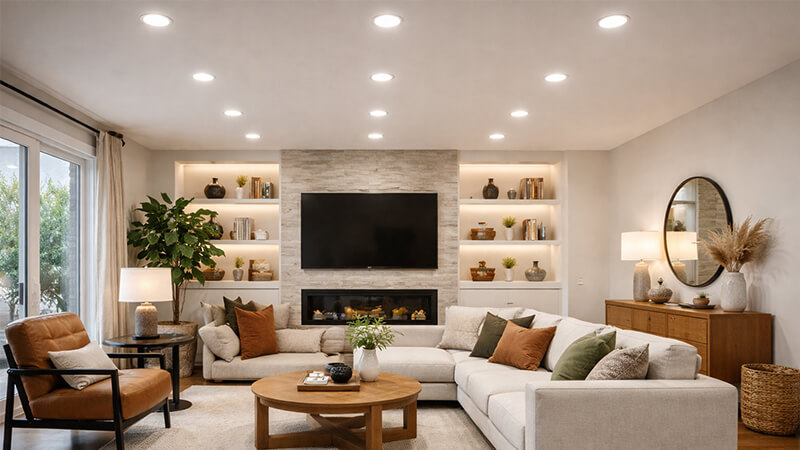
Getting the numbers right is just the start. The real secret to professional lighting design lies in the quality of the light itself and how it interacts with your space. Let’s dive deeper into the specifics to ensure your next project is perfectly illuminated.
How Much Area Does a Downlight Cover?
Are you choosing downlights based only on their wattage? This common mistake often results in uneven lighting and wasted energy. To get it right, you need to focus on beam angle and ceiling height.
The area a downlight covers is a direct function of its beam angle and the distance from the fixture to the floor or work surface. A wider beam angle from the same height will always cover more area. A narrow beam is for accenting, while a wide beam is for general illumination.
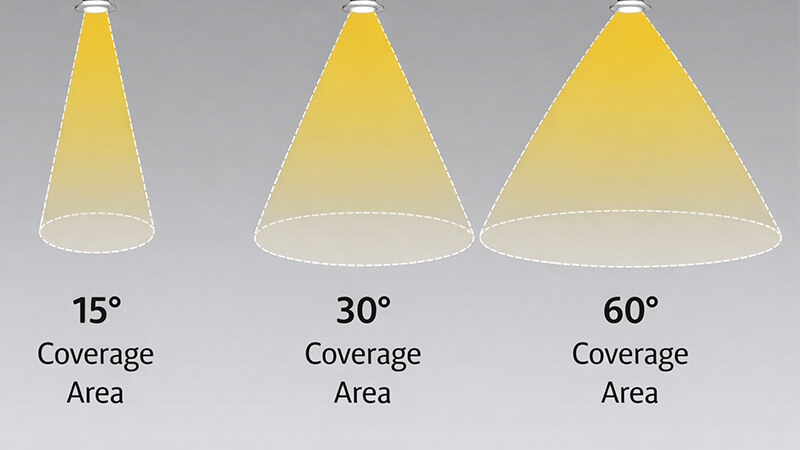
In my years of manufacturing, I’ve learned that the numbers only tell half the story. The other half is about the quality of the light at the edge of the beam.
The Role of Beam Angle
The beam angle tells you how wide the light spreads. A narrow angle, like 24 degrees, is great for spotlighting a piece of art. A wide angle, like 60 or 90 degrees, is what you need for general room lighting. To calculate the diameter of the light pool on the floor, you can use a simple formula, but most manufacturers provide these charts. Here’s a quick guide for an 8-foot (2.4m) ceiling:
| Beam Angle |
Coverage Diameter |
Coverage Area |
Best Use Case |
| 38° |
~5.4 ft (1.6m) |
~23 sq ft |
Accent Lighting |
| 60° |
~9.2 ft (2.8m) |
~67 sq ft |
General Lighting |
| 90° |
~16 ft (4.9m) |
~201 sq ft |
Wide Area Lighting |
The Secret is in the Edges
Here’s an insight from the factory floor: the most important factor isn’t the size of the bright circle on the floor. It’s the transition from light to shadow. A cheap downlight creates a harsh, defined circle that looks unnatural. It cuts the light off abruptly. A high-quality downlight, like the ones we design at iPHD, uses advanced optics—lenses and reflectors—to create a soft, feathered edge. This "penumbra," or soft edge, allows the light from one downlight to blend seamlessly with the next. This gentle transition eliminates the "scalloping" effect on walls and makes furniture and textures look richer and more high-end. It’s a detail that separates amateur lighting from a professional, luxurious feel.
How Much Light for a 100 sq ft Room?
Is your 100-square-foot room feeling too dim or uncomfortably bright? Getting the light level wrong can make a space feel completely wrong. Thankfully, a simple calculation can give you the target you need.
For a standard 100 sq ft room, the amount of light needed is determined by its purpose. A relaxing living room requires 1,000-2,000 total lumens. A functional space like a kitchen or office needs more, typically 3,000-4,000 lumens, to support various tasks.
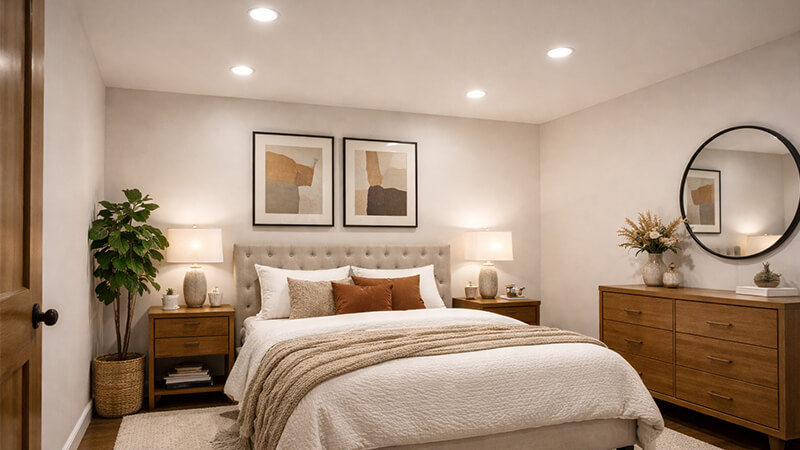
I often work with purchasing managers like Shaz, who need reliable data for large projects. Understanding lumens and how to apply them is the foundation of any solid lighting plan. It removes guesswork and ensures the client gets exactly what they need.
Understanding Lumens and Foot-Candles
First, let’s define our terms. Lumens measure the total amount of visible light from a source. Foot-candles (fc) measure how bright the light is when it reaches a surface. One foot-candle is equal to one lumen per square foot. Different activities require different light levels.
Here are some standard recommendations:
| Room Type |
Recommended Foot-Candles (fc) |
Total Lumens for 100 sq ft |
| Living Room / Bedroom |
10-20 fc |
1,000 – 2,000 lumens |
| Bathroom / Hallway |
20-30 fc |
2,000 – 3,000 lumens |
| Kitchen / Home Office |
30-50 fc |
3,000 – 5,000 lumens |
| Workshop / Garage |
70-80 fc |
7,000 – 8,000 lumens |
How to Calculate Your Needs
The formula is simple:
Room Area (in sq ft) x Recommended Foot-Candles = Total Lumens Needed
Let’s use an example. You have a 100 sq ft home office. For task-level lighting, you want about 40 foot-candles.
100 sq ft x 40 fc = 4,000 lumens
This means you need a total of 4,000 lumens from all the light sources in that room. If you choose downlights that each produce 800 lumens, you would need five of them (4000 / 800 = 5). This simple math is the first step in building a professional lighting layout that is both functional and comfortable.
How Many Recessed Lights Do I Need for a 12×12 Room?
Are you planning the lighting for a standard 12×12 room? Placing lights randomly will create an unprofessional look with uneven light. A simple spacing formula ensures you get perfect, balanced coverage every time.
For a 12×12 foot room (144 sq ft) with a standard 8-foot ceiling, you will generally need 4 to 6 recessed lights. A good starting point is to place them about 3 feet from the walls and 6 feet apart from each other for balanced, overlapping illumination.
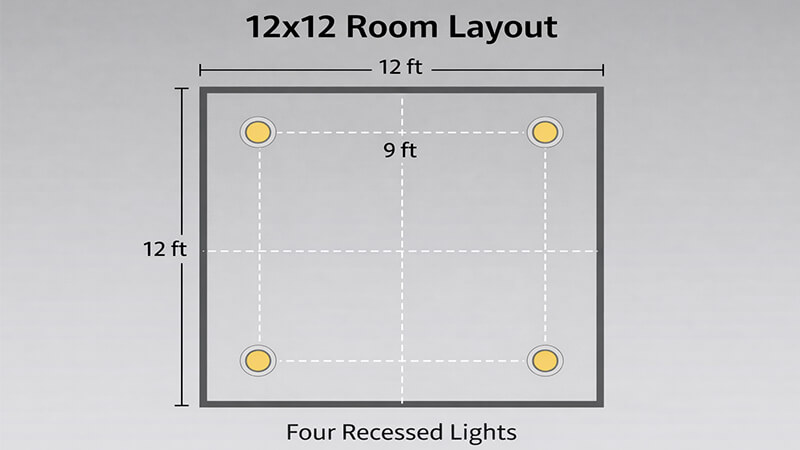
Building a layout is a process I’ve guided many clients through. It’s about combining the math of lumens with the art of placement. Let’s walk through how to do it for this common room size.
Step 1: Calculate Total Lumens
First, decide the room’s purpose. Let’s say this 12×12 room is a bedroom where you want soft, relaxing light. A bedroom needs about 10-20 foot-candles. We’ll aim for 15 fc.
The area is 12 ft x 12 ft = 144 sq ft.
The total lumens needed are 144 sq ft x 15 fc = 2,160 [lumens](https://sc-herrajes.com/en/blog/what-are-lumens-and-how-to-know-how-much-light-your-house-needs/)[^4].
Step 2: Choose Your Downlight
Now, choose a downlight. Let’s say you select a 4-inch downlight that produces 600 lumens.
To find the number of lights, divide the total lumens by the lumens per fixture:
2,160 lumens / 600 lumens/light = 3.6 lights.
Since you can’t install 0.6 of a light, you round up to 4 lights. This will give you slightly brighter light than your minimum target, which is perfect. Using four lights also makes for a symmetrical, clean layout.
Step 3: Determine Spacing
With four lights, the placement is straightforward. A general rule is to place the lights half the ceiling height away from the walls. For an 8-foot ceiling, that’s 4 feet. But in a 12×12 room, that would place the lights only 4 feet apart, which might be too close.
A better method is to divide the wall length by the number of lights along that wall, plus one. Here, we’ll place two rows of two lights.
For the 12-foot walls, we divide by 3 (2 lights + 1). This gives us 4. The first light is 4 feet from the corner, and the next is 4 feet from that, which doesn’t work.
So let’s use a simpler, more reliable method: Create a grid. Place the first row of lights 3 feet from one wall. Place the second row 3 feet from the opposite wall. This leaves 6 feet between the rows. Then, space the lights in each row 3 feet from the side walls. This creates a perfect 6×6 square of lights in the center of the ceiling. This provides excellent, overlapping coverage.
How Many Downlights Can I Have on One Circuit?
Are you worried about overloading an electrical circuit with your new lighting plan? A mistake here can lead to constantly tripped breakers or, even worse, a fire hazard. A quick, safe calculation is all you need.
The number of downlights on one circuit depends on the circuit’s amperage and each light’s wattage. On a standard 15-amp, 120-volt circuit, you can safely power up to 1440 watts. This would allow for 144 ten-watt LED downlights, but always consult an electrician.
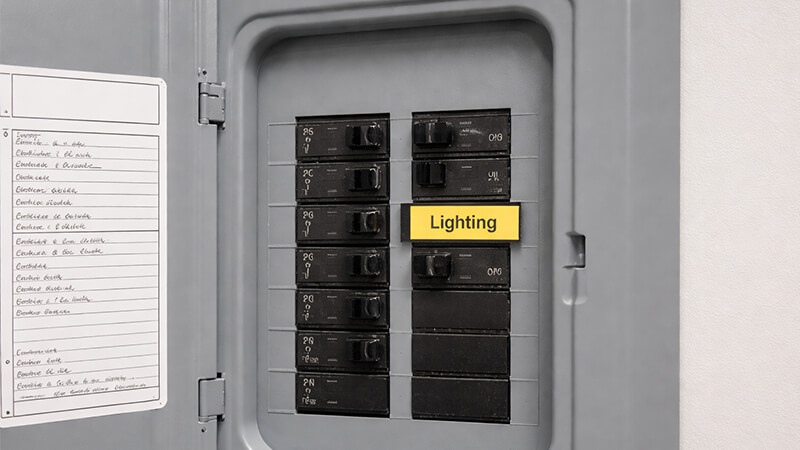
Safety is the most important part of any lighting installation. I’ve been in the manufacturing business for years, and while our LEDs are incredibly efficient, electrical rules are not flexible. Understanding circuit load is non-negotiable.
Understanding Circuit Capacity
Every circuit in a building is protected by a circuit breaker with a specific amperage (amp) rating. The total power the circuit can handle is measured in watts. The formula is:
Amps x Volts = Watts
- In the US and North America: A standard lighting circuit is 15 amps and runs on 120 volts.
15A x 120V = 1800 Watts
- In Europe and other regions: A common circuit might be 10 amps on 230 volts.
10A x 230V = 2300 Watts
For safety and to prevent the breaker from tripping unnecessarily, you should never load a circuit to more than 80% of its maximum capacity. This is especially true for continuous loads like lighting.
- US 15A Circuit:
1800W x 0.80 = 1440 Watts (Safe Load)
- European 10A Circuit:
2300W x 0.80 = 1840 Watts (Safe Load)
An Example Calculation
Now, let’s figure out how many lights you can install. Today’s LED downlights are very low-wattage. A typical 6-inch downlight might use only 12 watts while producing the light of an old 75-watt incandescent.
Let’s say you’re using 12-watt LED downlights on a 15-amp, 120-volt US circuit.
1440W (Safe Load) / 12W per light = 120 lights
So, you could theoretically put 120 of these lights on a single circuit. This is a huge number compared to the old days of halogen or incandescent bulbs. While the math shows it’s possible, for large projects, it’s still wise to distribute lights across multiple circuits to balance the load and for better control. Always check your local electrical codes and work with a qualified electrician to ensure your installation is safe and compliant.
Conclusion
Proper downlight planning combines simple math with quality optics. Get the spacing and lumens right for your room’s function, and always prioritize lights that produce a soft, well-blended beam.