Flood light mounting brackets can become a problem when a fixture reaches the site but cannot match the wall, pole, canopy, or steel structure available. I have seen project discussions become delayed when the mounting surface, fixing points, and aiming direction were considered too late. The right bracket arrangement helps buyers plan a workable installation before production and delivery.
Flood light mounting brackets improve installation flexibility by connecting a specific floodlight to the real mounting surface, available fixing points, and required aiming direction. A properly matched bracket can support practical positioning and beam adjustment, but it must be compatible with the fixture’s dimensions, weight, hole pattern, and project conditions. Engineering teams should confirm structural suitability, local code requirements, and wind-load considerations before installation.
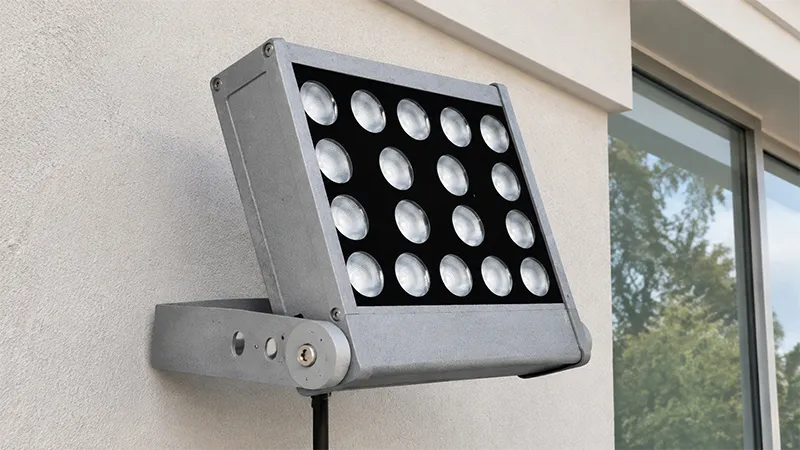
For procurement teams, a bracket should not be treated as a minor accessory. I view it as the installation interface between a floodlight and the project site. When we discuss OEM or ODM floodlight orders with contractors and engineering firms, I first ask where the fixture will be mounted and what direction it must aim.
Why Are Flood Light Mounting Brackets More Than an Accessory?
A floodlight may have the required wattage, lumen output, and IP rating, yet the project can still face installation problems. If the bracket does not suit the mounting surface or available fixing positions, installers may need to modify the arrangement on site. That can create delays, rework, and uncertainty. A correctly specified bracket helps prevent this issue.
Flood light mounting brackets are installation interfaces that connect the fixture to a wall, pole, ceiling, steel frame, or other approved structure. Their value comes from matching the fixture’s load, mounting-hole pattern, geometry, and aiming needs to the usable installation position, rather than simply providing a pivot point.
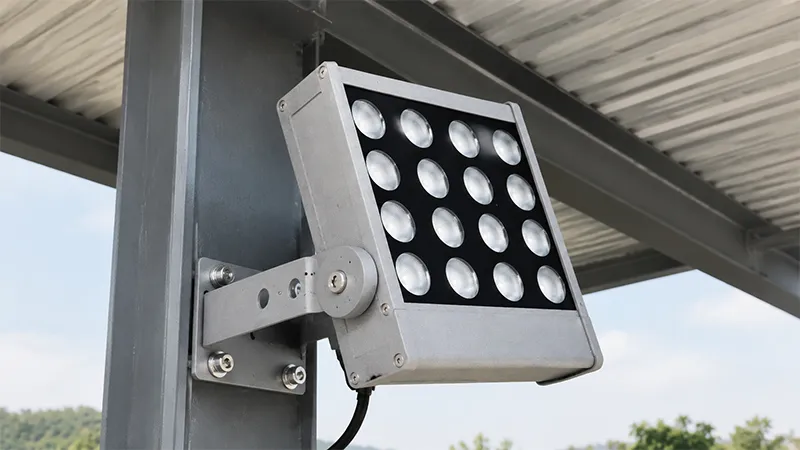
The Bracket Connects Several Project Decisions
When I speak with buyers about an outdoor floodlight, I do not consider the bracket separately from the fixture. The bracket affects how the floodlight can be installed, adjusted, and maintained over its operating life.
A practical mounting arrangement links these factors:
- Fixture dimensions: A large housing may need clearance from a wall, roof edge, or supporting member.
- Fixture weight: The mounting method should be assessed for the actual weight of the complete luminaire, not only the body.
- Bracket geometry: The arm length, width, pivot location, and base shape influence clearance and aiming range.
- Fixing-hole pattern: The bracket holes must align with usable anchors, bolts, channels, or pre-drilled positions.
- Mounting surface: Concrete, steel, masonry, wood, and aluminum structures require different project-specific fixing approaches.
- Target area: The light must face the intended area while avoiding unwanted spill light where possible.
In our manufacturing discussions, an engineering company may initially ask for “standard brackets.” That request often needs more detail. I normally ask: What is the mounting surface? Where are the usable fixing points? What direction must the light aim? These questions help us determine whether a standard yoke-style bracket may be suitable or whether a customized mounting arrangement should be reviewed.
Why “Included Bracket” Does Not Mean “Ready for Every Site”
Many LED floodlights are supplied with a U-shaped or yoke bracket. This common design can offer useful angular adjustment. However, it does not mean that every site can use it without consideration.
For example, a narrow steel member may not provide enough flat area for the bracket base. A wall-mounted installation may place the fixture too close to an overhang, restricting its downward angle. A retrofit project may have existing holes that do not align with the new bracket.
I have found that the best time to identify these limits is before a purchase order is finalized, not after cartons arrive at the project location.
At Upward Lighting, we manufacture floodlights for OEM/ODM buyers and project customers. We can discuss bracket dimensions, surface-treatment colors, optical parameters, and model configurations during product development. However, the project team and qualified professionals should confirm structural suitability, fastening details, local requirements, and any application-specific loads.
How Do Flood Light Mounting Brackets Support Better Aiming?
A floodlight can only deliver useful illumination when its beam is directed toward the intended area. Poor aiming can leave dark zones, push light beyond the property boundary, or create uncomfortable glare for drivers, pedestrians, workers, or nearby residents. An adjustable bracket helps, but only when the fixture can be securely positioned at a usable angle.
Flood light mounting brackets support better aiming by allowing the floodlight to rotate or tilt within the limits of its design. The final aiming range depends on fixture clearance, bracket shape, mounting location, beam angle, and the target area. Buyers should define the lighting direction before selecting a bracket arrangement.
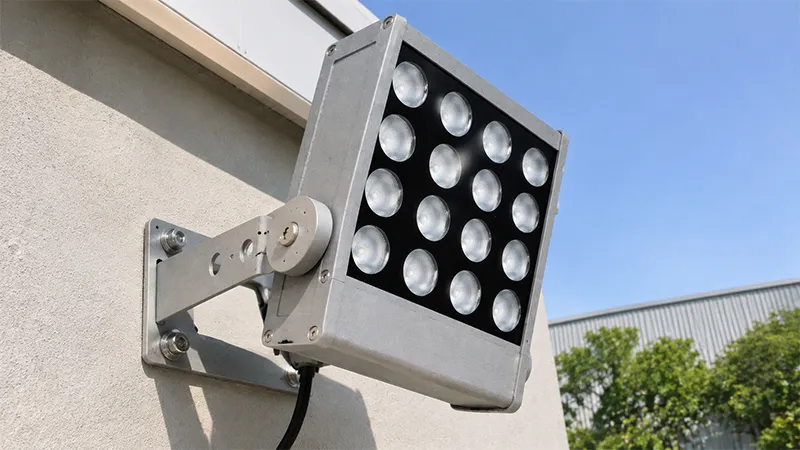
Mechanical Adjustment Affects Lighting Results
I recommend that procurement teams start with the lighting objective rather than the bracket alone. The key question is not simply, “Can this bracket tilt?” A better question is, “Can this fixture be mounted in a position that allows it to aim at the target area?”
The final bracket position can influence:
| Installation factor |
Potential lighting effect |
Question for the project team |
| [Mounting height |
Changes beam spread and illuminance distribution](http://www.cbat.eps.harvard.edu/nelpag/INFO09.html)[^6] |
How high will the floodlight be installed? |
| [Tilt angle |
Influences coverage direction and glare risk](https://docs.lib.purdue.edu/cgi/viewcontent.cgi?article=3347&context=jtrp)[^7] |
How far downward, upward, or sideways must it aim? |
| Distance from target |
Affects light levels and uniformity |
How far is the illuminated area from the fixture? |
| Nearby obstructions |
May block beam output or restrict adjustment |
Are there roof edges, pipes, signs, or beams nearby? |
| Beam angle |
Determines whether coverage is narrow or wide |
What optical distribution suits the target area? |
| Mounting orientation |
Can alter access, drainage, and aiming options |
Will the fixture be wall-, ceiling-, or structure-mounted? |
A bracket that allows a broad nominal tilt range may still have a limited usable range after installation. For instance, the rear of the floodlight housing may contact the wall before the desired angle is reached. In another case, the power cable route may require space that the mounting arrangement does not provide.
Define the Target Before Choosing the Mounting Arrangement
A contractor may need to illuminate a loading yard, façade, parking area, sports zone, or pathway. Each application can require different optical and mechanical decisions. I encourage buyers to share basic site information early:
- Target dimensions: Length, width, and approximate height of the area to be illuminated.
- Proposed mounting point: Wall, pole, truss, canopy, or other structure.
- Approximate mounting height: This affects the beam’s reach and spread.
- Required aiming direction: Forward, downward, cross-lighting, or upward façade lighting.
- Potential glare-sensitive locations: Roads, neighboring buildings, windows, cameras, or pedestrian routes.
- Fixture quantity and spacing: One floodlight may not provide the most balanced result for a large area.
I do not present a generic bracket as a guarantee of glare control or lighting performance. Those results depend on project-specific photometric planning, fixture selection, mounting geometry, surroundings, and professional evaluation. Still, confirming the intended aiming direction early can reduce the chance of selecting a floodlight configuration that cannot be positioned effectively on site.
Are Flood Light Mounting Brackets Universal or Interchangeable?
It is understandable that buyers want standardization. Using one bracket design across several models may simplify purchasing and inventory. However, assuming that all brackets are interchangeable can lead to compatibility problems. Floodlight housings differ in size, weight, center of gravity, fixing-hole location, and mounting geometry.
Flood light mounting brackets are not automatically universal or interchangeable because floodlights have different hole patterns, dimensions, weights, and load distribution. A replacement or custom bracket should be checked against the exact fixture model and the proposed mounting condition before it is specified for a project.
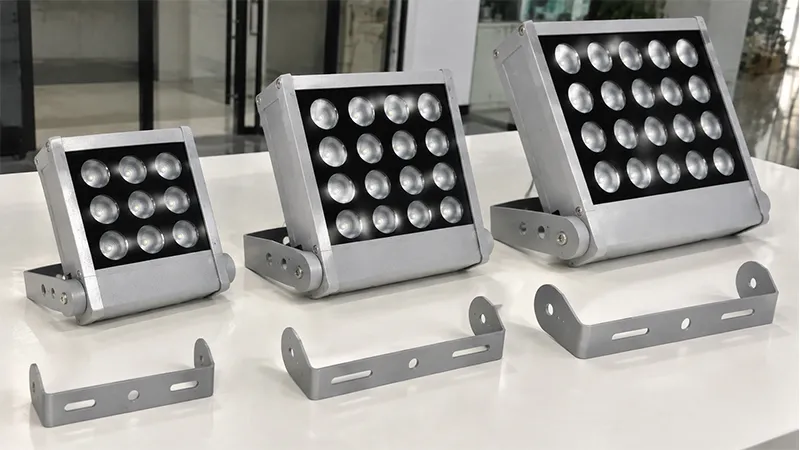
What Must Match Between a Fixture and Bracket?
When a buyer asks us whether a different bracket can be used, we first review the relevant mechanical information. The correct answer depends on the specific floodlight and installation concept.
Here are the main compatibility checks:
| Compatibility item |
Why it matters |
| Bracket-to-housing hole spacing |
Misalignment can prevent assembly or lead to unauthorized field modification. |
| Fastener size and thread engagement |
The fixture design may require a defined fastener specification. |
| [Fixture weight and center of gravity |
A larger or heavier housing may create different forces on the bracket and mounting point.](https://www.bu.edu/moss/mechanics-of-materials-bending-normal-stress/)[^9] |
| Bracket thickness and shape |
The component must fit the housing without interfering with adjustment. |
| Tilt pivot position |
Pivot placement affects achievable aiming angles and fixture clearance. |
| Cable and driver location |
The bracket should not obstruct cable routing, cable glands, or driver access. |
| Surface treatment |
Coating selection may matter for appearance and the expected environment. |
A bracket that physically bolts onto a housing is not necessarily suitable for the application. It may still limit movement, create clearance issues, or place the fixture in an impractical orientation.
A Common Procurement Scenario
In one anonymized discussion, a contractor had existing mounting points from a previous floodlight installation. The new LED floodlight model had different dimensions and a different bracket base. The initial expectation was that the existing holes would make the replacement simple.
After we asked for photos, center-to-center dimensions, fixture weight, and the required beam direction, it became clear that the bracket needed further review. The original mounting position may have restricted the new fixture’s aiming angle. The project team then had a better basis for deciding whether to adapt the support structure, choose another model, or consider a customized arrangement.
This type of early clarification is valuable because it keeps the decision focused on actual installation conditions. It also avoids treating a bracket as an interchangeable commodity when it is part of the overall luminaire mounting system.
For custom floodlight programs, we can review drawings, sample requirements, bracket finishes, and production feasibility. Buyers should provide accurate technical information, and qualified project professionals should verify all structural and compliance-related decisions.
What Should Buyers Confirm Before Ordering Flood Light Mounting Brackets?
Procurement delays often begin with missing installation information. A buyer may know the required wattage and quantity but not the mounting surface, hole locations, or aiming direction. Those details can determine whether a standard floodlight bracket is workable or whether the project needs a different fixture configuration.
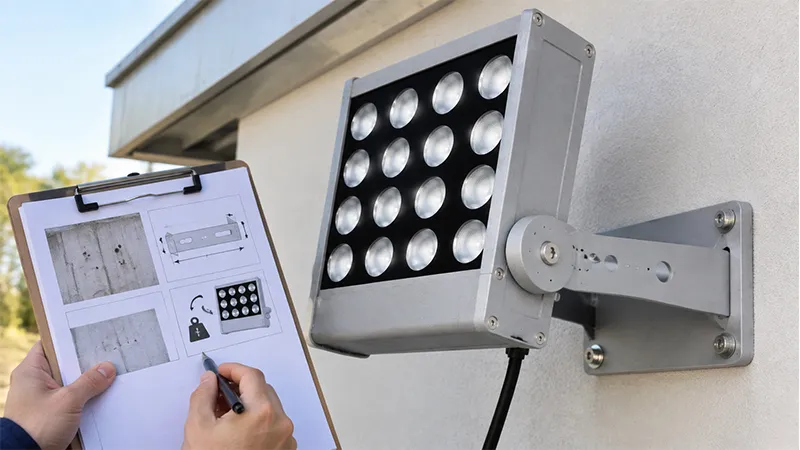
Before ordering flood light mounting brackets, buyers should confirm the mounting-surface material, load-bearing condition, usable fixing points, target aiming direction, fixture size and weight, and bracket compatibility. Clear site information allows suppliers and project teams to identify limitations before production, shipment, or installation begins.
A Practical Pre-Inquiry Checklist
I recommend that engineering firms, contractors, and purchasing managers prepare the following information before requesting a quotation:
- Mounting surface material: Is the floodlight going onto concrete, masonry, steel, aluminum, wood, or another material?
- Surface condition: Is the surface flat, accessible, and suitable for the intended installation method?
- Available fixing points: Are there existing holes, channels, bolts, plates, or structural members that define where the bracket can sit?
- Usable mounting area: What are the approximate width, height, and clearance around the location?
- Required aiming direction: Where should the beam point after installation?
- Mounting height and distance to target: These dimensions support lighting-layout discussions.
- Floodlight model or required specifications: Include wattage, housing size, beam angle, CCT, CRI, and quantity where available.
- Fixture weight: The completed luminaire weight should be considered with the proposed mounting concept.
- Environmental exposure: Is the area exposed to rain, dust, coastal air, vibration, or other conditions that may affect product selection?
- Project documentation: Photos, sketches, drawings, and existing-hole dimensions can make supplier communication much clearer.
Questions I Ask During Early Discussions
When we receive a floodlight inquiry, I try to move beyond a simple price-and-quantity conversation. I may ask:
“What is the mounting surface?”
“Where are the usable fixing points?”
“What direction must the light aim?”
“Does the fixture weight and hole pattern match the proposed bracket?”
These questions are not intended to replace a project engineer’s assessment. They help us understand the manufacturing and configuration requirements before we quote or develop samples.
At Upward Lighting, our production lines can support different indoor and outdoor lighting models, including LED floodlights. We also support OEM/ODM projects, small batches, and larger production programs. Our quality process includes incoming material inspection, in-process controls, finished-product inspection, and 100% aging testing before shipment. Depending on the product and project requirements, buyers can request relevant compliance documents for review. Certifications and test reports should always be verified against the exact model, destination market, and project requirement.
Avoid These Last-Minute Bracket Decisions
The following choices may create avoidable installation risk:
- Selecting by wattage only. Two 100 W floodlights can have very different housing sizes and brackets.
- Using site photos without dimensions. Photos are useful, but hole spacing, clearance, and mounting height still matter.
- Assuming an old mounting point suits a new fixture. Retrofit installations should be checked model by model.
- Defining beam direction after the fixtures arrive. The target area should guide product and bracket selection.
- Modifying brackets on site without approval. Unauthorized changes may affect fit, finish, or intended performance.
- Skipping professional review for structural or code issues. Local regulations, wind loads, fastener selection, and structural capacity require project-specific confirmation.
Frequently Asked Questions
Can a flood light mounting bracket be installed on any surface?
A flood light mounting bracket cannot automatically be installed on every surface. Concrete, steel, masonry, wood, and other materials may require different fixing methods and project checks. The project team should confirm the surface condition, load-bearing suitability, local requirements, and appropriate fasteners before installation.
Do adjustable flood light mounting brackets prevent glare?
Adjustable flood light mounting brackets can help position a fixture toward the intended area, but they do not guarantee glare control. Glare depends on mounting height, beam angle, aiming direction, surrounding conditions, and fixture placement. A project-specific lighting review may be required for sensitive applications.
How do I check floodlight bracket compatibility?
Buyers should compare the exact floodlight model with the bracket’s hole spacing, fastener requirements, dimensions, pivot location, and load distribution. They should also check whether the bracket provides enough clearance for aiming and cable routing. Supplier drawings and samples can support this review.
Can I use an existing bracket with a new LED floodlight?
An existing bracket may fit, but it should not be assumed to be compatible. The new fixture may have different dimensions, weight, hole positions, or center of gravity. The project team should compare technical drawings and confirm the proposed arrangement before installation.
What information should I send a floodlight supplier?
I recommend sending the mounting-surface type, photos, available hole or fixing-point dimensions, mounting height, required aiming direction, target area, expected environment, and desired floodlight specifications. This information helps a supplier evaluate whether a standard or customized mounting arrangement may be needed.
Conclusion
Flood light mounting brackets improve installation flexibility when buyers treat them as part of the complete project solution, not as a universal accessory. The best bracket arrangement depends on the floodlight’s size, weight, fixing-hole pattern, mounting surface, usable fixing points, and required aiming direction. I recommend confirming these details before ordering, especially for retrofit or custom projects. If your team needs OEM/ODM floodlight support, bracket drawings, or production guidance, contact Upward Lighting with your installation information for a practical manufacturing review.