LED flood lights can look similar in a catalog, but the wrong choice can create poor coverage, glare, premature outdoor failures, or an SKU that does not fit your target market. I often see buyers start with wattage and price alone. I recommend classifying flood lights by the lighting task, beam distribution, installation environment, and required functions before comparing specifications.
LED flood lights are best categorized by what they need to illuminate, how they distribute light, where they will be installed, and which control or customization features the project requires. Common categories include general-area flood lights, narrow-beam flood lights, asymmetric flood lights, sports flood lights, façade lights, high-IP outdoor models, corrosion-resistant models, and sensor- or dimming-ready versions. Buyers should verify final suitability through product specifications, photometric data, installation conditions, and local requirements.

I have learned from recurring OEM and wholesale inquiries that the most useful way to compare flood lights is not by creating a long list of shapes or wattages. A better approach is to connect each product configuration to a real lighting requirement. That process helps purchasing teams reduce mismatched orders and build a more practical product range.
Which LED Flood Lights Fit Different Lighting Tasks?
Buyers often ask me for a “100W LED flood light” or a “high-lumen flood light” without describing the area they need to illuminate. That creates uncertainty because the same nominal power can perform very differently at a warehouse entrance, building façade, parking area, billboard, or sports court. I always encourage buyers to start with the lighting task.
LED flood lights should first be selected by the target area and visual task. General-area models suit broad spaces, focused-beam models suit distant targets, façade models emphasize vertical surfaces, and sports or high-mast models are designed for larger areas where mounting height and uniformity are more demanding. Wattage and lumen output should be evaluated only after the application is defined.
General-area flood lights
General-area flood lights are commonly used for:
- Building entrances
- Loading bays
- Parking areas
- Courtyards
- Small construction yards
- Perimeter lighting
- Residential or commercial exterior spaces
These products usually aim to spread light across a relatively broad horizontal area. A purchaser should consider mounting height, pole spacing, wall position, target illuminance, and glare control. A product with a broad beam may work well at a lower mounting height but may lose useful intensity if installed too high.
Focused and long-throw flood lights
Focused LED flood lights direct more light toward a distant or defined target. Buyers may consider them for signs, tall façades, flagpoles, distant gates, landscape features, or selective security coverage.
A narrower optical distribution does not automatically mean that a product is better. It simply means that the light is concentrated. If a contractor installs a narrow-beam unit too close to a wall, the illuminated area may look uneven. If a broad-beam unit is placed too far away, the target may appear underlit.
Façade and architectural flood lights
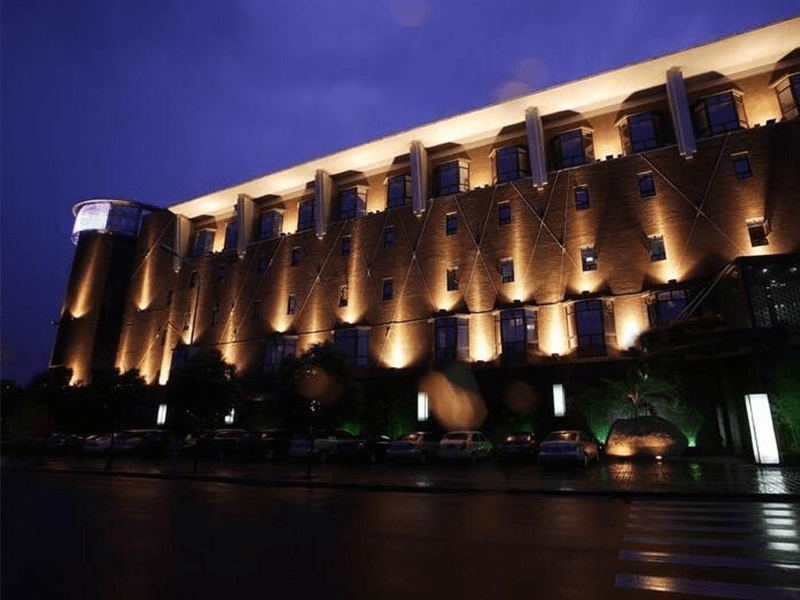
Façade lighting has a different purpose from general security lighting. The goal is often to reveal texture, geometry, branding features, or a building’s vertical form. Buyers should consider the surface material, mounting distance, aiming angle, color temperature, and required visual effect.
For example, a smooth wall may show hotspots more easily than a textured stone wall. In this type of project, beam control and placement often matter as much as total output.
Sports and high-mast flood lights
Sports areas, logistics yards, ports, and large industrial sites often need higher mounting positions and more controlled distributions. These applications may require several luminaires working together to achieve appropriate coverage and reduce glare.
I recommend that buyers request relevant photometric files, such as IES or LDT data when available, rather than relying only on a product photo or lumen claim. A qualified lighting professional should review the layout for application-specific projects, especially where player visibility, public safety, road visibility, or local lighting regulations are involved.
In my quotation discussions, the useful turning point usually comes when a buyer shares mounting height, dimensions of the illuminated area, and fixture quantity. Those details are more decision-relevant than asking for the lowest price of a single wattage.
How Do Beam Angles Define Types of LED Flood Lights?
A flood light can have the right housing, power range, and IP rating but still be wrong for the project because its beam pattern does not match the target. This problem can lead to dark edges, bright hotspots, glare, and inefficient use of installed power. I regard optics as one of the most important differences between LED flood lights.
LED flood lights are differentiated by beam angle and light distribution because optics determine where the light goes. Wide beams generally cover nearby broad areas, narrow beams reach more distant targets, and asymmetric distributions push light in a preferred direction. Buyers should match the beam pattern to mounting height, aiming position, target shape, and uniformity requirements.
Wide-beam distributions
Wide-beam LED flood lights are often suitable when the fixture is mounted relatively close to the area being illuminated. A wide beam can support broad coverage for entrances, wall-mounted perimeter lighting, small yards, and low-to-medium-height installations.
However, wide optics can create spill light if fixtures are not aimed carefully. Buyers who supply projects near residential areas, roads, or neighboring properties should consider glare and light trespass during product selection and installation planning.
Narrow-beam distributions
Narrow-beam products concentrate light over a smaller angle. They may be suitable for tall poles, distant signage, selective architectural features, or long-throw applications. They can also be useful where the buyer wants greater intensity on a specific target instead of broad ambient coverage.
A narrow beam requires more careful aiming. Small installation changes can move the main light pattern significantly. For this reason, I suggest that buyers consider adjustable brackets, aiming marks, and mounting accessibility when specifying a narrow-beam model.
Asymmetric distributions
Asymmetric optics distribute light unevenly by design. Instead of sending light equally in all directions, the fixture pushes more useful light forward, sideways, or along a defined surface. This can be helpful for:
- Building-side mounting
- Parking lot edges
- Walkways
- Loading areas
- Billboard illumination
- Perimeter applications
An asymmetric distribution can improve practical coverage from a wall or edge position. Still, the distribution must match the site layout. It is not a universal upgrade.
| Optical type |
Typical use |
Main buying question |
Potential risk if mismatched |
| Wide beam |
Nearby broad areas |
How large is the target area? |
Excess spill light or weak long-distance coverage |
| Narrow beam |
Long-throw or focused targets |
How far is the target from the fixture? |
Hotspots and poor edge coverage |
| Medium beam |
General commercial use |
What is the mounting height? |
Inconsistent coverage at unsuitable heights |
| Asymmetric beam |
Side-mounted or directional coverage |
Which direction needs more light? |
Uneven distribution if incorrectly oriented |
I advise procurement teams to ask suppliers for the beam angle, photometric distribution, lens type, and recommended mounting position for the specific model. These details should be confirmed in the approved specification rather than assumed from general catalog language.
Which LED Flood Lights Are Built for Outdoor Environments?
Outdoor sites expose LED flood lights to rain, dust, heat, wind, salt air, vibration, and temperature changes. A low-cost model may appear acceptable at the time of purchase but become unsuitable when the housing, sealing, driver, cable entry, or coating does not match the operating environment. I see this risk most often when buyers treat an IP rating as the entire environmental evaluation.
Outdoor LED flood lights should be categorized by the environmental risks they address, including water and dust ingress, corrosion, heat management, mechanical exposure, and driver reliability. IP ratings are important, but buyers should also review housing material, surface treatment, gasket design, cable connections, thermal structure, and model-specific test documentation.
Ingress protection and enclosure design
Ingress Protection, commonly called an IP rating, indicates a product’s stated protection against solid objects and water under defined test conditions. For outdoor flood lighting, buyers often compare IP65, IP66, or higher-rated products, depending on project requirements.
Still, an IP rating should not be treated as a lifetime guarantee in every environment. A buyer should check the complete approved product specification and consider practical installation factors, including:
- Cable gland installation
- Junction box sealing
- Mounting orientation
- Drainage around the fixture
- Repeated temperature cycling
- Maintenance practices
- Exposure to direct water jets or standing water
Corrosion resistance
Coastal areas, industrial zones, livestock facilities, and chemically exposed sites may require more attention to corrosion resistance. Aluminum housing construction, powder-coating quality, fastener material, and sealing design can affect long-term appearance and serviceability.
For coastal or high-corrosion locations, I recommend that buyers define the actual exposure conditions before requesting a quote. “Outdoor use” is too broad. A covered hotel entrance in a dry climate is very different from a marine-side facility exposed to salt spray.
Thermal management and driver selection
Heat is a major consideration for LED flood lights, especially at higher power levels or in hot climates. The housing and heat-sink structure need to manage heat generated by the LEDs and driver. Driver selection also matters because electrical stability, surge conditions, and operating temperature can influence field performance.
At Upward Lighting, we use aging procedures as part of our production quality process. Our stated process includes 100% aging before shipment, using room-temperature aging or higher-temperature aging depending on the production requirement. Buyers should still verify the exact aging procedure, driver brand, thermal design, and applicable test reports for the specific approved model.
Documents buyers should verify
I recommend that professional buyers request and review:
- Product specification sheet
- Dimension drawing and mounting information
- IP rating documentation for the specific model
- Applicable CE, CB, UL, RoHS, EMC, or LVD documents where required
- Photometric data and electrical parameters
- Warranty terms and exclusions
- Third-party test reports when the project or market requires them
Certifications and reports should always be verified for validity, scope, market acceptance, and consistency with the final product configuration.
What Functional and OEM Options Change LED Flood Light Selection?
Many buyers want every available feature added to a flood light: dimming, sensors, multiple color temperatures, special brackets, custom branding, and several finishes. That approach can increase cost, complicate inventory, and create unnecessary approval work. I believe functional options should support an actual project need or product-line strategy.
LED flood lights can include functional and OEM/ODM variations such as dimming, photocells, motion sensors, surge protection, adjustable brackets, custom power levels, color temperatures, finishes, and packaging. These options are useful when they solve a defined application, market, or brand requirement rather than being treated as automatic upgrades.
Controls and sensors
Common control-related configurations include:
- Photocells: Turn fixtures on or off based on ambient light.
- Motion sensors: Support activity-based operation in selected areas.
- 0–10V dimming: Often used in commercial control systems.
- DALI or other control protocols: May be required for certain building-management systems.
- Timers and external controls: Can support scheduled operation.
Each option must be compatible with the electrical design and application. For example, a sensor may be useful at a low-traffic entrance but may not fit a high-mounted sports flood light. Likewise, dimming capability is only useful if the project has a compatible control system.
Mounting and mechanical options
Brackets and mounting methods affect both installation time and aiming flexibility. Common choices include U-brackets, slip fitters, trunnion mounts, pole mounts, and wall-mount configurations.
A buyer should confirm:
- Mounting surface and structure
- Fixture weight
- Aiming range
- Wind-exposure considerations
- Cable-entry direction
- Installer access for adjustment and maintenance
Product-line customization
For brand owners, wholesalers, and large retailers, customization can support a clearer SKU strategy. In my experience, the most practical customization requests are those that create a defined market advantage, such as a preferred color temperature range, private-label packaging, a regional plug or cable option, a suitable mounting bracket, or a market-specific performance range.
At Upward Lighting, our OEM/ODM discussions can include power, color temperature, color rendering index, surface treatment colors, and packaging requirements. However, I recommend that buyers avoid creating too many minor variants at the beginning. A focused product range is easier to approve, stock, explain, and support.
| Configuration option |
Best reason to request it |
Procurement consideration |
| Color temperature |
Match project atmosphere or regional preference |
Confirm consistency across batches |
| Dimming |
Integrate with a known control system |
Verify driver and protocol compatibility |
| Motion sensor |
Reduce operating time in low-traffic areas |
Review detection range and mounting height |
| Custom finish |
Align with architecture or brand requirements |
Confirm coating and sample approval |
| Private-label packaging |
Build a retail or distributor brand |
Check artwork, MOQ, and packaging testing |
| Special mounting bracket |
Fit a defined installation condition |
Confirm dimensions and load requirements |
I have seen buyers gain better results when they first define three to five core SKUs and then add custom options only after market demand is clear. This approach reduces unnecessary complexity while preserving OEM flexibility.
Frequently Asked Questions
What is the most common type of LED flood light?
General-purpose outdoor LED flood lights are among the most common types because they can serve entrances, yards, parking areas, and building exteriors. However, I recommend selecting the final model based on beam pattern, mounting height, environmental exposure, and target coverage rather than popularity alone.
Are higher-wattage LED flood lights always better?
Higher wattage does not automatically provide a better result. A high-power fixture with the wrong beam angle or installation position can create glare and uneven coverage. Buyers should compare wattage alongside lumen output, light distribution, mounting height, thermal design, and project lighting requirements.
What IP rating should outdoor LED flood lights have?
Many outdoor applications use IP65 or IP66 flood lights, but the appropriate rating depends on the exposure conditions. Buyers should also assess cable glands, housing seals, mounting orientation, corrosion exposure, and the installation environment. The final rating and test documentation should be verified for the selected model.
Can LED flood lights be customized for private-label sales?
Yes, LED flood lights can often be customized for private-label programs. Common OEM/ODM options include logos, packaging, color temperature, power range, housing finishes, brackets, cables, and selected control functions. Buyers should confirm MOQ, samples, technical approvals, and market-specific compliance needs before production.
How should I compare LED flood light suppliers?
I recommend that buyers compare suppliers beyond unit price. Review product specifications, quality-control process, aging procedures, production capacity, communication speed, customization ability, inspection arrangements, and applicable documents. A sample review and clear written approval process can help reduce specification and batch-consistency risks.
Conclusion
The different types of LED flood lights are best understood through their intended task, optical distribution, outdoor-duty construction, and functional configuration. I recommend that buyers begin with the illuminated target, mounting conditions, coverage needs, and operating environment instead of relying on wattage or price alone. For OEM, wholesale, or project sourcing, our team at Upward Lighting can help you review practical configuration options, request samples, and develop a flood light specification that fits your market strategy.