LED downlights can look disappointing when buyers select them by wattage alone. A ceiling that is too high, too low, or poorly planned can lead to glare, shadowy corners, uneven brightness, and costly installation changes. I recommend using ceiling height as a starting filter, then matching the downlight range to the room’s task, layout, beam spread, and installation conditions.
Buyers should select LED downlights for different ceiling heights by evaluating lumen output, beam angle, fixture spacing, room use, and ceiling construction together—not by choosing a wattage for each height. For typical residential assortments, lower ceilings often suit lower-output, wider-beam options, while higher ceilings may need more output or improved spacing. However, every final specification should be checked against the layout, intended lighting effect, cutout, recessed depth, thermal conditions, and dimming requirements.
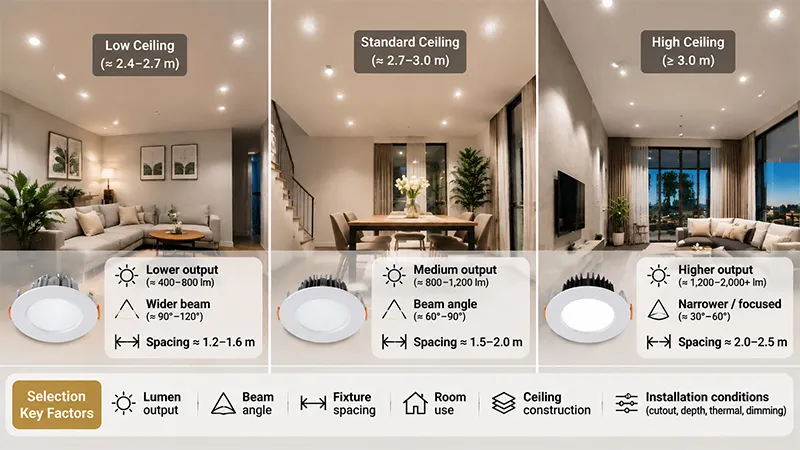
Ceiling height changes how far light travels from the fixture to the working plane. Still, it does not tell us everything a buyer needs to know. In my OEM and ODM discussions, buyers often request a “best wattage” before they share the room purpose, downlight spacing, ceiling finish, or installation details. Those missing details can make a seemingly simple SKU decision much more complex.
Why Is Ceiling Height Only a Starting Point for LED Downlights?
Buyers often need a quick rule for selecting LED downlights, especially when they are building a retail range or preparing a quotation. The problem is that ceiling height seems like an easy shortcut. That shortcut can create poor product positioning if it ignores what customers actually need to see and do in the room.
Ceiling height is a useful first filter because it affects light distribution and perceived brightness, but it is not a complete LED downlight specification. Buyers should first define the room’s lighting task, then review output, beam angle, spacing, color temperature, glare control, and installation limits. A higher ceiling may require a different lighting approach, but it does not automatically require a higher-wattage fitting.
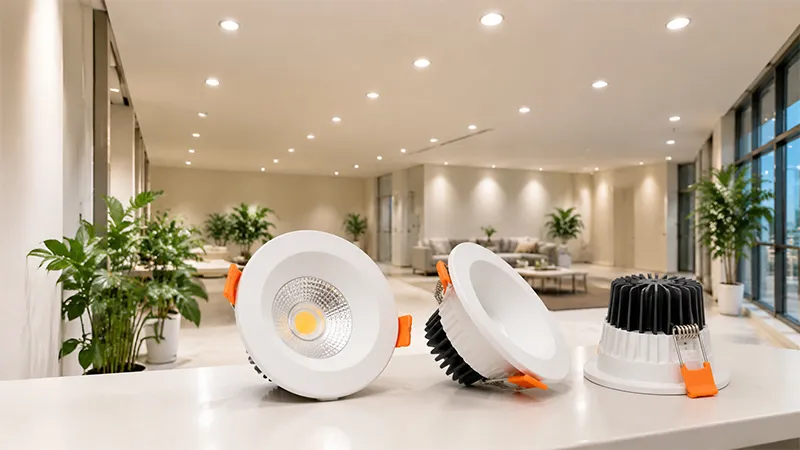
Start With the Lighting Outcome
I encourage buyers to change the first question from:
“What wattage should I use for a 3-meter ceiling?”
to:
“What should the light achieve in this room?”
A kitchen, bedroom, hallway, wardrobe area, and living room may all have the same ceiling height. Yet they can need very different lighting outcomes.
For example:
- A kitchen usually needs practical task lighting over counters and preparation areas.
- A living room may need softer ambient light, plus separate accent or decorative lighting.
- A hallway may need safe, even circulation lighting without excessive brightness.
- A bedroom often benefits from comfortable ambient light and dimming capability.
- A bathroom may require careful attention to moisture exposure, electrical requirements, and suitable placement.
Ceiling height affects the distance between the luminaire and the illuminated surface. However, the lighting task determines whether additional output is useful. A very bright downlight in a low residential ceiling can create uncomfortable glare instead of better visibility.
The System Matters More Than Wattage
A downlight works as part of a system. I normally advise buyers to consider the following factors together:
- Lumen output: This is the useful light output that reaches the space. It is more informative than wattage alone.
- Beam angle: A narrow beam concentrates light, while a wide beam spreads light over a larger area.
- Fixture quantity: More fixtures with controlled output may create a more even result than fewer high-output fittings.
- Spacing: Poor fixture spacing can leave visible dark bands or bright pools of light.
- Mounting height: Ceiling height influences beam spread at the floor or working plane.
- Surface reflectance: Dark walls, timber ceilings, and matte finishes can absorb more light than light-colored finishes.
- Dimming and controls: Dimming can help end users adapt the space after installation.
I have seen buyers create a stronger residential assortment by offering a small number of clear, well-differentiated choices rather than too many wattage options. For example, they may offer compact ambient downlights, higher-output general-lighting models, and adjustable accent models. This structure is often easier for retailers and installers to explain.
Which LED Downlights Are a Practical Starting Point for Typical Residential Ceiling Heights?
A product range needs practical guidance. Buyers cannot present only theory to a customer who needs to select products. The risk is that simple guidance becomes an oversimplified promise. I recommend using ceiling-height ranges as an SKU-screening tool, not as a final lighting design.
For typical residential spaces, buyers can use ceiling height to screen LED downlight options by output and beam spread. Lower ceilings commonly suit modest-output, wider-beam products, while ceilings above about 3 meters may justify higher-output models, different spacing, or layered lighting. These ranges are starting points only and should be validated for the actual room layout and intended effect.
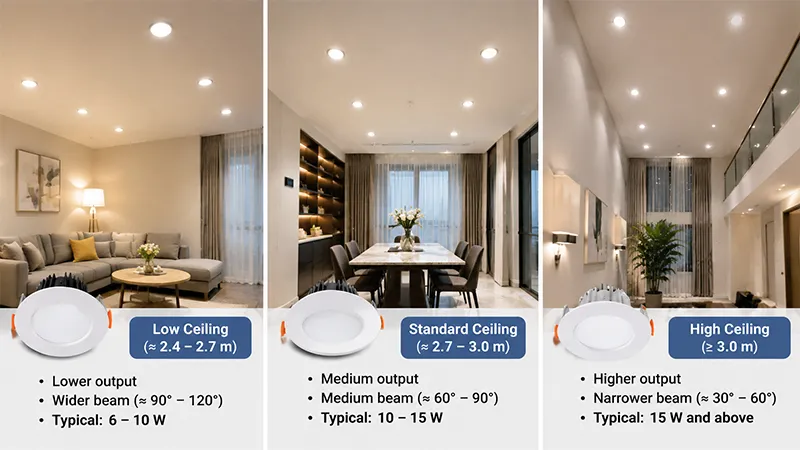
Residential Starter Matrix for SKU Screening
The matrix below is designed for brand owners, wholesalers, and retailers building a residential LED downlight assortment. It is not a final lighting plan. A qualified lighting professional should evaluate application-specific projects, especially when the room is large, has unusual finishes, or includes demanding visual tasks.
| Typical ceiling height |
Typical residential use |
Starter downlight direction |
Beam distribution considerations |
Key buyer checks |
| Up to 2.4 m |
Bedrooms, corridors, apartments |
Lower to moderate lumen package |
Wider beams can help avoid harsh bright spots |
Glare, dimming, cutout size, shallow ceiling void |
| 2.4–2.8 m |
Standard homes, kitchens, living rooms |
Moderate-output general-lighting range |
Medium to wide beams often support more even ambient lighting |
Spacing, task areas, color temperature, driver compatibility |
| 2.8–3.2 m |
Villas, open-plan rooms, entrance areas |
Moderate to higher-output options, depending on layout |
Beam angle and fixture quantity become more important |
Light uniformity, spacing, ceiling finish, thermal conditions |
| Above 3.2 m |
Double-height residential zones, feature spaces |
Consider higher-output options, layered lighting, or alternative fixture types |
Narrower beams may be useful for accents; general lighting still needs layout review |
Installation access, glare, maintenance, lighting calculations |
Why “More Watts” Is Not the Answer
LED efficacy varies across product designs, drivers, chips, optical systems, and thermal structures. Therefore, two downlights with the same wattage can deliver different lumen outputs and different visual results.
A buyer should request a clear product data sheet covering:
- Rated power and input voltage
- Lumen output and stated tolerance
- Color temperature options
- Color rendering index (CRI)
- Beam angle
- Dimming method and compatible dimmers
- Cutout size and outer diameter
- Recessed depth and driver dimensions
- IP rating where relevant
- Thermal operating conditions
- Certification documents applicable to the destination market
I find that a starter matrix is most useful when it helps the sales team ask better questions. It should not become a rigid instruction such as “10 W always suits 3 meters.” That claim would ignore room area, fixture spacing, surface color, and customer expectations.
A Simple Spacing Discussion
As a basic discussion tool, buyers may use a spacing-to-mounting-height concept. In many residential applications, fixture spacing is often considered in relation to the distance from the ceiling to the target plane. However, the correct spacing depends heavily on the photometric distribution of the actual LED downlights.
For example, a wide-beam product may cover a larger area, but it may also produce less punch on a kitchen counter. A narrower beam may create useful emphasis, but it can create scalloping or bright pools when fixtures are too far apart.
I recommend requesting IES or LDT photometric files when a buyer is evaluating a larger project or a technically demanding application. The project team can then use appropriate lighting design software or consult a qualified lighting professional.
How Do Beam Angle, Lumens, and Spacing Affect LED Downlights?
Many buyers compare LED downlight models by wattage because it is easy to list on packaging. That approach can cause returns when the installed lighting feels uneven or uncomfortable. The more useful approach is to assess how the optical system behaves across the ceiling and room layout.
Beam angle, lumen output, and spacing determine how LED downlights distribute light in a room. A wider beam can support broader ambient coverage, while a narrower beam can emphasize a task or feature. Buyers should balance these factors with mounting height and room layout to reduce dark areas, excessive brightness, and visible glare.
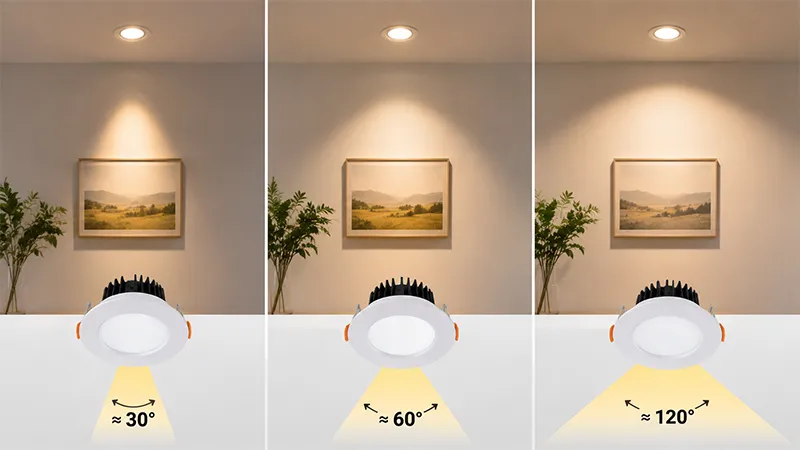
Beam Angle Changes the Visual Effect
Beam angle describes the spread of light from the optical system. It does not independently guarantee uniform illumination, but it strongly affects the appearance of the ceiling and floor.
| Beam approach |
Typical visual effect |
Possible residential use |
Buyer risk to review |
| Narrow beam |
Focused light, stronger contrast |
Artwork, wall features, selected accents |
Bright spots, shadows, glare |
| Medium beam |
Balanced spread and definition |
Kitchens, circulation zones, general lighting |
Incorrect spacing can create uneven pools |
| Wide beam |
Softer and broader ambient coverage |
Bedrooms, living rooms, lower ceilings |
May feel weak in high ceilings or task zones |
I usually suggest that buyers build assortments with a clear purpose for each optical option. A retailer does not always need five beam angles. It may be more practical to stock one reliable general-lighting option and one adjustable or narrower-beam option for accent applications.
Lumens Should Be Compared Carefully
Lumen output is a more meaningful comparison point than wattage, but buyers should still compare like with like. A claimed lumen value should be understood alongside color temperature, CRI, input power, test method, and product configuration.
For example, a warmer color temperature can appear different from a cooler option even when the stated lumen figure is similar. A higher CRI configuration may also have a different output profile. These are not defects. They are product trade-offs that buyers should communicate clearly.
Ceiling Finish and Room Surfaces Matter
A white ceiling and pale walls can reflect light and make a room feel brighter. Dark paint, exposed concrete, deep-colored wallpaper, timber cladding, and black fittings can absorb more light. This means two rooms with the same dimensions and the same downlight layout may not look the same.
During pre-sales discussions, I recommend asking for:
- Room length and width
- Ceiling height
- Ceiling color and wall finish
- Main room activity
- Furniture layout, where available
- Existing lighting points
- Preferred color temperature
- Whether dimming is required
These questions help translate a generic product request into a producible, lower-risk SKU recommendation. They do not replace a professional lighting design for a project-specific installation.
What Installation Factors Should Buyers Check Before Ordering LED Downlights?
A well-positioned product can still fail commercially if it does not fit the ceiling or work with the installed electrical system. Installation incompatibility is a frequent cause of delays, returns, and customer complaints. Buyers need to assess mechanical, electrical, and thermal requirements before they finalize the range.
Before ordering LED downlights, buyers should confirm cutout size, ceiling void depth, driver location, heat management, dimming compatibility, and wiring requirements. These factors affect whether the product can be installed safely and consistently. They also influence retailer returns, installer satisfaction, and long-term after-sales risk.
Cutout Size and Recessed Depth
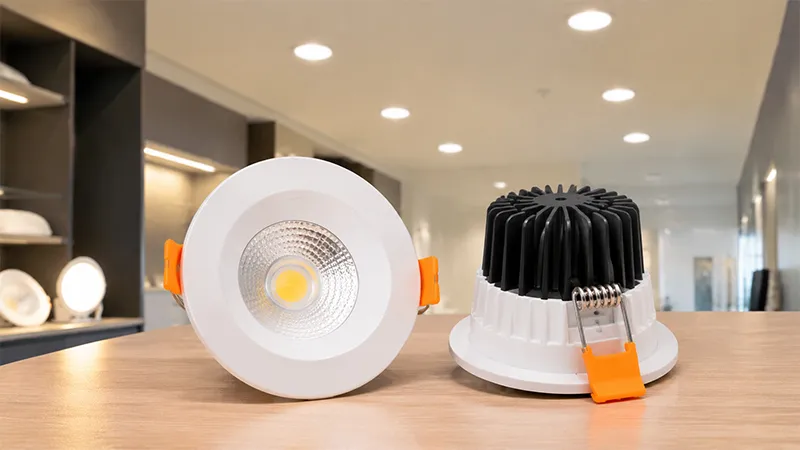
Cutout size is one of the first practical checks. A downlight that does not match the existing ceiling hole may require adapters, ceiling repair, or replacement products. These problems can be particularly expensive in renovation projects.
Buyers should confirm:
- Required ceiling cutout diameter
- Outer trim diameter
- Overall recessed depth
- Driver dimensions
- Minimum ceiling void depth
- Spring-clip range and ceiling thickness tolerance
- Access requirements for the driver
A slim downlight may look suitable in a catalog, but its driver still needs space and adequate ventilation. In some applications, the ceiling void may contain insulation, ducts, or structural elements. The installer should assess those conditions.
Thermal Management Is a Product and Installation Issue
Heat management affects LED performance, driver reliability, and lumen maintenance. A recessed luminaire installed in a restricted void may operate differently from one installed in an open, ventilated ceiling area.
I recommend that buyers ask suppliers for the product’s stated operating conditions and installation guidance. They should also confirm whether insulation contact is permitted, restricted, or prohibited for the specific model. This must be checked against product documentation and local electrical requirements.
At Upward Lighting, we use aging tests as part of our manufacturing quality process. Our business context includes 100% aging testing before shipment, with product aging conditions determined by the applicable production arrangement. Buyers should still verify the exact test scope, product configuration, and documentation relevant to their order rather than treating general factory statements as a substitute for project validation.
Dimming Compatibility Can Prevent Complaints
Dimming is often requested for bedrooms, living rooms, and premium residential projects. However, “dimmable” is not always enough information. Compatibility can depend on the dimming method, driver design, local voltage system, and the dimmer model used by the installer.
Before purchase, buyers should confirm:
- The dimming protocol, such as phase-cut, 0–10 V, DALI, or another specified system.
- The recommended compatible dimmer list, where available.
- The minimum and maximum load requirements of the dimmer.
- Whether multiple fittings will be controlled on one circuit.
- The expected dimming range and any low-end behavior.
This step can reduce flicker complaints, unstable dimming, audible noise, and confusion during installation.
How Can Buyers Build a Reliable LED Downlight Range for Retail and Wholesale?
A broad catalog can look attractive, but too many similar models can confuse sales teams and create inventory risk. Buyers need an assortment that is easy to explain, technically credible, and consistent across repeat orders. The challenge is not simply finding a low price. The challenge is selecting products that can be supplied reliably.
A reliable LED downlight range should combine clear product positioning with consistent specifications, verified documentation, compatible installation dimensions, and manageable customization options. Buyers can reduce risk by limiting overlapping SKUs and qualifying suppliers on quality controls, production capability, and batch-to-batch consistency.
Build a Simple Assortment Architecture
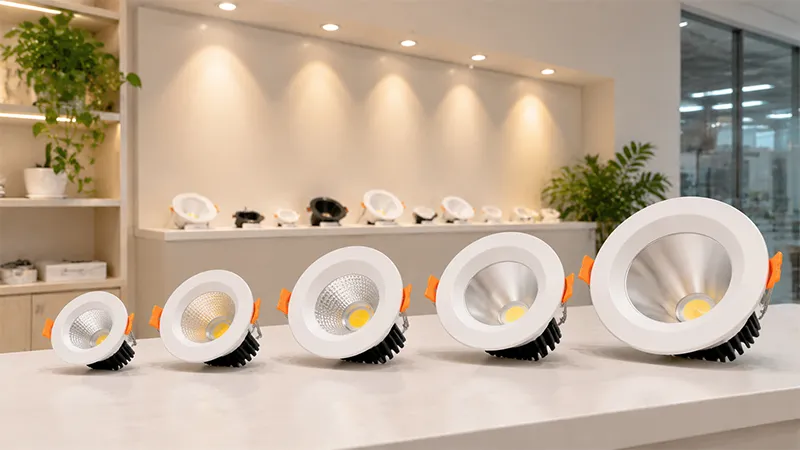
For many residential-focused customers, I suggest organizing an assortment around clear customer needs rather than only around power ratings.
A practical range may include:
- Compact low-profile downlights for shallow ceilings and renovation work
- General ambient downlights for standard residential rooms
- Higher-output options for larger or higher-ceiling residential areas
- Dimmable versions for premium living and bedroom applications
- Adjustable or directional models for wall washing and accent lighting
- Color-temperature variants suited to the buyer’s target market
This approach gives distributors and retailers a clearer sales story. It also helps prevent a common issue: stocking several products that appear different on paper but deliver nearly identical market value.
Evaluate Supplier Consistency
For OEM and ODM procurement, a buyer should look beyond a sample approval. A sample confirms one product at one time. A long-term supply relationship requires repeatable materials, controlled assembly, inspection processes, and traceable specifications.
At Upward Lighting, we support brand owners, wholesalers, and retailers with product specification confirmation, quotation discussions, and customization options. Our factory operates multiple production lines, with quality-control processes that include incoming material inspection, in-process checks, finished-product inspection, and aging testing. We can also discuss adjustments to color temperature, power, CRI, surface treatment, and other agreed product specifications.
However, I always encourage buyers to verify documentation for their specific model and destination market. CE, CB, UL, RoHS, EMC, and LVD requirements are not interchangeable labels. Buyers should request the relevant certificates, reports, declarations, and product-to-document correspondence as part of their supplier qualification process.
Supplier Questions Worth Asking
| Evaluation area |
Questions for the supplier |
| Product specification |
Can you provide a complete data sheet, dimensional drawing, and photometric information? |
| Installation |
What are the cutout, recessed depth, driver dimensions, and thermal installation requirements? |
| Dimming |
Which dimming methods are available, and what compatibility guidance can you provide? |
| Quality control |
What incoming, in-process, and finished-product inspections are performed? |
| Aging and reliability |
What aging test is applied, and what reliability tests are available for the model? |
| Consistency |
How do you control LEDs, drivers, color tolerance, and critical materials across batches? |
| Compliance |
Can you provide current documents relevant to the destination market and ordered configuration? |
| Customization |
What are the MOQ, lead time, sampling process, and change-control process? |
A well-structured supplier conversation helps buyers identify risks before the order is placed. It also creates a better foundation for retail packaging, installation instructions, and after-sales support.
Frequently Asked Questions
What wattage LED downlight is best for a 2.4-meter ceiling?
There is no universal wattage for a 2.4-meter ceiling. A lower ceiling often suits modest-output LED downlights with a wider beam, but the correct choice depends on room use, fixture spacing, ceiling color, and dimming needs. Buyers should compare lumens and beam angle, not wattage alone.
Do higher ceilings always need brighter LED downlights?
Higher ceilings may require more output, different spacing, or a different lighting layer, but they do not always need brighter downlights. A room may need more fixtures, a different beam angle, wall lighting, or decorative lighting instead. The desired lighting effect should guide the final choice.
How far apart should LED downlights be placed?
Downlight spacing depends on ceiling height, beam angle, lumen output, room use, and the actual photometric distribution. Buyers should avoid applying one spacing rule to every model. For larger projects, I recommend reviewing IES or LDT files with a qualified lighting professional.
What should buyers check before ordering recessed LED downlights?
Buyers should confirm the cutout diameter, trim size, recessed depth, driver size, ceiling void, heat-management requirements, dimming compatibility, electrical requirements, and relevant compliance documents. These checks can reduce installation problems and avoidable product returns.
Are LED downlights suitable for commercial ceilings?
LED downlights can be suitable for some commercial environments, but residential starter guidance should not be copied directly into retail, hospitality, office, or industrial projects. Commercial projects often require more detailed lighting calculations, glare assessment, emergency-lighting coordination, controls planning, and code compliance review.
Conclusion
Ceiling height is a useful first step when selecting LED downlights, but it should never be the only decision point. Buyers can create stronger residential ranges when they evaluate room purpose, lumen output, beam angle, spacing, cutout size, recessed depth, thermal conditions, dimming compatibility, and supply consistency together. I recommend treating ceiling-height guidance as a practical SKU filter, then validating each final selection for the actual installation. If you are building an OEM or ODM LED downlight range, Upward Lighting can help you confirm producible specifications, customization options, and quality-control requirements before you place an order.