Aluminum LED downlights can help brand owners and purchasing teams balance heat management, appearance, and product durability. However, a low unit price can hide risks when a fixture has insufficient heat-dissipation area, an unsuitable driver, or a decorative aluminum trim rather than a functional aluminum housing. We recommend evaluating the complete fixture design before making a sourcing decision.
Aluminum LED downlights offer potential benefits in thermal management, mechanical strength, surface finish, and product positioning. Their real value depends on the full construction: the aluminum type and thickness, housing geometry, wattage, LED and driver configuration, installation environment, and quality-control process. Buyers should compare complete specifications and test evidence—not simply select a product because it is described as aluminum.
At Upward Lighting, we have seen that material discussions often begin with a simple request: “We need an aluminum downlight.” Once we review the target wattage, cutout size, color, price range, and project application, the decision becomes more detailed. The following sections explain what aluminum construction can contribute, what buyers should verify, and how we approach the supplier evaluation process.
How Do Aluminum LED Downlights Support Heat Dissipation?
Heat is one of the most important reliability concerns in LED lighting. Buyers may expect every metal-bodied fixture to run cool, yet some compact models have limited heat-sink area or carry power levels that are too high for their dimensions. We encourage buyers to look beyond the material label.
Aluminum LED downlights can support heat dissipation because aluminum can transfer heat away from the LED module and driver area more effectively than many non-metal housing materials. However, the result depends on the thermal path, heat-sink surface area, fixture wattage, ventilation, and ambient temperature. Aluminum alone does not guarantee a cooler or longer-lasting downlight.
Why heat management matters in downlight procurement
LEDs generate less heat than traditional incandescent sources, but they still generate heat at the LED junction, driver, and surrounding electronic components. If the fixture cannot move that heat away efficiently, elevated temperatures can affect luminous output, color consistency, and component reliability over time.
In our production discussions, we usually examine heat management as a complete system rather than a single material choice. A well-considered system may include:
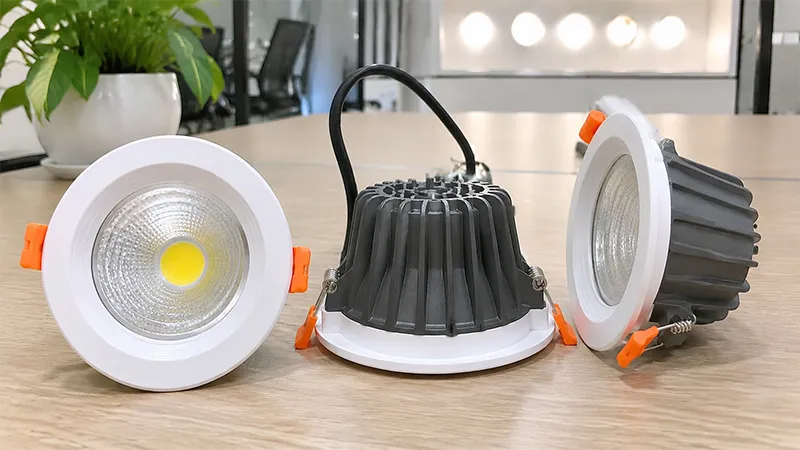
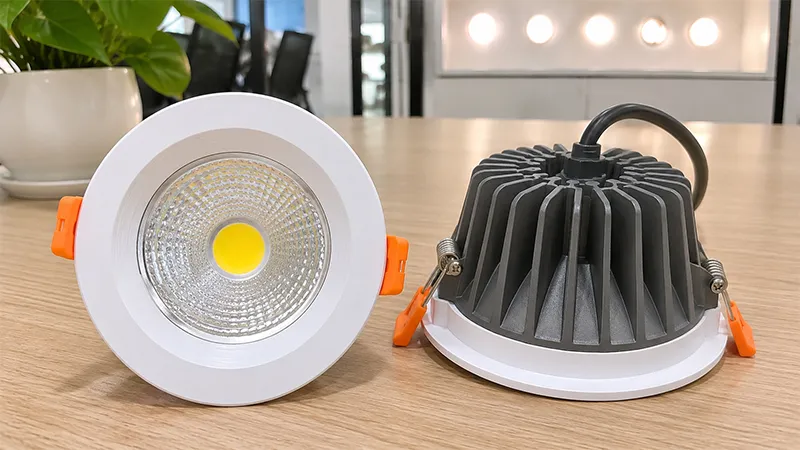
- A die-cast aluminum heat sink or housing
- A secure thermal interface between the LED board and housing
- Sufficient heat-dissipation fins or external surface area
- A power rating appropriate for the fixture diameter and body depth
- A driver designed for the electrical and thermal conditions
- Installation guidance for insulated ceilings, enclosed spaces, or high-temperature rooms
A larger fixture does not automatically perform better, but it often gives designers more physical space to create a meaningful thermal path. For example, a high-output 20 W recessed fixture typically requires more thermal consideration than a compact 5 W downlight.
Aluminum construction types are not equal
We advise customers to ask exactly which aluminum component is being offered. “Aluminum downlight” can describe several different constructions.
| Construction type |
Typical role |
Buyer evaluation point |
| Die-cast aluminum body |
Main housing and heat sink |
Check body mass, fin design, LED contact area, and casting quality |
| Extruded aluminum profile |
Housing or heat-dissipation section |
Check wall thickness, profile geometry, and assembly method |
| Aluminum front trim |
Decorative face ring |
Confirm whether it contributes to heat dissipation or appearance only |
| Aluminum-coated plastic |
Cosmetic finish |
Verify the actual base material and thermal function |
| Mixed-material construction |
Aluminum heat sink with plastic components |
Evaluate the role and temperature exposure of each material |
A thin aluminum face ring can provide an attractive finish, but it should not be presented as equivalent to a full aluminum heat-dissipation body. We have encountered OEM inquiries where customers initially requested “aluminum,” but their actual need was a premium-looking trim at a controlled cost. In that case, a mixed-material design may be suitable if the thermal load is modest and the complete design is properly evaluated.
What evidence should buyers request?
We recommend asking a supplier for model-specific information, including:
- A cross-sectional drawing or exploded view that identifies housing materials.
- Fixture dimensions and net weight, which can help buyers compare construction, although weight alone is not a performance guarantee.
- Rated power, input voltage, and driver specification.
- Thermal test records, where available, for the specific model and stated test conditions.
- Installation restrictions, especially for covered ceilings or enclosed cavities.
- Third-party test reports, when required by the destination market or project specification.
At our factory, we can review thermal and reliability reports for the tested model and stated conditions. We do not treat a chamber test or an aging test as proof of multi-year performance in every installation. Actual field results depend on application conditions, installation quality, operating hours, voltage stability, and maintenance practices.
What Structural Benefits Do Aluminum LED Downlights Provide?
A lighting product must survive more than heat. It must also withstand handling, installation, packaging, and normal use. Buyers may face costly replacements when housing parts deform, spring clips fit poorly, or surface finishes vary between batches. Aluminum can help, but design and manufacturing control remain essential.
Aluminum LED downlights can provide a more robust housing structure and a refined visual finish than some lower-cost alternatives. Die-cast or extruded aluminum may resist deformation and support stable assembly, but buyers should assess wall thickness, casting consistency, mounting details, and the specific performance requirements of the intended application.
Mechanical stability starts with the housing design
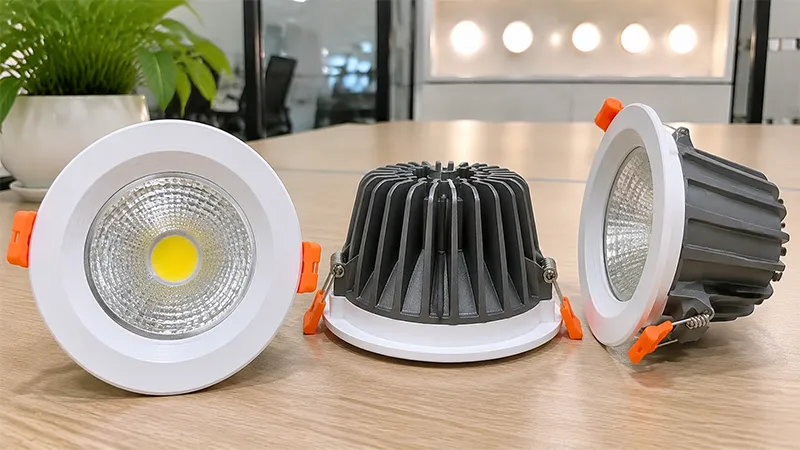
For recessed lighting, the body supports multiple parts at once: the LED board, reflector or lens, driver connection, spring clips, wiring terminals, and trim components. A stable housing can help keep these parts aligned during assembly and installation.
We pay close attention to several practical details during product development and incoming inspection:
- Housing thickness: Very thin sections may be more vulnerable to damage or dimensional variation.
- Casting quality: Die-cast parts should be checked for visible defects, sharp edges, porosity concerns, and inconsistent surfaces.
- Spring clip attachment: The clip location must remain stable through packaging and installation.
- Cutout tolerance: The fixture should match the customer’s required ceiling cutout range.
- Driver placement: A driver should not be forced into a position that creates unnecessary mechanical stress or restricts heat flow.
- Wiring and terminal access: Installers need a safe, practical connection method.
Surface finish and product positioning
Aluminum can also support a broad range of visual options. We often discuss white, black, silver, gold, brushed, sand-textured, and custom powder-coated finishes with OEM and ODM customers. Surface treatment can influence the perceived quality of a downlight and help a brand create a recognizable product line.
Still, we tell buyers to separate appearance from functional quality. A smooth black trim looks premium, but it does not confirm the performance of the driver, LED board, or internal thermal structure. A purchasing specification should cover both cosmetic standards and technical requirements.
| Procurement factor |
Questions we recommend asking |
| Finish color |
What color reference, gloss level, and sample approval process will apply? |
| Surface treatment |
Is the finish powder coated, painted, anodized, or otherwise treated? |
| Visual inspection |
What cosmetic defects are acceptable or unacceptable? |
| Batch consistency |
How will the supplier control color and texture variation between orders? |
| Packaging protection |
How will the supplier protect finished surfaces during shipping? |
A material decision should match the product tier
A full aluminum housing may be a sensible choice for a premium residential series, hospitality project, showroom product, or higher-wattage commercial downlight. It may also support a brand’s desired market position.
However, we do not recommend treating aluminum as the only acceptable material. Plastic, thermally conductive composites, or mixed-material designs can be appropriate for certain low-power products, budget-focused ranges, or designs where insulation and styling requirements differ. The best choice depends on the intended thermal load, target selling price, visual standard, installation environment, and customer expectations.
How Should Buyers Compare Aluminum LED Downlights With Other Materials?
Sourcing teams often compare aluminum against plastic based only on purchase price. That approach can create problems because the product’s value includes more than the material cost. Buyers need to compare thermal design, failure exposure, appearance, manufacturing consistency, and anticipated after-sales workload.
When comparing aluminum LED downlights with plastic or mixed-material alternatives, buyers should evaluate the complete fixture rather than assume one material is always superior. Aluminum may offer advantages in heat dissipation and premium positioning, while alternative materials may suit lower-power, cost-sensitive, or application-specific designs when properly engineered and tested.
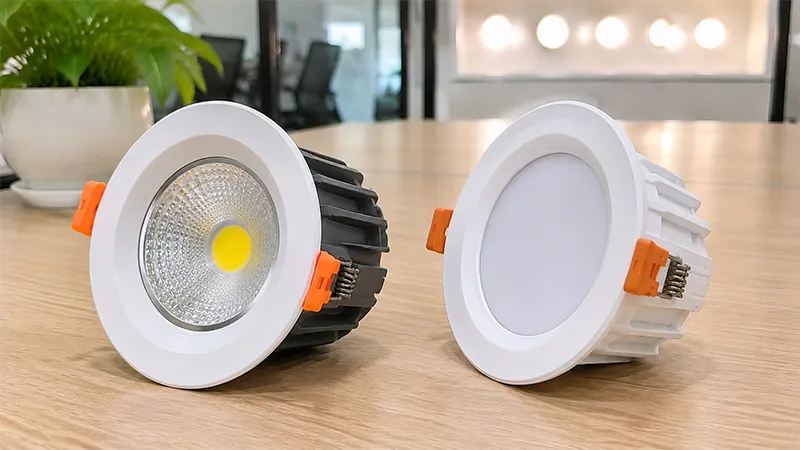
Compare total sourcing risk, not only unit cost
The lowest quotation is not always the lowest lifecycle-cost option. A fixture that is inexpensive at purchase can create higher costs if it causes more customer complaints, replacements, freight claims, or retailer returns.
For brand owners, wholesalers, and large retailers, we recommend comparing suppliers against a broader set of commercial factors.
| Evaluation area |
Aluminum housing consideration |
Why it matters to buyers |
| Initial unit cost |
Full die-cast aluminum commonly adds material and processing cost |
Affects margin and target retail price |
| Thermal design |
Aluminum can support heat transfer when the design has an effective path |
Can influence reliability risk |
| Appearance |
Aluminum can accept various finishes and trims |
Supports brand positioning |
| Dimensional stability |
A robust housing can support consistent assembly |
Can reduce installation complaints |
| Weight |
Metal housings may be heavier than some alternatives |
Affects packaging and logistics planning |
| Production consistency |
Depends on tooling, process control, and inspection |
Influences batch-to-batch quality |
| After-sales exposure |
Depends on the complete fixture and application |
Affects replacement and service cost |
Questions for an RFQ or supplier briefing
We find that the best RFQs define the product requirement rather than simply requesting an “aluminum LED downlight.” Buyers can include:
- Required diameter, height, and ceiling cutout
- Rated wattage and desired lumen range
- Required color temperature, such as 3000 K, 4000 K, or 6500 K
- Minimum color rendering index, such as CRI 80 or CRI 90
- Dimming requirement, if any
- Required beam angle, glare-control preference, and reflector finish
- Target housing material and whether it must be a full heat-sink body
- Driver brand or performance expectation
- Intended installation environment
- Required compliance documents for the destination market
- Packaging, branding, barcode, and instruction-manual needs
- Quality inspection and acceptable quality level requirements
At Upward Lighting, we use these discussions to determine whether a die-cast aluminum body, aluminum profile, or mixed-material solution better fits the project. This process can prevent a mismatch between a customer’s product promise and the fixture that reaches mass production.
Verify compliance documents carefully
Some buyers require CE, EMC, LVD, RoHS, CB, or UL-related documentation depending on the product category and destination market. We recommend that buyers verify the document scope, issuing organization, product model, validity, and market applicability before relying on any certification claim.
A certificate or test report should correspond to the actual product configuration. If a supplier changes the driver, LED source, housing, or electrical design, buyers should determine whether the existing documentation still applies. Qualified compliance professionals can provide application-specific guidance where requirements are uncertain.
What Quality Controls Matter for Aluminum LED Downlights?
A good aluminum housing cannot compensate for weak assembly control, inconsistent components, or insufficient inspection. Buyers who want reliable supply should examine how a manufacturer manages materials, production, aging, and final inspection—not merely review a catalog photograph.
Quality control for aluminum LED downlights should cover incoming materials, assembly processes, electrical safety checks, aging, visual inspection, and final packaging. A supplier’s pre-shipment aging process can identify certain early failures, but it should be viewed as one quality-control measure rather than proof of years of field performance.
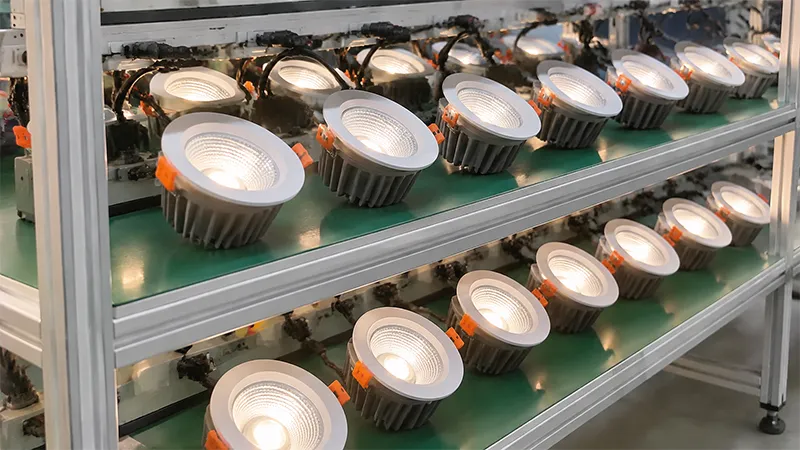
Incoming inspection protects the production line
The quality process starts before assembly. At our factory, we use Incoming Quality Control (IQC) to check raw materials and supplied components before they enter production. For aluminum LED downlights, this may include housing appearance, dimensions, finish, LED board condition, driver labeling, wiring, springs, and optical components.
A supplier should have a defined approach for handling nonconforming materials. Without this process, inconsistent housings or unsuitable components may enter the assembly line and become more difficult to identify later.
In-process and final controls support consistency
We also use first-article and in-process checks to identify deviations early. During a production run, operators and QC staff should verify the agreed model specifications, including power, color temperature, appearance, assembly position, and basic functional performance.
For a typical downlight order, buyers can ask how the factory manages:
- First article approval: Is the initial assembled product checked before full production begins?
- In-process inspection: Are critical assembly points checked during production?
- Electrical safety testing: Does the factory conduct appropriate checks such as withstand-voltage and insulation testing where applicable?
- Photometric checks: How are power, CCT, CRI, and luminous performance monitored?
- Final inspection: Is there sampling, full inspection, or a combination based on customer requirements?
- Aging procedures: What duration, temperature, and pass/fail criteria apply?
- Traceability: Can the supplier link product batches to production dates and component records?
Our stated factory process includes 100% aging before shipment. Depending on the product and order requirement, we use room-temperature aging or higher-temperature aging conditions. We also maintain an independent aging test chamber and can conduct at least 44 hours of room-temperature aging or 6 hours of 45°C high-temperature aging for applicable products and agreed processes.
These measures can help identify early electrical or assembly failures before shipment. They do not demonstrate how every downlight will perform after years in every ceiling, climate, or operating schedule. We consider them part of risk reduction, not a substitute for correct engineering and application-specific evaluation.
Third-party reliability testing has a defined scope
For selected products and customer requirements, reliability verification may be commissioned through third-party laboratories. Such tests can include temperature rise, insulation, withstand voltage, and other relevant assessments.
We recommend that buyers read reports carefully. A report is meaningful for the exact model, configuration, and test conditions stated in the document. It should not automatically be generalized to a modified version of the same fixture or a different installation environment.
How Can Buyers Select the Right Aluminum LED Downlights Supplier?
A technically suitable product can still become a procurement problem if the supplier cannot maintain specifications, respond to changes, or support the order process. For OEM and ODM buyers, supplier capability is as important as the first approved sample.
Buyers should select an aluminum LED downlights supplier by reviewing product construction, quality controls, manufacturing capacity, documentation, customization ability, communication speed, and sample consistency. The most suitable supplier is one that can match the housing design and full specification to the intended price point, market, and application.
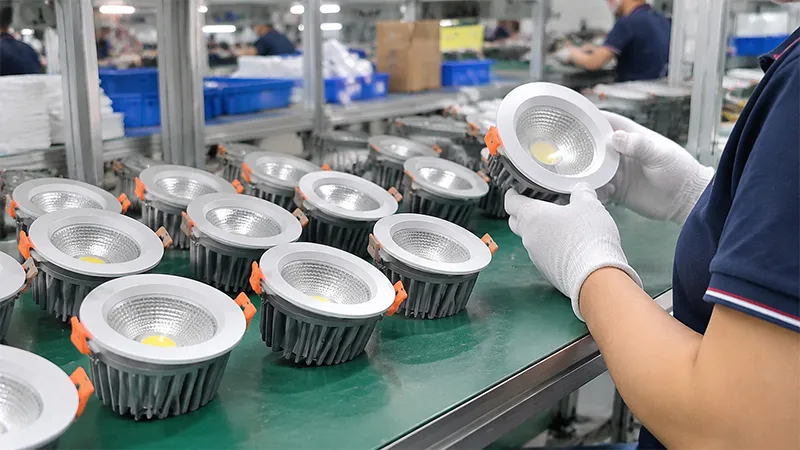
A practical supplier evaluation checklist
We suggest using a structured checklist before placing a production order:
- Does the supplier clearly identify the housing construction?
- Can the supplier explain the thermal design without making unsupported lifetime claims?
- Can the supplier provide approved samples before mass production?
- Does the supplier support required wattage, CCT, CRI, beam angle, finish, and packaging options?
- Does the supplier have a documented QC process?
- Can the supplier provide applicable compliance documents for review?
- Does the supplier have enough production capacity for your forecast?
- Does the supplier support small trial orders as well as larger repeat orders?
- Can the supplier manage OEM labeling, manuals, cartons, and barcodes?
- Does the supplier communicate clearly about design trade-offs and lead times?
What we discuss with OEM and ODM customers
At Upward Lighting, we have worked with customers who need a cost-effective standard downlight and others who need a more differentiated product line. Our role is to clarify the practical trade-offs.
For example, a customer may request a slim profile, high wattage, premium finish, high CRI, dimming function, and a very low target price. Those requirements can conflict. We help customers prioritize what matters most: output, appearance, thermal margin, dimming compatibility, material construction, or target cost.
Our facility in Zhongshan City has operated since 2009 and supports OEM/ODM indoor and outdoor lighting projects. We operate five production lines, with flexible configuration for different models and batch sizes. However, buyers should still evaluate each supplier based on the specific product, order volume, market requirement, and agreed inspection standard.
We believe that a transparent supplier discussion is more valuable than a broad promise. A supplier should explain what a construction can do, what it cannot do, and which details need validation before mass production.
Frequently Asked Questions
Are aluminum LED downlights better than plastic downlights?
Aluminum LED downlights can offer stronger heat-dissipation potential and a more premium finish, especially when they use a functional aluminum housing. However, plastic or mixed-material fixtures can be appropriate for lower-power or cost-sensitive applications. Buyers should compare the complete design, application, and test evidence.
Does an aluminum downlight always last longer?
No. Aluminum can help manage heat, but lifespan depends on the full system, including LED quality, driver quality, thermal path, assembly consistency, operating hours, ambient temperature, and installation conditions. We recommend reviewing model-specific specifications and relevant test documentation.
What is the difference between die-cast aluminum and an aluminum trim ring?
A die-cast aluminum body can act as a structural housing and heat sink. An aluminum trim ring is often mainly decorative and may contribute little to heat dissipation. Buyers should request a cross-section or material breakdown to confirm which parts are aluminum.
What should I ask an aluminum LED downlights manufacturer before ordering?
Buyers should ask about housing construction, wattage, dimensions, driver specification, LED configuration, aging process, inspection procedures, compliance documents, sample approval, lead time, customization options, and packaging. We also recommend confirming the intended installation environment before production begins.
Can pre-shipment aging tests prove long-term downlight reliability?
No. Aging tests can help identify certain early failures before shipment, which supports quality control. They cannot prove years of real-world service because field performance also depends on installation, ambient temperature, electrical conditions, operating hours, and maintenance practices.
Conclusion
Aluminum LED downlights can be a strong option for brands and purchasing teams that need effective thermal design potential, durable construction, flexible finishes, and a more premium product position. Still, aluminum is only one part of the decision. We recommend evaluating the complete fixture, including housing geometry, wattage, LED board, driver, testing scope, installation environment, and supplier quality controls. If you are sourcing an OEM or ODM downlight range, we can help you review the construction and specification trade-offs before you move to sampling or mass production.