An LED downlight heat sink can become a hidden source of project risk when buyers focus only on appearance, price, or initial brightness. Poor heat control may contribute to faster lumen depreciation, unstable color, driver faults, and warranty claims. I recommend evaluating the complete thermal design rather than judging one metal component alone.
An LED downlight heat sink affects product performance by moving heat away from the LED and related components, helping the complete luminaire operate within its intended temperature range. Its real value depends on the full thermal path, including LED power, driver placement, housing design, airflow, installation conditions, materials, and production consistency—not simply its weight or size.
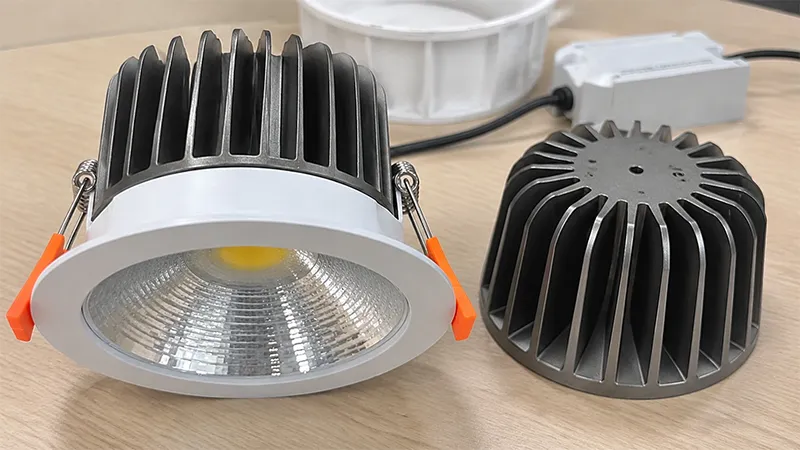
In my experience as a lighting manufacturer, the most useful procurement question is rarely, “How heavy is the heat sink?” A better question is, “Can this specific downlight manage heat reliably in its intended application?” That shift helps brand owners, contractors, and engineering teams compare products on evidence rather than surface-level signals.
Why Does an LED Downlight Heat Sink Matter for Thermal Management?
An LED downlight heat sink matters because LEDs and drivers generate heat during operation, even though LED technology is more efficient than many traditional light sources. If that heat is not managed well, a downlight may look acceptable during a short inspection but create performance concerns after extended use.
The LED downlight heat sink is one part of the luminaire’s thermal-management system. It transfers heat away from the LED module and distributes it through the housing and surrounding air. Effective heat management can support more stable light output, color appearance, driver operation, and long-term reliability when the product is correctly designed and installed.

The thermal path is more important than one component
I view heat control as a chain. The chain begins at the LED junction and continues through the LED package, circuit board, thermal interface material, heat sink, housing, and finally the air around the product. A weakness at any point can reduce the benefit of the other parts.
For example, a downlight can use a large-looking aluminum body, yet still perform poorly if:
- The LED board does not make consistent contact with the heat-dissipation surface.
- The thermal interface material is poorly applied, inconsistent, or unsuitable for the design.
- The driver is exposed to excessive heat inside a compact enclosure.
- The fixture is installed in a shallow ceiling void with limited airflow.
- Insulation or building materials restrict ventilation around the luminaire.
- The LED power is too high for the complete housing structure.
This is why I do not consider heat-sink size alone to be a reliable quality verdict. A compact downlight is not automatically thermally weak, and a heavy downlight is not automatically robust. The relevant issue is whether the thermal path matches the product’s power level, physical structure, operating duration, and application environment.
Heat affects more than brightness
Many buyers associate temperature only with lumen output. Lumen maintenance is important, but it is only one consequence of thermal design. Excessive operating temperatures may also influence:
| Performance area |
Potential concern when heat is poorly controlled |
Buyer impact |
| Light output |
Faster reduction in visible brightness over time |
Customer complaints and replacement costs |
| Color consistency |
Color appearance may shift or become less consistent |
Aesthetic risk in hospitality, retail, and residential projects |
| Driver reliability |
Electronic components can face greater thermal stress |
Flicker, early failure, or intermittent operation |
| Material durability |
Diffusers, plastics, wiring, and adhesives may age differently |
Appearance and safety-related quality concerns |
| Warranty exposure |
Field failures may increase service calls |
Commercial and brand risk |
At Upward Lighting, I see thermal management as a manufacturing balance rather than a single design feature. A heat sink must work alongside the LED module, driver, trim, housing, and intended installation method. We can use aging processes as part of our production quality control, but I would not treat routine aging as a substitute for complete application-specific thermal validation.
Buyers should request evidence for the exact model, wattage, trim style, driver configuration, and installation condition under consideration.
Can a Larger LED Downlight Heat Sink Guarantee Better Performance?
Buyers often use weight, thickness, or visible aluminum area as a fast way to compare products. That approach is understandable, especially when sourcing remotely. However, a larger LED downlight heat sink cannot guarantee better performance by itself because performance depends on the entire luminaire design and verified operating conditions.
A larger LED downlight heat sink may provide more surface area or thermal mass, but it does not prove superior thermal performance on its own. The LED board connection, input power, driver design, housing geometry, airflow, ceiling construction, and quality consistency must also be evaluated through product-specific documentation and testing.
Why visual procurement signals can mislead
In practical sourcing, I have seen buyers request a “heavier heat sink” as a direct proxy for quality. Weight can be relevant, but it is incomplete evidence. Two fixtures with similar weights can manage heat very differently. Their internal layouts, LED board contact, driver locations, and airflow routes may not be the same.
Likewise, terms such as die-cast aluminum, extruded aluminum, or named aluminum grades should not become automatic selection decisions. These materials and processes can serve different design needs. A die-cast body may allow complex shapes and integrated structures. An extruded profile may suit another form factor. Neither label confirms that a downlight will operate at an acceptable temperature in a real ceiling.
A practical comparison framework
Instead of relying on one visible feature, I suggest that procurement teams compare the following points:
-
Rated power and housing size
Ask whether the wattage is appropriate for the fixture’s physical design. A small housing can work well in some models, but buyers should seek model-specific evidence rather than assumptions.
-
LED module and heat-transfer interface
Review how the LED board contacts the heat-dissipation structure. Consistent assembly pressure and suitable thermal interface materials matter.
-
Driver location and driver rating
Determine whether the driver is integrated, external, isolated, or placed close to heat-generating components. The driver’s own temperature limitations are important.
-
Installation environment
Confirm whether the product is intended for recessed ceilings, enclosed spaces, insulated ceilings, damp areas, or other special conditions. Installation can change the thermal reality substantially.
-
Operating duration
A lobby light running many hours each day has a different duty cycle from a residential downlight used briefly in the evening.
-
Available verification documents
Ask for product-specific thermal, electrical safety, aging, or reliability-related records where available. A qualified engineer should review whether the evidence fits the intended project.
The initial-brightness trap
High initial brightness can be commercially attractive. Yet initial output does not answer how a luminaire will behave after prolonged operation in the installed environment. I encourage buyers to compare optical data, thermal design, driver specifications, and quality controls together.
At our factory, we balance output targets against housing structure and manufacturability during product development. We also recognize that laboratory conditions, installation conditions, and customer use patterns differ. Therefore, final claims about temperature, lifespan, or lumen maintenance should be validated for the exact model and application rather than inferred from a sample’s first impression.
How Does an LED Downlight Heat Sink Affect Driver Reliability and Light Quality?
A downlight can have a reasonably designed LED cooling surface yet still face reliability problems if the driver, wiring, optical parts, or nearby materials experience excessive temperature. An LED downlight heat sink affects the entire product because heat moves through connected components and enclosed spaces.
An LED downlight heat sink can support driver reliability and light quality by reducing thermal stress around the LED module and housing. However, the driver’s component quality, placement, ventilation, electrical design, and ambient installation conditions also determine whether the full downlight can operate consistently over time.
LED performance and driver performance are connected
The LED module receives most of the attention in lighting discussions. However, a downlight is an electrical system, not just an LED chip mounted to metal. The driver converts incoming power into controlled output for the LED. If its internal components operate under unfavorable thermal conditions, the customer may see symptoms such as flicker, inconsistent startup, dimming issues, or failure.
These issues can be difficult for contractors because the root cause may not be obvious from the ceiling surface. A failed fitting may require access work, labor scheduling, replacement stock, and tenant disruption. For a hotel, retail chain, office, or residential developer, that service burden can cost more than the original fixture-price difference.
Color stability is also an application issue
Color consistency matters especially in spaces where many luminaires operate side by side. Retail displays, hotel corridors, kitchens, galleries, and premium residential projects can reveal differences in color appearance more easily than utility spaces.
Temperature is one variable that can influence LED behavior, but it is not the only factor. Buyers should also consider:
- LED binning and supplier controls
- Color-temperature specifications
- Color rendering index requirements
- Driver current stability
- Diffuser and optical-material behavior
- Batch consistency during manufacturing
- Installation conditions across different ceiling zones
I remember reviewing a recessed-lighting request where the buyer focused almost entirely on wattage and cutout size. Once we discussed the application, we learned that the fixtures would operate for long periods in a warm, enclosed retail ceiling. The discussion changed from “Which unit is cheapest?” to “Which configuration has suitable evidence for this environment?” That is the more useful procurement conversation.
What production controls can contribute?
Manufacturing consistency matters because even a sound design can lose performance if assembly quality varies from unit to unit. At Upward Lighting, our quality process includes incoming quality control for raw materials, in-process inspections, and finished-product inspection. We also conduct 100% aging before shipment according to our production arrangements, with aging conditions and durations subject to the relevant product and order requirements.
Our factory has an independent aging-test chamber. We use aging as a practical production-control step to identify certain early issues before shipment. Still, I would be careful with the interpretation: an aging test is not equivalent to full thermal simulation, certified lifetime prediction, or a guarantee of performance in every ceiling and climate.
For application-critical projects, I recommend that the buyer and qualified technical professionals review the proposed fixture, driver, installation detail, local requirements, and available test documents together.
What Should Buyers Ask a LED Downlight Heat Sink Supplier?
Selecting a downlight supplier can feel difficult because product listings often show similar wattage, appearance, and broad compliance statements. The strongest buyers look beyond catalog images and ask structured questions about the complete LED downlight heat sink design, manufacturing controls, and project suitability.
Buyers should ask an LED downlight heat sink supplier about the complete luminaire thermal path, power-to-housing match, driver arrangement, intended installation limits, aging process, inspection controls, and product-specific test documents. The supplier should provide clear, verifiable information rather than relying only on weight, material labels, or general lifetime claims.
A supplier-evaluation checklist for procurement teams
I recommend using a repeatable checklist, especially when comparing OEM or ODM proposals from multiple factories.
| Evaluation question |
Why it matters |
Evidence to request |
| What is the rated power and intended application? |
Thermal suitability depends on use case |
Datasheet and application guidance |
| How is heat transferred from the LED board to the housing? |
The interface can affect consistency |
Product drawings, assembly explanation, sample review |
| Where is the driver located? |
Driver temperature can affect reliability |
Internal layout, driver specification |
| Is the unit suitable for insulated or enclosed ceilings? |
Installation changes heat dissipation |
Written installation instructions and verified test information |
| What aging process is used? |
Aging can help screen for early production issues |
Factory process description and relevant records |
| What incoming and in-process controls are used? |
Material and assembly variation can affect products |
IQC, IPQC, and finished-inspection procedures |
| Which compliance documents are available? |
Market access requires document verification |
Current, model-specific CE, CB, UL, RoHS, EMC, LVD, or other applicable documents |
| Can the supplier support a pilot order? |
Field review reduces project risk |
Sample and pilot-production plan |
Ask for the right documentation
Buyers should verify certifications and reports rather than accept broad statements at face value. A document should be checked for the correct manufacturer, model number, product configuration, issue date, applicable standard, and market relevance.
Our products are designed to meet applicable international requirements, and we can provide relevant compliance information for the product configuration under discussion. However, certification scope can vary by market and model. I always recommend that purchasers verify the current documents with their compliance team, testing body, importer, or local authority before making a final buying decision.
Evaluate the supplier’s manufacturing reality
A supplier should explain not only what the final product looks like, but also how it is made consistently. At Upward Lighting, we operate five production lines and use quality-control steps across material receipt, assembly, aging, and final inspection. Our team supports OEM and ODM programs, including adjustments to optical parameters, power, color temperature, color rendering index, and surface finishes based on project requirements.
For me, customization must be handled carefully. If a buyer requests higher power, a different housing color, a new trim, or a compact format, the change may affect the overall design balance. A responsible supplier should review the implications rather than simply approve every change without discussion.
Use samples strategically
A sample is useful, but one sample is not the same as mass-production consistency. I suggest a staged process:
- Review the specification and intended installation.
- Assess samples for appearance, fit, optical output, and basic operation.
- Request relevant product-specific documents.
- Run a pilot order where the project scale justifies it.
- Monitor installation feedback before full rollout.
- Set clear incoming-inspection and warranty terms in the purchase agreement.
This approach gives buyers a more defensible basis for selecting a downlight supplier and managing after-sales risk.
Frequently Asked Questions
Does a heavier LED downlight heat sink mean better quality?
Not necessarily. A heavier LED downlight heat sink may contain more material, but weight alone does not confirm thermal performance. Buyers should assess the complete thermal path, LED power, driver design, housing structure, installation environment, and model-specific test evidence.
Is die-cast aluminum better than extruded aluminum for LED downlights?
Neither process is universally better. Die-cast and extruded aluminum can both support effective designs depending on fixture geometry, production needs, cost targets, and thermal layout. Buyers should evaluate the complete luminaire and request evidence for the exact product configuration.
Can factory aging tests prove LED downlight lifespan?
No. Factory aging can help manufacturers identify some early defects and support production quality control. It does not replace application-specific thermal testing, laboratory reliability evaluation, or a certified lifetime prediction. Buyers should verify available records for the specific model and project conditions.
Can recessed ceiling conditions affect downlight performance?
Yes. Ceiling depth, insulation, ambient temperature, ventilation, installation spacing, and operating hours can all affect the thermal conditions around a recessed downlight. Contractors and engineers should follow the manufacturer’s installation instructions and evaluate unusual conditions before installation.
What documents should I request from an LED downlight supplier?
Request the product datasheet, installation instructions, driver details, applicable test reports, and current compliance documents for the exact model. You should verify documents such as CE, CB, UL, RoHS, EMC, or LVD records for scope, validity, model matching, and relevance to your destination market.
Conclusion
An LED downlight heat sink affects product performance because it is part of a complete thermal system, not an isolated piece of metal. Buyers should look beyond heat-sink weight, size, aluminum labels, and initial brightness. A stronger evaluation considers LED power, thermal interfaces, driver placement, housing structure, installation conditions, manufacturing consistency, aging controls, and verifiable documents. If you are sourcing OEM or ODM downlights, I invite you to discuss your project specifications with Upward Lighting so we can help review a practical, application-appropriate product configuration.